Most teams do not go looking for a HubSpot alternative because the product is bad. They go looking because the invoice grew faster than the team did. A tool that cost $20 a seat at signup turns into a four or five figure monthly commitment once marketing contacts climb past the included tier, the workflow builder gets locked behind Professional, and a mandatory onboarding fee lands on the first invoice. That is the moment a buyer starts pricing the exit.
This guide is built for that buyer, the one already on HubSpot (or about to sign) who wants to know what else can do the job, what it costs in Q2 2026, and how hard the move actually is. It is not a hit piece. HubSpot is a genuinely good all-in-one platform, and for plenty of teams staying put is the right call, so there is an honest section on when not to switch. But if the cost curve or the complexity has stopped making sense, you have real options, and they sort cleanly by what you are trying to replace.
We review 13 alternatives grouped into five tiers, each with verified Q2 2026 pricing, an honest limitation, a one-line migration note, and a use-case verdict. If you want a single head-to-head instead of the wider field, our HubSpot vs Salesforce comparison goes deep on that one matchup. For the broader catalog of platforms beyond HubSpot replacements, the CRM software examples roundup covers discovery. This article is the switching cut: leaving HubSpot, by tier.
Key Takeaways
- Two cost mechanics drive most exits: the jump from Sales Hub Starter ($20/seat/mo) to the automation tier, and Marketing Hub’s contact-tier pricing that re-bills mid-contract as your list grows past 2,000 contacts (all figures as of Q2 2026).
- Cheapest credible swaps: Zoho CRM, EngageBay, Brevo, and Freshsales all start under $15/user/mo with a real free tier and no mandatory onboarding fee (as of Q2 2026).
- Best for pure sales teams: Pipedrive and Close give you pipeline and built-in calling without HubSpot’s marketing-contact cost model.
- Best for marketing automation: ActiveCampaign and Keap are priced by contacts, not marketing seats, which is cheaper for big lists worked by small teams.
- Migration effort scales with what you built: contacts and deals export cleanly; workflows, sequences, and marketing emails get rebuilt by hand. Salesforce is the heaviest move; Pipedrive and Folk are the lightest.
Why Teams Switch From HubSpot in 2026
Teams leave HubSpot for cost and complexity reasons that show up at predictable growth moments, not because the software stops working. Three pressures account for most of the switching intent we see, and all three are structural rather than cosmetic.
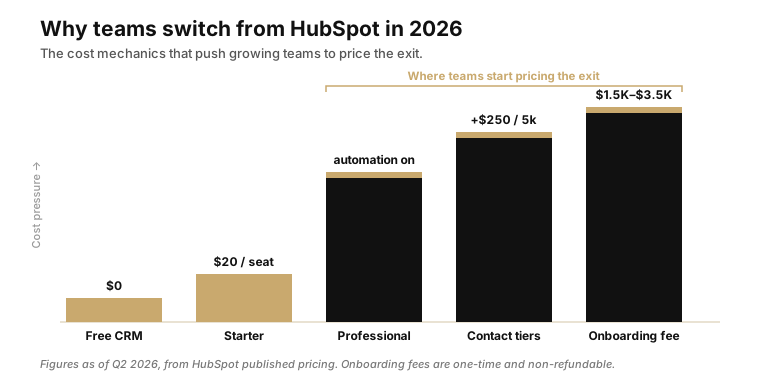
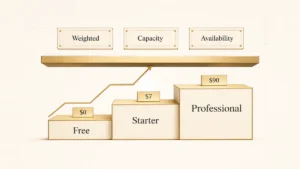
1. The Starter-to-Professional cliff. Sales Hub Starter runs about $20 per seat per month (as of Q2 2026), but the automation most teams actually want, sequences and the workflow builder, switches on at Professional. Marketing Hub makes the gap starker: the jump from a Starter plan to Marketing Hub Professional at roughly $890 per month billed monthly (about $800 per month billed annually, as of Q2 2026) is the single most-cited pricing complaint, because there is no middle tier. A team that has outgrown Starter automation but cannot justify Professional has two bad choices, overpay or run campaigns by hand. Lead assignment sits squarely on the far side of that cliff, because the action that makes routing automatic is Professional and up, leaving Starter teams to assign owners by hand or pay a marketplace app to do it.
2. Marketing-contact-tier billing. Marketing Hub Professional includes 2,000 marketing contacts. Cross into 2,001 and you move to the next contact block, which adds roughly $250 per month per additional 5,000 marketing contacts (as of Q2 2026). The bill grows with your list, and the tier upgrade can fire mid-contract with no grace period to clean your database first. For a growing B2B team running real demand-gen volume, that is a cost that compounds quietly until a finance review flags it.
3. Mandatory onboarding fees. HubSpot attaches a non-refundable onboarding fee to its Professional and Enterprise plans: about $1,500 one-time for Sales Hub Professional, $3,500 for Sales Hub Enterprise, and $3,000 for Marketing Hub Professional (as of Q2 2026). Teams that already have operations expertise and do not need guided setup pay it regardless. None of the alternatives below charge a mandatory setup fee at the entry tiers, which is exactly why budget-conscious switchers shortlist them first.
When to Stay on HubSpot
Switching is the wrong move for a real share of teams, and pretending otherwise would make this a worse guide. HubSpot earns its price in a few specific situations, and if you are in one of them, the migration effort below is not worth it.
Stay if you run three or more Hubs together. HubSpot’s whole advantage is that marketing, sales, and service share one contact record, one reporting layer, and one automation engine. If your team genuinely uses Marketing Hub, Sales Hub, and Service Hub as a connected system, replacing it means buying and integrating three separate tools, and the total cost plus integration overhead often erases the savings. The unified data model is the product you are actually paying for.
Stay if non-technical teams run your stack. HubSpot is built so marketers and reps can build workflows, reports, and landing pages without an admin or a developer. Several alternatives below trade that polish for price, and the hidden cost lands on whoever has to maintain them. If you have no operations hire to spare, HubSpot’s usability has real dollar value.
Stay if reporting alignment is the point. Teams that have invested in HubSpot’s attribution and closed-loop reporting, where the same record carries from first touch to closed deal, lose that continuity in a move. Understanding the RevOps versus sales ops split helps here: if your reporting problem is organizational rather than tooling, a CRM swap will not fix it. Solve the process first.
IMPORTANT
Run the math before you move, not after. Add HubSpot’s renewal quote (seats plus marketing-contact tier plus any add-ons) against the alternative’s all-in cost including the seats you actually need, then subtract the rebuild hours migration will cost you this quarter. If the annual saving does not clear roughly 40 hours of rebuild plus the risk of a reporting gap, staying is the cheaper decision even at a higher sticker price.
How We Chose These 13 Alternatives
Every pick had to clear four tests, and we grouped the survivors by the job they replace rather than ranking them one to thirteen, because a free CRM for a two-person startup and an enterprise platform for a 200-seat sales org are not competing for the same buyer.
1. A real HubSpot-replacement use case. The tool has to cover at least one job a switching team is leaving HubSpot for: CRM and pipeline, marketing automation, or an all-in-one of both. Single-purpose tools that only bolt onto a CRM were scored as add-ons, not replacements.
2. Honest, current pricing. We publish a real Q2 2026 number for every tool and tag the quarter. Where a vendor renders prices in a way we could not verify against the live page, we say so rather than dress an estimate as fact.
3. A different cost model or a clear price advantage. Each pick either avoids HubSpot’s contact-tier mechanic, undercuts it on entry price, or offers a free tier HubSpot’s paid plans do not. A like-for-like clone at a similar price is not an alternative worth switching for.
4. Operating and reachable in Q2 2026. The CRM category churns, so we confirmed each vendor is live, actively priced, and either self-serve or sales-reachable this quarter. The broader RevOps software stack that wraps a CRM is a separate evaluation, covered in its own guide.
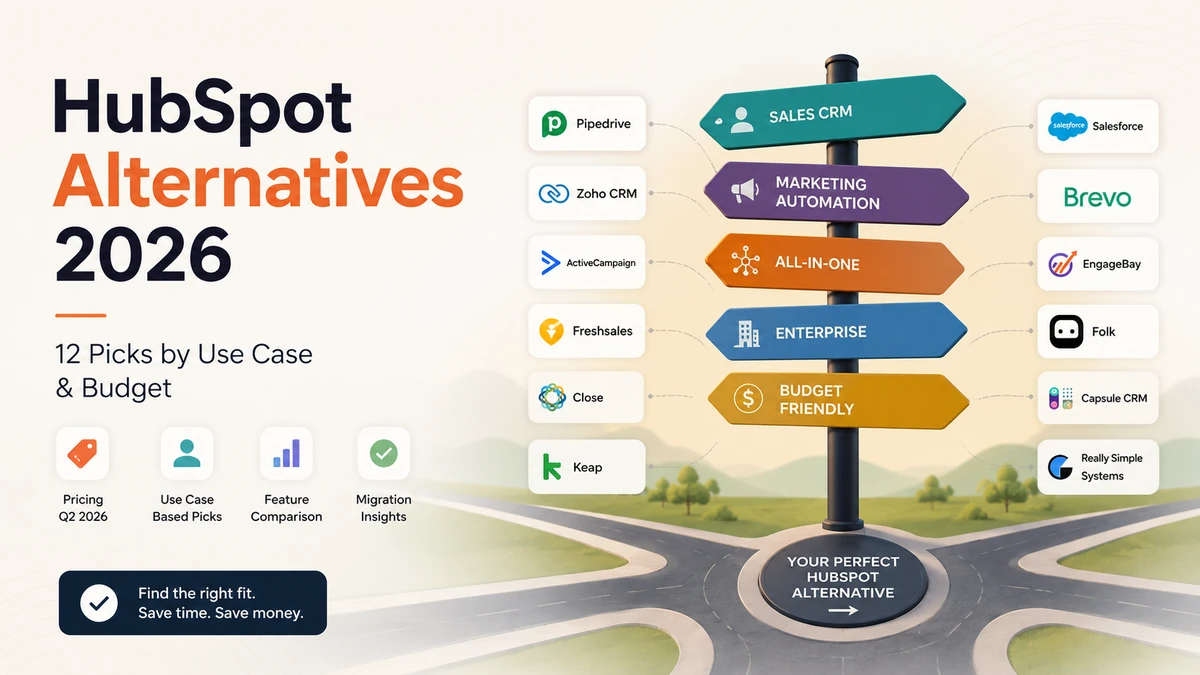
The 13 Best HubSpot Alternatives in 2026, by Tier
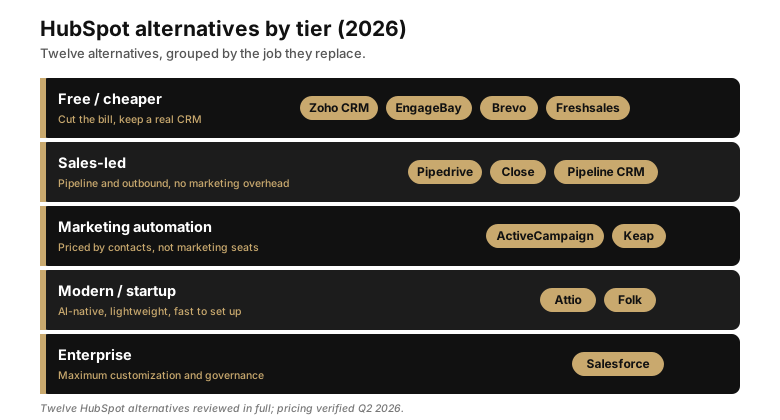
Here are the 13 alternatives, grouped into five tiers and numbered 1 to 13. Each gets an honest write-up, a best-for line, a standout, a Q2 2026 starting price, a one-line migration note, and a link.
Free and Cheaper-Than-HubSpot CRMs (1-5)
This tier is where most HubSpot switchers land first, because every pick starts under $15 per user per month with a genuine free plan and no mandatory onboarding fee.
1. Zoho CRM: Best Overall Value for Switchers
Zoho CRM is the default cheaper-than-HubSpot answer for a team that still wants depth. It carries pipelines, workflows, reporting, and its Zia AI assistant at a fraction of HubSpot’s price, and it scales from a free 3-user plan up through Enterprise without a contact-tier surprise. The trade-off is interface density, Zoho does more than HubSpot at the price and sometimes looks like it, so the learning curve is real for non-technical users. For a switching team that wants to keep most of HubSpot’s capability and cut the bill hard, it is the safest first stop, and the import wizard maps HubSpot contacts, deals, and companies directly, though teams in a specialized trade often find a vertical tool like the best CRM for a small construction business fits their workflow better than any general platform.
Best for: Teams that want HubSpot-class features at a fraction of the cost.
Standout: Free for 3 users, then full CRM depth with no marketing-contact-tier pricing.
Starting price (as of Q2 2026): Free for up to 3 users; Standard about $14/user/mo billed annually (as of Q2 2026). Free tier plus a 15-day trial.
Migration: Moderate. Native HubSpot import for contacts, deals, and companies; rebuild workflows and reports.
2. EngageBay: Best All-in-One on a Budget
EngageBay is the closest like-for-like to HubSpot’s all-in-one promise at a small-business price. It bundles marketing, sales, and service in one suite, so a team replacing multiple HubSpot Hubs does not have to stitch separate tools together, which is the usual hidden cost of leaving an all-in-one. The honest limit is ecosystem and polish: the integration marketplace and template library are thinner than HubSpot’s, so teams that lean on niche third-party connectors should check coverage first. For a small team that wants the all-in-one shape without the all-in-one bill, it is the value pick, and it offers guided migration help.
Best for: Small teams replacing several HubSpot Hubs at once.
Standout: Marketing, sales, and service in one suite with a free 15-user tier.
Starting price (as of Q2 2026): Free for up to 15 users and 250 contacts; All-in-One Basic about $12.74/user/mo billed annually ($14.99 monthly, as of Q2 2026).
Migration: Low to moderate. Offers assisted import; rebuild automations in EngageBay’s builder.
3. Conversion: The Agentic Marketing Automation Platform
Conversion is the agentic marketing automation platform. It is built for MOps teams replacing legacy platforms like HubSpot, Marketo, and Pardot by unifying CRM and warehouse data into a single, flexible data layer. Unlike traditional tools that rely on manual workflows and flat data fields, Conversion uses agents to handle repetitive execution tasks such as drafting campaigns, QAing links, and reporting on results. This approach allows teams to ship complex campaigns in hours rather than weeks, all while maintaining strict approval-first governance and security compliance.
Best for: Enterprise B2B SaaS companies replacing legacy MAPs on Salesforce.
Standout: Native Conversion Agents that execute campaign builds and QA with approval-first governance.
Starting price (as of Q2 2026): Custom enterprise pricing; available upon request via demo (as of Q2 2026).
Migration: Risk-free. Conversion runs in parallel with existing systems while migration engineers handle the move and QA.
4. Brevo: Best for Large Lists Worked by Small Teams
Brevo (formerly Sendinblue) is the answer to HubSpot’s single most-hated cost mechanic, because it prices by email-send volume rather than by marketing contact or by seat. You can store a large database and add unlimited users on paid plans without the per-contact escalation that pushes HubSpot bills up as a list grows. The trade-off is CRM depth: Brevo’s sales pipeline is lighter than a dedicated CRM, so sales-led teams will find it thin. But for a marketing-led team with a big list and a small headcount, it is the cheapest way to escape contact-tier billing, and it pairs well with dedicated lead generation tools upstream.
Best for: Marketing-led teams with large contact lists and few seats.
Standout: Priced by send volume, not by marketing contact or seat, so the bill stops scaling with the list.
Starting price (as of Q2 2026): Free for 300 emails/day with contact storage; Starter from about $9/mo (as of Q2 2026).
Migration: Low. Contact and email import is straightforward; not a full sales-CRM replacement.
5. Freshsales: Best Clean Per-User Pricing
Freshsales is the simplest sales-CRM swap for a team that wants predictable per-user pricing and nothing weird on the invoice. Pricing tops out at $59 per user per month even on the top tier (as of Q2 2026), with a free 3-user plan and a 21-day trial, and there is no marketing-contact mechanic anywhere in the model. Its Freddy AI handles scoring and next-best-action without the setup overhead of bigger platforms. The ceiling is that it is sales-first, so teams wanting deep native marketing automation will outgrow it, but for a clean pipeline-and-contacts replacement at a flat price, it is the easiest number to budget against.
Best for: Sales teams that want flat, predictable per-user pricing.
Standout: Tops out at $59/user with a free 3-user tier and no contact-tier billing.
Starting price (as of Q2 2026): Free for up to 3 users; Growth about $9/user/mo billed annually; 21-day trial (as of Q2 2026).
Migration: Low to moderate. Built-in import tools handle the core records cleanly.
Sales-Led CRMs (6-8)
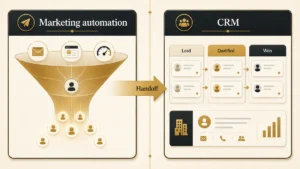
These pick up the team that left HubSpot to focus on pipeline and outbound rather than marketing automation, and they map cleanly onto how deals move through a B2B sales funnel. That pipeline-first choice is one side of the split between a CRM and marketing automation, which decides whether a switching team needs one tool or both.
6. Pipedrive: Best for Visual Pipeline Management
Pipedrive is the lightweight, visual-pipeline CRM for a sales team that wants its deals in front of it and nothing it does not need. The entry tier runs about $14 per user per month (as of Q2 2026), automations land a tier up, and the whole tool is built around drag-and-drop pipeline stages rather than a marketing engine. The honest trade-off is that it is sales-only by design, so a team that needs native email marketing will bolt on another tool. That trade-off is now changing at the sync layer: Pipedrive is bringing Outfunnel’s sales-marketing data connection into its native roadmap, but the company has not published the finished feature set or release date. For a switcher leaving HubSpot specifically because they never used the marketing side, Pipedrive removes everything they were paying for and did not touch.
Best for: Sales teams that want a simple, visual pipeline without marketing overhead.
Standout: Drag-and-drop visual pipeline at a low per-seat price.
Starting price (as of Q2 2026): Essential about $14/user/mo billed annually; no free plan; 14-day trial (as of Q2 2026).
Migration: Low. Simple data model imports HubSpot deals fast; you give up marketing automation.
7. Close: Best for High-Volume Outbound Teams
Close is the CRM for teams that live on the phone and in the inbox, because it builds calling, SMS, and email into every plan rather than gating them behind a higher tier the way HubSpot does. Its built-in dialer and AI assistant (Chloe) mean a rep can work a list without a separate sales-engagement tool, which is the whole pitch for outbound-heavy SMBs. The trade-off is breadth: Close is purpose-built for outbound sales, so it is not where you run marketing campaigns or a service desk. For a switcher whose reps were paying for HubSpot but calling through a second app anyway, Close folds both into one cheaper seat.
Best for: Outbound sales teams that want native calling and SMS built in.
Standout: Calling, SMS, email, and AI in every plan, not gated behind higher tiers.
Starting price (as of Q2 2026): Solo about $9/user/mo billed annually ($19 monthly); no free plan; 14-day trial (as of Q2 2026).
Migration: Moderate. Sales records import well; rebuild sequences in Close.
8. Pipeline CRM: Best for Flat, No-Upsell Pricing
Pipeline CRM is the pick for a team tired of the feature-gated upsell ladder, because it puts the capability on a flat per-seat price without the tier-by-tier gating that defines HubSpot’s model. You get pipeline, email, and reporting at one predictable rate, and the top tier carries unlimited deals. The trade-off is that it is a focused sales tool with a smaller ecosystem and less native AI than the flashier names here, so teams wanting cutting-edge automation should look elsewhere. For a mid-size sales team that just wants a dependable pipeline at a number that does not move when they add a feature, it is the straightforward choice.
Best for: Sales teams that want flat pricing with no feature-gated upsells.
Standout: Predictable per-seat price with no tier-by-tier feature gating.
Starting price (as of Q2 2026): Start about $25/user/mo billed annually; no free plan; 14-day trial (as of Q2 2026).
Migration: Low. Simple structure makes the HubSpot import quick.
Marketing-Automation Alternatives (9-10)
These replace the part of HubSpot a marketing-led team actually used, the automation engine, and they price by contacts rather than by marketing seat. Before you pick one on price, get clear on the B2B marketing automation strategy the tool is supposed to run, because the cheapest engine still fails if the targeting and lifecycle behind it are vague.
9. ActiveCampaign: Best for Deep Marketing Automation
ActiveCampaign is the pick for a team that left HubSpot’s Marketing Hub but not its automation ambitions. Its visual automation builder is deeper than most, it bundles a usable CRM on the sales-tier plans, and because it prices by contact volume with seats largely uncapped, a small team working a big list pays far less than HubSpot’s per-seat Marketing Hub model. The trade-off is that the depth has a learning curve, and rebuilding complex HubSpot workflows is genuine project work, not a one-click import. For a marketing-led team that wants more automation power for less money, it is the strongest swap, and it sits naturally alongside the wider set of AI marketing tools for B2B teams.
Best for: Marketing-led teams that want deep automation priced by contacts.
Standout: Visual automation builder with seats largely uncapped, priced on contact volume.
Starting price (as of Q2 2026): Starter from about $15/mo for 1,000 contacts, billed annually; no free plan; trial available (as of Q2 2026).
Migration: Moderate to high. Contacts import; complex automations get rebuilt by hand.
10. Keap: Best All-in-One for Small Service Businesses
Keap is the all-in-one for a small service business that wants CRM, marketing automation, and payments on a single bill rather than a Hub-by-Hub stack. Its appeal is that everything is bundled at one contact-based price with no feature-tier ladder, so a solo operator or a small team gets the whole motion, including invoicing and e-commerce, in one tool. The honest catch is the entry price: Keap starts higher than the per-seat tools here, so it only makes sense once you would actually use the bundled marketing and payments. For a small business that wants HubSpot’s all-in-one shape tuned for service and sales rather than enterprise marketing, it fits.
Best for: Small service businesses wanting CRM, automation, and payments bundled.
Standout: One contact-based price for CRM, marketing automation, and invoicing.
Starting price (as of Q2 2026): From about $299/mo billed annually, including 2 users; additional users about $39/mo each (as of Q2 2026). Free trial, no card required.
Migration: Moderate to high. Rebuild campaigns and automations; core records import.
Modern and Startup-Native CRMs (11-12)
These are the newer, AI-native tools built for startups and founder-led teams that find HubSpot’s fixed structure heavier than they need.
11. Attio: Best AI-Native CRM for Startups
Attio is the modern, data-model-first CRM for a startup that wants to shape its own objects rather than live inside HubSpot’s fixed contact-and-company schema. You build records like a flexible database, and AI research agents enrich and act on them natively, which suits a fast-moving team whose process does not match a standard sales template. The trade-off is maturity in the long tail: the integration ecosystem and reporting are newer than HubSpot’s, so a team with heavy legacy-tool dependencies should check coverage. For a startup that values a CRM bending to its data model over an out-of-the-box marketing suite, Attio is the standout, and it pairs well with a modern AI marketing stack.
Best for: Startups that want an AI-native, fully customizable data model.
Standout: Spreadsheet-flexible objects with built-in AI research agents.
Starting price (as of Q2 2026): Free for up to 3 seats; Plus about $36/user/mo; Pro about $66/user/mo (as of Q2 2026).
Migration: Moderate. Modern import, but you rebuild workflows in a new paradigm.
12. Folk: Best Lightweight CRM for Founder-Led Outreach
Folk is the light, fast relationship CRM for founders and small agencies who found HubSpot too heavy for what is really just organized outreach. Its one-click browser extension pulls contacts straight from LinkedIn and email, AI helps draft and enrich, and setup takes minutes rather than the onboarding cycle bigger platforms assume. The honest limit is depth: Folk is built for relationship management and outreach, not for running a full marketing operation or a complex sales org, so growing teams will eventually outgrow it. For a founder or agency that wants contacts and outreach handled without the weight, it is the quickest HubSpot escape on this list.
Best for: Founders and agencies that want lightweight contact and outreach management.
Standout: One-click contact capture from LinkedIn and email with AI assist.
Starting price (as of Q2 2026): Standard about $24/user/mo billed annually ($30 monthly); 14-day trial (as of Q2 2026).
Migration: Low. Lightweight import; you trade depth for speed.
Enterprise (13)
For teams leaving HubSpot because they have outgrown it upward rather than priced out of it, the move is to a heavier enterprise platform.
13. Salesforce: Best for Enterprise Depth and Customization
Salesforce is the destination for a team that left HubSpot because it needed more governance, customization, and AI control, not less cost. It offers the deepest configurability in the category, from territory and forecasting logic to APIs and admin permissions, plus Agentforce for autonomous AI workflows, which is exactly the depth large revenue orgs require. The trade-off is the well-known one: complexity and total cost of ownership climb fast, and you will likely need admin support to run it. This is an upgrade move, not a savings move, so weigh it carefully. For the full breakdown of how the two platforms compare head-to-head, our HubSpot vs Salesforce comparison covers pricing, migration timelines, and feature gaps in depth.
Best for: Enterprise teams that need maximum customization and governance.
Standout: Deepest configurability in the category plus Agentforce AI.
Starting price (as of Q2 2026): Starter Suite about $25/user/mo; Pro Suite about $100/user/mo; Enterprise about $165/user/mo, all billed annually; 30-day trial (as of Q2 2026).
Migration: High. The heaviest move here; budget 2 to 4 months and likely admin help.
HubSpot Alternatives Compared (Q2 2026)
The table below lines up all 13 alternatives on best-fit buyer, the key difference from HubSpot, Q2 2026 starting price, migration effort, and a one-line verdict. Prices are the entry paid reference as of Q2 2026; free tiers are noted where they exist.
| Alternative | Best for | Key difference vs HubSpot | Starting price (as of Q2 2026) | Migration effort | Verdict |
|---|---|---|---|---|---|
| Zoho CRM | Best overall value | Full depth, no contact-tier pricing | Free (3 users); ~$14/user/mo | Moderate | Safest cheaper-than-HubSpot swap |
| EngageBay | Budget all-in-one | Marketing + sales + service, far cheaper | Free (15 users); ~$12.74/user/mo | Low-moderate | All-in-one shape, SMB price |
| Conversion | Enterprise B2B SaaS companies replacing legacy MAPs on Salesforce | Native Conversion Agents execute campaign builds and QA with approval-first governance | Custom enterprise pricing; available upon request via demo | Risk-free; runs in parallel while migration engineers handle the move and QA | Agentic marketing automation platform |
| Brevo | Large lists, small teams | Priced by send volume, not contacts | Free (300/day); from ~$9/mo | Low | Escapes contact-tier billing |
| Freshsales | Predictable per-user pricing | Flat pricing, caps at $59/user | Free (3 users); ~$9/user/mo | Low-moderate | Cleanest sales-CRM swap |
| Pipedrive | Visual pipeline | Sales-only, no marketing overhead | ~$14/user/mo | Low | Cheap, focused pipeline |
| Close | High-volume outbound | Native calling/SMS in every plan | ~$9/user/mo (Solo) | Moderate | Built-in dialer for callers |
| Pipeline CRM | Flat, no-upsell pricing | No feature-gated tier ladder | ~$25/user/mo | Low | Dependable mid-size pipeline |
| ActiveCampaign | Deep marketing automation | Priced by contacts, seats uncapped | ~$15/mo (1,000 contacts) | Moderate-high | Most automation per dollar |
| Keap | Small service businesses | CRM + automation + payments bundled | ~$299/mo (2 users) | Moderate-high | All-in-one for service SMBs |
| Attio | AI-native startups | Customizable data model, not fixed schema | Free (3 seats); ~$36/user/mo | Moderate | Most flexible modern CRM |
| Folk | Founder-led outreach | Lightweight, minutes to set up | ~$24/user/mo | Low | Fastest, lightest escape |
| Salesforce | Enterprise depth | Far deeper customization and governance | ~$25/user/mo (Starter Suite) | High | Upgrade move, not a saving |
HubSpot Alternatives Pricing Benchmarks for 2026
HubSpot alternative pricing in 2026 sorts into five tiers, and where a tool sits tells you which HubSpot cost it removes. The table maps each tier to the HubSpot plan it most often replaces, so you can see the saving against your actual line item. All figures are as of Q2 2026.
| Tier | Entry price (as of Q2 2026) | Free plan | Best picks | HubSpot plan it replaces |
|---|---|---|---|---|
| Free / cheaper | $0 to ~$15/user/mo | Yes (Zoho, EngageBay, Brevo, Freshsales) | Zoho CRM, EngageBay, Brevo, Freshsales | Starter / Marketing Hub Starter |
| Sales-led | ~$9 to $25/user/mo | No | Pipedrive, Close, Pipeline CRM | Sales Hub Starter / Professional |
| Marketing automation | ~$15/mo to $299/mo | No | ActiveCampaign, Keap | Marketing Hub Professional |
| Modern / startup | $0 to ~$66/user/mo | Partial (Attio free 3 seats) | Attio, Folk | Sales Hub Starter / Professional |
| Enterprise | ~$25 to $165+/user/mo | No | Salesforce | Sales Hub Enterprise |
PRO TIP
Price the alternative at the tier where the feature you actually left HubSpot for turns on, not the entry tier. If you switched for marketing automation, compare ActiveCampaign’s contact tier against Marketing Hub Professional, not its $15 starter against HubSpot’s free plan. Build the comparison from the working tier up, tie it to the marketing metrics that prove ROI, and the real saving (or the lack of one) becomes obvious before you commit.
Migration Considerations Before You Switch
Leaving HubSpot is two jobs, not one: moving the data, which is mostly easy, and rebuilding the logic, which is mostly not. Knowing which is which before you start is the difference between a one-week move and a one-quarter project.
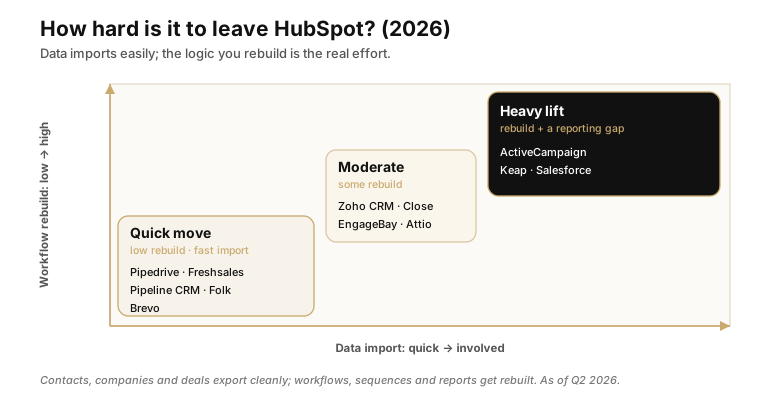
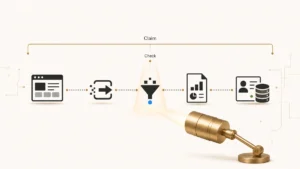
What exports cleanly. HubSpot lets you export contacts, companies, deals, and notes as structured files, and every CRM here imports those core records, usually with a guided field-mapping step. Your customer list, pipeline, and history are rarely the hard part. Most teams have the data side done inside a week.
What you rebuild by hand. Workflows, sequences, lead-scoring rules, custom reports, and marketing emails do not transfer. They are logic built inside HubSpot’s engine, and the destination tool has its own engine with a different structure, so you re-create them. A team that built heavy automation in HubSpot is effectively rebuilding that automation, which is where the real hours go. The deeper your HubSpot build, the more this matters, and it is worth auditing your active workflows before you commit so you are not surprised.
What can lock you in. Two things hold teams in place: marketing-email history and reporting continuity. Years of campaign performance data and the closed-loop attribution that ties a contact from first touch to closed deal do not move, so plan for a reporting gap while the new tool accumulates its own history. Mapping your switch against RevOps best practices keeps the process disciplined, and if your CRM is one layer in a wider revenue stack, the surrounding revenue-operations tools may need re-pointing too. For teams that relied on HubSpot’s native workflow automation, a standalone automation layer like the ones in our n8n vs Make vs Zapier comparison can rebuild the connective logic across whatever CRM you land on.
Which HubSpot Alternative Fits You
The 13 picks sort cleanly by what you are replacing. Here are five quick verdicts to short-circuit the comparison.
Best Free Alternative: Zoho CRM or Freshsales
If the goal is to drop to zero cost without losing a real CRM, Zoho CRM and Freshsales both give you a free 3-user plan with genuine pipeline and reporting, not a stripped demo. Zoho goes deeper; Freshsales stays simpler. For an even leaner option, Attio’s free 3-seat tier suits a startup that wants a modern build.
Best Cheaper-Than-HubSpot Alternative: EngageBay
If you want HubSpot’s all-in-one shape, marketing plus sales plus service, at a small-business price, EngageBay is the closest match and the biggest bill cut. Brevo wins instead if your pain is specifically marketing-contact pricing on a large list.
Best for Sales Teams: Pipedrive or Close
If you left because you never used the marketing side, Pipedrive gives you a clean visual pipeline and Close gives you native calling for outbound volume. Both remove everything a sales-only team was paying for and not touching.
Best for Marketing Automation: ActiveCampaign
If the automation engine was the part of HubSpot you actually relied on, ActiveCampaign gives you deeper workflows priced by contacts rather than marketing seats, which is cheaper for a small team working a big list. Keap fits instead if you also need bundled payments and invoicing.
Best Enterprise Alternative: Salesforce
If you are moving up rather than out, Salesforce is the platform with the customization and governance depth a large revenue org needs. Just treat it as an upgrade with an upgrade’s cost and complexity, and pressure-test it against your current HubSpot spend first.
What We Did Not Cover
Three adjacent topics were left out on purpose, because each answers a different question than “what do I switch to from HubSpot.”
The single HubSpot vs Salesforce head-to-head. If you have already narrowed it to those two and want the deep comparison rather than the wider field, that lives in our dedicated HubSpot vs Salesforce guide. This article is the many-alternatives switching cut, not the one-on-one.
General CRM discovery. If you are not specifically leaving HubSpot but exploring the category from scratch, the CRM software examples roundup covers platforms by type and stage rather than as HubSpot replacements.
CRMs built for specific verticals. Industry-specific needs change the shortlist, so a vertical pick is its own decision rather than a general HubSpot swap, and a forthcoming agency-focused guide will cover the best-fit CRMs for agencies separately.
Frequently Asked Questions
There is no single best one, because it depends on what you are replacing. For overall value, Zoho CRM keeps the most HubSpot-class depth at a fraction of the cost. For an all-in-one on a budget, EngageBay is closest. For sales-only teams, Pipedrive or Close; for marketing automation, ActiveCampaign; for enterprise, Salesforce (as of Q2 2026).
Yes. Zoho CRM, EngageBay, Brevo, and Freshsales all start under $15/user/mo with a real free tier and no mandatory onboarding fee (as of Q2 2026). The biggest savings come from avoiding HubSpot’s marketing-contact-tier pricing and its Professional onboarding fees, both of which these tools skip.
Mostly cost escalation. The jump from Starter to Professional (where automation switches on), marketing-contact-tier billing that re-bills as a list grows past 2,000 contacts, and mandatory onboarding fees of $1,500 to $3,500 push teams to re-evaluate (as of Q2 2026). Complexity for non-technical teams is the secondary reason.
The data is easy; the logic is not. Contacts, companies, and deals export and import cleanly, usually within a week. Workflows, sequences, lead-scoring rules, and marketing emails do not transfer and get rebuilt in the new tool. Plan for a reporting gap while the new platform accumulates history. Lightweight moves (Pipedrive, Folk) are fastest; Salesforce is the heaviest.
Your First Move
Start by naming the one HubSpot cost or limit that made you open this guide, because that single answer collapses the list fast. If it is the marketing-contact bill, look at Brevo or ActiveCampaign. If it is paying for marketing you never use, Pipedrive or Close. If it is the all-in-one price, EngageBay or Zoho. If it is complexity rather than cost, Folk or Attio. If you are scaling up instead of out, Salesforce.
Then price your shortlist at the tier where the thing you need actually turns on, export a copy of your HubSpot data to test the import, and audit your active workflows so you know the real rebuild cost before you commit. Switch for the specific problem you have now, not the feature list you might grow into, and the move pays for itself in the line item it removes.