
Your sales ops team is crushing it. Territory plans are tight, the CRM is clean, reps know their numbers. But pipeline keeps leaking between marketing and sales. Customer success is flying blind on expansion revenue.
And nobody can agree on what a “qualified lead” actually means. Sound familiar? That’s the ceiling of sales ops, and it’s where the revops vs sales ops conversation gets real.
The confusion between these two functions costs companies months of misaligned effort. Some teams rename sales ops to RevOps without changing anything. Others build a RevOps team from scratch when stronger sales ops would’ve solved the problem faster. Both mistakes are expensive.
This guide explains what each function actually does, how they differ across scope, metrics, tools, and reporting, when you need one versus the other, and how the two work together in companies that get it right.
Key Takeaways
- Sales ops optimizes the sales team’s performance. RevOps aligns sales, marketing, and customer success into one revenue engine.
- The core difference is scope: sales ops owns the sales function, RevOps owns the entire customer journey from first touch to renewal.
- Most companies start with sales ops and add RevOps when cross-departmental misalignment starts hurting revenue.
- RevOps doesn’t replace sales ops. In mature organizations, sales ops operates within the RevOps framework as the sales-specific execution arm.
- The transition signal isn’t company size or ARR. It’s when revenue leaks between departments become your biggest growth constraint.
What Is Sales Ops?
Sales operations is a function dedicated to making the sales team more effective by optimizing processes, managing tools, cleaning data, and removing administrative friction so reps can focus on selling. It owns everything that supports the sales department: CRM management, territory planning, forecasting, compensation structures, and sales analytics.
A good sales ops team turns chaos into a system. Instead of reps manually updating spreadsheets and guessing which leads to call, sales ops builds the infrastructure that routes leads automatically, tracks pipeline accurately, and surfaces the data reps need to close deals. That build work has grown technical enough that the build layer has split off into a role of its own, which is worth understanding before you decide whether your next hire is an operator or an engineer.
Core sales ops responsibilities include:
- CRM administration: Keeping Salesforce or HubSpot clean, configured, and actually useful for the sales team.
- Sales process design: Defining stages, exit criteria, and handoff points within the sales funnel.
- Territory and quota planning: Assigning accounts to reps based on geography, vertical, or deal size, and setting targets that are ambitious but achievable.
- Forecasting: Building pipeline models that predict revenue based on historical conversion rates and current deal velocity.
- Sales analytics: Tracking win rates, cycle length, average deal size, and rep productivity to identify what’s working and what’s not.
- Compensation management: Designing and administering commission structures that incentivize the right behaviors.
Sales ops typically reports to the VP of Sales or Chief Sales Officer. The team is laser-focused on one question: how do we help the sales team sell more, faster?
What Is RevOps?
Revenue operations is a strategic function that aligns sales, marketing, and customer success under one operational framework to maximize revenue across the entire customer lifecycle. Instead of optimizing one department, RevOps connects all revenue-generating teams so they share data, follow consistent processes, and work toward unified revenue goals.
Where sales ops asks “how do we close more deals?”, RevOps asks “how do we generate more revenue across the full customer journey, from first website visit to renewal and expansion?”
That distinction matters because B2B buying doesn’t happen in neat departmental silos. A prospect interacts with your marketing content, talks to a sales rep, gets handed to customer success, then comes back to sales for an upsell. If each department runs its own operational stack with its own data and its own definitions, revenue falls through the cracks at every handoff.
According to Gartner’s research, 75% of the highest-growth companies will deploy a RevOps model by 2026. And a Boston Consulting Group study found that companies with aligned revenue operations saw 10–20% increases in sales productivity and up to 15% growth in profitability.
Core RevOps responsibilities include:
- Cross-functional process alignment: Making sure lead handoffs between marketing and sales (and between sales and customer success) are clean, tracked, and consistent.
- Unified data management: Creating a single source of truth across CRM, marketing automation, and customer success platforms. No more “marketing says X, sales says Y.”
- Revenue tech stack governance: Managing tool decisions across all revenue teams, not just sales. Ensuring integrations work and data flows correctly.
- Full-funnel forecasting: Predicting revenue from pipeline creation through closed-won through renewal, not just the sales portion.
- Customer journey optimization: Identifying where prospects and customers experience friction across departments and fixing it.
- Revenue analytics: Tracking metrics that span the full lifecycle: CAC, CLV, net revenue retention, and marketing-sourced pipeline contribution.
RevOps usually reports to the CEO, CRO, or COO, reflecting its cross-departmental mandate. The team often includes specialists in marketing ops, sales ops, customer success ops, and revenue analytics, all working under one unified structure.
RevOps vs Sales Ops: Key Differences
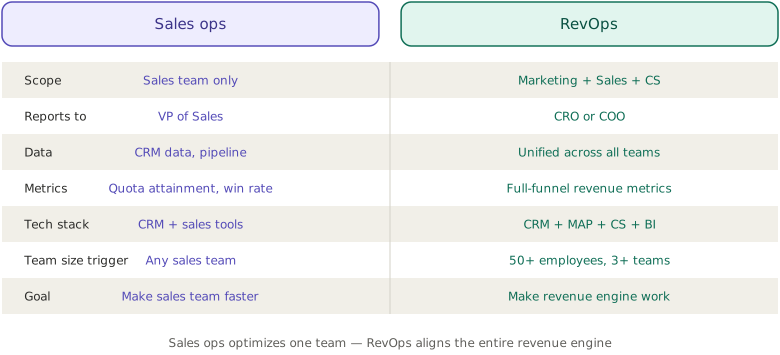
The differences go deeper than “sales ops handles sales, RevOps handles everything.” Here’s how they diverge across the dimensions that matter most for choosing between them.
Scope and Focus
Sales ops focuses exclusively on the sales department. Its mission is making sales reps more productive and the sales process more efficient. Every initiative, tool, and metric ties back to sales performance.
RevOps spans the entire go-to-market organization. It looks at how marketing generates demand, how sales converts it, how customer success retains and expands it, and where the gaps between those functions cause revenue to leak. When a sales ops leader evaluates a new tool, they ask “will this help our reps close more deals?” When a RevOps leader evaluates the same tool, they ask “how does this integrate with our marketing and CS stack, and will it improve the full customer experience?”
Data and Technology
Sales ops manages sales-specific tools: CRM configuration, sales engagement platforms like Outreach or Salesloft, CPQ software, and sales analytics dashboards. Their data lives primarily in the CRM.
As automation matures, many organizations are exploring AI agents for RevOps to handle tasks that once required dedicated analysts.
RevOps governs the entire revenue tech stack. That includes marketing automation (HubSpot, Marketo), the CRM (Salesforce, HubSpot CRM), customer success platforms (Gainsight, ChurnZero), and the integrations between all of them. RevOps is responsible for data governance across systems, which means standardizing definitions (what counts as an MQL vs SQL), ensuring data flows cleanly between tools, and maintaining a single source of truth. For a breakdown of the 10 platforms most RevOps teams evaluate and how to match them to your team stage, see our best RevOps software guide.
PRO TIP
The number one sign that you’ve outgrown sales ops: you have “multiple sources of truth” for customer data. Marketing’s numbers don’t match sales’ numbers, which don’t match CS’s numbers. RevOps exists specifically to eliminate that problem.
Metrics
Sales ops tracks sales-specific KPIs: win rate, sales cycle length, pipeline velocity, quota attainment, average deal size, and individual rep performance. These metrics tell you how the sales engine is running.
RevOps tracks end-to-end revenue metrics: customer acquisition cost (CAC), customer lifetime value (CLV), net revenue retention (NRR), marketing-sourced pipeline, lead-to-close conversion across the full funnel, and revenue per employee. According to Forrester’s analysis, organizations that adopt unified revenue metrics see faster identification of pipeline bottlenecks and more accurate forecasting than those tracking departmental KPIs in isolation.
Reporting Structure
Sales ops reports to the Head of Sales or CSO. This alignment makes sense because sales ops serves one stakeholder: the sales leader. The downside is that sales ops priorities are always filtered through the sales team’s perspective.
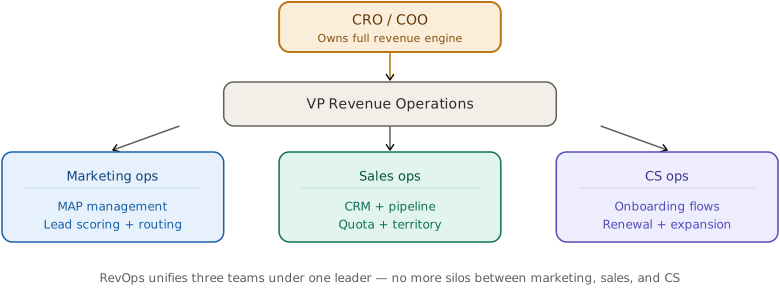
RevOps reports to the CEO, CRO, or COO. This higher-level reporting gives RevOps the authority to make decisions that affect multiple departments, even when those decisions create short-term friction for one team. For example, RevOps might change the lead scoring model in a way that reduces MQL volume (frustrating for marketing) but increases SQL quality (better for sales and overall revenue).
Salary Ranges
Compensation reflects the difference in scope. According to industry benchmarks, sales ops professionals in the US typically earn between $70,000 and $150,000 depending on seniority, with directors reaching $150,000 to $200,000. RevOps roles command higher salaries due to their broader mandate: entry-level positions start around $80,000 to $100,000, managers earn $120,000 to $180,000, and directors or VPs of RevOps typically range from $150,000 to $250,000+. These figures vary by company size, industry, and location.
When to Choose Sales Ops vs RevOps
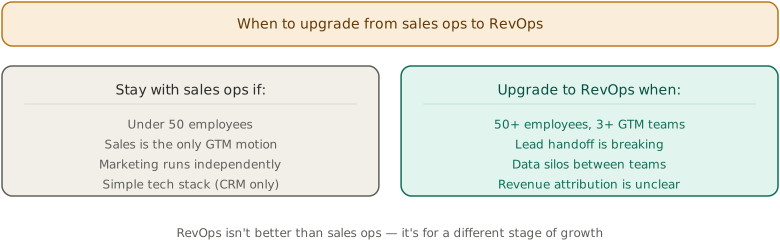
This isn’t about company size or ARR thresholds. It’s about which operational problems are constraining your growth.
Start with Sales Ops When:
- Your sales process is the primary bottleneck (reps are disorganized, pipeline is unpredictable, forecasting is guesswork).
- You don’t have a marketing team or customer success team yet, so there’s nothing to align across.
- You’re early-stage (under 20 employees) and need someone to build the sales infrastructure from scratch.
- Your CRM is a mess and nobody owns it.
You Need RevOps When:
- Leads are falling through the cracks between marketing and sales.
- Customer success has no visibility into what sales promised during the deal.
- Marketing and sales disagree on lead quality, and there’s no shared definition of MQL vs SQL.
- You’re running multiple go-to-market motions (inbound, outbound, PLG, partnerships) that need coordination.
- Your tech stack has grown to 6+ tools across departments and nobody owns the integrations.
- Manual reporting consumes hours every week because data lives in different systems.
The pattern is consistent: you start with sales ops to build a functional sales machine, then add RevOps when the gaps between departments become your biggest revenue constraint.
IMPORTANT
Don’t just rename your sales ops team to “RevOps” without changing the scope, reporting structure, and mandate. That’s the most common mistake companies make, and it creates confusion without solving any cross-functional problems.
How RevOps and Sales Ops Work Together
This isn’t an either/or decision in mature organizations. Sales ops and RevOps coexist, with sales ops operating as the sales-specific execution arm within the broader RevOps framework.
Here’s how the relationship works in practice:
RevOps sets the strategy. They define the overall revenue process, set cross-functional KPIs, and manage the tech stack governance. They decide how data flows between systems and what the lead lifecycle looks like from first touch to renewal.
Sales ops executes within sales. They take the RevOps framework and apply it to the sales team specifically. They configure sales-specific tools, design territories, run sales forecasting, and manage compensation. They’re the tactical arm that makes the RevOps strategy work on the sales floor.
A concrete example: RevOps identifies that lead-to-close time is 20% longer than industry benchmarks. They analyze the data and discover the bottleneck is in the handoff from marketing to sales. RevOps redesigns the lead routing process across both departments. Sales ops then implements the changes within the sales team, including updating the CRM workflows, training reps on the new process, and tracking the sales-specific metrics to confirm the improvement.
This partnership works because each function focuses on what it does best. RevOps handles the cross-functional complexity. Sales ops handles the sales-specific execution. Neither steps on the other’s toes as long as ownership boundaries are documented clearly.
Common Mistakes When Building These Functions
Hiring RevOps too early. If you have 10 sales reps and no marketing ops or CS ops, you don’t need RevOps. You need strong sales ops. Build the foundation before adding the cross-functional layer.
Treating RevOps as a reporting function. RevOps isn’t a team that builds dashboards. It’s a strategic function that designs processes, manages data governance, and drives revenue efficiency. If your RevOps team spends 80% of their time building reports, something is wrong.
Not giving RevOps enough authority. RevOps needs to report high enough (CEO or CRO level) to make decisions that affect multiple departments. If RevOps reports to the VP of Sales, it becomes sales ops with a new title.
Skipping the documentation. The biggest source of RevOps/sales ops tension is unclear ownership. Document who owns what: CRM governance, lead scoring, tool procurement, data definitions, reporting. Write it down. Review it quarterly.
Frequently Asked Questions
Sales ops focuses on optimizing the sales team’s processes, tools, and performance. RevOps takes a broader approach, aligning sales, marketing, and customer success under one operational framework to maximize revenue across the entire customer lifecycle. Sales ops is department-specific. RevOps is cross-functional.
Marketing ops focuses on the marketing team’s tools, data, and campaign execution (managing HubSpot, building email workflows, tracking attribution). RevOps sits above marketing ops, sales ops, and CS ops, aligning all three under a unified revenue strategy. In a RevOps structure, marketing ops is a specialized function within the larger RevOps team. That function has its own internal shape worth designing deliberately, since the four duty families inside marketing ops split into separate seats at predictable headcount thresholds whether or not a RevOps layer sits above them.
RevOps aligns go-to-market teams (sales, marketing, customer success) to optimize revenue generation. FinOps (Financial Operations) manages cloud infrastructure costs and financial accountability for technology spending. They’re completely different functions that occasionally collaborate on budget forecasting and cost-per-acquisition analysis.
Yes, but it usually looks different. In a 30-person company, RevOps might be one person who owns the CRM, manages marketing and sales tool integrations, and ensures data consistency across teams. You don’t need a 5-person RevOps team. You need someone with a cross-functional mindset and the authority to make process decisions across departments.
Your Next Step
Run this diagnostic right now: open your CRM and pull last quarter’s pipeline report. Then ask marketing for their lead generation numbers for the same period. If the numbers don’t match (they almost never do), you’ve found your first RevOps problem. That gap between marketing’s “leads generated” and sales’ “leads received” is exactly the kind of revenue leak that RevOps exists to fix. Start there.
For a complete breakdown of how to build a RevOps function from scratch, including frameworks, KPIs, and team structure, read our guide to RevOps best practices.