
Most marketing operations team structures were not designed. They accumulated. Someone needed the automation platform cleaned up, so a contractor came in. Reporting broke, so an analyst got borrowed from finance. A routing rule misfired during a product launch, and whoever fixed it quietly owned routing from then on.
That works until roughly the moment a second person joins. Then questions start arriving with no owner attached. Who approves a new field on the lead object? Who decides whether campaigns follow a naming convention or a UTM standard? When the pipeline figure in the board deck disagrees with the figure in the CRM, whose job is it to reconcile them?
This article covers what the function actually owns, the five roles inside it, how many people you need at each company size, where the team should report, and where the line sits between marketing ops, RevOps and GTM engineering.
Direct answer — How should a marketing operations team be structured?
A marketing operations team is structured around four ownership families: campaign operations, marketing technology administration, data and analytics, and governance. Below roughly 50 employees, one generalist covers all four. Between 50 and 500, the analytics seat separates first, then platform administration. Above 500, a marketing ops leader manages specialists per family. The reporting line matters more than headcount: a team reporting into RevOps optimises for pipeline, one reporting into the CMO optimises for campaign throughput.
Key Takeaways
- Marketing ops owns four duty families. Survey data puts process at 77.8%, data at 73.3% and technology at 72.7% of practitioners’ responsibilities, which is why one person covering all three saturates fast.
- Headcount tracks marketing team size, not company revenue. A workable planning rule is roughly one marketing ops FTE per ten marketers, with a floor of one once an automation platform is live.
- The analytics seat is almost always the correct second hire, not a second campaign builder.
- Where the team reports decides what it optimises. Under the CMO it protects campaign throughput; under RevOps it protects pipeline integrity. Neither is wrong, but the choice is not reversible cheaply.
- Marketing ops, RevOps and GTM engineering are three different jobs. Blurring them is the most common reason a well-staffed team still misses.
What a marketing operations team actually owns
Marketing operations is the function that owns the systems, data and processes marketing runs on, so that campaigns can be built, measured and repeated without renegotiating how the machine works each time. It is not a help desk for the marketing team, though it degrades into one when nobody defines its scope.
The scope question has a reasonably good empirical answer. In the State of the Marketing Ops Professional research covering more than 600 practitioners, Scott Brinker reported that process responsibilities sat at 77.8%, data at 73.3% and technology at 72.7%. Those three numbers are close together on purpose. They describe a function where most practitioners carry all three duty families at once rather than specialising in one.
That overlap is the structural fact everything else follows from. Four families cover almost everything a marketing ops team is asked to do:
- Campaign operations — building, QA-ing and launching campaigns, plus the lead lifecycle rules underneath them: scoring, routing, lifecycle stage transitions.
- Marketing technology administration — owning the automation platform and its integrations, managing users and permissions, evaluating and retiring tools.
- Data and analytics — reporting infrastructure, attribution setup, data hygiene, and reconciling numbers across systems.
- Governance — naming conventions, field standards, consent and privacy compliance, and the approval path for changes to shared objects.
Adoption of the function itself is no longer in question. Analysis of the same research programme found that more than 80% of companies had a dedicated marketing operations individual or team, up from 65% in 2021. The open question was never whether to have marketing ops. It is how to shape it.
What marketing ops does not own
Scope is defined as much by exclusions as by duties, and the exclusions are where most teams get overloaded. Marketing ops does not own campaign strategy, offer selection, creative or copy. It does not own channel performance, which belongs to demand generation. It does not own the content calendar. It does not own quota or territory design, which sit with sales ops or RevOps.
The distinction that causes the most friction is between building a campaign and deciding what the campaign should say. Marketing ops owns the first and should have no vote on the second. When that line blurs, the team acquires opinions it has no mandate to enforce, and the requesting teams start treating operational objections as creative interference. Write the exclusions into the charter alongside the duties. The exclusions are what make the duties defensible.
PRO TIP
Before writing a job description, spend an hour listing every task marketing ops performed last quarter and tag each with one of the four families. The distribution tells you which role to hire. Teams that skip this step reliably hire a second campaign builder when what broke was reporting.
Marketing ops vs RevOps vs GTM engineering: who owns what
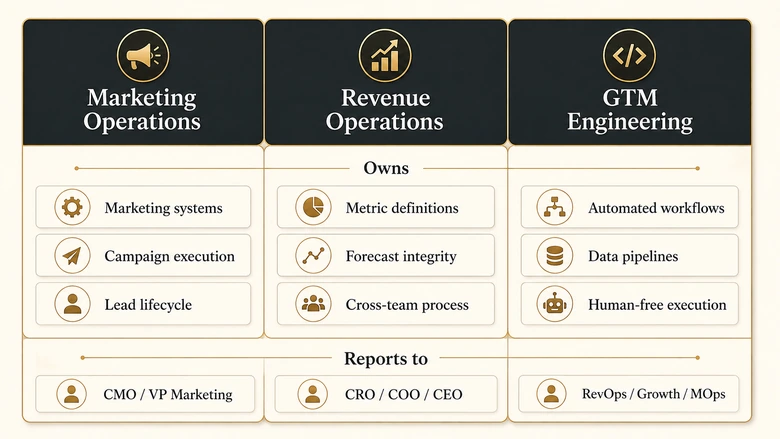
These three functions overlap enough that job titles have stopped being reliable, and different enough that combining them into one seat produces a person who does none of them well. The distinction is about the object each function is accountable for.
| Marketing operations | Revenue operations | GTM engineering | |
|---|---|---|---|
| Owns | Marketing systems, campaign execution, lead lifecycle up to handoff | Metric definitions, forecast integrity, process across marketing, sales and CS | Automated workflows and data pipelines that run go-to-market motions |
| Accountable for | Campaigns launching correctly and leads reaching sales in a usable state | One agreed number per metric and a forecast leadership can act on | Systems that execute without a human in the loop |
| Typically reports to | CMO or VP Marketing | CRO, COO or CEO | RevOps, growth, or marketing ops |
| Hire when | You have an automation platform and more than one marketer | Two go-to-market teams disagree about the same number | Manual workflow volume caps growth and the work is genuinely repeatable |
| Fails when | It becomes a campaign ticket queue with no authority over standards | It becomes a reporting function with no process mandate | It ships scripts nobody else can maintain |
The practical test is simpler than the table. If the question is “why did this campaign not send correctly,” that is marketing ops. If the question is “why does marketing say 400 MQLs and sales say 260,” that is RevOps, because the disagreement is about definitions rather than execution. If the question is “can we stop doing this by hand,” that is GTM engineering, which is a build discipline rather than an administration one.
Companies below roughly 200 employees usually should not have all three. Marketing ops comes first because it is the one with a daily failure mode. RevOps arrives when two teams start arguing about numbers, and that argument is worth reading against the older sales ops boundary, which RevOps did not so much replace as widen. GTM engineering arrives last, and only when there is enough repeatable volume to justify building rather than configuring.
Reading past the job title
Titles will not help you here, and it is worth being explicit about why. The same job posting may be labelled marketing operations manager at one company and revenue operations manager at another while describing identical duties, because titles track what the hiring manager reports to rather than what the work is. Read the responsibilities section instead and count which of the three objects the role is accountable for. If a posting lists campaign build, lead routing and platform administration, it is a marketing ops role regardless of the title on it. If it lists forecast accuracy and cross-team definitions, it is RevOps. If it lists pipeline construction, API work and workflow automation, it is GTM engineering wearing someone else’s badge.
Getting this boundary wrong is expensive in a specific way. A marketing ops hire given a RevOps mandate spends the first two quarters in definition meetings while campaigns rot. A RevOps hire given a marketing ops mandate becomes the person who rebuilds the same dashboard every month. The operating disciplines that make a revenue operations function work assume the execution layer beneath it already has an owner.
The five roles inside a marketing operations team
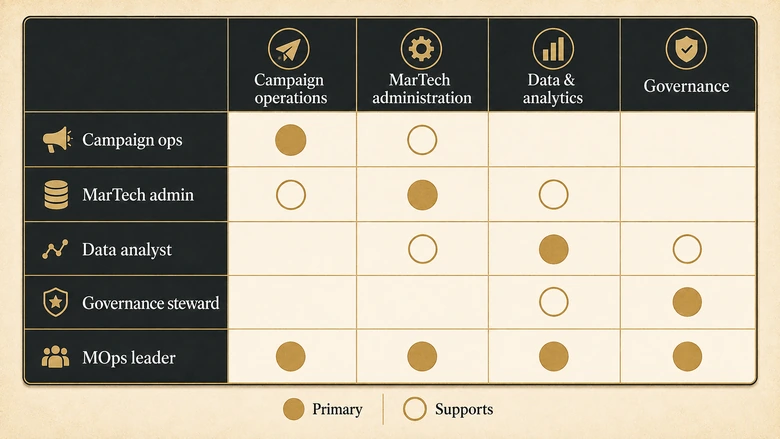
A fully separated marketing operations team has five distinct seats. Most companies never staff all five, and that is fine. What matters is knowing which duties each seat absorbs, so you can say out loud which ones are currently unowned.
Campaign operations manager
Builds and launches campaigns, owns the QA gate before send, and maintains the lead lifecycle rules underneath: scoring model, routing logic, lifecycle stage definitions. This is the seat closest to the marketing calendar and the first one to feel volume.
First sign you need it: campaign launches slip because one person is the bottleneck for every build. What breaks without it: campaigns ship with broken tracking, and nobody notices until the quarterly review.
Marketing automation and MarTech administrator
Owns the automation platform itself, its integration with the CRM, user permissions, and the tool portfolio. This person decides what a new field costs before it gets created, and is the reason your instance is still usable in year three.
First sign you need it: nobody can say confidently what a given integration writes back, or which tools are still paid for. What breaks without it: platform debt compounds silently until a migration becomes the only remaining option.
Marketing data analyst
Owns reporting infrastructure, attribution setup, and the reconciliation between what marketing reports and what the CRM says. In practice this is the seat that separates first when a one-person team grows, because analysis is the duty a generalist defers when campaign deadlines compete.
First sign you need it: the monthly report takes more than a day to assemble by hand. What breaks without it: marketing loses arguments it should win, because it cannot evidence its own contribution.
Data governance and privacy steward
Owns field standards, naming conventions, consent capture and retention rules, and the approval path for changes to shared objects. Practitioner priorities from the State of the Marketing Ops Professional research programme show why this seat matters: data enrichment sat at 52.4%, data quality at 46.8% and data integration at 45.8% of stated data priorities, which describes a function spending much of its attention on inputs it does not control.
First sign you need it: two teams have created near-duplicate fields for the same concept. What breaks without it: the analyst’s numbers stop being trustworthy, and consent exposure accumulates quietly.
Marketing operations leader
Sets scope, arbitrates between marketing’s requests and system integrity, negotiates the interfaces with sales and RevOps, and owns the roadmap. This seat exists to say no with a reason, which is the single hardest thing a marketing ops team does.
First sign you need it: three or more people are doing marketing ops work with no shared prioritisation. What breaks without it: the team becomes a ticket queue and its best people leave.
Generalist, specialist or contractor
The seats above describe duties, not headcount. Below about 200 employees you are filling them with fractions of people, and the choice of who holds each fraction matters more than the org chart shape.
Hire generalists first and specialists second, because a specialist with no peers has nobody to hand the other three families to. The profile that works at small scale is someone deep in one family and functional in the other three, which is a harder hire than it sounds and worth paying above band for. Screen on the platform they will actually administer rather than on marketing ops as an abstraction; a strong operator on one automation platform is typically productive on another within a quarter, but a candidate who has only ever requested changes rather than made them is not.
Contractors are the right answer for two situations specifically: a defined migration with an end date, and specialist work you will need once a year, such as a scoring model rebuild. They are the wrong answer for standing duties, because governance and platform administration compound in value with tenure. The knowledge of why a field exists is worth more than the ability to create one, and that knowledge leaves with the contract.
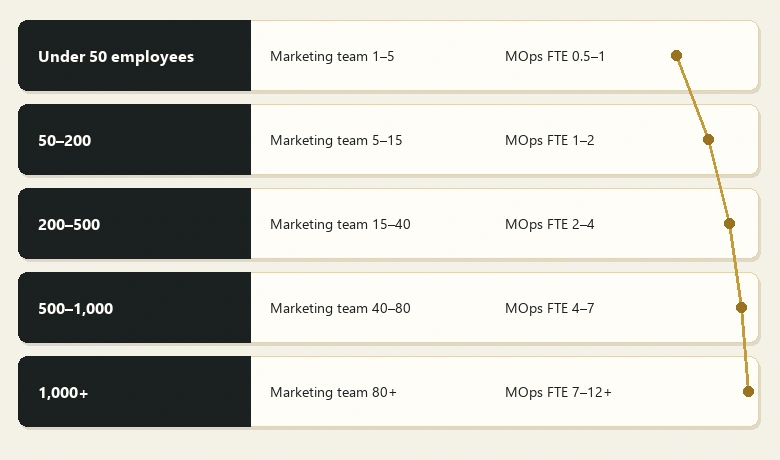
Marketing operations team structure by company size
Published headcount benchmarks for marketing ops specifically are thin. The most defensible anchor point available is that analysis of roughly 600 surveyed practitioners put average marketing operations team size between two and ten people, which is a wide band that tells you the function exists but not how to plan a hire.
So rather than borrow a benchmark, here is the model IVRIS uses, with its assumptions stated so you can disagree with them. It scales against marketing headcount, not company revenue, because marketing ops workload is driven by how many campaigns and how many requesters exist, not by how much money the business makes.
Marketing ops FTE ≈ Marketing headcount × 0.10, minimum 1 once an automation platform is live| Company size | Marketing team | Marketing ops FTE | What the seat covers |
|---|---|---|---|
| Under 50 employees | 1–5 | 0.5–1 | One generalist, often part-time or contracted. Platform admin plus campaign build plus whatever reporting is survivable. |
| 50–200 | 5–15 | 1–2 | Generalist plus the first specialist. The analytics duties separate before anything else. |
| 200–500 | 15–40 | 2–4 | Campaign ops, platform administration and analytics as distinct seats. |
| 500–1,000 | 40–80 | 4–7 | Adds governance and a manager. The leader stops building and starts arbitrating. |
| 1,000+ | 80+ | 7–12+ | Director plus specialists per family. Data engineering support usually appears here. |
Two caveats worth stating plainly. This is a derived planning model, not survey output, and the ratio holds only where marketing runs one primary automation platform. Multi-brand or multi-region setups running parallel instances need the ratio applied per instance, which is the single most common reason a team that looks correctly staffed on paper is drowning.
Three other conditions break the ratio upward. Heavy field marketing or events programmes generate campaign volume out of proportion to headcount, because each event carries a registration flow, a list load and a follow-up sequence. Product-led motions push work toward product analytics and in-app instrumentation, which needs a more technical seat than a standard campaign operator. Regulated industries add review cycles to every send, and that review time lands on marketing ops rather than on the requester. If two of the three apply, plan closer to one FTE per seven marketers than one per ten.
When you are a team of one
Most marketing ops people reading this are the entire function, and the honest structural advice for that situation is different from an org chart. A team of one cannot own four duty families at a consistent standard. Attempting it produces a person who is permanently behind on all four and visibly failing at whichever one leadership looked at most recently.
The move that works is explicit triage. Pick the two families you will hold to a high standard, usually campaign operations and technology administration, since those have daily failure modes. Then define a deliberately lower service level for the other two and say so in writing. Reporting becomes a fixed monthly package rather than an on-demand service. Governance becomes a quarterly cleanup rather than a continuous review.
This is not a lowering of ambition. It converts an invisible, unbounded backlog into a stated scope that a manager can either accept or resource. The teams of one who last are the ones who made the trade-off visible early. The ones who burn out are those who let every family stay nominally in scope and absorbed the gap personally.
What each seat costs
Cost matters to this conversation because the seats are not interchangeable in price. Job posting analysis of 154 marketing operations roles with disclosed compensation, put median pay at $75,000 for entry level, $96,000 mid, $123,000 senior, $153,800 director and $178,500 VP (as of Q2 2026). A director-level hire made too early is the most common structural mistake in the 50 to 200 band, because the work available is still execution and a director will not do it for long.
The hiring sequence that holds up
Hire in this order and each hire relieves the previous one rather than duplicating them. First a generalist who can administer the platform and build campaigns. Second an analyst, because reporting is the duty a generalist defers under deadline pressure. Third a dedicated campaign operations manager, which frees the generalist to become the platform owner. Fourth governance, once field sprawl has become visible. Fifth a leader, once three or more people need shared prioritisation.
Where marketing operations should report
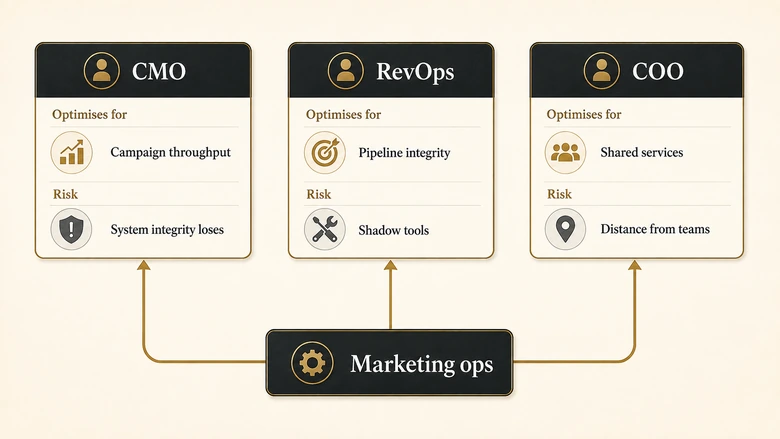
The reporting line is the decision with the longest shadow in this entire article, and it is the one most org charts make by accident. It determines what the team optimises for when two requests compete, which happens weekly.
There are three real options.
Into the CMO or VP Marketing. The team optimises for campaign throughput and marketing’s own reporting needs. Requests get served fast. The risk is that system integrity loses every argument against a launch date, and that marketing’s numbers stay marketing’s numbers rather than becoming the company’s.
Into RevOps. The team optimises for pipeline integrity and cross-functional consistency. Definitions get enforced. The risk is that marketing starts experiencing its own operations team as an external gatekeeper, and begins routing around it with shadow tools.
Into a COO or central operations group. Rare below enterprise scale, and usually a symptom of the CMO and CRO being unable to agree. It works when there is a genuine shared-services model already running. It fails when it just adds a layer between the team and the people it serves.
IMPORTANT
Whichever line you choose, write down which requests the team is allowed to refuse and who hears the appeal. A marketing ops team without refusal rights is a ticket queue regardless of where the line on the org chart points.
Choosing between them
Use the CMO line when marketing is the dominant pipeline source, campaign volume is the binding constraint, and there is no RevOps function yet. This is correct for most companies under 200 employees.
Use the RevOps line when sales and marketing already disagree about the same numbers, when the handoff is where deals leak, or when a single lifecycle spans multiple teams. This is usually correct above 500 employees.
Avoid the COO line unless a shared-services operating model already exists and works for another function. Adding it to resolve an executive disagreement moves the disagreement rather than settling it.
The reporting line is not an administrative detail. It is a standing instruction about which failure the team is expected to prevent.
Signals you chose the wrong line
The choice is testable after a quarter or two. Under a CMO line, the warning signs are technical debt accumulating with no owner willing to fund the cleanup, marketing numbers that sales does not accept, and a scoring model nobody outside marketing believes. Each of those says the team has no mandate beyond marketing’s own boundary.
Under a RevOps line, the signs are campaign launches slipping while waiting on approvals, marketers buying tools on personal cards, and requests being reframed as tickets in a queue owned by someone with no stake in the campaign calendar. Each of those says the team has drifted too far from the people it serves.
One or two of these signals is normal friction. Three or more sustained across a quarter means the line is wrong for your current stage, and the fix is usually a dotted line plus a written arbitration rule rather than a full reorganisation. Reorganisations are expensive and slow; naming who breaks a tie is neither.
Three marketing operations team structure models, and how each one fails
Once you have more than two people, the team takes one of three shapes. Each works at a particular scale and each has a characteristic failure.
Centralised
All marketing ops people sit in one team and serve all of marketing through a shared intake. Standards are consistent and platform debt stays low, because one group owns every change.
How it fails: intake becomes a queue, response time degrades, and the regional or product teams that wait longest start buying their own tools. The symptom is a shadow stack you discover during a security review.
Embedded
Marketing ops people sit inside the teams they serve, one per business unit or region. Response time is excellent and context is deep.
How it fails: three embedded operators build three incompatible scoring models and three naming conventions. Nobody is wrong locally. The aggregate is unreportable, and the reconciliation cost lands on whoever eventually has to produce one company number.
Hybrid
A central team owns the platform, standards and shared data model. Embedded operators own execution inside their business units and work within those standards. This is what most companies above 500 employees converge on.
How it fails: the boundary between central and embedded is never written down, so both sides assume the other owns a given decision. The specific failure is a change made locally to a shared object, which is why hybrid models need a written approval path more than the other two do.
Moving between models
Almost every company travels centralised to hybrid, and the transition is where structures break. The mistake is moving people before moving standards. If you embed operators into business units while the naming conventions, field standards and scoring logic still live in one person’s head, you have not decentralised execution. You have created three teams who will each invent their own version within two quarters.
Sequence it the other way. Write the shared standards down and get them adopted while the team is still centralised, because a standard that survives only through proximity will not survive distance. Then embed. The central team keeps the platform, the data model and the right to approve changes to shared objects, and gives up everything else. Expect the first embedded operator to test that boundary within a month, and treat that test as useful information rather than insubordination: it tells you which parts of the standard were never actually written down.
The handoffs that decide whether the structure holds
A correct org chart still produces a broken function if the interfaces are undefined. Three handoffs do most of the damage.
Four interfaces worth writing down
Marketing to sales. This is where a structure gets tested weekly. The agreement needs an enforcement point in the CRM rather than a paragraph in a document, and the useful version of a sales and marketing SLA names the field that proves each clause was met. Marketing ops usually owns the instrumentation even when it does not own the agreement.
Marketing ops to RevOps on metric definitions. When both functions exist, the failure mode is two teams computing the same metric two ways and both being technically right. This is settled by naming one owner and one source system per metric, which is exactly what a metric register that assigns an owner and a source of record to each definition is for. Without it, the reconciliation work never ends.
Requesters to the team. Every marketing ops team needs a stated intake path, a stated priority rule, and a stated turnaround expectation. Teams that skip this are not more responsive. They are simply prioritising by whoever asks loudest.
Marketing ops to IT and security. This one is missing from most org charts and shows up as a crisis rather than a process. Marketing ops procures tools that touch customer data, requests integrations that move it between systems, and configures consent capture that carries legal exposure. IT usually finds out at renewal or during an audit. Agree three things in advance: who approves a new tool that will hold personal data, who owns the data processing records for marketing systems, and what the review path is for an integration that writes to the CRM. Settling this costs an hour a quarter. Not settling it costs a procurement freeze at the worst possible moment, usually mid-launch.
Run the design session
Workflow · 2 hours
How to design a marketing operations team structure: a two-hour working session
Produces a defensible org design: an owner for every duty, a reporting line, a headcount target and a written handoff. Run it with the marketing leader and whoever currently does the ops work.
Inventory every duty performed last quarter
List every marketing ops task completed in the last 90 days. Pull from the ticket queue, the campaign calendar and the platform audit log so the list reflects real work rather than the job description.
Tag each duty to one of the four families
Mark every item as campaign operations, technology administration, data and analytics, or governance. Count the items per family and note which family has duties nobody currently owns.
Set the reporting line before naming any role
Choose CMO, RevOps or central operations using the criteria above, then write one sentence stating which failure this team exists to prevent. Every later decision references that sentence.
Size the team against marketing headcount
Apply roughly one FTE per ten marketers, with a floor of one. Apply it per automation instance if you run more than one, then compare the result to your current headcount.
Sequence the hires against the duty count
Order openings by which family has the largest unowned duty count, not by which title sounds most senior. Confirm the analytics seat comes before a second campaign builder.
Write the intake path and the refusal rule
Document how work reaches the team, how it is prioritised, what turnaround requesters should expect, and which requests the team may decline. Circulate it to every requesting team before the next planning cycle.
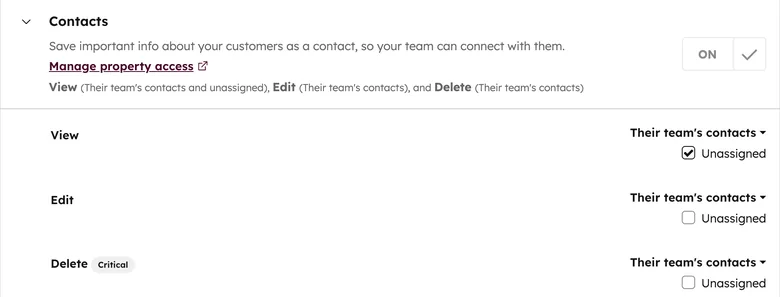
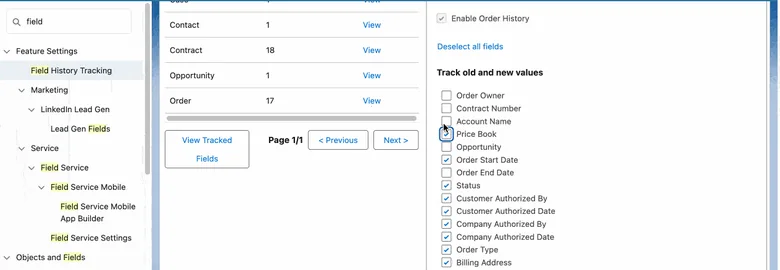
Two structural details are worth instrumenting directly in the platform rather than in a document. User roles and permissions decide who can change a shared object, and field-level history decides whether you can answer the question of who changed it and when. Both belong to marketing ops regardless of which model you run.
Frequently Asked Questions
Plan roughly one marketing operations FTE per ten marketers, with a minimum of one once an automation platform is running. That puts a 15-person marketing team at one to two, and a 40-person team at two to four. Apply the ratio separately per automation instance if you run multiple brands or regions.
Both are defensible. Report into the CMO when marketing is the dominant pipeline source and campaign volume is the constraint, which fits most companies under 200 employees. Report into RevOps when sales and marketing already disagree about the same numbers, or when one lifecycle spans several teams.
No. Marketing operations owns marketing systems, campaign execution and the lead lifecycle up to the sales handoff. Revenue operations owns metric definitions, forecast integrity and process across marketing, sales and customer success. Marketing ops answers execution questions; RevOps answers definition questions.
A fully separated team runs a marketing operations leader over four specialist seats: campaign operations, marketing technology administration, data and analytics, and data governance. Smaller teams collapse these into one or two generalist roles, which is normal below about 200 employees.
A generalist who can administer the automation platform and build campaigns. Resist hiring at director level first: at that stage the available work is execution, and a director will not do it for long. The second hire should be an analyst, because reporting is the duty a generalist defers under deadline pressure.