
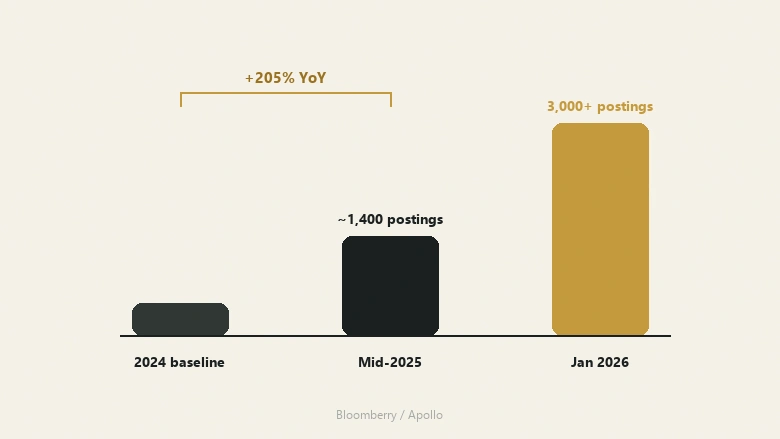
Two years ago, nobody had “GTM engineer” on an org chart. Now there are more than 3,000 open postings and a median salary that clears six figures. The instinct is to call it a rebrand of RevOps with better tooling. That instinct is wrong, and getting it wrong is expensive, because the two roles fail in completely different ways.
GTM engineering is what happens when the systems behind revenue stop being a reporting problem and start being a build problem. Somebody has to write the enrichment logic, decide which signals fire which play, wire the APIs, and own the thing at 2am when a webhook goes quiet. This guide covers what the role actually is, how it differs from the roles it gets confused with, the four-layer stack it runs on, and the six workflows that make up most of the job.
Direct answer — What is GTM engineering?
GTM engineering is the practice of building and operating the automated systems a revenue team runs on: data enrichment, signal detection, lead matching, routing, lifecycle logic, and the AI workflows that connect them. A GTM engineer builds those systems rather than administering a CRM or running outbound manually. The role sits between RevOps and software engineering, and it is defined by what it ships, not by which team it reports into.
Key Takeaways
- GTM engineering is a build function, not an ops function. RevOps governs the process that exists; GTM engineering creates the system that runs it.
- Demand is real but young: job postings grew 205% year over year, and the role barely existed in 2023.
- The stack has four layers: data, orchestration, execution, and observability. Most teams buy the first three and skip the fourth, which is why their automation fails silently.
- Six workflows cover most of the job: define the ICP in data terms, enrich, deduplicate, match to accounts, route, and QA the whole chain.
- Published salary figures sit about $50,000 apart (as of Q1 2026) because they measure different populations. Read the methodology before you use any of them to set a budget.
- Hire a GTM engineer when your data foundation is sound and your bottleneck is build capacity. Hire one before that and you automate a mess faster.
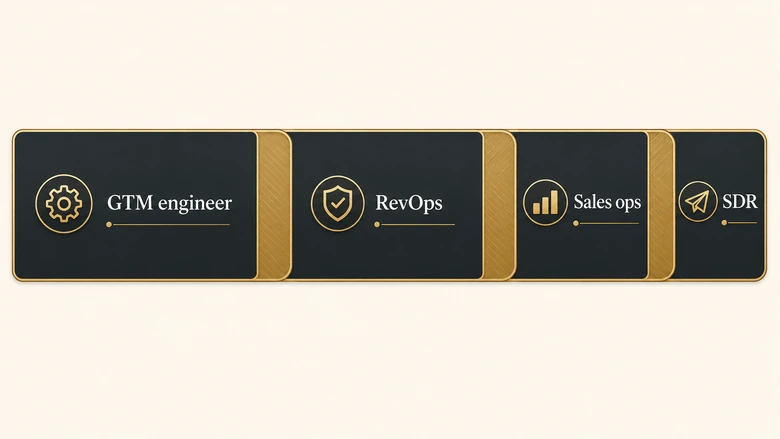
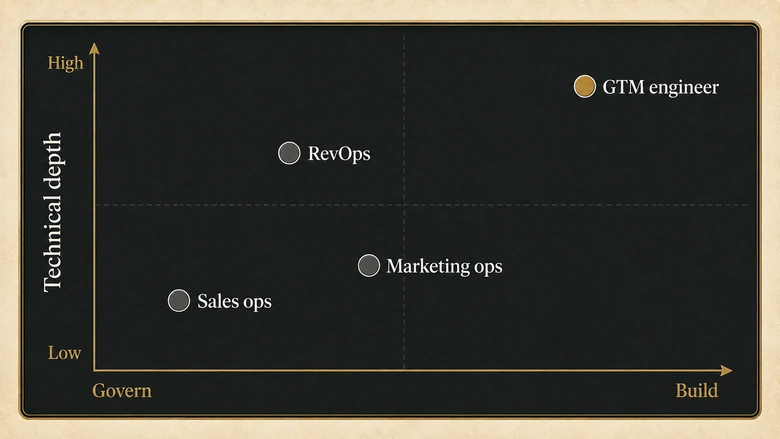
Before the detail, here is the boundary that causes the most confusion. Four roles touch the same revenue stack, and they are not interchangeable.
| Role | Core question it answers | Primary output | Fails when |
|---|---|---|---|
| GTM engineer | How do we build a system that does this automatically? | Working automations, enrichment logic, internal tools | Built on dirty data, or built with no monitoring |
| RevOps | Is the revenue process defined, governed, and measurable? | Process design, forecasting, reporting, governance | Governs a process nobody can execute at speed |
| Sales ops | Are reps equipped, assigned, and compensated correctly? | Territories, quotas, comp plans, CRM administration | Optimises rep mechanics while pipeline quality drops |
| SDR | Can I start a real conversation with this buyer? | Meetings booked, qualified conversations | Executes volume manually that a system should handle |
IMPORTANT
The most common hiring mistake is posting a GTM engineer role to fix a RevOps problem. If your process is undefined, your fields are inconsistent, and nobody agrees what a qualified lead is, a builder will encode that confusion into automation and make it harder to see. Fix the definition first.
What is GTM engineering?
GTM engineering is the discipline of building automated systems that run go-to-market work: finding accounts that match the ICP, enriching them with usable data, detecting buying signals, and moving the right record to the right person at the right moment. It treats revenue operations as software rather than as administration.
The practical difference shows up in the artefact. A RevOps hire produces a documented process and a dashboard. A GTM engineer produces a running workflow with an API key, a failure mode, and a log. Both are necessary. Only one of them wakes up when the enrichment provider deprecates an endpoint.
What a GTM engineer actually owns
Job descriptions are still inconsistent, but the work clusters into five recurring responsibilities:
- Data foundation. Enrichment logic, field architecture, CRM hygiene, and the rules that decide which source wins when two disagree.
- Signal operationalisation. Turning raw behaviour into something a system can act on: job changes, funding events, product usage, site visits, hiring patterns.
- Workflow automation. Chaining tools so a trigger produces an outcome without a human relaying it between tabs.
- AI integration. Wiring language models into research, qualification, and message generation where they genuinely beat a rule.
- Internal tooling. Small applications and interfaces that let reps and marketers use the system without filing a ticket.
Notice what is absent. Selling is absent. Forecasting is absent. A GTM engineer builds the machine that a seller operates, which is why measuring the role on booked revenue alone tends to produce bad decisions in the first two quarters.
GTM engineer vs RevOps: the difference that matters
The distinction is build versus govern. RevOps owns whether the revenue process is correct, measurable, and followed. GTM engineering owns whether the system that executes that process actually exists and works.
An analogy that holds up: RevOps writes the building code and inspects the result. GTM engineering pours the concrete. A city needs both, and neither one can substitute for the other for very long.
If your team can describe the workflow perfectly but nobody has built it, you have a GTM engineering gap. If a workflow exists but nobody can explain why it makes those decisions, you have a RevOps gap.
In practice the roles overlap most at the boundary of data quality, which is where both disciplines meet the same wall. Deciding which record survives a merge is governance. Writing the survivorship logic that executes the merge across 400,000 records is engineering. Teams that treat these as one job usually end up doing neither well.
The reporting line matters less than the split of responsibility. Series A and B companies typically embed the engineer inside RevOps. Later-stage companies with multi-product motions centralise a small team. Enterprises federate engineers into functions. All three work; what does not work is leaving the build function implicit and hoping an ops hire picks it up.
Versus the SDR
An SDR executes outbound one conversation at a time. A GTM engineer builds the system that decides which conversations are worth starting and puts the right context in front of whoever starts them. The distinction is linear effort against compounding effort.
This gets framed as replacement, which is lazy. The realistic version is that a GTM engineer removes the parts of the SDR job that were never human work: list building, research, data entry, and deciding who to contact next. What remains is the part that was always the actual job, which is having a conversation a buyer values. Teams that treat GTM engineering as a headcount-reduction play tend to automate the volume and keep the mediocre messaging, then wonder why reply rates fell.
Versus marketing ops
Marketing ops owns the demand side: campaign infrastructure, forms, attribution, email deliverability, and the lifecycle model on the marketing side of the handoff. GTM engineering spans the whole funnel and is defined by the build layer rather than by a functional domain.
In smaller companies these are the same person wearing two hats. The split becomes real when the systems stop being campaign-shaped. A marketing ops professional optimises the campaign that exists; a GTM engineer builds the mechanism that decides which campaign a record should enter, based on data neither the campaign nor the form could see.
Why the role appeared in the last two years
The role appeared because three things happened at once: enrichment data became composable, workflow tools became programmable, and language models became cheap enough to put inside a loop. Any one of those alone would have produced a better SDR. Together they produced a job that did not previously exist.
The hiring data is unambiguous about direction, if young. Bloomberry’s analysis of 1,000 GTM engineering job postings found listings grew 205% year over year between 2024 and 2025, with roughly 100 new listings going live each month. Apollo’s February 2026 round-up puts the total above 3,000 postings by January 2026, up from about 1,400 in mid-2025.
One tool dominates the postings to a degree that is unusual for a young discipline. Bloomberry found Clay appearing in more than 90% of GTM engineer profiles, which makes it the closest thing the field has to a required credential. That concentration is worth watching rather than celebrating; a discipline defined by one vendor is a discipline with a single point of failure.
The salary numbers disagree, and the reason is methodological
Published compensation figures for this role sit about $50,000 apart (as of Q1 2026), which trips up anyone building a budget from a single blog post. The gap is not noise. It comes from measuring different populations.
Bloomberry’s median of $127,500 (as of Q4 2025) comes from job postings that publicly disclose a salary range, which skews toward US states with pay-transparency laws and toward earlier-stage companies. Apollo’s median of $176,000 (as of Q1 2026) draws on recruiter and community data, which skews senior and toward companies that hire through specialist search. Neither is wrong. They answer different questions.
PRO TIP
When you see two salary benchmarks for the same role, check whether the source is posted ranges or reported offers. Posted ranges run low because they are opening bids and legally binding. Reported offers run high because nobody volunteers a disappointing number.
The GTM engineering stack, layer by layer
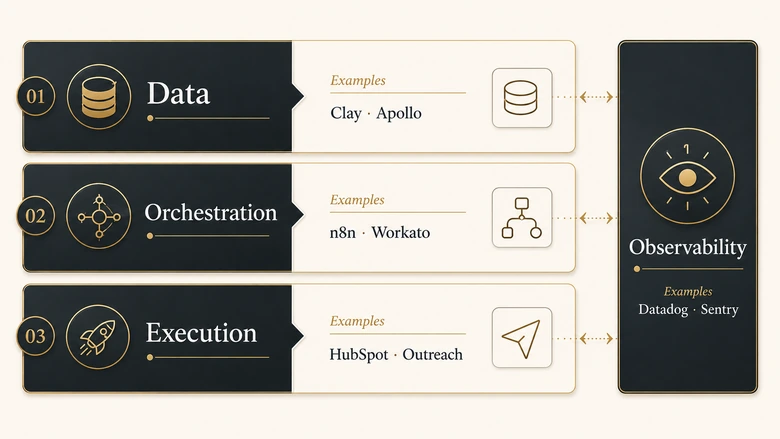
The GTM engineering stack has four layers: data, orchestration, execution, and observability. Most teams buy tools for the first three and assume the fourth is included. It is not, and that assumption is the single most common reason automated GTM systems fail without anyone noticing.
Layer 1: data
The data layer answers “who is this, and is it true?” It covers firmographic and contact enrichment, intent signals, identity resolution, and the waterfall logic that queries providers in sequence until a field is filled. Coverage claims in this category are close to unfalsifiable, so the practical selection criterion is disclosure rather than headline percentages. Our breakdown of how the major enrichment vendors actually disclose their coverage grades them on that basis instead of on marketing numbers.
Layer 2: orchestration
The orchestration layer decides what happens next. This is where scoring runs, where matching and deduplication logic lives, and where routing rules resolve. Tools here range from native CRM automation through to n8n, Zapier, Make, and Workato, plus whatever custom code the engineer writes when a visual builder runs out of room.
Layer 3: execution
The execution layer does the visible work: sequences fire, tasks appear, records move, messages send. It is the layer buyers evaluate first and the one that matters least to system quality, because execution tools are largely interchangeable and none of them can compensate for bad inputs.
Layer 4: observability
The observability layer tells you whether any of the above is still working. Silent failure is the defining risk of automated GTM: a form stops posting, a field stops syncing, a rule matches nothing, and the dashboard keeps showing green because zero errors and zero records look identical from a distance. This layer is monitoring, alerting, reconciliation, and scheduled tests.
If you build only three layers, you will find out about failures from a rep in a Slack thread three weeks later. That is not a hypothetical failure mode; it is the normal one.
The six workflows a GTM engineer owns
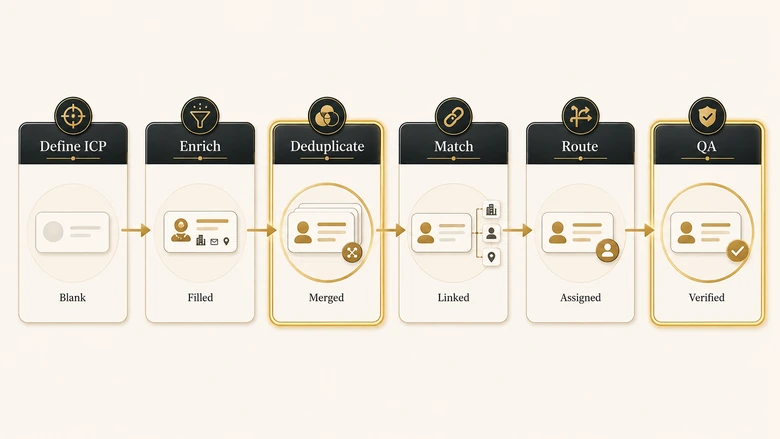
Most of the job reduces to six workflows that run in sequence. Each one depends on the one before it, which is why skipping a step upstream produces failures that look random downstream.
1. Define the ICP in data terms
Every automated system needs the ICP expressed as fields a machine can filter on, not as a paragraph in a strategy deck. That means employee-count bands, technographic markers, industry codes, and disqualifying attributes with explicit thresholds. Turning a narrative profile into a filterable definition of the ideal customer is the work that determines whether everything downstream targets the right companies.
2. Enrich
Enrichment fills the gaps between what a form captured and what the system needs to make a decision. The engineering question is not which vendor has the best coverage, but what the fallback chain does when the primary source returns nothing, and whether a low-confidence result is written to the record or held back.
3. Deduplicate
Duplicate records break attribution, routing, and reporting at the same time, and they accumulate faster than most teams estimate. The work here is detection logic, survivorship rules that decide which record wins, and merge governance that keeps the decision auditable. Our guide to building survivorship rules that survive a real merge covers the failure cases that generic dedup features tend to handle badly.
4. Match to accounts
Lead-to-account matching connects an inbound person to the company record they belong to, which is what makes ABM, ownership, and duplicate prevention possible at all. Exact and domain matching handle the easy cases; the hard cases are subsidiaries, free email domains, and companies whose legal name shares nothing with their brand. Getting match confidence thresholds set correctly matters more than the matching method, because a threshold set too loose silently attaches leads to the wrong parent.
5. Route
Routing moves the matched, enriched, deduplicated record to an owner and makes that ownership stick. This is where speed-to-lead is won or lost, and where most teams discover their rules conflict. The mechanics of rule precedence when two routing rules match the same lead are worth settling before you automate anything, since ambiguous precedence produces assignment behaviour nobody can reproduce.
6. QA the chain
The last workflow is testing the other five before and after they go live. A GTM engineer who cannot demonstrate that a change works has shipped a liability. Running a structured pass with a repeatable activation QA checklist catches the failures that only appear under real traffic, which is the category that silent-failure monitoring exists to cover.
Two of those six deserve emphasis because they are the ones teams skip. Nobody skips enrichment; it is visible and vendors sell it hard. Almost everybody underinvests in deduplication and QA, because neither produces a demo-able artefact. Those are also the two that determine whether the other four survive contact with production data.
How to operationalise a buying signal
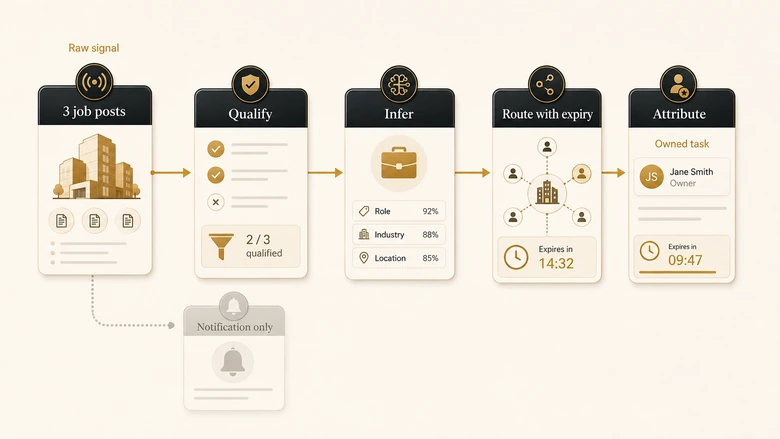
To operationalise a buying signal, convert an observed event into a scored, routed, and measurable action with an explicit expiry. A signal that produces a notification is not operationalised. A signal that produces an owned task with a deadline is.
Most teams collect far more signals than they act on, which is a design failure rather than a data failure. The gap is usually that nobody defined what the signal means commercially, so it arrives as information rather than as an instruction.
A worked example: the hiring signal
Take a concrete case. A target account posts three job openings for data engineers. The raw event is a hiring signal. Operationalising it means answering four questions in the system, not in a meeting:
- Does it qualify? The account must already match the ICP. A hiring signal from a company you would never sell to is noise with good production values.
- What does it imply? Three data engineering roles suggests a data platform build, which suggests budget and a technical buying committee. That inference should be written down, because it determines the message.
- Who acts, and when? The signal routes to an owner with a deadline attached. Signals decay; a hiring post is interesting for about three weeks and worthless at three months.
- How do we know it worked? Signal-sourced activity needs its own attribution, or you cannot tell a good signal from an expensive one.
That last point is where most signal programmes quietly fail. Teams wire up eight signal types, act on all of them, and never separate the performance of each. Six months later the programme is judged as a whole, and the two signals that actually worked get cancelled alongside the six that did not.
PRO TIP
Give every signal type its own field and its own expiry window before you turn any of them on. Retrofitting signal attribution after the fact means reconstructing intent from timestamps, which is guesswork dressed as analysis.
When to hire a GTM engineer, and when not to
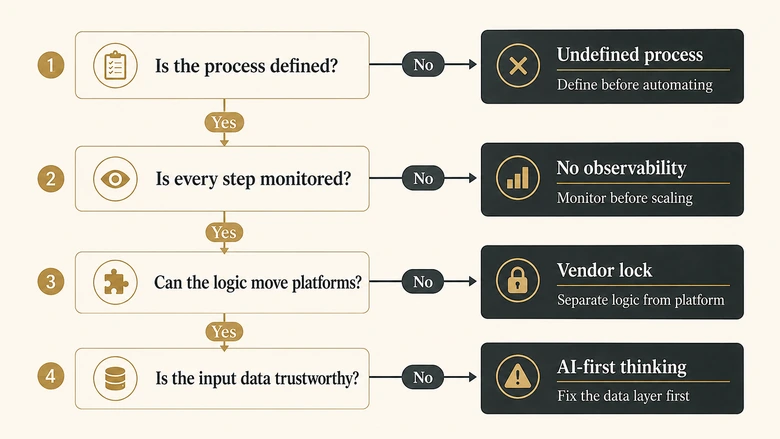
Hire a GTM engineer when your process is defined, your data is reasonably clean, and your constraint is that nobody can build fast enough. Do not hire one when the underlying problem is that your team disagrees about what a qualified lead is.
The decision framework is short:
- Hire now if you have a documented lead lifecycle, a CRM people actually use, and a backlog of automation requests that ops cannot clear.
- Hire soon if your motion is outbound-heavy, your enrichment spend is climbing, and you are stitching tools together manually every week.
- Wait if your field architecture is inconsistent, your stages mean different things to different teams, or your CRM is a partial record of reality.
- Do not hire if what you actually need is a first RevOps hire. Sequence matters here, and reversing it is costly.
The readiness question that separates the first two from the last two is simple: can you write down, today, the exact rule that decides whether a new lead is worth a rep’s time? If that answer takes a meeting to produce, you are not ready to automate it. The same readiness logic governs which pipeline stages are safe to automate and which need a human checkpoint, and it is worth resolving before a builder starts encoding assumptions.
One more consideration on sequencing. A GTM engineer hired into a clean environment shows measurable output in weeks, because the constraint really was build capacity. The same hire dropped into an undefined process spends two quarters doing archaeology, gets judged on delivery they were never positioned to make, and leaves. That pattern is common enough now that candidates ask about it in interviews.
How to structure a GTM engineering function
There are three working structures for a GTM engineering function: embedded in RevOps, centralised as its own team, or federated across functions. The right one is determined by company stage and how many distinct motions the business runs, not by preference.
Embedded in RevOps
One engineer sits inside the RevOps team and takes build work from a shared backlog. This is the default at Series A and B, and it works because the governance and build functions stay in constant contact. The risk is that the engineer becomes a CRM administrator by attrition, since urgent admin requests always outrank important build work.
Centralised team
Two to five engineers operate as a shared service with their own roadmap and intake process. This suits Series B and later companies running multiple products or segments, where the same enrichment and routing infrastructure serves several motions. The failure mode is distance: a central team that stops sitting with sellers starts building things nobody asked for.
Federated across functions
Engineers are placed inside sales, marketing, and customer success, with a shared standards group holding the architecture together. This is an enterprise pattern and it only works when the standards layer has real authority. Without it, you get four teams building four incompatible versions of the same lead object.
Whichever structure you pick, the intake process matters more than the org chart. A GTM engineering function without a triage rule becomes a ticket queue sorted by whoever complains loudest, and that produces a stack of small automations with no architecture behind them.
How to measure a GTM engineering function
Measure GTM engineering on system health and cycle time, not on sourced revenue. The function builds infrastructure that other people convert, so attributing closed deals to the engineer produces a number that is either flattering or damning and is rarely either accurate or actionable.
Four measures hold up in practice:
- Data completeness on decision fields. Not every field, only the ones a rule reads. If routing depends on employee count and 30% of records lack it, that is the number that matters.
- Speed to first action. The elapsed time from record creation to an owned task existing. This captures enrichment, matching, dedup, and routing in one figure, which is why it moves when any of them break.
- Silent-failure detection time. How long a broken integration runs before anyone notices. If you cannot compute this, you do not have an observability layer.
- Automation coverage. The share of records that complete the chain without a human touching them, tracked against the share that needed manual repair.
Two supporting numbers are worth watching without treating them as targets. Enrichment cost per qualified record keeps vendor spend honest, particularly once waterfall logic starts querying three providers per contact. Rule count per object is a complexity signal: when a single lead object carries forty active rules across Salesforce, a warehouse job in Snowflake or BigQuery, and two automation platforms, nobody can predict behaviour any more, and the correct next project is consolidation rather than another rule.
If your GTM engineer is judged on pipeline in quarter one, they will build the thing that looks like pipeline. If they are judged on speed to first action and silent-failure detection, they will build the thing that produces pipeline in quarter three.
How to become a GTM engineer
To become a GTM engineer, build working systems and show them. The field has no certification that carries weight, hiring managers evaluate demonstrated builds over credentials, and the fastest credible path runs through a portfolio rather than a course.
The skill set splits three ways:
- Technical fluency. SQL and Python appear in roughly 38% of postings, alongside API literacy, webhooks, and enough data modelling to reason about joins and cardinality.
- Commercial fluency. You need to know why a stage exists, what an SDR’s day looks like, and which metrics a CRO is judged on. Engineers without this build technically correct systems that answer no commercial question.
- Systems thinking. The ability to trace a symptom backwards through four tools to the field that broke, and to design so that failures announce themselves.
The most common entry paths are lateral rather than junior. Sales ops and RevOps practitioners move in by learning the build layer. Software engineers move in by learning the commercial layer. SDRs who automated their own workflow out of frustration move in with the strongest portfolios, because they built against a problem they felt personally.
On the question of whether it is a good career: the demand curve is genuinely steep and the pay is genuinely above adjacent ops roles. The honest caveat is that the title is two years old and partly defined by one vendor’s ecosystem. Build transferable skills, which means the data modelling and API work, and treat any single platform as an implementation detail rather than the identity.
Where GTM engineering goes wrong
GTM engineering fails in four predictable ways, and three of them are avoidable with sequencing rather than skill. Recognising the pattern early costs a conversation; recognising it late costs a rebuild.
Automating an undefined process. Covered above, and worth repeating because it is the most expensive mistake. Automation makes an unclear process faster and much harder to inspect.
Building without observability. A system nobody monitors is a system that has already failed and not told you. Silent failure is the default state of integrated tooling, not an edge case.
Over-fitting to one vendor. When a discipline concentrates around a single platform, teams confuse platform expertise with engineering ability. Pricing changes, acquisitions, and deprecations then land as strategic events instead of maintenance.
Believing the AI layer is the hard part. It usually is not. MIT’s Project NANDA reported in its 2025 GenAI Divide study that 95% of enterprise generative AI pilots produced no measurable P&L impact, based on 300-plus disclosed initiatives, 52 organisation interviews, and 153 survey responses. That study is preliminary and has not been peer reviewed, so treat the exact figure as directional. The direction still matches what shows up in GTM systems: models fail on messy inputs, and the data layer is where the actual difficulty lives.
The stance worth holding is that GTM engineering is mostly a data-quality discipline wearing an AI costume. The interesting part is the model. The part that determines whether it works is whether the record it read was correct.
Frequently Asked Questions
A GTM engineer builds and operates the automated systems a revenue team runs on: enrichment logic, signal detection, lead matching, routing rules, and AI workflows. The role is technical and build-focused, sitting between RevOps and software engineering. It is measured on working systems shipped, not on meetings booked or forecasts produced.
Demand is growing fast, with postings up 205% year over year, and pay sits above adjacent operations roles. The caveat is that the title is roughly two years old and heavily shaped by one vendor ecosystem. Build transferable data modelling and API skills so your value survives any single platform.
Published medians range from about $127,500 to $176,000 (as of Q1 2026) depending on the source. Posted-range data skews lower because it reflects opening bids in pay-transparency states. Recruiter and community data skews higher because it captures senior offers. Check which population a benchmark measures before using it.
Build working systems and show them. Learn SQL, Python basics, and API mechanics, then automate a real revenue workflow end to end and document what broke. Most entrants move laterally from sales ops, RevOps, SDR, or software engineering rather than entering junior, and portfolios outweigh certifications.
RevOps governs whether the revenue process is defined, measurable, and followed. GTM engineering builds the system that executes it. RevOps produces process design, forecasts, and reporting; GTM engineering produces running automations with logs and failure modes. Most teams need both, and hiring them out of sequence causes the common failures.