
Ask a RevOps team whether their lead routing works and you will usually get a screenshot of a rule builder. The rules fire, the owner field changes, the dashboard is green. Then someone opens a queue nobody has worked in three weeks and finds forty inbound leads sitting in it, each one correctly assigned and none of them touched.
Both things are true at once. The routing rules did their job. The leads still died. That gap is the whole subject, and almost every guide on this topic writes past it, because the category has quietly agreed that routing means “getting the lead to the right rep” and stops counting the moment a CRM field updates.
A field update is not a person taking responsibility. Until you separate those two events and measure both, you cannot tell the difference between a routing system that works and one that merely runs.
Direct answer — what is lead routing?
Lead routing is the controlled process that moves a captured lead through validation, identity resolution, enrichment, qualification, relationship matching, rule evaluation, assignment, notification and owner acceptance. A lead is not fully routed because a CRM owner field changed. The route is complete when a valid owner accepts traceable responsibility, or when the system raises an observable exception with a defined fallback, timer and escalation.
Key Takeaways
- Assignment is one stage inside lead routing, not the finish line. Queue ownership, notification delivery and owner acceptance are separate observable events, and each can fail on its own.
- “Round robin” is a family of algorithms, not one algorithm. Microsoft Dynamics 365, HubSpot and LeanData each count turns differently, so the label alone tells you nothing about fairness or workload.
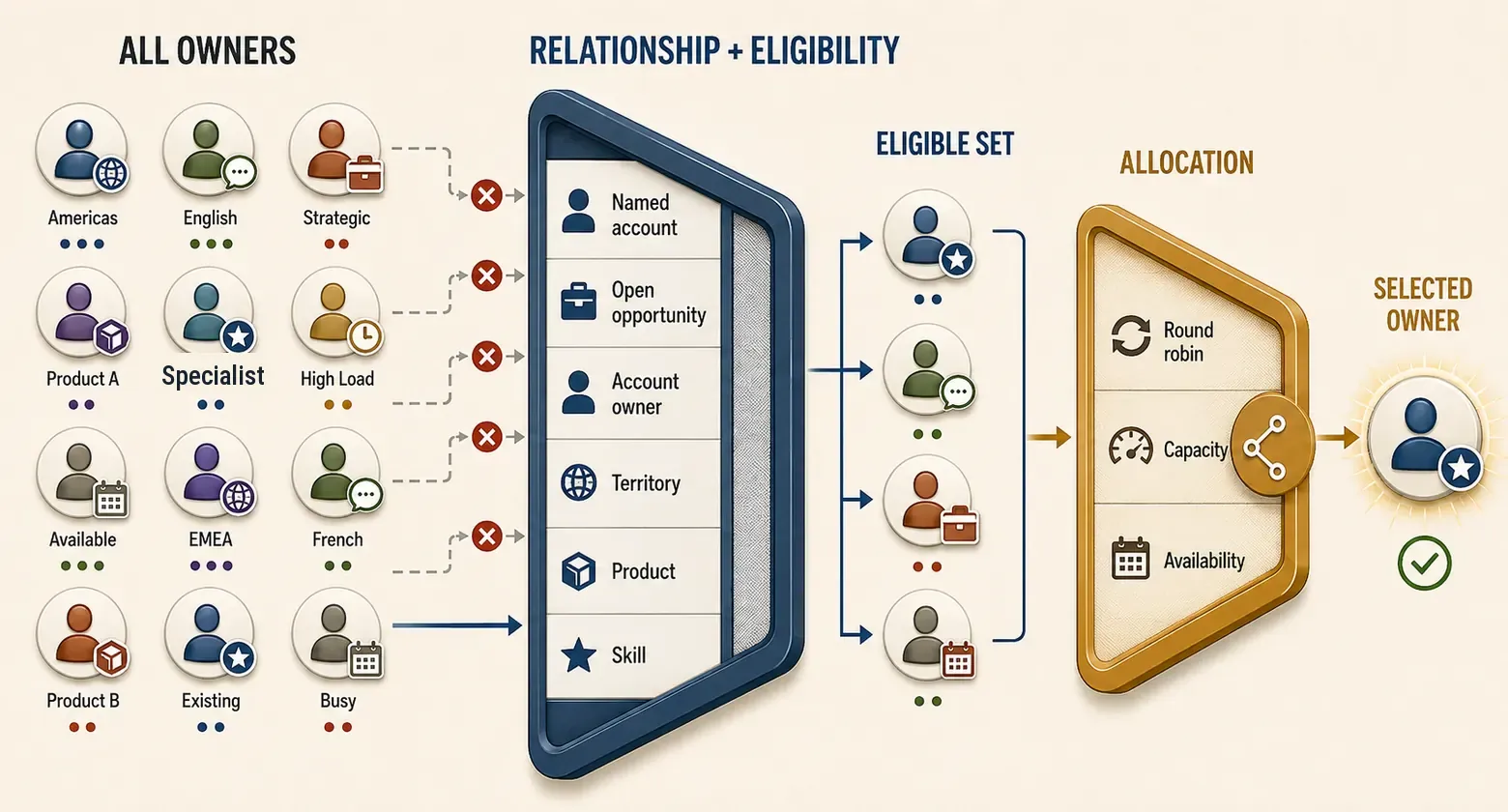
- Relationship rules and distribution rules are different layers. Named accounts, open opportunities and account ownership decide who is eligible. Round robin, capacity and availability only choose within that eligible set.
- Exceptions are designed states, not leftovers. No match, no available seller, cap reached, inactive owner and failed notification are all documented platform behaviours that need reason codes, timers and a non-recursive fallback.
- The public response-time research supports urgency, not routing ROI. The strongest studies measured contact and qualification after a web inquiry. None of them observed routing-stage timestamps.
- Measure routing as a chain of clocks, not one number. Capture, eligibility, decision, assignment, notification and acceptance each need their own timestamp, or delay hides inside an average.
What is lead routing?
Lead routing is the process that takes an inbound lead from the moment it is captured to the moment a named owner accepts responsibility for working it. It covers data validation, duplicate resolution, qualification, relationship matching, owner selection, the CRM write, notification, and the acceptance step that most teams never instrument. The same chain runs when the unit of demand is a committee rather than a person, except that ownership is decided once for the whole set: assigning one owner to an entire buying group rather than routing each member separately stops a second contact from the same deal landing with a different rep.
Three neighbouring terms get used interchangeably, and keeping them apart is what makes the rest of this page usable.
| Term | What it means | Where it sits |
|---|---|---|
| Lead routing | The controlled chain from captured record to accepted ownership or a governed exception. | The whole process. |
| Lead assignment | The write or transfer of an owner, team or queue in the authoritative system. | One stage inside routing. |
| Lead distribution | Choosing among an already-eligible pool of owners by turn, weight, capacity or availability. | One decision inside routing. It does not create eligibility. |
| Speed to lead | Elapsed time from the lead’s start event to the first qualifying human action. | An outcome measured partly after routing ends. |
We use a single completeness test to decide whether a lead has actually been routed. Every term in it has to be observable in your systems, not inferred:
Routed = Identity × Eligibility × Relationship × Ownership × Delivery × (Acceptance OR Governed exception)If any term is false, the route is incomplete even when the owner field is populated and the rule log says success. That is the definition this page argues for, and it is deliberately stricter than the one you will find on most competing pages.
How lead routing works, from capture to accepted ownership
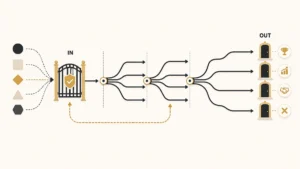
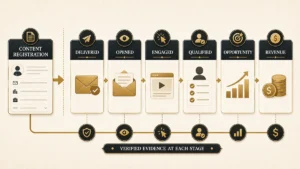
The Routing Integrity Chain breaks routing into eleven observable stages. Each stage answers one control question and emits outputs you can query later. The value is not the diagram, it is that every stage has a failure exit, so no record can fall through silently. Those exits only help if something is watching them, which is why routing is one link in a chain that starts at the ICP definition and ends at a monitoring layer most stacks never build.
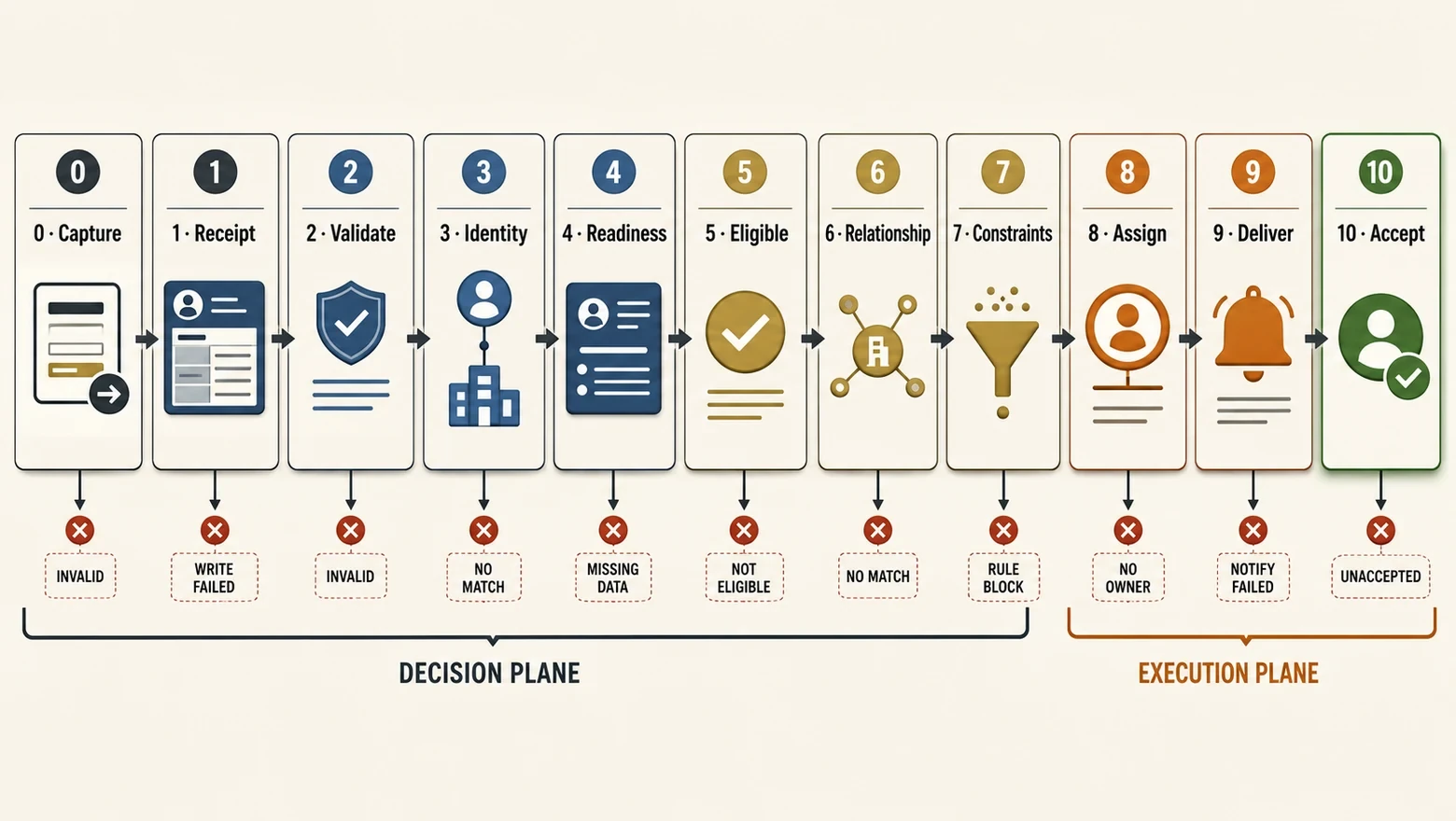
| # | Stage | Control question | Observable outputs |
|---|---|---|---|
| 0 | Capture trigger | What created this routing candidate? | Source event, source-system ID, immutable capture timestamp |
| 1 | Receipt and reconciliation | Did the intended record actually arrive in the CRM? | Receipt ID, created or updated outcome, source-to-CRM reconciliation |
| 2 | Validate and normalise | Is this usable, and are the decision fields consistent? | Validation result, normalised country, domain and phone, rejection reason |
| 3 | Resolve identity | Do we already have this person or company? | Existing or new record ID, duplicate rule, merge or update decision |
| 4 | Enrich and establish readiness | What is missing that a declared routing decision needs? | Field source, confidence, timeout, missing-field state |
| 5 | Qualify for routing | Should this go to sales at all? | Eligibility timestamp, qualification rule and version |
| 6 | Resolve commercial relationship | Does someone already own this relationship? | Match candidates, confidence, precedence result |
| 7 | Resolve constraints and select model | Who is eligible, and how do we choose between them? | Eligible pool, excluded owners, model, rule version |
| 8 | Commit ownership | Did the owner write actually succeed? | Assigned timestamp, owner, write status, error code |
| 9 | Deliver and notify | Does the owner know? | Notification timestamp, channel, delivery status |
| 10 | Accept, reject or escalate | Has a person taken responsibility? | Acceptance timestamp, actor, rejection or exception code, final owner |
| — | First qualifying action | Did someone actually work it? | First-action timestamp, channel, action definition |
Note where the chain ends. Stage 10 is the last routing stage. The first qualifying action sits outside it, because a rep calling a lead is a sales outcome, not a routing outcome. Collapsing the two is how teams end up blaming the routing engine for a coverage problem, or blaming reps for a notification bug.
The decision plane and the execution plane
Stages 0 to 7 decide something. Stages 8 to 10 execute it. Storing those results in the same field is a common design mistake, because a correct decision followed by a failed CRM write then looks identical to a rule that never matched. Keep the decision reason and the execution status in separate fields and the difference becomes a query rather than an investigation. This is a pattern rather than a one-off: the same separation applies to lifecycle stage and lead status, two fields that answer different questions and break the moment one is made to carry the other.
Acceptance deserves its own field too. A record sitting in a queue has been delivered, not accepted, and the governance for what happens after a rep formally takes or rejects it belongs to your sales accepted lead definitions, which is where rejection reasons and re-entry rules should already be written down.
The data you need before routing can work
Routing quality is capped by the data available at the moment the decision runs. A rule that reads a field which is empty forty percent of the time is not a rule, it is a coin flip with extra steps. These twelve controls are the minimum readiness gate.
| # | Control | Gate | Why it matters |
|---|---|---|---|
| 1 | Immutable source ID and capture timestamp | Required | Without it a record cannot be reconciled or timed at all. |
| 2 | Declared ingestion channel and source event | Required | Assignment-rule invocation varies by channel. |
| 3 | Normalised email, domain, phone and country | Conditional by model | Prevents inconsistent equality and territory checks. |
| 4 | Person and company duplicate rules with disposition | Required | Detection without disposition leaves ownership ambiguous. |
| 5 | Account match method, confidence and hierarchy policy | Required for account-based routing | Domain alone cannot resolve corporate groups. |
| 6 | Qualification and routing-eligibility definition | Required | Separates real candidates from spam, marketing-only and support requests. |
| 7 | Named-account, opportunity, partner and owner-mapping flags | Required where those motions exist | These usually precede net-new distribution. |
| 8 | Territory, product, skill and language fields | Required only for models that use them | Weak inferred fields need an explicit fallback. |
| 9 | Owner active status, permissions and team membership | Required | An invalid owner is an incomplete route. |
| 10 | Availability and capacity definition with refresh cadence | Required only if used | Calendar availability and workload are different things. |
| 11 | Fallback owner or queue, timer and escalation | Required | No-match has to be observable and recoverable. |
| 12 | Stage timestamps, reason codes and reconciliation | Required | Enables audit, latency attribution and correction. |
Control 1 is the one teams skip and regret. If the form submission that created a record cannot be traced back to the submission event itself, every downstream number becomes an estimate, which is why source-to-CRM capture fidelity is a routing prerequisite rather than an analytics nicety.
Controls 2 and 6 decide what should not be routed at all. If a record cannot pass your lead validation gate it should never reach a distribution model, and the stage at which a record becomes sales-eligible is the same boundary your MQL and SQL definitions already draw.
Enrichment sits between those two gates, and it needs a hard timeout. Enrichment that fills a routing-decision field earns its place in the chain. Enrichment that blocks assignment for six minutes while it waits on a provider is a latency bug wearing a data-quality costume, and the fix is a timeout plus an explicit missing-field branch rather than a faster vendor.
IMPORTANT
Deduplication is not lead-to-account matching. Matching a person to an existing person record and matching a person to the right commercial account are separate problems with separate failure modes. Solving the first does not solve the second. The tooling splits along the same line, and which products actually solve the account side is a different shortlist from the dedupe one.
Lead routing models and when to use each
There is no best routing model. There is only the model that matches your revenue motion and the decision data you actually have. Most guides list models and stop; the useful column is the last one, which says when not to use each.
| Model | Best fit | Minimum decision data | Do not use when |
|---|---|---|---|
| Round robin | Homogeneous inbound team with interchangeable reps | Eligible pool, active owner, pool membership | Capacity, expertise, geography or contractual ownership differ materially |
| Weighted round robin | Planned FTE, ramp or seniority differences | Weights, eligible pool, active status, schedule | Weights are standing in for performance with no governance |
| Territory | Geographic, industry, segment or legal coverage | Normalised geography and segment fields, territory table, overlap priority | Fields are incomplete or territories overlap with no tie-break |
| Account-based | ABM, expansion, multi-contact B2B | Reliable lead-to-account match, account owner, hierarchy | Match confidence is weak or the account owner is stale |
| Named-account | Strategic lists and enterprise ABM | Versioned list, domain or entity keys, account team | Lists are stale or subsidiaries are ambiguous |
| Capacity-based | Uneven active workloads, finite capacity | Capacity definition, consumed-work calculation, active status | A “lead” varies wildly in effort and the capacity metric is naive |
| Skill-based | Technical, regulated or vertical selling | Skill taxonomy, proficiency, product signal | Skills are self-reported, stale, or too granular for the volume |
| Availability-based | Real-time handoff, chat, inbound scheduling | Working hours, calendar, live presence, timezone | Calendar availability is being mistaken for sales workload or ownership |
| Product-based | Multi-product or specialist business units | Product interest or SKU, product-owner map | Product signal is inferred from weak content engagement |
| Language-based | Multilingual and regulated markets | Language preference, proficiency, timezone | Language is inferred only from IP or name, or pools become tiny |
| Partner routing | Channel, reseller and deal-registration motions | Partner ID, registration status, territory or account ownership | Partner identity and registration cannot be verified |
| Exception routing | Every motion | Reason code, fallback owner, timer, escalation | Never omit it |
Round robin is a family, not an algorithm
This is the single most expensive misunderstanding in the category, because teams buy and configure from the label. Three vendors, three different meanings of the same two words.
HubSpot documents that in a workflow rotate action, “distribution of ownership for each rotate action is based on the assignment count for that particular action, not based on how many objects each user owns overall in your account.” Two workflows can therefore each be perfectly fair and still produce a badly lopsided global workload. Microsoft Dynamics 365 treats round robin and load balancing as two separate choices, where round robin distributes evenly by turn and load balancing distributes “based on their workload.” LeanData splits pools into Order-Based, which advances “one position with each assignment”, and Count-Based, where “the member with the lowest Net Count receives the next record”, with weighting expressed as percentages.
None of those is wrong. They are answers to different questions. Before you configure any of them, write down what fairness means for your team: equal turns, equal open workload, equal realised share over a quarter, or equal opportunity value. Those four goals produce four different configurations.
Relationship rules come before distribution rules
Account-based and named-account routing are not alternatives to round robin. They run earlier. A matched account, an open opportunity or a partner registration decides who is eligible; only then does an allocation model pick among the survivors. Getting this order wrong is how a round robin hands a strategic customer’s new inquiry to a rep who has never heard of them.
The account-based case gets harder in exactly the situations where it matters most. When several people from one organisation submit forms across a quarter, the routing question stops being about a lead and becomes about coverage of a B2B buying committee, where the right answer is usually to route to the existing relationship owner rather than to whoever happens to be next in the rotation. Score-based prioritisation can sit on top, but treat it as ranking rather than eligibility: your lead scoring criteria decide which eligible lead gets worked first, not who is allowed to own it.
Rule precedence: what wins when two rules match
Most routing incidents are precedence bugs rather than logic bugs. Two rules both match, and the outcome depends on which one happens to sit higher in a list nobody has reviewed since the last territory change. This is a defensible default order, and the important part is that yours is written down, versioned and testable. Of the eligibility constraints, territory is the dimension where that order most often goes unwritten, which is why Salesforce documents that one record can sit in two territories at once and leaves the tie-break entirely to you.
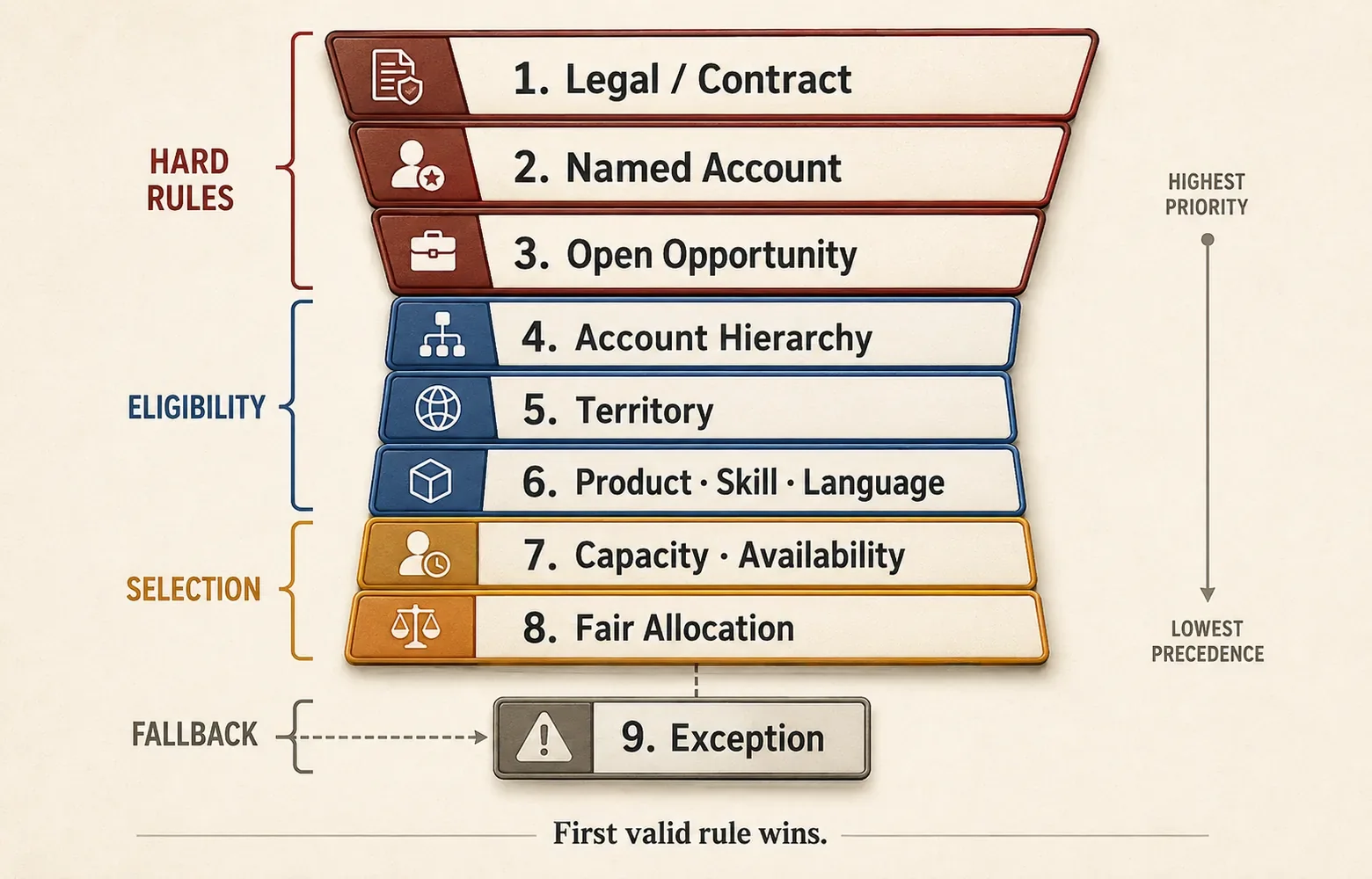
- Legal, regulatory or contractual restriction. Hard override. Partner rights, data residency, regulated skill requirements.
- Named-account or explicit strategic ownership. Hard relationship rule, driven by a versioned list.
- Open opportunity or active commercial process. Continuity, with status and age thresholds.
- Existing account and hierarchy ownership. Continuity, with a stated local-versus-global parent policy.
- Hard territory boundary. Eligibility constraint.
- Product, skill and language eligibility. Eligibility constraint, often producing several pools.
- Capacity and availability. Operational constraint, applied inside the eligible pool.
- Fair allocation. Round robin, weighted or another declared algorithm.
- Exception and discovery. Governed fallback for no-match, conflict, missing data or execution failure.
Three conflicts are worth pre-deciding, because they will happen in the first month. A subsidiary matches while the global parent is owned elsewhere: pick a level and document it. A lead matches an open opportunity that closed-lost eleven months ago: set an age threshold, or stale opportunities will quietly capture new demand. A partner registers a deal on an account your direct team already owns: this one needs a human conflict queue, not a rule. Naming that queue is the easy half, because the partner case belongs in a governed hold queue with an owner, a dwell timer and a written exit criterion, and a hold with none of those turns into the place records go to be forgotten.
Where routing leaks revenue
Exceptions are not edge cases. Every state below is documented platform behaviour, which means it will occur. The only question is whether it produces a reason code and a timer, or a silence.
| Exception | Detection signal | Fallback | Reason code |
|---|---|---|---|
| Existing account | High-confidence account match | Account-coverage queue or mapped SDR | EXISTING_ACCOUNT |
| Subsidiary or parent conflict | Matched subsidiary and global parent differ | Hierarchy-conflict queue | HIERARCHY_CONFLICT |
| Open opportunity | Active opportunity matched to the account | Account owner or conflict queue | OPEN_OPPORTUNITY |
| Duplicate record | Email, phone or record match above threshold | Duplicate-review queue | DUPLICATE_RECORD |
| Conflicting territories | More than one territory matches | Territory-conflict queue | MULTI_TERRITORY |
| No route matched | Zero primary rules match | Operations owner, before the response SLA expires | NO_ROUTE |
| Missing decision field | Required geography, segment or product absent | Discovery queue or generalist pool | MISSING_FIELD |
| Inactive owner | Owner user inactive or lacks permission | Mapped replacement or manager | OWNER_INACTIVE |
| Owner unavailable | Schedule or calendar shows unavailable | Coverage pool, within a configured maximum wait | OWNER_UNAVAILABLE |
| Capacity exhausted | Available capacity at or below zero | Overflow pool or manager queue | CAPACITY_EXHAUSTED |
| Queued but unaccepted | Record stays queue-owned past the acceptance SLA | Reroute or escalate to a named backup | QUEUE_UNACCEPTED |
| Notification failure | Owner set but email, Slack or webhook failed | Retry the channel and raise a visible task | NOTIFICATION_FAILED |
| CRM write failure | API error, validation rule, permissions | Idempotent retry or failure queue | ASSIGNMENT_WRITE_FAILED |
| Partner conflict | Registration and direct ownership both match | Channel-conflict owner | PARTNER_CONFLICT |
| Recycled lead | Previously disqualified record shows a new qualifying event | Recycling queue with a prior-owner check | RECYCLED_LEAD |
| Manual override | Authorised user changes the owner | Record reason and expiry, then return to policy | MANUAL_OVERRIDE |
| Spam or invalid | Validation or abuse signal | Quarantine, retaining the audit count | INVALID_OR_SPAM |
QUEUE_UNACCEPTED is the one that funds this entire page. In Salesforce, queue members take ownership of records in a queue, which means a queue-owned lead has been delivered and has not been accepted. If you do not run an acceptance clock against queue dwell, a perfectly routed lead can sit unopened for weeks while every routing report shows success.
PRO TIP
Every fallback must be non-recursive. A no-match rule that routes back into a pool which can itself no-match will loop, and the record will look busy while going nowhere. Terminate every branch at a human or a named queue with a timer on it. The same discipline applies one system upstream, where tracing every branch to an end state before activation catches the parked-record version of this failure while it still costs nothing to fix.
How Salesforce, HubSpot and Dynamics actually behave
Similarly named features behave differently across platforms, and the differences are the implementation risk. This table is a dated snapshot taken from official documentation on 23 July 2026, not a permanent feature promise. Re-check before you build. HubSpot is the sharpest case in the table, because “round robin” names two unrelated features there: meeting rotation starts at Starter while lead rotation needs Professional, and teams routinely buy the first believing they have bought the second.
| Platform behaviour | What the documentation says | What it means for you |
|---|---|---|
| Dynamics 365 rule order | Rules apply in listed order from the top, and “if a record meets the conditions of a rule, that rule is applied and no other rule is considered.” | Rule order is part of your data model. One broad early rule shadows every later rule. |
| Dynamics 365 distribution | Round robin distributes evenly by turn; load balancing distributes “based on their workload.” | Two different fairness definitions, selected by a dropdown. |
| Dynamics 365 capacity | “Available capacity = Maximum capacity – Consumed capacity”, where consumed capacity counts active records owned for the configured entity. | Capacity is only as good as the entity scope you configured. |
| Dynamics 365 availability default | “If sellers don’t set their work availability, the rule considers them always available.” | An unconfigured seller silently becomes the always-on fallback. |
| Dynamics 365 no-seller state | If no seller is available within the configured window, the record is “left unassigned and marked overdue.” | Automation does not guarantee an owner. Monitor the unassigned state. |
| Dynamics 365 processing delay | “There might be a delay between when a record meets the conditions of the assignment rule and when it gets assigned to a seller.” | Assignment latency exists even with no rule error. Measure it separately. |
| HubSpot rotation counting | Fairness is counted per rotate action, “not based on how many objects each user owns overall in your account.” | Per-action fairness is not workload balancing. |
| HubSpot rotation reset | Adding or removing owners from the action resets the established rotation. | A routine team change silently restarts your distribution. |
| HubSpot imports | “Users who are assigned a record through import will not receive a notification that they were assigned a new object.” | Assignment and notification are separate controls. Test them separately. |
| Salesforce API invocation | The Assignment Rule header “is a request header applied when creating or updating Accounts, Cases, or Leads. If enabled, the active assignment rules are used.” | An integration that omits the header creates leads that never run your rules. |
| Salesforce queues | Queue members take ownership of records sitting in a queue. | Queue assignment is delivery. Acceptance is a separate event needing its own clock. |
| LeanData round robin | Order-Based pools advance “one position with each assignment”; Count-Based pools give the next record to “the member with the lowest Net Count.” Paused or capped users are skipped. | Specialist tools expose the fairness definition explicitly. Choose it deliberately. |
Read the Salesforce row twice. It is the most common silent routing failure we see described in operations communities: the web form works, the API integration works, and the two produce different owners because only one of them invokes assignment rules. Every ingestion path needs its own test. Until that test runs the second path is not a risk anyone has accepted, and sorting it into the four states a pre-launch finding can sit in keeps it from being signed off on the strength of the first path working. The same split shows up one object over as a campaign membership that never counted as a response, where the record syncs correctly and the campaign reporting still reads zero. Testing them individually also protects the reporting layer, since a lead that never becomes a record cannot breach an SLA and therefore never appears in the numbers you would use to notice the problem.
Deterministic rules versus AI-assisted prioritisation
AI belongs in routing, inside a governed envelope. The split that holds up is simple: deterministic logic decides who is allowed to own a record, and AI decides what to do with the ones that are allowed.
Keep legal, contractual, named-account, hierarchy, territory and hard eligibility constraints deterministic, versioned and reproducible. The same inputs must always produce the same eligible owner set, because those constraints are commitments rather than predictions. Use AI for classification, match-candidate ranking and prioritisation, where being right most of the time is genuinely useful.
Two guardrails make the difference between a useful model and an unauditable one. Log the inputs, model version, recommendation and any human override, so a disputed assignment can be reconstructed. And treat historical training labels with suspicion, because a model learned from past lifecycle transitions will faithfully reproduce whatever bias your old process had. This is the same governance boundary that applies to AI agents across RevOps: the model can propose, but the protected constraints stay deterministic and the rollback path stays open.
How to measure lead routing
A single speed number hides everything you need to know. If leads take nineteen minutes to reach a rep, the fix is completely different depending on whether those minutes were spent in enrichment, in a rules-engine queue, in a failed CRM write and retry, or sitting in a queue nobody was watching. Instrument the stages and the answer becomes obvious.
| Timestamp | Event |
|---|---|
| T_capture | Authoritative receipt of the source event. Immutable, reconciled to a source-system ID. |
| T_eligible | All mandatory validation, identity and qualification gates completed. |
| T_decision | Routing engine selected a rule, model and intended owner. |
| T_assigned | Authoritative system confirmed the owner write. A retry is not a success. |
| T_notified | Required notification confirmed delivered, or task created. |
| T_accepted | An individual accepted ownership. The preferred routing-completion event. |
| T_first_action | First qualifying human action. A post-routing outcome. |
From those seven timestamps, the two clocks that matter most are these.
Routing latency = T_accepted − T_captureOwner acceptance latency = T_accepted − T_assignedThe acceptance gap is the number almost nobody reports and the one that explains the most. It isolates the time between “the system says this is yours” and “a person agreed”, which is exactly the interval where queue dwell, failed notifications and coverage gaps live. Report medians and percentiles rather than means, because latency distributions are heavily skewed and a single stuck record will wreck an average.
Keep routing latency and first-action latency in separate columns. They answer different questions, and merging them is the most common reason a routing improvement and a speed-to-lead measurement disagree about whether anything got better.
What the response-time research actually proves
The statistics in this category get repeated far past what their sources support. Here is the public record, with the scope attached, because the scope is the part that keeps getting dropped.
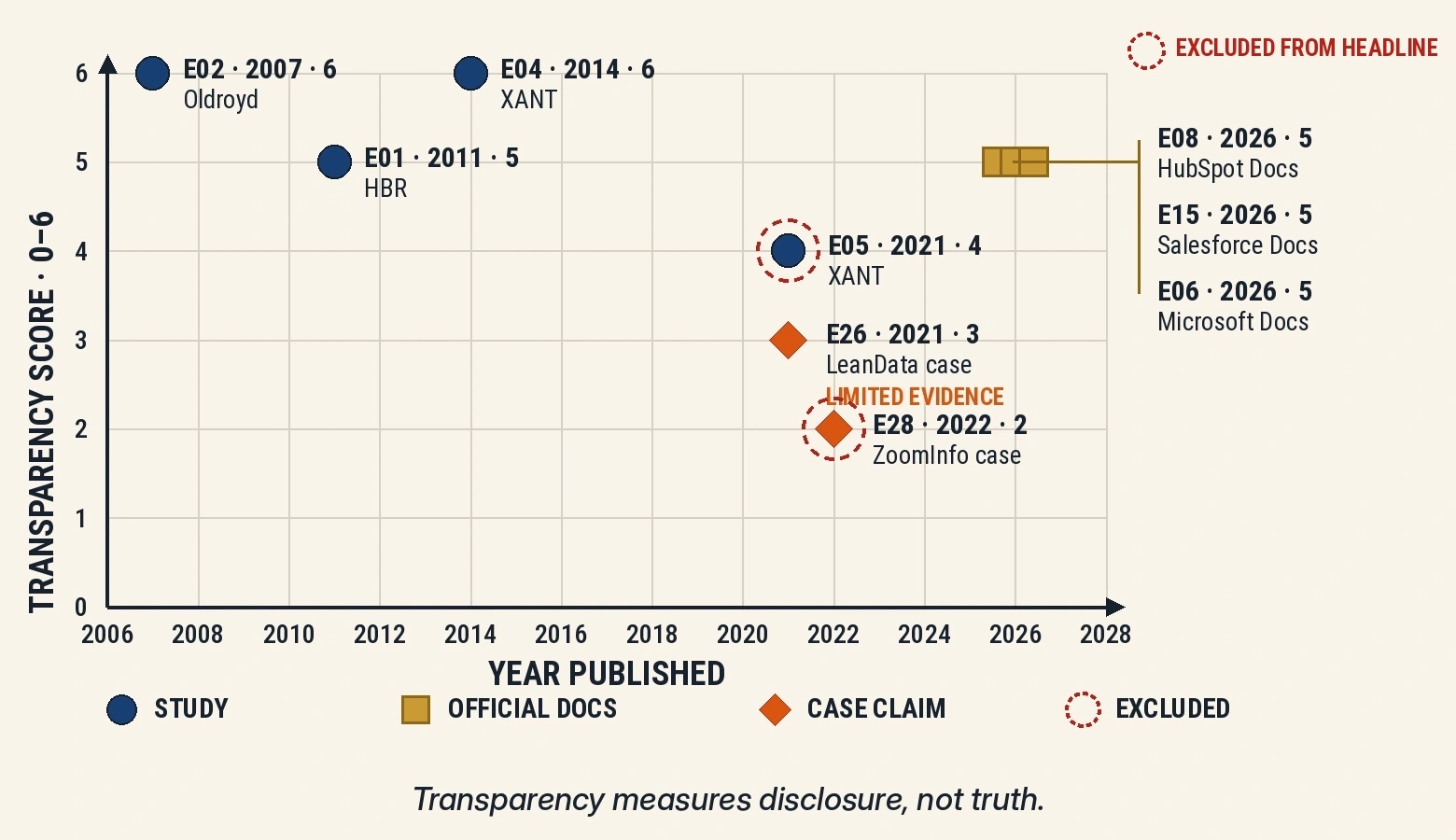
| ID | Source | What it found | Sample and population | Transparency | Use |
|---|---|---|---|---|---|
| E01 | HBR, The Short Life of Online Sales Leads (2011) | 37% of audited firms responded to a test lead within an hour; 23% never responded. In a separate analysis, attempts within an hour were roughly 7× as likely to qualify as attempts an hour later. | 2,241 US companies audited; separate 1.25m-lead study | 5/6 | Urgency, scoped. Not routing accuracy. |
| E02 | Oldroyd, Lead Response Management (2007) | Contact odds at 5 minutes versus 30 minutes reported at 100×; qualification odds at 21×. Close ratios were explicitly out of scope. | >15,000 web leads, >100,000 call attempts, 6 companies, ~3 years | 6/6 | Context only, with date and phone-centric caveats. |
| E04 | XANT, 2014 Lead Response Report | 4,472 of 9,538 successful submissions (47%) got no response. Median first call 3h08m; mean 61h01m. | 2013 secret-shop audit of US companies | 6/6 | Prevalence of non-response. Cause unobserved. |
| E05 | XANT, Lead Response Management (2021) | An 8× conversion difference within five minutes. | ~30m attempts, >10,000 platform users, 2018–2020 | 4/6 | Excluded from headline. “Conversion” is undefined and the sample is platform users only. |
| E06 | Microsoft, Dynamics 365 assignment rules | First-match rule order, round robin versus load balancing, capacity formula, unassigned and overdue states. | Official product documentation, updated 2026-06-15 | 5/6 | Direct platform behaviour. |
| E08 | HubSpot, Assign ownership of records | Per-action rotation counting, rotation reset on owner change, no notification on import. | Official product documentation | 5/6 | Direct platform behaviour. |
| E15 | Salesforce, Assignment Rule Header | Active assignment rules run on API create or update only when the header is enabled. | Official developer documentation | 5/6 | Direct platform behaviour. |
| E26 | LeanData / Brandwatch case study | Time to first touch reportedly fell from hours to minutes; MQL-to-meeting conversion reportedly doubled. | One named customer; no control group, period or counts disclosed | 3/6 | Named example only. Not evidence of causation. |
| E28 | ZoomInfo / Momentive claim | Speed-to-lead reportedly cut from 20 minutes to 60 seconds. | One customer; no sample, period or endpoint definition | 2/6 | Excluded. Repetition across articles is not independent confirmation. |
The transparency score is the sum of six disclosures: sample, population, data period, metric definition, methodology availability and primary-source access. It measures how much a source tells you about itself, not whether it is true. Official product documentation scores 5 because the empirical sample field does not apply to it, and it remains fully authoritative for its own product’s behaviour.
Read together, these sources support one conclusion and refuse another. They support urgency: slow and absent responses to inbound inquiries were common across large samples, and faster first contact was associated with better contact and qualification odds within the populations studied. They do not support routing ROI, because not one of them observed a routing-stage timestamp. Nobody in the public record has measured how long assignment took, whether notification arrived, or whether an owner accepted. Any page telling you that routing automation produced a revenue multiple is extrapolating past its evidence.
IMPORTANT
Five of the 31 sources behind this page went dead between the research date and publication, when LeanData retired its Zendesk help centre and moved to a new domain. Two claims also described mechanics its current documentation no longer uses. Vendor documentation is the least durable evidence class in this category, which is why every row in our ledger carries a health status and a check date.
Implementing and testing routing
Ten principles, each with an outcome you can actually test. If a principle cannot be tested, it is a preference. Turning those outcomes into a run that actually proves something means sizing it first, and the number of records a workflow needs is something you can derive from the rule table rather than guess at.
- Declare the end state first. Write the exact acceptance or exception event before writing any rule. Test: every test record reaches a terminal state.
- Separate the planes. Store the decision result apart from the execution status. Test: a correct decision with a failed write is visible as such.
- Resolve relationships before allocating. Test: no round robin can capture a protected relationship.
- Keep hard constraints deterministic. Test: identical inputs reproduce an identical eligible owner set.
- Make AI subordinate. Test: inputs, model version, recommendation and override are all logged.
- Design fallback before the happy path. Test: no record remains silently stuck, and no fallback recurses.
- Test every ingestion path. Forms, API, imports, syncs, chat and manual creation. Test: identical payloads through each channel produce the same policy outcome, or the difference is documented.
- Instrument every state transition. Test: latency can be attributed to a stage rather than guessed.
- Publish reason codes. Test: an audit can group causes without anyone reading raw logs.
- Canary and reconcile. Launch to a controlled segment and reconcile source submissions to CRM outcomes daily. Test: unexpected loss triggers a rollback.
Principle 7 deserves a synthetic test pack rather than good intentions. Build a fixed set of records covering each positive path, each overlap, and each exception, then push that same set through every ingestion channel before any launch. Rule versioning and rollback authority sit alongside the rest of your RevOps change controls, because a routing rule edited directly in production on a Friday is an incident waiting for Monday.
Native CRM, specialist router or orchestration layer
Evaluate on capability rather than brand. Native CRM assignment is usually enough when your motion is single-product, single-territory and net-new heavy. A specialist router earns its cost when you need account and hierarchy matching, expressive precedence, capacity or availability logic, simulation against historical records, and record-level decision logs. An orchestration layer makes sense when routing is one step in a larger cross-system process.
The questions worth scoring are the same either way: can it represent account hierarchy and named-account precedence, can it simulate rules without changing ownership, does it expose stage timestamps and decision paths in an exportable log, and can a change be versioned and rolled back. A full vendor-by-vendor comparison is a separate exercise and is deliberately out of scope here.
PRO TIP
Download the Lead Routing Kit (XLSX) and the requirements template (CSV) before you brief a vendor. The 50-point requirements template turns this page into a working document, and answering it first tends to change which product you actually need.
Where this becomes an audit rather than a build, start with the operating model and the evidence trail rather than a software recommendation. IVRIS can review the capture-to-acceptance chain, test data readiness and rule precedence, and design the observability needed to surface unassigned, misrouted and unaccepted records.
Frequently Asked Questions
Lead routing means moving a captured lead through validation, identity resolution, qualification, relationship matching and owner selection until a named person accepts responsibility for it. It covers the data and delivery steps around assignment, not just the moment a CRM owner field changes.
Assignment is the single act of writing an owner, team or queue onto a record. Routing is the whole chain around it: the data gates that make a lead eligible, the precedence rules that decide who qualifies, the notification that tells them, and the acceptance step that confirms a person took it on.
There is no canonical set of three. Most lists collapse a dozen distinct models into a memorable number. A more useful split is by layer: relationship rules such as named account and open opportunity, eligibility constraints such as territory, product and skill, and allocation methods such as round robin and capacity.
Lead form routing uses answers submitted on a web form, such as country, company size, product interest or job role, to decide who should own the resulting record. It is routing driven by declared form fields rather than by enrichment or CRM history, so it depends heavily on field validation quality.
Default lead routing is the fallback owner a system uses when no assignment rule matches. In Salesforce, web-generated leads can fall to a default lead owner if active assignment rules are not invoked. Treat that default as an exception queue to be monitored, not as a working assignment.
No. Automation can cut the machine delay between capture and assignment. It cannot make a person available, deliver a failed notification, or work a queue nobody is watching. Dynamics 365 documents that a record can be left unassigned and marked overdue when no seller becomes available.
Methodology and sources
This page is built from public third-party research and official product documentation. IVRIS did not conduct any of the underlying studies, and each organisation retains ownership of its own research. What IVRIS contributes is the synthesis layer: the Routing Integrity Chain, the model decision matrix, the exception taxonomy, the timestamp and latency definitions, and the transparency scoring applied to every source.
Every source carries its original date, sample, population and metric definition. Figures measured against different denominators or endpoints are never averaged together. Where the evidence does not support a conclusion, we say so rather than filling the gap: no public dataset we found exposes capture, eligibility, assignment, notification and acceptance timestamps in one compatible cohort, so this page publishes the stage-attribution method and no stage-attribution result.
Last reviewed: 23 July 2026. All 31 sources re-checked on this date: 24 live, 4 replaced after a vendor help-centre migration, 1 retired with no verified replacement, 2 live but restricted to automated checking and therefore not quoted.
Revision history: 23 July 2026, first publication.
Suggested citation: IVRIS Tech, “Lead Routing: Models, Rules and the Routing Integrity Chain,” https://ivristech.com/lead-routing/, reviewed 23 July 2026.