Every guide to sales territory management teaches you to draw a map. Split the country into regions, balance the account value across them, hand each region to a rep, revisit it once a year. That advice is not wrong, but it describes about a third of the job.
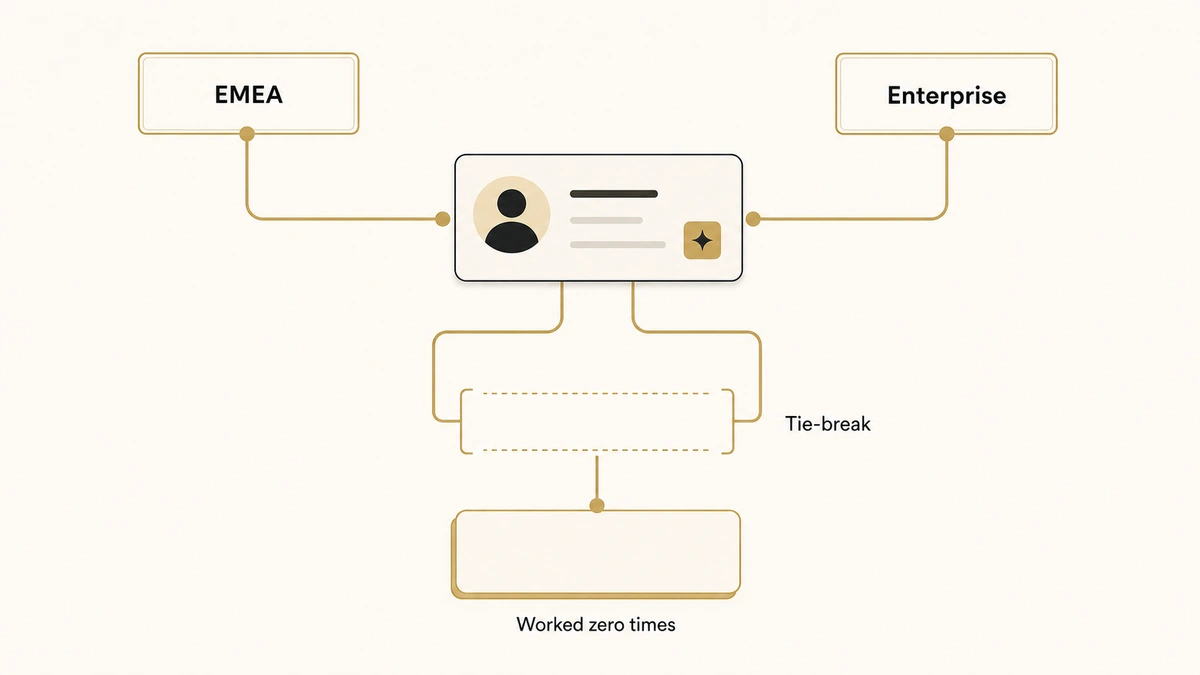
The other two thirds happen after the map exists, in your CRM, every time a form gets submitted. A territory is a filter that decides who owns an inbound record. It runs alongside your named-account rules, your round robin pools and your product routing, and when two of those filters both claim the same lead, something has to break the tie. Most revenue teams have never written down what that something is.
That gap is where territory work actually goes wrong. Not in the mapping exercise, which teams do carefully, but in the assignment rules that execute the map, which teams almost never test.
Direct answer — What is sales territory management?
Sales territory management is the practice of dividing a market into defined segments and assigning ownership of the accounts in each segment to specific reps or teams. Operationally it is a set of assignment rules that decide who owns a record. Segments can be built on geography, named accounts, industry, company size, or a hybrid of these. Its hardest problem is not drawing boundaries but resolving conflicts when two territories claim the same account.
Key Takeaways
- Territory is a routing dimension. It sits in the eligibility layer of your assignment logic, next to product and language, and above allocation methods like round robin.
- Salesforce documents that a record “can be assigned to more than one territory.” No platform ships a default tie-break, so the precedence order is yours to define and yours to forget.
- Salesforce’s own priority field is direction-agnostic: the docs say 001 can mean highest or lowest priority, while the sample Apex class treats higher numbers as higher priority. Teams invert this silently.
- Almost nobody defines what happens when an account’s industry, size or headquarters changes after assignment. That single omission produces most mid-year ownership disputes.
- The widely quoted “10% to 20% productivity gain” from territory design is published by a consultancy with no sample, no methodology and no date attached.
- A rules-of-engagement document, not a better map, is what stops the arguments. The full template is below, free to copy.
What is sales territory management?
Sales territory management is the practice of dividing a market into defined segments and assigning ownership of the accounts in each segment to specific salespeople or teams. The segments can be geographic, but they can equally be built on industry, company size, named-account lists, or a combination.
Two definitions matter more than the rest, because they come from the people who built the field rather than from vendors selling mapping software.
The foundational academic work defines it as an assignment problem outright. In Marketing Science, Andris Zoltners and Prabhakant Sinha open their 2004 ISMS Practice Prize paper with the line “sales territory alignment is the assignment of accounts and their associated selling activities to salespeople and teams.” A decade later, writing in Harvard Business Review, the same authors described territory design as “the way in which responsibility for accounts is assigned to salespeople or sales teams.”
Assignment. Both times. Neither definition mentions a map, and neither treats the boundary drawing as the point. The point is who ends up owning the account.
Territory is a routing dimension, not a map
Territory belongs to a specific layer of your routing logic, and putting it in the wrong layer is what creates unresolvable conflicts later.
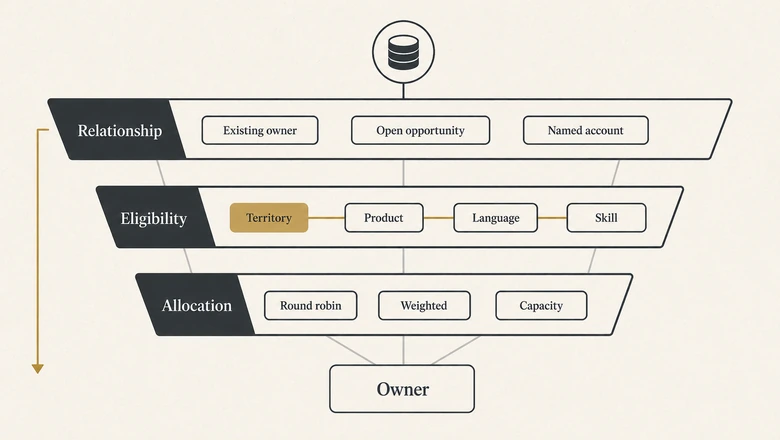
Assignment rules operate in three layers. Relationship rules come first: if the account already has an owner, an open opportunity, or a named-account designation, that relationship wins before anything else is evaluated. Eligibility constraints come second, narrowing the set of reps who may legitimately receive the record. Allocation methods come last, choosing one rep from the eligible set.
Territory is an eligibility constraint. It sits beside product specialisation, language and skill, and it belongs above the distribution model you use to pick a rep rather than instead of it. Round robin distributes within a territory; it does not compete with one. Teams that treat territory as an allocation method end up with rules that fight each other for the same records, which is the same failure mode the wider routing chain produces when precedence is undefined.
This layering is also why territory assignment depends on something upstream. A territory rule that keys on company headquarters, industry code or employee count can only fire if the inbound record has been resolved to the right account first. Get the lead-to-account match wrong and the territory rule evaluates against the wrong firmographics, then routes confidently to the wrong owner. The rule screen will look perfectly healthy afterwards.
The five territory models, compared
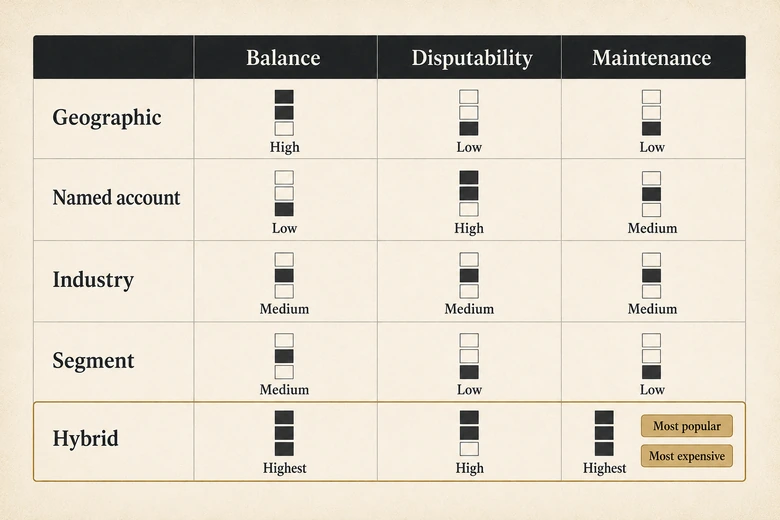
Most articles list four territory types and stop. The types matter less than how each one behaves under pressure, so this table scores the five models on the dimensions that predict operational cost rather than on how tidy they look on a whiteboard.
“Disputability” is how often two reps can plausibly both claim a record. “Drift” is what happens when a company’s firmographics change after you have assigned it.
| Model | Basis | Balance-ability | Disputability | Maintenance cost | Behaviour on firmographic drift |
|---|---|---|---|---|---|
| Geographic | Country, state, ZIP, region | High. Postal units are granular enough to rebalance precisely. | Low, until remote work makes the contact’s location differ from the account’s HQ. | Low. Boundaries are stable. | Rare but disruptive. An HQ relocation moves the whole account. |
| Named account | An explicit list of accounts | Low. Lists are hand-built and drift out of balance fast. | Very low. The list is the answer. | High. Someone owns list hygiene forever. | None. Membership is manual, so drift does not move anything. |
| Vertical / industry | SIC, NAICS or your own taxonomy | Medium. Industry sizes are uneven and you cannot subdivide them arbitrarily. | High. Conglomerates and multi-industry accounts match two verticals at once. | Medium. Taxonomies need governance. | Common. Enrichment vendors reclassify industry codes without telling you. |
| Segment / size | Employee count, revenue, ARR band | High. Bands are adjustable to the record. | Medium. Records sitting on a band boundary flip between owners. | Medium. Bands need annual review. | Very common. Headcount fields change constantly, so accounts cross bands mid-cycle. |
| Hybrid | Two or more of the above | Highest, in theory. | Highest in practice. Every added dimension multiplies the number of overlapping claims. | High. Complexity compounds. | Worst case. Drift on any single dimension can re-trigger the whole rule set. |
The table has a bias worth stating plainly: hybrid models are the most popular choice among growing teams and the most expensive to operate. Each additional dimension is another way for two rules to match the same record. If you adopt a hybrid model, adopt the tie-break rules in the next section at the same time, not a year later when the first dispute reaches your VP.
Segment territories carry a related trap. A band boundary is only as defensible as the definition behind it, so the segment thresholds should come from the same place as your ICP definition rather than from a round number somebody picked in a planning meeting.
When two territories claim the same record
Multi-territory assignment is not an edge case and not a misconfiguration. It is documented, expected platform behaviour.
Salesforce states it directly in its Enterprise Territory Management implementation guide: “Depending on how your organization assigns records, a record can be assigned to more than one territory.” The platform will happily hold both assignments. What it will not do is decide which rep gets to work the lead.
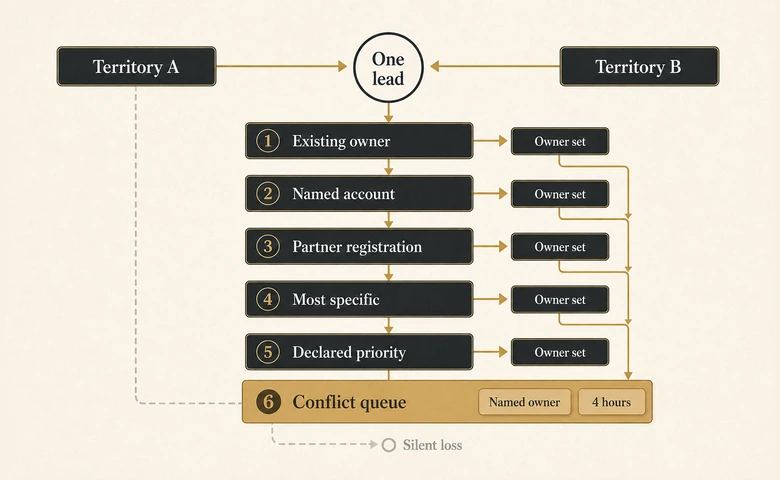
So the tie-break is yours to write. Here is a defensible default precedence order, in evaluation sequence:
- Existing ownership. An account with a current owner or an open opportunity is not up for reassignment by a territory rule.
- Named account designation. An explicit list beats any computed rule, because the list encodes a commitment somebody made deliberately.
- Contractual or partner registration. Deal registration and reseller agreements are legal obligations, not preferences.
- Most specific territory wins. A rule matching on three attributes beats one matching on a single attribute.
- Declared territory priority. When specificity ties, a documented numeric priority resolves it.
- Conflict queue. When nothing above resolves it, the record goes to a named human within a stated response window. It never sits unassigned.
The sixth step is the one teams skip, and skipping it is expensive. A record that matches two territories with no resolution path does not get worked twice. It usually gets worked zero times, because each rep assumes the other one has it. That is a silent loss, and it does not appear on any dashboard until you go looking for it with a transaction-level routing audit.
IMPORTANT
A conflict queue with no named owner and no response window is not a tie-break. It is a place records go to die quietly. Name a person and state the window in hours.
When the firmographics change after assignment
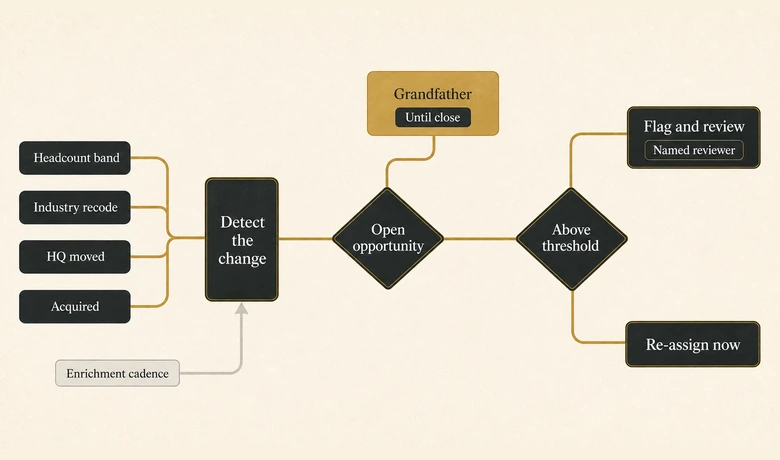
Territory rules evaluate against data that changes. An account crosses an employee band, an enrichment vendor reclassifies its industry code, a company relocates its headquarters, or a subsidiary gets acquired into a parent that belongs to someone else’s named list.
Almost no published guidance covers what should happen next, which is why this is the most common source of mid-year ownership arguments. There are only three coherent policies, and the failure is having none rather than picking the wrong one.
Policy 1: re-assign on change
The territory rule re-fires and ownership moves immediately. Clean in theory, disruptive in practice, and actively harmful once an opportunity is open. Use it only for accounts with no active pipeline.
Policy 2: grandfather until a closing event
Ownership stays put until the current opportunity closes or a renewal completes, and only then does the new territory rule apply. This is the default worth choosing for most B2B teams, because it protects in-flight deals without letting misalignment persist forever.
Policy 3: flag and review
The change raises a task for a named reviewer instead of moving anything automatically. Appropriate for named accounts and any account above a revenue threshold you set.
Whichever you choose, the deciding question is the same: does the drift affect an account with an open opportunity? If yes, ownership should not move automatically under any model.
Two operational notes. First, this policy only works if you can detect the change, which means your enrichment cadence and your territory rule set have to be discussed together rather than owned by different people. Second, the quality of your matching engine determines whether drift is even visible to you, which is one of the practical differences between the matching tools on the market.
How Salesforce Enterprise Territory Management actually behaves
Enterprise Territory Management is a distinct feature from lead assignment rules, and confusing the two costs teams weeks. ETM assigns accounts to territories. Leads still route through standard lead assignment rules, which can reference territory data but are configured separately and run on their own triggers.
Six documented behaviours to design around
These come from Salesforce’s own implementation guide, checked in Q3 2026. Quoted strings are verbatim.
| Behaviour | What Salesforce documents | What it costs you if you miss it |
|---|---|---|
| One active model | “Only one model in your Salesforce organization can be active at a time.” | Nothing, if you use Planning state to model alternatives first. ETM is unusually good at this. |
| Multi-territory records | “Depending on how your organization assigns records, a record can be assigned to more than one territory.” | Overlapping claims with no platform tie-break. This is the conflict case, and it is expected behaviour. |
| ZIP codes compare as text | Postal codes “are alphanumeric fields, not number fields, so in a comparison, 9 is ‘higher’ than 80000.” | Any ZIP-range territory silently mis-sorts. Use padded values or explicit lists. |
| State criteria matching | “Territory assignment rules using states as a criteria must use contains matching instead of equals matching.” | Rules quietly miss records whose state value arrived from a form in a different format. |
| Rules re-run conditionally | On account update, rules fire only if “Evaluate this account against territory rules on save” is selected and the rule sits in the active model. Via API, AssignmentRuleHeader must be specified. | Rules that are live, correct, and not running. Nothing errors. |
| Inherited rules | “If a rule has Apply to Child Territories selected, do not assign the rule separately to child territories.” | Duplicate rule evaluation across the hierarchy. |
The priority field that inverts itself
One behaviour deserves its own treatment, because it produces a wrong answer rather than an error. The documentation for territory type priority says “you create your own priority scheme. For example, 001 can indicate that a territory type is the highest priority or the lowest.” The field itself is direction-agnostic.
But the sample Apex class Salesforce ships for opportunity territory assignment states that “the higher the number, the higher the priority.” So a team that reads the field documentation, reasonably decides 001 means highest priority, and then adopts the sample class has inverted its own precedence order. No error fires. The rules run, records get owners, and the wrong territory wins every tie.
PRO TIP
Write your priority direction into the field’s help text in Setup, not just into a document. The next admin will read the field before they read your wiki.
Where native capability runs out
HubSpot has no equivalent territory object at all. Territory logic there is built from properties and workflow branches, which is workable but means the boundary definitions live in several places rather than one, a constraint worth understanding before you commit to routing territories through HubSpot. When native capability runs out on either platform, the honest comparison of dedicated routing tools is a better next step than another layer of workflow branches.
The territory rules-of-engagement template
Every RevOps team needs this document and almost nobody publishes a usable starting point, so here is ours. Copy it, fill in the bracketed values, and put it somewhere both sales and marketing can find it. It is free to reuse with attribution.
Workflow · 45 min
How to write territory rules of engagement
Produces a single document that resolves ownership disputes without escalation, covering assignment, conflicts, drift and renewals.
Define what ownership means
State which CRM field is authoritative for ownership and which record type it lives on. Name the one field that wins when account owner and lead owner disagree.
List the assignment triggers
Write down every event that can assign or reassign a record: form submission, account creation, enrichment update, manual change, batch rule run. Anything not on the list should not move ownership.
Record the precedence order
Copy the six-step order from the conflict section above, adjust it to your motion, and version it with a date. Store it beside the rules themselves, not in a separate wiki.
Name the dispute path and its owner
Specify where a contested record goes, who reviews it, the response window in hours, and who decides if the reviewer cannot. One named person, not a team alias.
Set the drift policy
Choose re-assign, grandfather, or flag-and-review for each account tier, and state the open-opportunity exception explicitly.
Cover renewals, expansion and review cadence
Say who owns a renewal and who owns expansion into a new business unit, then set a fixed review date for the whole document.
The template itself, section by section:
| Section | What to write | Worked example |
|---|---|---|
| 1. Ownership definition | The authoritative field, the object it lives on, and the tie-break when lead owner and account owner disagree. | “Account.OwnerId is authoritative. Lead.OwnerId is provisional until the lead is converted or matched.” |
| 2. Assignment triggers | Every event permitted to set or change ownership. | “Form submission, account create, quarterly batch run, manual change by [role]. Enrichment updates do not trigger reassignment.” |
| 3. Territory definitions | Each territory, its model, its criteria, its owner, and the date last reviewed. | “EMEA-MidMarket: geographic AND segment. HQ country in [list] AND employees 100–999. Owner: [name]. Reviewed: [date].” |
| 4. Precedence order | The numbered evaluation sequence, versioned and dated. | “Existing ownership > named account > partner registration > most specific > declared priority > conflict queue. v2.1, [date].” |
| 5. Dispute resolution | Where contested records go, who reviews, the response window, and the final decider. | “Queue: Territory-Conflict. Reviewer: [name]. Window: 4 business hours. Escalation: [name].” |
| 6. Drift and reassignment | The policy per account tier, plus the open-opportunity exception. | “Grandfather until close for accounts with an open opportunity. Flag-and-review above [ARR]. Re-assign otherwise.” |
| 7. Renewals and expansion | Who owns the renewal, and who owns a new business unit inside an existing account. | “Renewals to the CSM of record. New business unit follows the parent account’s territory unless separately registered.” |
| 8. Escalation and review | The named escalation owner and the fixed date the whole document is next reviewed. | “Escalation: VP Revenue Operations. Next review: [date]. Changes require sign-off from sales and marketing ops.” |
Two rules make the difference between a document people use and one they ignore. Sections 4 and 5 must name individuals rather than teams, because a queue owned by everyone is owned by nobody. And the document has to be versioned with a date, because the first question in any ownership argument is which version of the rules was live when the lead came in.
Suggested citation: IVRIS Tech, “Territory Rules-of-Engagement Template”, Sales Territory Management, 2026. https://ivristech.com/sales-territory-management/
What the territory-impact numbers actually say
Four figures circulate across every page ranking for this topic, and Google’s AI Overview currently repeats one of them as settled fact. Their provenance is uneven, so here is what each one is actually built on.
| Circulating claim | Traced origin | Year | Stated sample or basis | Verdict |
|---|---|---|---|---|
| Territory realignment lifts sales 5–10% | Zoltners & Sinha, Marketing Science 24(3), pp. 313–331 | 2005 | 1,500 project implementations, 500 companies, 500,000 territories | Sound. Peer-reviewed, sample stated, prize-awarded. Old, but honestly old. |
| Territory redesign increases revenue 2–7% | Zoltners, Sinha & Lorimer, Harvard Business Review | 2015 | Not stated on the page | Attributable but undated in use. An 11-year-old figure quoted across the 2026 SERP with no year attached. |
| ~55% of territories are too large or too small | Attributed to the same ZS body of work | Varies | Quoted as “4,800 territories, 500 companies, 25 years” and as “2,000 projects, 50+ countries”, neither matching the published “1,500 projects, 500 companies, 500,000 territories” | Provenance unresolved. Three incompatible sample descriptions for one number. |
| Well-designed territories improve productivity 10–20% | Alexander Group insights page | Undated | None published | Not independently verifiable. No sample, no methodology, no citation, no date. This is the figure the AI Overview repeats. |
The bottom row deserves attention, because it shows how a number becomes a fact. A consultancy publishes a range on a marketing page with no stated sample or method. Vendor blogs repeat it. Google’s AI Overview then cites those blogs and presents “10% to 20%” as established. Nothing was fabricated at any step, and the result is still a claim nobody can check.
The related “15–25% capacity loss” figure attributed to the same firm does not appear on the page usually cited for it. That page gives different numbers entirely: 20–30% of territories experiencing constrained growth, and 10–15% cost reduction. The capacity figure has drifted from whatever its source was.
Our position: use the 2005 Marketing Science figure when you need a defensible number, cite it with its year and its sample, and treat the rest as directional. Territory design is worth doing well regardless of whether the lift is 2% or 20%, and a range you cannot source is not an argument you want to make to a CFO.
Frequently Asked Questions
There is no canonical set of three. The commonly cited trio is geographic, industry and account size, but named-account territories are equally common in enterprise sales, and most real organisations run a hybrid of two or more. The number three comes from how lists are written, not from how territories are built.
A territory manager owns revenue for a defined segment of accounts: prospecting into it, running its opportunities, and maintaining its relationships. In practice they also arbitrate ownership questions at the edges of their territory, which is why written rules of engagement reduce their administrative load noticeably.
Enterprise Territory Management is the Salesforce feature that assigns accounts to territories using rules based on account fields. Only one territory model can be active at a time, though you can build alternatives in Planning state. It is separate from lead assignment rules, which route leads and are configured independently.
Salesforce documents that a record can be assigned to more than one territory, and no platform ships a default tie-break. Without a written precedence order the record typically gets worked by nobody, because each rep assumes the other owns it. Define the order and route unresolved cases to a named conflict queue.
Annual review is the common cadence for boundaries, but the rules-of-engagement document should be reviewed whenever the sales structure changes rather than on a calendar. Firmographic drift needs continuous handling through a stated policy, not a yearly cleanup, because accounts cross segment bands throughout the year.
Methodology and sources
Salesforce platform behaviour in this article was verified against the Enterprise Territory Management implementation guide published by Salesforce, checked in Q3 2026. Quoted platform strings are reproduced verbatim from that document.
Research figures were traced to their original publications rather than to recap articles. Where a figure could not be traced to a source with a stated sample and date, it is marked as unverifiable in the provenance table rather than repeated. IVRIS has not run its own territory study and does not present any figure here as original research.
The five-model comparison and the rules-of-engagement template are original to IVRIS, built from the routing failure modes documented across our lead routing work rather than from a survey. They are judgment frameworks, not measurements, and are offered as such.