
Turn on round robin lead assignment and the rotation looks fair from the first day. Lead one goes to the first rep, lead two to the second, lead three to the third, then the counter loops back to the top. Everyone gets the same number of leads. The dashboard agrees. The trouble is that “the same number of leads” and “a fair, productive distribution” are not the same claim, and the space between them is where most rotations quietly break.
A rep on holiday still gets their turn. A rep already sitting on forty open leads gets a forty-first. A rep who closes enterprise deals gets the same trickle as the hire in week two. The rotation did exactly what it promised. It just optimised for the wrong thing.
That is why round robin is really four different tools wearing one name. This page explains each one, shows the logic it runs, and gives you a way to pick.
Direct answer — what is round robin lead assignment?
Round robin lead assignment is a rule that distributes inbound leads to sales reps in a repeating rotation, so each eligible rep receives the next lead in turn. It comes in four models: simple (equal turns), weighted (proportional shares), capacity-based (fewest open leads first) and availability-aware (skip anyone offline or at their cap). It only chooses inside an already-eligible pool; it does not decide who is eligible.
Key Takeaways
- Round robin is a family of four models, not one setting. Simple, weighted, capacity-based and availability-aware rotations answer four different definitions of “fair”, and choosing the wrong one is the most common configuration mistake.
- Simple round robin counts turns, not workload. Two reps can each take exactly one turn in three and still end the quarter with very different open-lead piles, because turn-fairness ignores what a rep already holds.
- Capacity-based rotation fixes that by assigning to the rep with the fewest active leads, using a defined formula rather than a running count of turns.
- Availability-aware rotation skips reps who are offline, out of office or at their cap, then lets them back in. Without it, an absent or unconfigured rep silently becomes a lead graveyard.
- Round robin only allocates inside a pool that is already eligible. Territory, named-account and open-opportunity rules decide who qualifies; the rotation just picks among the survivors.
- Weighted round robin sends proportionally more leads to some reps. Use it for planned differences like ramp, seniority or hours, never as an unofficial performance reward with no review.
What round robin lead assignment actually does
Round robin lead assignment automates a single decision: which eligible rep receives the next lead. It answers that by rotating through the pool in a set order, so volume spreads evenly instead of piling onto whoever watches the queue most closely or claims the best-looking leads first. Before any rotation runs, though, a lead has to be cleared for sales in the first place, and that qualification gate is a separate decision from distribution.
The word doing the quiet work is “eligible”. Round robin never decides eligibility. It runs after the rules that do: territory, named-account ownership, an open opportunity, product or language fit. Those rules narrow the field to a set of interchangeable reps, and only then does the rotation choose one. Get the order wrong and a round robin will happily hand a strategic account’s new inquiry to whoever is next in line, a failure mode our lead routing guide covers across the whole capture-to-ownership chain. Treat this page as the zoom-in on the allocation step by itself.
Assignment is also not acceptance. The rotation writes an owner onto the record; it cannot make that person open the lead. A rep who is next in line but signed off for the day still gets handed a lead, which then sits untouched, so the accepted-lead handoff belongs on its own clock rather than folded into the assignment event.
The four round robin models at a glance
There are four round robin models in common use, and they differ only in how they pick the next rep. The rotation idea and the eligible pool stay the same across all four. This table is the short version; the sections after it show the logic each one runs.
| Model | How it picks the next rep | Best for | Where it breaks |
|---|---|---|---|
| Simple round robin | Next rep in a fixed order; advance one position per assignment. | Small, interchangeable inbound teams with steady volume. | Uneven workloads, absences, or reps who convert at very different rates. |
| Weighted round robin | Proportional shares; weight 2 gets roughly twice the turns of weight 1. | Planned differences: ramp, seniority, part-time hours, pod size. | Weights quietly become a performance reward that nobody reviews. |
| Capacity-based | Assign to the eligible rep holding the fewest active open leads right now. | Teams where lead effort varies and reps clear work at different speeds. | A naive “open lead” count treats a 3-day and a 3-month deal as equal. |
| Availability-aware | Skip any rep offline, out of office or at their cap; they re-enter when free. | Real-time handoff, chat, live scheduling, multi-timezone teams. | Calendar availability gets mistaken for capacity or ownership. |
Two of these count turns (simple and weighted) and two count workload (capacity-based and availability-aware). That single split, turns versus workload, is the one most teams never make out loud, and it decides which of the four you actually want.
IMPORTANT
None of the four models improves lead quality or conversion on its own. What a rotation protects is response time, by removing the manual step where a lead waits for a human to notice it and claim it. Any page promising a revenue lift from the rotation itself is selling past its evidence.
How each round robin model works
Each model runs a short, deterministic procedure every time a lead arrives. Writing that procedure out is the fastest way to see what a model optimises for, and what it ignores.
Simple round robin
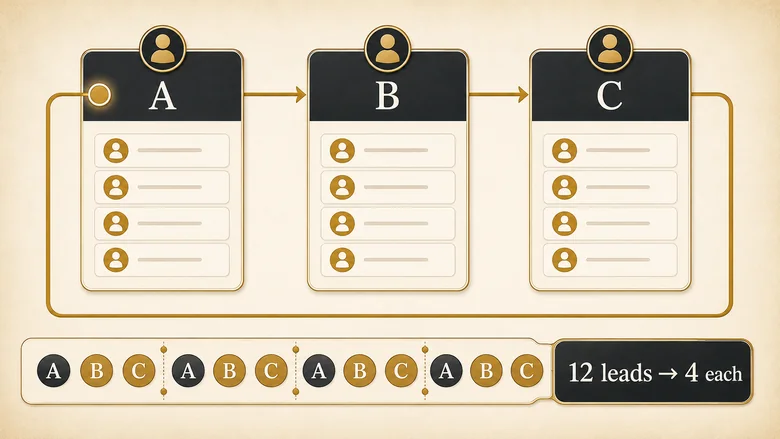
Simple round robin keeps an ordered list of eligible reps and a pointer to whoever is next. Each new lead goes to the rep at the pointer, and the pointer then moves on by one, wrapping back to the top after the last rep.
- Build the ordered list of reps eligible for this lead.
- Assign the lead to the rep at the current pointer position.
- Advance the pointer by one, wrapping to the first rep after the last.
- Skip and re-seat the pointer if that rep has gone inactive.
With reps A, B and C and twelve leads, the sequence is A, B, C, A, B, C and so on, four leads each. Perfectly even by turn. The catch is what “even” counts. HubSpot documents that in a rotate action, distribution “is based on the assignment count for that particular action, not based on how many objects each user owns overall in your account.” So two separate rotations can each be flawless and still leave one rep buried, because neither can see the other’s leads or the pile already on the desk.
Weighted round robin
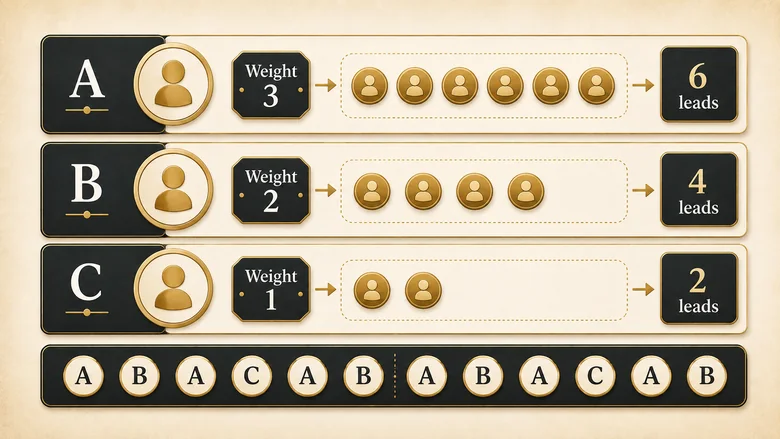
Weighted round robin gives each rep a share instead of an equal turn. A rep with weight 2 receives roughly twice as many leads as a rep with weight 1, and the rotation still interleaves rather than handing one rep a long run.
- Give each eligible rep a positive weight.
- Deal leads so that, over a full cycle, each rep’s share matches its weight over the total weight.
- Interleave the turns rather than front-loading, so a heavier rep never gets a long unbroken run.
Rep's share of leads = Rep weight ÷ Sum of all weightsThree reps with weights 3, 2 and 1 share a total weight of 6. Over twelve leads, that is six, four and two leads. A clean interleave deals them A, B, A, C, A, B and repeats, so the heavier reps stay busy without ever monopolising a run. Weighted rotation is the right tool for planned, defensible differences: a ramping hire on half load, a senior who also carries named accounts, a part-timer at half hours. It turns into a problem when the weights quietly encode “who the manager rates”, with no written basis and no review date. If a weight is standing in for skill or priority, that is closer to how lead scoring ranks a lead than to how a rotation should share volume, and it should be governed the same way.
Capacity-based round robin
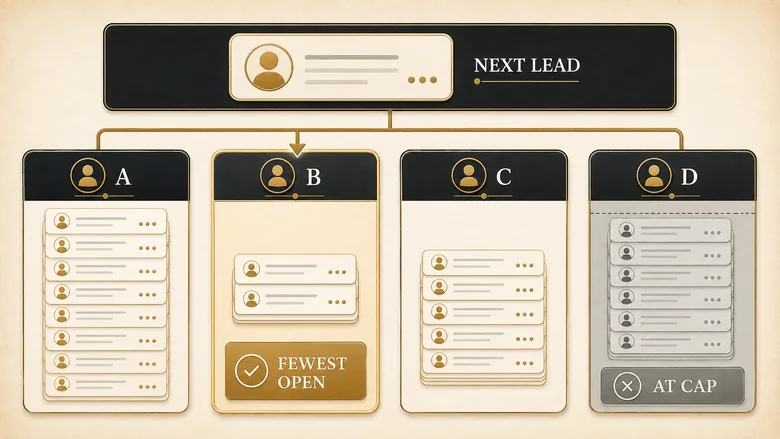
Capacity-based round robin, often labelled load balancing, ignores whose turn it is and assigns each lead to the eligible rep carrying the fewest active leads right now. The rotation follows the work rather than the clock.
- For each eligible rep, count the active open leads they currently own.
- Assign the new lead to the rep with the lowest count.
- Break ties with the normal rotation order.
- Remove any rep whose count has reached their configured cap.
Microsoft’s Dynamics 365 documentation draws the same line between the two families: round robin “distributes the records evenly in turn”, while load balancing “distributes leads to sellers based on their workload, so that all sellers are equally busy.” It also states the workload calculation outright.
Available capacity = Maximum capacity − Consumed capacityConsumed capacity is the number of active records a rep already owns. Dynamics gives the worked case: a rep with a maximum of 50 who owns 20 active leads has 30 of capacity left, and the rotation prefers whoever has the most room. Reach for this model when a “lead” means very different amounts of work and a plain turn count would keep loading a rep who is already underwater. Its own weak point is a crude counter. If one open lead is a three-day close and another is a six-month enterprise cycle, counting them both as one unit hides exactly the imbalance you switched the model on to fix.
Availability-aware round robin
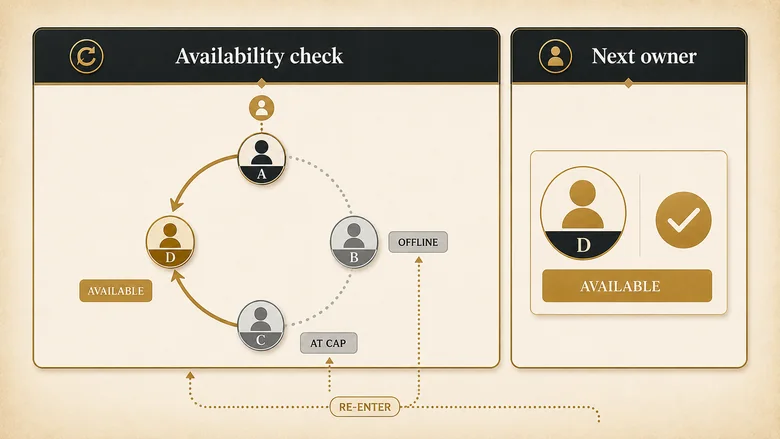
Availability-aware round robin adds one test before it assigns: can this rep actually take the lead right now? Anyone offline, outside working hours, on leave or already at their cap is skipped, the rotation moves to the next available rep, and the skipped rep re-enters when they return.
- Pick the next rep by the underlying model (simple, weighted or capacity).
- Check that rep’s presence: working hours, timezone, live status and cap.
- If available, assign. If not, skip to the next rep and mark the skipped one for re-entry.
- If nobody is available, hold the lead in a fallback queue rather than force it onto an absent owner.
This is where defaults bite. Dynamics 365 warns that “if sellers don’t set their work availability, the rule considers them always available”, so an unconfigured rep becomes the always-on sink for overflow. It also documents that when no seller is available in the configured window, the record is “left unassigned and marked overdue” rather than parked on someone who cannot work it. Availability-aware routing is essential for real-time motions, chat and calendar handoff, and for teams spread across timezones, where the alternative is a lead landing on a rep who is asleep. To wire any of this up in a specific platform, the mechanics differ by tool: our walkthrough of Salesforce lead assignment rules covers the queue-and-rule setup there, and specialist routers expose the fairness choice as a direct setting, which the lead routing software comparison gets into.
Which round robin model should you use?
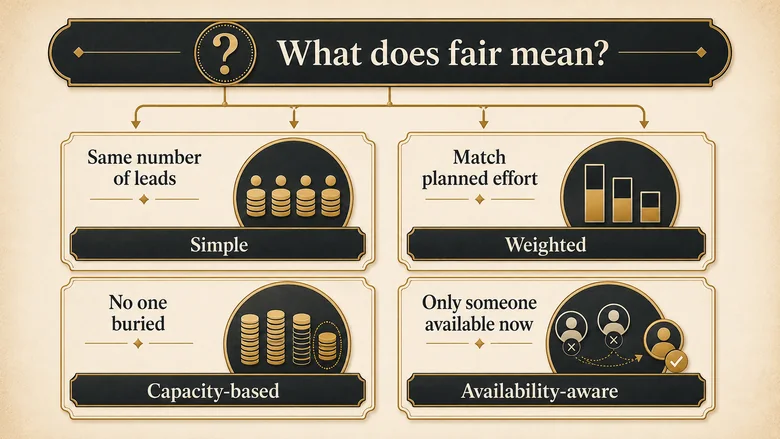
Pick the model by answering one question first: what does “fair” mean for your team? Each answer points at a different model, and the mismatch between the fairness you intended and the fairness you configured is where most complaints start.
- Use simple round robin when reps are genuinely interchangeable, volume is steady, and every lead is roughly the same amount of work. Drop it the moment workloads, skills or absences diverge.
- Use weighted round robin when the differences are planned and written down: ramp schedules, part-time hours, pod sizes, seniority that carries other duties. Avoid it as a stand-in for untracked performance judgements.
- Use capacity-based when leads vary in effort and reps clear them at different speeds, so open workload matters more than turns. Skip it if your active-lead count is too crude to mean anything.
- Add availability-aware on top of any of the above whenever timing matters: live handoff, chat, scheduling, or a team across timezones. Do not rely on it alone, because presence is not the same as capacity or ownership.
| If “fair” means… | Use | Because it optimises for… |
|---|---|---|
| Everyone gets the same number of leads | Simple round robin | Equal turns |
| Shares match planned effort or hours | Weighted round robin | Proportional turns |
| Nobody is buried while others idle | Capacity-based | Equal open workload |
| Leads only go to someone who can act now | Availability-aware | Present, in hours, under cap |
PRO TIP
Most production setups do not pick one model. They layer them: eligibility rules narrow the pool, a capacity or weighted base allocates inside it, and an availability check sits on top. Decide your base first, then add availability, rather than treating the four as rival options.
When round robin lead assignment fails
Round robin fails in predictable ways, and every one of them is a distribution problem the rotation cannot see on its own. Knowing the failure modes is what turns a fair-looking counter into a system you can trust. Several of them also start one layer up, because rotation can only be fair across a pool that the rules above it have already made eligible, and a rotation asked to carry an eligibility decision will distribute the wrong leads evenly.
The failure that funds all the others is silent non-acceptance. A rotation writes an owner and moves on. If that rep is absent, gaming the queue, or simply not watching, the lead sits assigned and unworked while every report shows a tidy, even split. Round robin holds no opinion about whether anyone opened the lead. Pair it with an acceptance clock and an automatic re-route, or the fairest rotation on paper will still let leads die in a queue.
The quieter failures are structural. Turn-fairness hides workload, so a simple rotation keeps feeding a rep who is already buried. An unconfigured availability setting turns one rep into the overflow sink. HubSpot resets an established rotation whenever you add or remove an owner from the action, so a routine team change silently restarts the count. And a rotation with no relationship layer in front of it will capture a strategic account’s inquiry for a stranger, which is why eligibility rules have to run first.
Speed is the reason to automate this at all, and it is worth being precise about what the evidence supports. The public research measures response time, not routing: the Lead Response Management study reported that the odds of qualifying a lead fell roughly 21 times between a five-minute and a thirty-minute reply, and Harvard Business Review’s audit of 2,241 companies found 23% never responded to a test lead at all. Neither observed a rotation. What they establish is that the manual “who wants this one?” delay is expensive, and an automatic rotation removes it. That is a speed argument, and only a speed argument. For the full evidence and how to set the response SLA, our speed-to-lead guide takes it apart.
Whether your rotation is fair in practice is an auditable question, not an assumption. Counting the leads each rep received, opened and worked over a real period is how you catch a rotation that reset itself, a rep quietly skipped, or a cap that never engaged, and it is the starting point of a lead routing audit.
Frequently Asked Questions
Round robin distributes leads evenly by turn, so each rep gets the next lead in the rotation regardless of how busy they are. Load balancing, or capacity-based assignment, sends the next lead to whoever holds the fewest active leads. Round robin counts turns; load balancing counts current workload.
Weighted round robin gives each rep a proportional share of leads instead of an equal turn. A rep with a weight of two receives roughly twice as many leads as a rep with a weight of one. It suits planned differences such as ramp time, part-time hours, pod size or seniority.
It works well when reps are interchangeable and leads are similar in effort, because it removes cherry-picking and spreads volume fairly. It works poorly when workloads, skills or availability differ, since equal turns then create unequal workloads. Match the model to your team rather than defaulting to the simplest rotation.
Salesforce has no native round robin button. Teams build one with an assignment rule that cycles through a queue, a numeric rotation field and formula, a Flow, or a dedicated app. Entries evaluate top to bottom, so the rotation logic lives in how you order, cap and reset those entries.
In an availability-aware setup, an unavailable rep is skipped, the lead goes to the next available rep, and the skipped rep re-enters the rotation on return. In a simple rotation with no availability check, the lead is still assigned to the absent rep and waits until they come back.
No. Round robin is sequential, not random. It follows a fixed rotation order and gives each eligible rep the next lead in turn. Some tools randomise the starting position or reset the order when the team changes, but within a cycle the distribution is ordered and predictable rather than chance.
Methodology and sources
This explainer is built from official product documentation and public response-time research. The four-model framing, the selection matrix and the sample-logic procedures are the IVRIS synthesis; the platform mechanics and the response-time figures belong to their original publishers, each linked at the point it is used.
Platform behaviour is quoted from vendor documentation current at the review date and is a dated snapshot, not a permanent promise, so re-check it before you build. Response-time figures are reported with their original scope, and we state plainly that this research measured contact and qualification speed after an inquiry, not routing or any round robin model in particular.
Last reviewed: 25 July 2026.
Revision history: 25 July 2026, first publication.
Suggested citation: IVRIS Tech, “Round Robin Lead Assignment: Four Models and When to Use Each,” https://ivristech.com/round-robin-lead-assignment/, reviewed 25 July 2026.