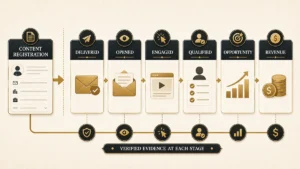

Two reps call the same prospect in the same week, each looking at a different record. A follow-up email lands twice in one inbox. Your pipeline report counts an account as three opportunities because the lead came in through a webinar, a content download, and a demo form, and nothing tied them together. None of these failures announce themselves. They just quietly erode routing accuracy, inflate your numbers, and make every rep trust the CRM a little less.
Lead deduplication is the discipline that stops this. It is the operational work of finding records that represent the same person or company, deciding which version of the truth survives, and merging them without losing anything that matters. Done well, it is invisible. Done badly, or not at all, it taxes every downstream system that reads from your database.
Gartner puts the average cost of poor data quality at $12.9 million a year per organization, and duplicates are one of the most common and least-audited contributors to that bill. Most guides on this topic are published by the vendors selling dedupe tools, so they stop at the pitch. This one covers the actual mechanics: how to detect duplicates, the survivorship rules nobody writes down, how to govern a merge so it is auditable, and how to stop duplicates forming in the first place.
Direct answer — What is lead deduplication?
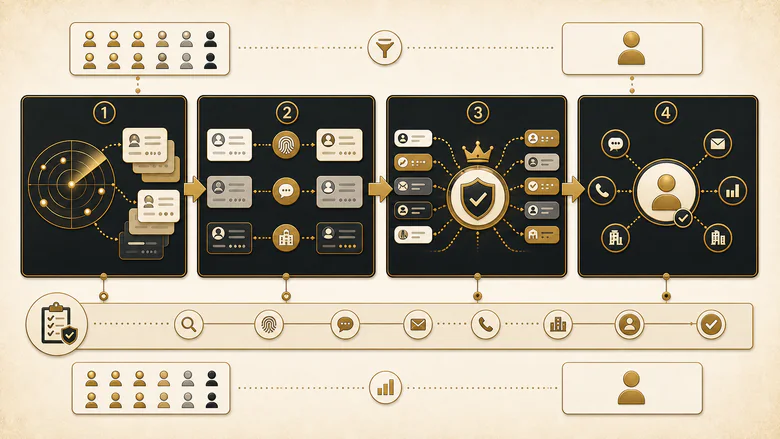
Lead deduplication is the process of finding lead or contact records that represent the same person or company and merging them into one trusted record. It runs in four stages: detect candidate duplicates, match them on identifiers like email, phone, and company domain, apply survivorship rules to decide which field values win, then merge and re-link related activity. Unlike broad data cleansing, it targets duplicate records specifically, and the one rule that must never break is preserving consent and opt-out flags on every merge.
Key Takeaways
- Deduplication has four stages: detect, match, apply survivorship, and merge. Skipping the survivorship step is how teams destroy data during a cleanup.
- Matching runs on identifiers, not guesses. Email and company domain are strong signals; name-only fuzzy matches need a tuned threshold before you trust them.
- Survivorship rules decide which field value wins when two records disagree. Write them down per field before any merge runs.
- Consent, opt-out, and Do-Not-Contact flags must survive every merge without exception. The most restrictive value always wins.
- Merge governance is the difference between a clean database and a data-loss incident: confidence tiers, a human review queue, and an audit trail.
- Prevention beats cleanup. Deduplicate at the point of entry so duplicates never reach the database, because a merge you never have to make is the cheapest one.
What is lead deduplication?
Lead deduplication is the process of identifying lead records that point to the same real-world person or company and consolidating them into a single record, so every downstream system reads one accurate version instead of several conflicting ones. In practice it means comparing records against each other on chosen fields, scoring how likely they are to be the same entity, and merging the ones that clear a confidence bar.
The reason it is a standing discipline rather than a one-time cleanup is that duplicates form continuously. Every new lead source, every integration, and every manual entry is another way for a second copy of an existing person to enter the database. CRM deduplication is the recurring practice of catching those copies and collapsing them before they distort routing and reporting.
It is easy to confuse deduplication with the neighbouring jobs in data quality, but they solve different problems, and treating them as one is how scope gets muddled. The table below draws the lines.
| Practice | What it does | Trigger | Primary owner |
|---|---|---|---|
| Deduplication | Finds and merges records for the same entity | Two or more records represent one person or company | RevOps / CRM admin |
| Data cleansing | Corrects, standardizes, and removes invalid data | Fields are malformed, outdated, or junk | RevOps / data ops |
| Data enrichment | Adds missing fields from external sources | Records are thin or incomplete | Marketing ops |
| Validation | Blocks bad data at the point of entry | A record is being created or updated | Marketing / web ops |
The four overlap in useful ways. Clean, standardized data makes deduplication far more accurate, which is why normalization runs first. And once records are merged, enrichment fills the gaps the surviving record still has so the merged profile is more complete than either original. Deduplication sits in the middle of that chain: it assumes reasonably clean inputs and produces a single record worth enriching.
Why duplicate leads happen, and what they cost
Duplicate leads happen because a single database accepts records from many uncoordinated sources, and none of them check whether the person already exists. Understanding the sources matters, because prevention later in this guide maps directly onto them.
- Multi-channel capture. The same buyer fills in a webinar form, downloads a report, and books a demo. Three touches, three records, unless something links them on entry.
- Integrations and imports. Syncing a marketing automation platform, an events tool, or a purchased list into the CRM writes new records that overlap existing ones.
- Manual entry. A rep types “Bob Smith” while a record for “Robert Smith” already exists, with no match surfaced at the moment of creation.
- No match-on-entry rule. When the CRM never checks for an existing match before creating a record, duplication is the default, not the exception.
The volume this produces is larger than most teams assume. Plauti, analysing 12 billion Salesforce records across 2021, found that more than 45% of all new records entered into CRMs were duplicates, climbing toward 80% for records arriving through API integrations. That figure is drawn from Salesforce data specifically, so treat it as a directional signal about integration-heavy environments rather than a universal constant, but the direction is unambiguous: unmanaged, duplication compounds fast.
The cost shows up in three places. Sales productivity drops when reps chase records that another rep already owns, or work a contact who has already been disqualified elsewhere in the database. Reporting distorts, because one account counted as three inflates pipeline and breaks account-level metrics that any lead scoring model depends on to rank fairly. And customer experience suffers when duplicate records trigger duplicate emails or contradictory outreach. Duplicates are cheap to create and expensive to live with, which is the whole argument for a deliberate deduplication practice inside the wider RevOps data discipline that keeps the funnel trustworthy.
Detection: how to find duplicate leads
Detection is the process of comparing records to identify which ones are likely duplicates, and it runs on identifiers rather than intuition. The quality of your matching keys decides everything downstream, because a merge is only as trustworthy as the match that triggered it. Two matching methods do most of the work, and the difference between a clean database and a damaged one is usually how deliberately they are combined.
Exact matching
Exact matching flags records as duplicates when a chosen field is identical after normalization. Normalization is the quiet prerequisite: it strips casing, punctuation, whitespace, and legal suffixes so that “Acme, Inc.” and “Acme Inc” resolve to the same key before comparison. Matched on a strong identifier like email address, an exact match is almost never a false positive. Its weakness is reach, because real data is rarely identical across two entries, so exact matching alone leaves many duplicates undetected. Use it as the high-confidence first pass.
Fuzzy matching
Fuzzy matching flags records as probable duplicates when values are similar but not identical, scoring how close two strings are and matching above a threshold. It is what catches “Robert Smith” against “Bob Smith,” or a company entered as “int’l business machines” against “IBM.” The mechanics come from string-distance algorithms, edit distance for typos and phonetic encoders for sound-alike spellings, and the threshold-tuning that governs them deserves its own treatment. Here the point is narrower: fuzzy matching has the widest reach and the sharpest downside, because loosening the threshold raises recall but also collides short and common names. It earns an auto-merge only above a score you have tuned on your own data.
Which identifiers to match on
For people, the strongest identifier is a verified email address, followed by phone, then name combined with company. For companies, the best identifier is the web or email domain, then a normalized company name, and the firmographic fields that describe each account help break ties between similar records. A single signal is rarely enough on its own. The discipline that separates a trustworthy dedupe from a destructive one is grading matches by how many independent signals agree, then acting differently on each tier.
| Signal agreement | Match type | Confidence | Recommended action |
|---|---|---|---|
| Two or more strong identifiers agree (corporate email plus normalized name) | Deterministic | High | Auto-merge and write to the audit log |
| One strong identifier is identical (exact email or exact phone) | Deterministic | High | Auto-merge with audit trail |
| Strong name similarity above threshold plus a shared domain | Probabilistic | Medium | Route to a human review queue |
| Name similarity only, free email or no domain | Fuzzy | Low | Hold; require a second signal before merging |
| A single weak or partial field | Heuristic | Very low | Do not merge; leave as separate records |
You tune those tiers with two numbers most teams never calculate. Precision tells you how many of your merges were correct. Recall tells you how many of the duplicates that exist you actually caught. They pull against each other, so a stricter threshold raises precision and lowers recall.
Duplicate rate = duplicate records ÷ total records × 100PRO TIP
Start strict. Set the auto-merge bar high, send everything ambiguous to a review queue, and watch what humans approve for a month. Their decisions become the training set that tells you where you can safely loosen the threshold.
Survivorship rules: which record wins
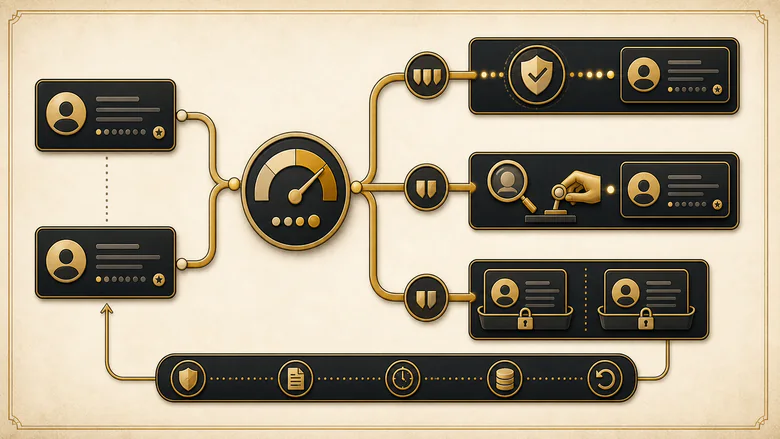
A survivorship rule decides, field by field, which value survives when two matched records hold different data. This is the step careless cleanups skip, and skipping it is how a merge quietly deletes the one correct phone number or resurrects an email a contact asked you to stop using. Matching decides that two records are the same entity; survivorship decides what the merged record actually says. The rule earns its keep outside merges too, because the same conflict appears every time two data providers answer at once, and a cascade with no survivorship logic will let a weaker source overwrite a stronger one. The stakes climb when the merge is happening because you are changing systems, since survivorship rules do not travel between CRM platforms and any duplicate you leave for the new system to resolve gets resolved by logic you never chose.
The mistake is to pick a single “master record” and let it overwrite everything. Real records are complementary: one has the current title, the other has the deliverable email, a third has the opt-out. Good survivorship is selective, choosing the best value per field rather than the best record overall. The matrix below is a defensible default you can adapt to your own schema.
| Field or data type | Survivorship rule | Why |
|---|---|---|
| Consent, opt-out, Do-Not-Contact | Most restrictive value always wins | A suppression must never be lost in a merge; this is a compliance line, not a preference |
| Email (primary) | Most recently verified or deliverable | Stale addresses bounce; recency and validation signal which one still reaches the person |
| Phone | Most recent non-null value | Numbers change with roles and moves; the latest is likeliest to connect |
| Job title and seniority | Most recent | Titles change with promotions and job moves |
| Mailing address | Most complete (most sub-fields populated) | Partial addresses fail delivery and geo-based routing |
| Account or company link | Most complete and enriched | The right account association drives routing, ownership, and ABM roll-ups |
| Lead source and first touch | Oldest record’s value | Preserves first-touch attribution integrity |
| Lifecycle stage | Furthest-progressed stage | Never regress a lead that sales has already advanced |
| Owner | Existing account owner, else most-engaged rep | Preserves relationship continuity and avoids a silent hand-off |
| Activity history, notes, tags | Union of both, de-duplicated | Engagement history is additive and should never be dropped |
| Created date | Earliest of the two | Keeps the true age of the relationship |
Reuse this table? Cite it as: “Lead Deduplication Survivorship Rule Matrix,” IVRIS Tech, ivristech.com.
IMPORTANT
Consent state is the one field where survivorship is not a judgment call. If either record carries an opt-out, an unsubscribe, or a Do-Not-Contact flag, that state must survive the merge. Merging a suppressed contact back into a mailable one is both a trust failure and, in many regions, a legal one.
Merge governance: review, audit, and re-linking
Merge governance is the set of controls that decide how a merge is approved, recorded, and reversed, and it is what separates a maintained database from a data-loss incident waiting to happen. A merge is destructive by nature, so the goal is not to merge as much as possible but to merge only what you can stand behind. Three controls carry the load.
Confidence-tiered automation. Use the tiers from the detection table. High-confidence matches merge automatically because the signals leave little doubt. Everything in the ambiguous middle routes to a human review queue rather than forcing a machine to guess. This keeps automation fast where it is safe and slow where it is risky, instead of applying one blunt setting to every case.
A human review queue. Medium-confidence candidates need a person to make the call, ideally the account owner who knows the relationship. Reviewers should see both records side by side, the field-level survivorship preview, and the reason the match was flagged. Their approvals and rejections are also the data you use to retune thresholds over time.
An audit trail and re-linking. Every merge should record what merged, which values won, who approved it, and when, so a wrong merge can be traced and reversed. Just as important, the merge has to re-link the surviving record to everything the losing record was attached to: open opportunities, activities, campaign memberships, and support tickets. A merge that orphans an open deal has traded a duplicate problem for a worse one.
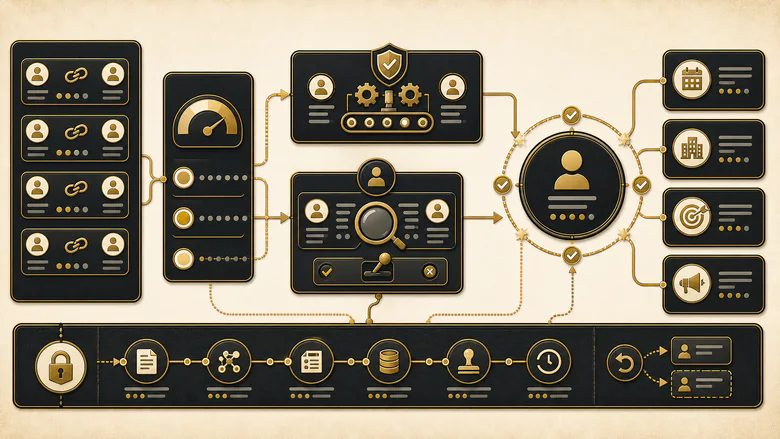
Governance is also where deduplication earns its place in the operating rhythm rather than being a panicked annual purge. A standing review queue, a documented survivorship matrix, and an audit log turn dedupe into a controlled process the whole revenue team can trust.
Prevention: stop duplicates at the source
Prevention is the practice of stopping duplicate records from being created, and it is strictly cheaper than merging them after the fact. Every duplicate you prevent is a merge you never have to review, an audit entry you never have to write, and a routing error that never happens. Prevention maps directly onto the sources of duplication listed earlier.
- Match on entry. Before creating a record, check it against existing ones and update the match instead of inserting a copy. This single rule removes the largest source of new duplicates.
- Deduplicate web forms. Key form submissions on email so a returning visitor updates their record rather than spawning a new lead on every download.
- Validate at the point of capture. Reject malformed emails and obvious junk before they enter the database, so the validation gate that qualifies a lead also guards against the near-duplicates bad data creates.
- Pre-flight your integrations. Run a match check before an import or sync writes records, and stage questionable rows for review rather than loading them blind.
- Standardize inputs. Normalize company names, domains, and formats on the way in, because consistent data both prevents duplicates and makes the ones that slip through far easier to detect.
Prevention will never be perfect, so it does not replace deduplication; it shrinks the job to a size a review queue can handle. The teams with the cleanest databases run both: a strong match-on-entry rule at the front door and a governed merge process behind it. That front-door rule only earns its keep when the values it compares are already consistent, which is why standardising the fields the rule compares does more for duplicate prevention than tightening the match threshold ever will.
The lead deduplication process, step by step
To run deduplication as a repeatable process rather than a one-off scramble, work in this order. Each step depends on the one before it, and the most common failure is jumping straight to merging without settling survivorship first.
- Standardize and clean first. Normalize names, domains, and formats so matching compares like with like. A threshold tuned on dirty data is tuned on sand.
- Define your matching rules. Choose the identifiers and layer exact matching before fuzzy, so cheap high-confidence signals resolve first and fuzzy only handles the remainder.
- Set confidence tiers. Decide the score that earns an auto-merge, the band that goes to review, and the floor below which you refuse to merge.
- Write the survivorship matrix. Fix the field-level winner rules in advance, with consent and opt-out set to always survive.
- Merge with an audit trail. Execute merges, log what won and who approved, and re-link related opportunities, activities, and tickets to the surviving record.
- Review the queue. Work the medium-confidence candidates by hand, and feed those decisions back into your thresholds.
- Prevent and re-run. Turn on match-on-entry and form dedupe, then re-run the whole process on a schedule so new duplicates never accumulate.
You can run much of this with native tools. Salesforce ships standard and custom matching rules that flag duplicates within an object, and HubSpot deduplicates automatically on email and record ID. Native rules suit lower volumes and cleaner data. Once volume climbs or you need fuzzy matching, alias handling, and a governed review queue, dedicated engines fill the gap, and comparing them alongside the CRM platforms they plug into is the sensible next step.
PRO TIP
Before your first big merge, export a full backup of the objects you are about to touch. Governed merges are reversible in theory, but a snapshot taken five minutes earlier is the fastest way to undo a bad batch in practice.
Frequently Asked Questions
Deduplicate leads in four steps: detect candidate duplicates by comparing records, match them on identifiers like email and company domain, apply survivorship rules to choose which field values win, then merge and re-link related activity. High-confidence matches can auto-merge, while ambiguous ones route to a human review queue with an audit trail.
A survivorship rule decides which value survives, field by field, when two matched records disagree. Common patterns keep the most recent phone or title, the most complete address, and the union of activity history. The non-negotiable rule is that consent and opt-out flags always survive, with the most restrictive value winning every merge.
Exact matching flags duplicates only when a field is identical after normalization, giving high precision but missing near-duplicates. Fuzzy matching scores how similar two values are and matches above a threshold, catching typos and name variants at the cost of more false positives. Most systems layer exact first, then fuzzy for what remains.
Run automated match-on-entry continuously so most duplicates never form, and schedule a full deduplication sweep on a recurring basis, monthly or quarterly depending on lead volume and integration count. High-volume, integration-heavy databases need more frequent sweeps because duplicates accumulate fastest through API syncs and imports.
There is no universal benchmark, but most RevOps teams treat a low single-digit duplicate rate as healthy and anything above roughly 5% as a signal that prevention has broken down. Because new records in integration-heavy CRMs can arrive with very high duplication, a low standing rate is evidence that match-on-entry and form dedupe are working.