
You signed a service-level agreement that promises sales a set number of qualified leads every month. Then a third of them bounce, go silent, or turn out to be a student, a competitor doing research, or a bot that filled in your form at 3 a.m. B2B lead validation criteria are the checks that confirm a lead is real, reachable, and a genuine fit before it ever reaches a rep.
Most teams jump straight from “form submitted” to “lead scored,” and that skipped step is where pipeline quality quietly dies. This guide gives marketing directors and marketing executives the exact gate to run first: nine criteria, two pass thresholds, and a clean line between validation, qualification, and scoring that almost nobody draws correctly.
Direct answer – b2b prospect validation criteria
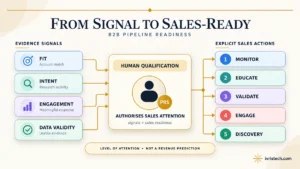
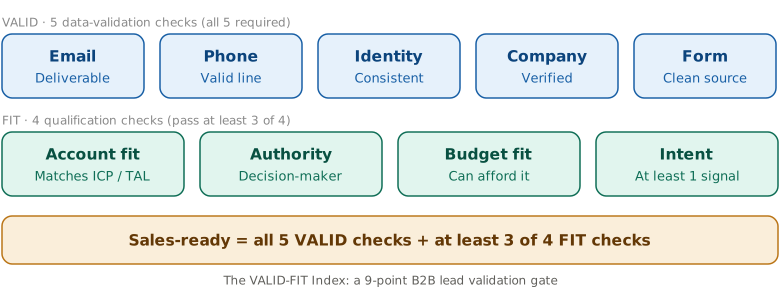
B2B prospect validation criteria are the checks that confirm a prospect is real, reachable, and a genuine fit before a rep works it. The VALID-FIT Index sets nine: five data checks (email deliverability, phone validity, identity consistency, company verification, form integrity) and four fit checks (target-account match, authority, budget and size fit, intent present). A prospect is sales-ready when it passes all five VALID checks plus at least three of the four FIT checks. Validation only asks whether the record is real; qualification and scoring run after it.
Key Takeaways
- Validation, qualification, and scoring are three separate gates. Validation asks “is this lead real?”, qualification asks “is it a fit worth a rep’s time?”, and scoring ranks the survivors. Collapsing them is the root cause of low-trust pipeline.
- The VALID-FIT Index is a nine-point gate: five data checks (VALID) and four fit checks (FIT). A lead is sales-ready when it passes all five VALID criteria and at least three of the four FIT criteria.
- B2B marketing data decays about 22.5% a year, so validation is a recurring gate, not a one-time form check.
- Speed is part of the handoff: a 2007 six-company study reported 21 times higher qualification odds for web-generated leads called at five minutes rather than 30.
- In 2026, 69% of B2B buyers still bring in a human to validate AI-generated insights (Gartner), so checking AI-sourced and auto-filled leads is now part of the gate.
What Is B2B Lead Validation?
B2B lead validation is the process of confirming a lead is real, reachable, and a genuine fit before it reaches sales. It runs at the form layer and just after, filtering out fake, duplicate, undeliverable, and off-target records so reps spend their time only on leads that can become pipeline.
The cost of skipping it is well documented. MarketingSherpa’s 2012 B2B Benchmark Report found that 73% of B2B leads are not sales-ready at the point they convert. Salesforce piles on from the other side: its State of Sales research shows reps already spend under 30% of their week actually selling. Hand them unvalidated leads and that thin selling time gets burned on dead numbers and wrong-fit accounts.
Here is the opinionated part: most validation advice stops at the email check. That is the expensive mistake. A deliverable email belonging to someone who cannot buy, at a company you do not sell to, is just a tidy record of a worthless lead.
Validation vs Qualification vs Scoring: The Three Gates
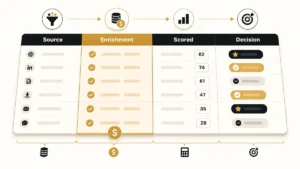
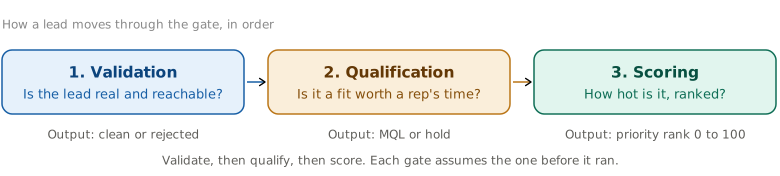
These three terms get used interchangeably, and that is exactly why pipelines clog. They are different gates that run in sequence. Validation is binary: real or not. Qualification is a fit judgment: worth a rep’s time or not. Scoring is a gradient that ranks the leads that already passed, and it is where your scoring model assigns point values to decide who is hottest.
| Gate | Question it answers | Binary or gradient | When it runs | Output |
|---|---|---|---|---|
| Validation | Is this lead real and reachable? | Binary (pass / fail) | At the form, on capture | Clean record or rejected |
| Qualification | Is it a fit worth a rep’s time? | Judgment (yes / no) | After validation, before routing | MQL or hold |
| Scoring | How hot is it, ranked against others? | Gradient (0 to 100) | After qualification | Priority rank for sales |
Read top to bottom and the order is obvious: you validate, then qualify, then score. Where this gate sits in your funnel is right at the entrance, before a lead is ever counted as pipeline. “Not yet pipeline” still has to be a state your CRM can report on, so decide which stage the record occupies while it waits before you build the gate itself.
IMPORTANT
A high lead score on an unvalidated record is worse than no score at all, because it tells a rep to call with confidence on data nobody checked.
Data Validation Criteria: Is the Lead Real and Reachable?
Data validation criteria confirm a lead’s contact and company information is accurate, deliverable, and verifiable at the moment of capture. These five checks form the VALID half of the index, and they are the layer almost every scoring model silently assumes has already happened. Drawing that line cleanly matters because what fails validation outright versus what merely loses points as a negative signal are two different actions: a fake or undeliverable record is rejected here, while a real but poor-fit lead is simply scored down later. Validation guards the front door, but the back office still needs cleaning, which is the job of correcting the records already inside the CRM.
Email Deliverability
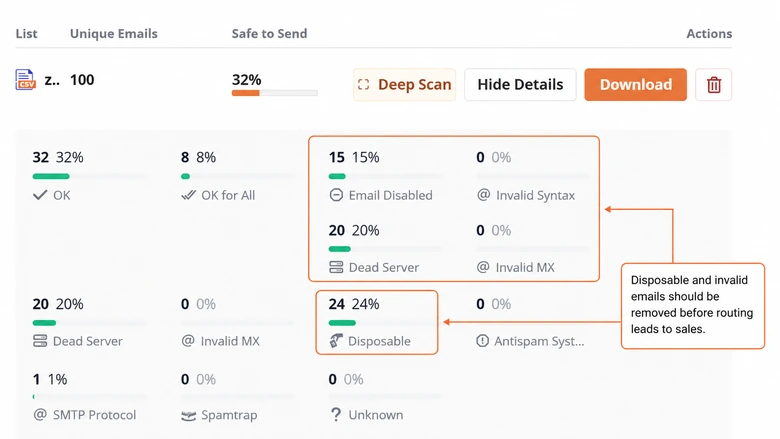
Start with the email, because it is your cheapest signal and your most common failure point. Verify the domain has a live mail server, the mailbox exists, and the address is not a disposable or role account. ZeroBounce’s benchmark data pegs invalid emails at around 20% of a typical list, with a healthy bounce rate sitting under 2%. One in five is a lot of wasted effort to catch at the door.
Phone and Identity
Check that the phone number is correctly formatted and dialable, and that the line type is not a known spam or burner range. Then confirm identity consistency: the name, the email, and the company domain should agree. Those same identifiers do double duty later, because matching duplicate leads to merge them keys on the very fields you validate here. A contact using a personal Gmail while claiming a senior role at a Fortune 500 is the classic pattern of a test entry or a gated-content grab. Catching these early pays off twice, because further down the funnel test entries and duplicates quietly inflate the denominator of every attendance and conversion rate they survive into. That same domain signal does double duty: it is also what lets you resolve that lead to its real company record, which is why a personal Gmail quietly breaks both checks at once. Testing whether a typed company name agrees with a domain is a comparison, not a lookup, so reduce both sides to a canonical form first or the check fails on a stray full stop.
Firmographic Match
Confirm the company is a real, operating business that matches your firmographic profile: industry, employee count, and region. Enrichment tools resolve a work email or domain to a verified company record, which also fills the gaps a short form left blank. This step turns “someone filled in a form” into “a named account you can actually sell to.” Once it’s a named account, weighting it by revenue range is what moves it up or down the priority list. The Popl-RocketReach event enrichment deal moves that same account-resolution step into exhibitor research before a conference begins.
Form Integrity
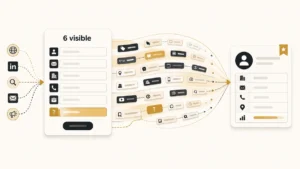
The form itself is a validation surface. Block freemail and disposable domains on business-critical forms, run a honeypot field to catch bots, and make sure hidden fields are capturing source and UTM data correctly. When that capture breaks, you lose the attribution you validate and route on. The same captured fields are what a Salesforce assignment rule reads to choose an owner, so a broken field quietly sends the lead to the wrong queue. Hidden fields that silently drop UTM data are one of the most common reasons a “clean” lead arrives with no usable source.
| VALID criterion | What to check | Pass threshold | Why it matters |
|---|---|---|---|
| Email deliverability | Live MX, real mailbox, not disposable or role-based | Deliverable and non-disposable | Undeliverable emails waste touches and hurt sender reputation |
| Phone validity | Correct format, dialable, line type not a spam range | Valid and dialable | Dead numbers inflate “contacted” with zero real reach |
| Identity consistency | Name, email, and company domain agree | No mismatch | Catches bots, test entries, and personal-email fraud |
| Company verification | Firmographic match to a real, operating business | Match found in a firmographic source | A lead with no verifiable company cannot be an account |
| Form integrity | Clean source, UTM intact, honeypot not tripped | Clean source and no spam flag | Broken capture means unattributable, often bot, leads |
You do not have to build any of this by hand. Enrichment and verification platforms run most of the VALID checks at the point of capture:
PRO TIP
Validation is not a one-time event. B2B marketing data decays about 22.5% a year as people change jobs and companies, so the teams that recalibrate their model and re-check records on a schedule keep a far higher share of reachable leads than teams that validate once.
Lead Qualification Criteria: Is the Lead a Genuine Fit?
Lead qualification criteria measure whether a validated lead matches your ideal customer profile, holds buying authority, and shows real intent. These four checks form the FIT half of the index, and a lead must pass at least three of them to earn a place on a rep’s calendar. When the lead is a senior buyer, those same checks need re-weighting, which is what executive outreach qualification criteria do, pushing seniority and economic authority above budget and timing.
Target Account and ICP Match
Fit starts with the account, not the person. Does the company sit inside your ideal customer profile or on your target account list: right industry, right size band, right region? An off-ICP lead converts far worse than an on-ICP one no matter how engaged it looks, which is why account match is the first FIT check. Turning that yes-or-no match into a graded number is the job of an ICP scoring rubric that grades fit on a 0-100 scale, scoring the account on weighted firmographic, technographic, and intent pillars so “on-ICP” becomes an 86 or a 64 instead of a coin flip. That same account-fit test is also the first of five signals in a B2B sales reset classification, where fit decides which tier an account lands in before any intent signal is weighed.
Authority
Map the contact’s title to a role in the buying committee: decision-maker, influencer, champion, or blocker. A coordinator downloading a guide is not the same lead as a VP requesting a demo. You do not need a C-level contact to qualify, but you do need a credible path to one. The same fit bar applies to leads that arrive from an outside provider, which are not pre-qualified just because you paid for them.
Budget and Size Fit
Confirm the company is the kind that can afford and absorb your solution, using revenue or headcount as a proxy when an explicit budget is not on the table. Routing a ten-person startup into an enterprise sales motion wastes everyone’s time and skews your win-rate math.
| FIT criterion | What to check | Pass threshold | Why it matters |
|---|---|---|---|
| Target-account match | Industry, size band, and region vs ICP or TAL | On the target list or inside the ICP band | Off-ICP leads convert far worse regardless of activity |
| Authority | Title maps to a buyer, influencer, or champion | Decision-maker or a credible path to one | A coordinator cannot approve; routing them stalls the deal |
| Budget and size fit | Revenue or headcount can absorb your solution | Inside your serviceable size band | Under-sized accounts churn or never close |
| Intent present | At least one first-party or third-party signal | One or more qualifying signals | Fit without intent means the timing is wrong |
Frameworks That Formalize Fit
You do not have to invent qualification from scratch. Four established frameworks turn fit into a repeatable script, and the right one depends on your deal size and sales motion.
| Framework | What it stands for | Best for | Watch-out |
|---|---|---|---|
| BANT | Budget, Authority, Need, Timeline | Fast inbound triage | Can disqualify good early-stage buyers with no budget line yet |
| MEDDIC | Metrics, Economic buyer, Decision criteria, Decision process, Identify pain, Champion | Complex, high-value deals | Heavy for self-serve or low-value motions |
| CHAMP | Challenges, Authority, Money, Prioritization | Challenge-led discovery | Needs disciplined reps to run consistently |
| FAINT | Funds, Authority, Interest, Need, Timing | Early buyers before a budget exists | Looser than BANT on commitment |
Intent and Engagement Signals: Is the Lead Actually Buying?
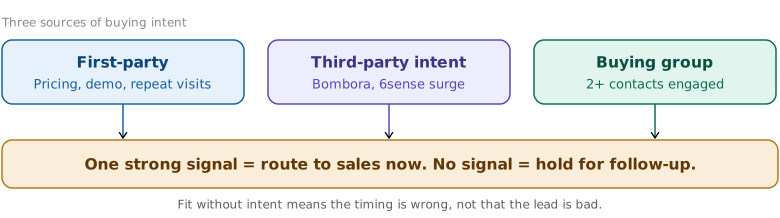
Intent signals show active buying interest through content consumption, third-party research data, and coordinated engagement from more than one person at an account. Fit without intent means the timing is wrong, so this is the check that decides route now or hold.
First-Party Engagement
Your own properties give the cleanest read: pricing-page visits, demo requests, repeated return visits, and case-study or comparison downloads. These actions are owned data, not inferred, which makes them the highest-trust intent you have. Supademo’s demo-agent pattern adds a richer owned signal to that list: what product proof the buyer asked to see before agreeing to a live sales call.
Third-Party Intent Data
Providers like Bombora and 6sense detect when an account is researching your category across the wider web, before they ever land on your site. Forrester’s B2B intent-data survey found over 85% of companies using intent data reported business benefits. Treat it as an early warning, then confirm with first-party signals before routing.
Buying-Group Engagement
B2B purchases are rarely a solo act. Two or more engaged contacts from the same target account is a stronger signal than one very active individual, because it shows the buying committee is forming. Multi-threading is both an intent signal and a qualification one.
AI has made this messier. A May 2026 Gartner survey of 645 B2B buyers found 69% still bring in a human to validate AI-generated insights. When an AI agent or an enrichment tool hands you a “high-intent” lead, treat that as an input to your gate, not a replacement for it.
Validating Leads from LinkedIn and Paid Forms
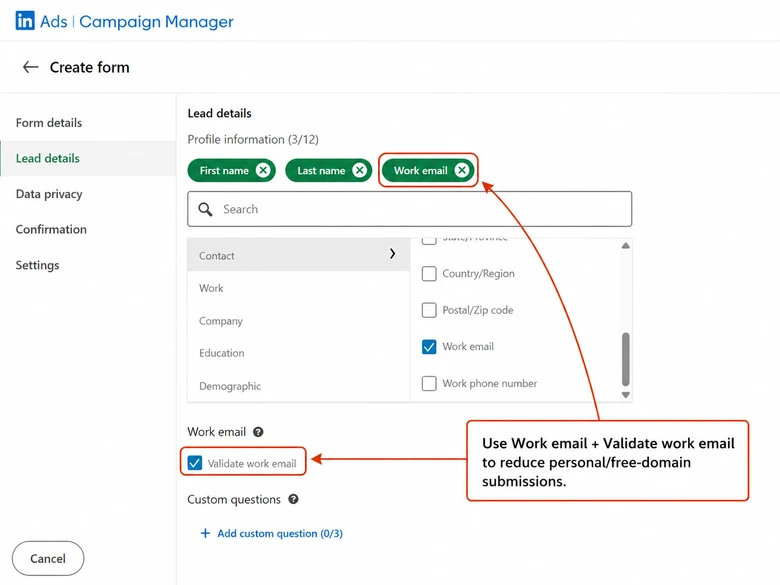
LinkedIn lead validation criteria add one step: confirm the auto-filled contact details map to a real, current role before you treat the lead as qualified. LinkedIn Lead Gen Forms pre-fill from the member’s profile, which lifts conversion volume but quietly lowers data quality.
Why Auto-Fill Inflates Volume
Pre-filled forms are easy to submit, so you collect more leads, including accidental and low-intent ones. The email LinkedIn pre-fills is often the member’s personal address, and the job title can be years out of date. Volume goes up; the share that passes a real validation check goes down.
Re-Validating Paid-Social Leads
Run every LinkedIn and paid-social lead through the same VALID checks as your website forms, then resolve the personal email to a business identity and company record. A lead you did not capture on your own site needs more validation, not less, because you have less context on how it arrived. One assumption sits underneath all five checks and is worth testing separately, since you can only validate a lead that actually arrived and a suppressed submission never reaches the criteria at all. The same reasoning applies before a campaign goes live, where less context means less evidence, and evidence rather than confidence is what makes a launch risk acceptable.
Setting the Gate: Thresholds, SLAs, and Routing
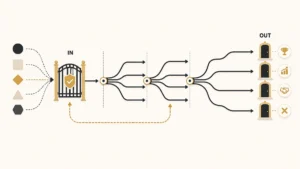
A lead validation gate defines the minimum criteria a lead must pass before marketing routes it to sales under a shared SLA. The VALID-FIT rule is the default setting: all five VALID checks, at least three of four FIT checks, then route; anything short holds for follow-up. The word doing the most work there is “route”, since what the routing chain does after the gate opens decides whether a validated lead reaches a named owner or stalls in an unowned state. Passing the gate is only the first half of the promise, though: a validated lead can still land on the wrong owner or sit unassigned, which is why it pays to confirm the validated lead reached the owner your rules intended rather than assume the route fired.
Choosing Your Pass Threshold
Five-of-five VALID is non-negotiable, because a lead that fails any data check is not a lead yet. The three-of-four FIT bar is where you tune for volume against quality: tighten to four-of-four when sales capacity is scarce, loosen toward two-of-four when you are opening a new territory and want reps talking to more of the market. Watch what that dial does downstream before you turn it, because loosening the fit bar shows up as more bookings and fewer accepted opportunities, which reads as a win on every dashboard that stops at the meeting. Routing is marketing’s half of the job; the sales-acceptance step that comes next is where a rep formally agrees the lead is worth working and starts the follow-up clock.
The Marketing-to-Sales SLA
The gate only works if both sides agree on it in writing. Marketing commits to a definition of a pass; sales commits to working every lead that clears it within a set time. That contract is the heart of the handoff from marketing-qualified to sales-qualified, and it depends on the operating cadence that keeps both teams honest about whether the bar is set right.
Routing and Speed
Once a lead clears the gate, route it promptly. The 2007 MIT and InsideSales Lead Response Management study reported that the odds of qualifying a web-generated lead by phone were 21 times higher at five minutes than at 30 across six companies. The result is dated and does not guarantee the same multiplier in another funnel, but a manual review queue still adds avoidable delay.
Workflow · 5 min
How to validate a B2B lead before it reaches sales
Run every inbound lead through one gate so only real, on-fit, intent-backed leads reach a rep.
Screen at the form
Block freemail and disposable domains, require a business email, and run a honeypot field so bots fail before they enter your database.
Verify the contact data
Check email deliverability, phone validity, and that the name, email, and company domain agree. Reject any record that fails a check.
Match the company to your ICP
Enrich the domain to a real company record and confirm industry, size, and region fit your ideal customer profile or target account list.
Check authority
Map the contact’s title to the buying committee. Flag decision-makers and influencers; hold pure end-users for a follow-up track.
Confirm at least one intent signal
Look for a first-party action, a third-party surge, or a second engaged contact at the account before you route.
Route or hold
Pass all five VALID checks plus three of four FIT checks, route to sales instantly. Anything short goes to a follow-up sequence.
IMPORTANT
For a marketing director, this gate is the single lever that protects the SLA you signed with sales. Every lead that clears it on agreed criteria is a lead sales cannot blame on marketing.
Common Lead Validation Mistakes Marketing Leaders Make
The most common B2B lead validation mistakes are validating too late, trusting self-reported data, and never re-validating as records decay. Each one quietly erodes the trust between marketing and sales that the gate exists to protect. The second mistake has scaled since these gates were designed, because a chat widget turns self-reported data into a high-volume input and writes budget and authority answers into the same fields your enriched firmographics live in.
Validating After the Handoff
If the first time anyone checks a lead is when a rep tries to call it, you have moved the cost of bad data onto your most expensive team. Validate at the form, not at the dial. The point of the gate is to fail cheap.
Treating a Complete Form as a Qualified Lead
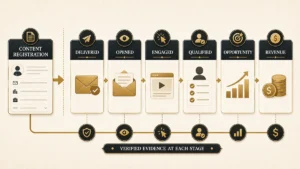
A fully filled-in form feels like a win, but completeness is not fit. A real person at the wrong company, and a right-fit company represented by a junior contact with no intent, will both complete your form. Run them through FIT before you celebrate. The same rule applies to third-party registrations: content syndication evidence stops at registration unless later stages are observed.
Ignoring Data Decay
Validation has a shelf life. With B2B data aging out at over a fifth per year, a clean list is a moving target, and a record that cleared the gate last quarter may already be unreachable. Build re-validation into your cadence so the gate keeps meaning something six months after the form fill.
Frequently Asked Questions
Validate data first, then qualify fit. Confirm the lead is real and reachable, match it against your ideal customer profile and target account list, verify the contact holds buying authority, and check for at least one intent signal before routing to sales. A lead missing any data check is not ready.
Five factors define a qualified B2B lead: target-account fit (does the company match your ICP), authority (is the contact a decision-maker or influencer), budget or company-size fit, a verified and reachable contact record, and at least one genuine buying signal. Miss any one and the lead is not yet sales-ready.
Lead scoring assigns numeric point values to a lead’s firmographic, behavioral, and intent signals to rank readiness, usually on a 0 to 100 scale with MQL and SQL thresholds. It runs after validation and qualification, ranking only the leads that already passed the gate rather than deciding whether they belong there.
Lead qualification in B2B is the process of deciding whether a validated lead is worth a salesperson’s time. It tests fit (does the company match your ICP), authority (can the contact buy or influence), and intent (are they showing buying signals). Leads that pass become marketing-qualified and move toward sales.
Prospect validation is the gate that confirms a B2B prospect is real, reachable, and a genuine fit before a rep works it. It runs the five VALID data checks first, then the four FIT checks, rejecting fake or undeliverable records and holding poor-fit ones. It happens at the form, ahead of qualification and scoring.
Lead validation confirms a lead is real and reachable, a binary pass-or-fail check on data quality and fit. Lead scoring ranks the leads that already passed, assigning point values to firmographic and behavioral signals on a 0 to 100 scale. Validation is the gate; scoring is the ranking that happens after it.