Most manufacturers build an ideal customer profile that fits half the companies in the country. “Industrial firms, 100-plus employees, based in the US” is not a profile; it describes roughly 200,000 businesses, and your sales team knows it. So they ignore the document and chase whatever quote requests land in the inbox.
An ideal customer profile for manufacturing only earns its keep when it is specific enough to disqualify. In industrial B2B, the firmographics everyone starts with (industry, revenue, headcount) are the least predictive part. The certifications a plant holds, the machines on its floor, and the events reshaping its supply chain tell you far more about whether it will buy. Gartner puts the typical complex B2B purchase in the hands of six to ten decision-makers, so you are not profiling one buyer. You are profiling a committee inside a factory.
This guide gives you a named scoring framework (the FORGED scorecard), three worked examples, a fill-in template, and the exact steps to build a manufacturing ICP your reps will actually use.
Direct answer – What is an ideal customer profile for manufacturing?
An ideal customer profile for manufacturing is a data-backed description of the industrial companies most likely to buy, expand, and renew, scored across six weighted dimensions rather than just industry and size. The FORGED scorecard scores Firmographics, Operations, Regulatory, Geography, Equipment, and Demand triggers into a 0-100 composite, with 70-plus routed to sales. Certifications and installed equipment predict fit better than headcount, and a real profile also names the manufacturers you will decline.
Key Takeaways
- A manufacturing ICP scores six dimensions, not just industry and size. Certifications and installed equipment predict fit better than headcount.
- Keep three things separate: the ICP (which companies to target), the buyer persona (the people inside), and TAM/SAM/SOM (how many exist).
- The FORGED scorecard turns fit into a 0-100 number with a 70-plus “route to sales now” threshold, so qualification stops being a gut call.
- Job shops, OEMs, contract manufacturers, and process plants buy differently. Segment before you score.
- Triggers beat static attributes for timing. A reshoring project or an ERP migration signals intent that a perfect firmographic match never will.
What an Ideal Customer Profile for Manufacturing Is (and Isn’t)
An ideal customer profile for manufacturing is a data-backed description of the industrial companies most likely to buy, expand, and renew, scored on firmographics, certifications, installed technology, geography, and active operational triggers. It describes a company, not a person, and it is built to exclude as much as to include.
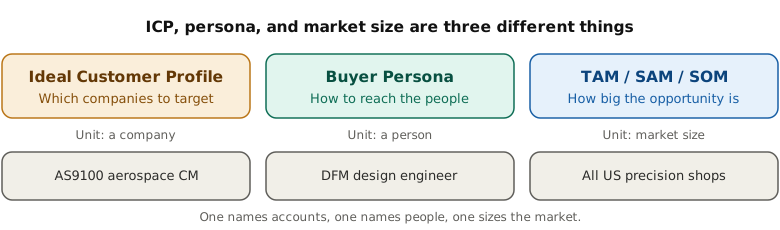
The distinction that trips up most teams is the gap between an ICP and the other two targeting artifacts it gets confused with. Your ICP is not your buyer persona, and neither one is your market size. A clean manufacturing ICP keeps all three in their lanes, because each answers a different question and feeds a different part of the go-to-market plan. This is the same company-level fit that anchors a B2B go-to-market strategy before any channel or message is chosen.
| Concept | Question it answers | Unit | Manufacturing example |
|---|---|---|---|
| Ideal Customer Profile | Which companies should we target? | Company / account | AS9100-certified aerospace contract manufacturers, $20M-$100M revenue, US-based, running an MES |
| Buyer Persona | How do we speak to the people inside? | Person / role | A design engineer focused on DFM; a procurement lead under reshoring pressure |
| TAM / SAM / SOM | How big is the opportunity? | Market size | All US precision machining firms, then those needing your process, then those you can realistically win this year |
Why a Generic Manufacturing ICP Fails
A profile that fits 200,000 companies cannot route a single lead. When the criteria are “manufacturer, mid-size, US,” every inbound inquiry looks equally qualified, so reps fall back on instinct and marketing spends budget on accounts that were never going to close. The cost is not abstract: a complex industrial deal can run many months from first touch to purchase order, and a quarter spent on a poor-fit account is a quarter you do not get back.
The fix is a profile with teeth. Gartner found that 74% of B2B buying teams hit unhealthy internal conflict during a purchase, and groups that reach consensus are 2.5 times more likely to call the deal high quality. You cannot control that committee, but you can refuse to enter deals where the fit is weak and the friction is high. A real ICP names who you will not sell to, and that anti-profile is where most of its value lives.
The FORGED Scorecard: 6 Dimensions of a Manufacturing ICP
The FORGED scorecard scores a manufacturing ICP across six weighted dimensions: Firmographics, Operations, Regulatory, Geography, Equipment, and Demand triggers. Each dimension is scored in bands, the bands roll up to a 0-100 composite, and the composite sorts every account into a tier with a clear next action. The Firmographics dimension is where company revenue lives, and turning that revenue into scored bands follows the same roll-up logic. Those firmographic fields only score once they are filled, which is the job of the enrichment that populates those firmographic fields.
The framework exists because generic ICP models built for software miss what actually separates industrial buyers. Two plants with identical revenue and headcount are not the same prospect if one holds the certification your product requires and the other does not. Scoring fit and intent as separate signals is the same logic behind good B2B lead scoring criteria, applied one level up at the account.
| Dimension | Core-ICP fit (full points) | Adjacent fit (partial) | Anti-profile (0 / disqualify) | Weight |
|---|---|---|---|---|
| F — Firmographics | Target NAICS, revenue and headcount inside your proven band, multi-plant | Adjacent NAICS or edge of the revenue band | Wrong industry, far below minimum, or 10,000-plus enterprise | 15 |
| O — Operations | Right type (discrete or process), mid-volume, OEE tracked, MES or ERP in place | Right type, no MES yet | No process match, fully manual shop floor | 20 |
| R — Regulatory | Holds the cert you require (AS9100, IATF 16949, ISO 13485, FDA 21 CFR 820) | ISO 9001 only, or cert in progress | No quality cert, or a cert mismatch for your market | 15 |
| G — Geography | Inside serviceable territory, reshoring or nearshoring posture | Serviceable but distant | Outside territory, committed offshore | 15 |
| E — Equipment | Runs the machines you serve (5-axis CNC, injection molding), uses CAD/PLM, investing in automation | Partial equipment match | No relevant equipment, no digital tooling | 15 |
| D — Demand triggers | Active trigger: line scale-up, reshoring, ERP/MES migration, vendor consolidation, NPI | Soft signal or early interest | No trigger, status quo, just bought a competitor | 20 |
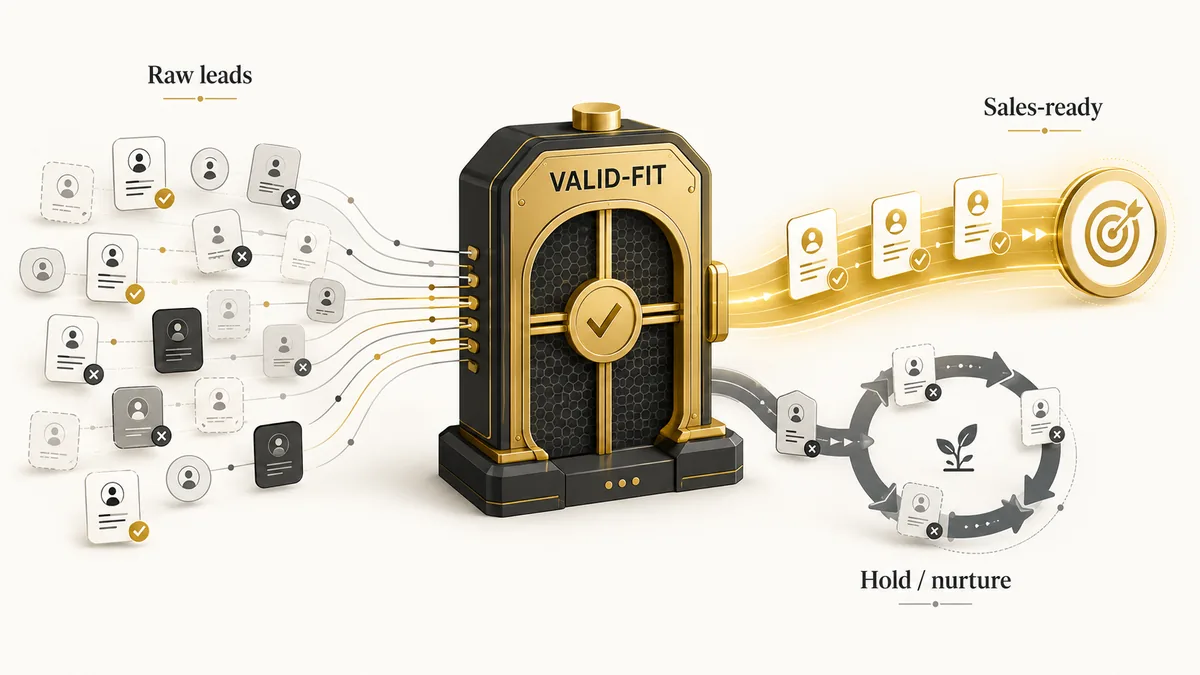
FORGED Score = F + O + R + G + E + D (0 to 100; Tier-1 ≥ 70)Score every target account and three tiers fall out: 70 and above is Tier-1, your core ICP, route it to sales now. 45 to 69 is Tier-2, a watch-list candidate worth tracking for a trigger. Below 45 is out of profile, and saying so out loud is the point. The two manufacturing-specific dimensions, Regulatory and Equipment, are what generic frameworks leave out, and they often carry more predictive weight than the firmographics a software ICP leads with. That software-side counterpart is its own build: a B2B SaaS ICP scoring rubric swaps certifications and machines for tech stack and product-usage intent while keeping the same weighted, tier-based shape.
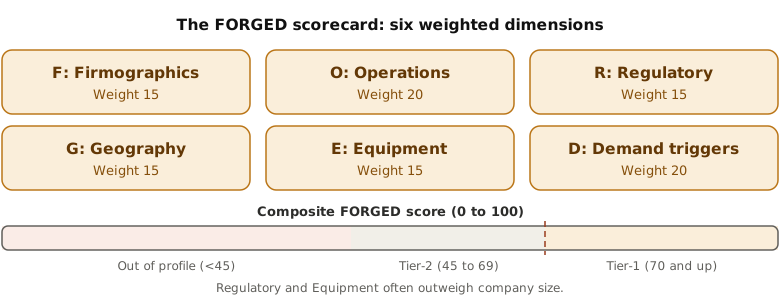
The weights above are a starting point, not gospel. The fastest way to calibrate them is to score your last 20 to 30 closed-won accounts, then check which dimension actually separated the wins from the near-misses. If every won account held the same certification, push Regulatory higher. If geography never mattered because you ship nationwide, drop its weight and move those points to Demand. The goal is a scorecard tuned to your own win data, not a generic template, and the tuning takes an afternoon. Re-run it once a year, because the dimension that predicts your best customers shifts as you add capacity, chase a new vertical, or win a certification that opens a market you could not serve before.
Why Regulatory and Equipment Carry the Weight
Certifications are a near-perfect fit filter because they are expensive, audited, and specific to an industry. A supplier that needs AS9100 will not seriously evaluate a shop that only holds ISO 9001, no matter how good the website looks. The same logic runs through installed equipment and technology. Deloitte’s 2026 Manufacturing Industry Outlook found that equipping workers to run smart-manufacturing systems was the top concern for more than a third of the 600 executives it surveyed, which tells you that a plant’s technology maturity is both a fit signal and a pain you can speak to.
PRO TIP
Weight Equipment and Regulatory above headcount. A 40-person AS9100 job shop running 5-axis cells often outranks a 600-person commodity stamper with no relevant cert. Size feels like signal; in manufacturing it usually isn’t.
Why Demand Triggers Get the Highest Weight
Demand triggers earn the heaviest weight because they answer the question fit cannot: not whether an account could buy, but whether it is about to. Reshoring and foreign direct investment announced 244,000 US manufacturing jobs in 2024 and more than 2 million since 2010, according to the Reshoring Initiative. Every one of those projects is a plant rethinking suppliers, capacity, and systems at the exact moment a new vendor can get in.
In manufacturing, a buying trigger beats a static attribute every time. A perfect-fit plant with no active project is a future customer. An average-fit plant mid-reshoring is a deal this quarter.
Manufacturing ICP Segments: Job Shop vs OEM vs Contract Manufacturer
Manufacturing buyers fall into distinct segments, job shops, OEMs, contract manufacturers, and process plants, and each one carries a different volume profile, buying committee, sales cycle, and dominant trigger. Scoring a job shop and an OEM against the same weights produces noise, so segment first, then apply the FORGED bands within the segment. Those first three attributes do double duty, because the same three inputs decide whether a segment justifies the operational build that scoring, routing and reporting all depend on.
| Segment | Typical volume / mix | Discrete or process | Primary buying committee | Sales cycle | Dominant trigger |
|---|---|---|---|---|---|
| Job shop | High-mix, low-volume, custom | Discrete | Owner or GM, shop-floor lead | Shorter, project-based | Capacity bottleneck, new contract win |
| OEM | Medium-to-high volume, own product line | Discrete | Engineering, procurement, operations | Long, multi-month | New product introduction, line expansion |
| Contract manufacturer (CM/EMS) | Varies by client program | Discrete | Quality, program management, procurement | Long, multi-stakeholder | Reshoring, customer audit, capacity add |
| Process plant | High-volume continuous | Process | Plant manager, quality, EHS | Long, compliance-gated | Compliance change, recipe or capacity change |
| Discrete assembly | High-volume repetitive | Discrete | Operations, supply chain | Medium-to-long | Throughput or OEE pressure, automation push |
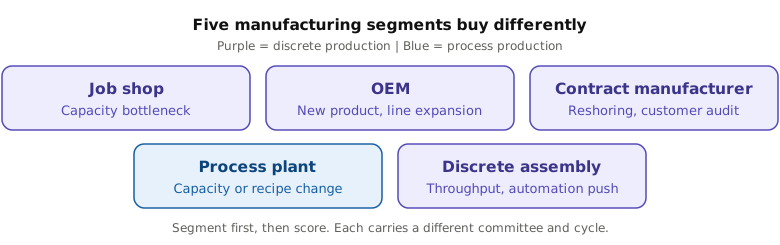
Segment choice also decides how you reach the account. A job shop owner answers a direct call; an OEM buying committee needs a coordinated, multi-contact motion closer to the account-based plays you would run against a named target list. The segment is the bridge between the static profile and the campaign.
Manufacturing ICP Examples (3 Worked Profiles)
A manufacturing ICP example pairs scored firmographics with named certifications, equipment, geography, and an active trigger. The three profiles below are illustrative composites, not specific companies, and each one is scored on FORGED so you can see how the tiers separate a strong fit from a borderline one.
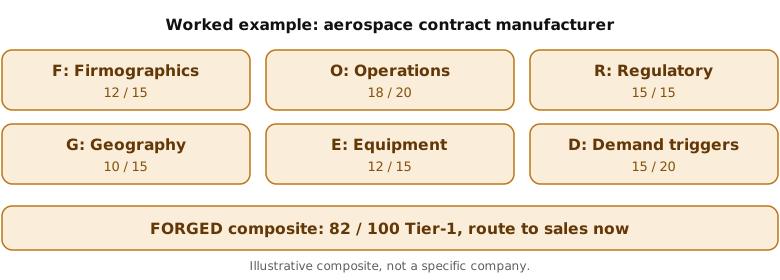
Example 1: Aerospace Contract Manufacturer (Tier-1, 82)
A US precision contract manufacturer, $40M revenue and 220 employees, holds AS9100 and runs 5-axis CNC cells with an MES on the floor. It just won a defense subcontract and is scaling a new line. It scores full marks on Regulatory, Equipment, Operations, and Demand, with strong Firmographics and Geography. Composite: 82, a clear Tier-1 that belongs in front of a rep this week.
Example 2: Food and Beverage Process Plant (Tier-1, 71)
A multi-site processor, $120M revenue, runs continuous process lines and is mid-way through a compliance-driven systems upgrade. It scores full marks on Operations and Demand, strong on Firmographics and Geography, partial on Regulatory if your cert focus is discrete-world (AS9100 or IATF). Composite: 71, Tier-1, but the partial Regulatory band tells the rep exactly which proof points to lead with.
Example 3: Metal-Fab Job Shop (Tier-2, 58)
A regional fabrication shop, $8M revenue and 45 employees, holds ISO 9001 and runs press brakes and welding cells with no MES. It has a capacity bottleneck but no funded project yet. It scores partial across most dimensions and low on Demand. Composite: 58, a Tier-2 worth tracking, and proof that not every company labeled “manufacturer” is a core-ICP fit. Tracking which of these accounts turn into pipeline is where account-based marketing metrics replace lead-level vanity numbers.
How to Build Your Manufacturing ICP (Step by Step)
To build a manufacturing ICP, analyze your won and lost accounts, score them on the six FORGED dimensions, isolate the pattern in your best accounts, write an anti-profile, and validate the draft with sales before you lock the threshold. The whole exercise takes a couple of focused hours with your CRM open.
Workflow · about 2 hours
How to build your manufacturing ICP
Turn your closed-deal history into a scored, sales-ready ideal customer profile for manufacturing.
Pull your best and worst accounts
Export your last 20 to 30 closed-won accounts plus a sample of closed-lost and churned ones. Twenty is the floor for patterns to appear.
Score each account on the six FORGED dimensions
Tag firmographics, operations profile, certifications, geography, equipment, and active triggers for every account, using the criteria table above as the rubric.
Find the Tier-1 pattern
Sort by composite score. The traits your 70-plus accounts share, a specific cert, an installed machine class, a recurring trigger, become your core weights.
Write the anti-profile
Document the disqualifiers your worst accounts shared: wrong cert, un-serviceable geography, sub-threshold volume, no budget authority. These set the zero-point bands.
Draft the ICP statement and template
Fill the one-page template and write the ICP-statement line. Name the segment: job shop, OEM, contract manufacturer, process, or discrete.
Validate with sales and lock the threshold
Walk the draft past two reps and one closer, adjust weights to what they see win, and set the Tier-1 routing threshold before you operationalize.
The order matters. Teams that skip the anti-profile end up with a feel-good document that approves everyone, and teams that skip sales validation build a model marketing believes and reps ignore. The threshold you set in the final step is the number that decides when a scored account becomes sales-ready, the same handoff logic that separates an MQL from an SQL at the lead level.
IMPORTANT
The anti-profile is not optional. If your ICP cannot name a type of manufacturer you will decline, it is a wish list, not a profile. Write down the disqualifiers and let reps cite them. A disqualifier only survives the next reorg if it is stored rather than remembered, which is why writing each disqualifier as a field, an operator, and a value matters more than agreeing on it in a room.
One more discipline keeps the model honest: the Demand dimension decays. A trigger that was hot two quarters ago is stale now, so re-score it on signal events rather than letting an old project prop up a score. Building that decay into the model is a core lead scoring best practice that applies just as cleanly at the account level.
The Manufacturing ICP Template (Fill-In)
A manufacturing ICP template is a one-page worksheet that captures each FORGED dimension, its target and anti-profile bands, the buying committee, and the composite score in a form you can fill in and reuse. It is the artifact every competitor on this topic promises and almost none actually ships.
Teams searching for an “ICP for manufacturing template” or one of its many long-tail variants, including the oddly specific “metaops ideal customer profile manufacturing,” all want the same thing: a structure they can complete, not another wall of prose. Here is that structure.
Fill one row per FORGED dimension, then map the committee and write the statement line:
- Per dimension (F, O, R, G, E, D): target criteria | anti-profile disqualifiers | score band (full / partial / zero)
- Buying committee: economic buyer (owner, GM, or CFO) | champion (often engineering) | technical evaluator (DFM or quality) | procurement | operations or plant-management blocker
- ICP statement line: “We sell to [segment] manufacturers with [certifications], running [equipment / MES], in [geography], showing [trigger], where [title] owns the budget.”
- Result: composite FORGED score, tier, and the next action
TEMPLATE
Download the FORGED scorecard: Use the editable workbook to score manufacturing accounts, map the buying committee, and generate an ICP statement your sales team can use.
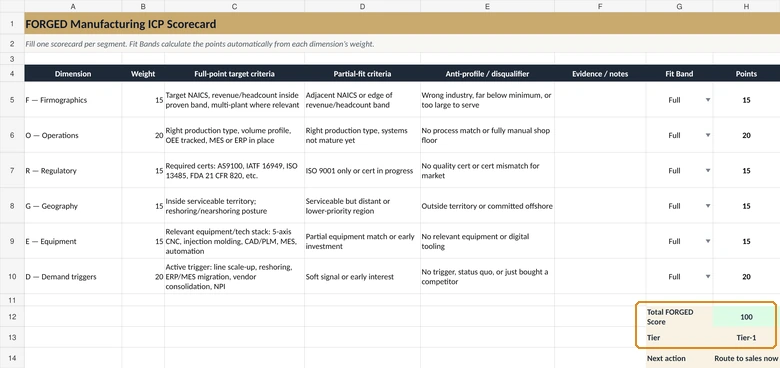
A worked statement reads like this: “We sell to discrete contract manufacturers with AS9100, running 5-axis CNC and an MES, in North America, scaling a new program, where the Director of Operations owns the budget.” That single sentence does more routing work than a five-page persona deck, because a rep can hold it in their head on every call.
Activating Your Manufacturing ICP (ABM, Content, Sales)
Activating a manufacturing ICP means feeding the scorecard into lead routing, account-based targeting, and content so only high-fit accounts consume budget and reach reps. A profile that lives in a slide deck changes nothing; a profile wired into the funnel changes what every team works on.
Three moves turn the document into pipeline. Route by tier, so Tier-1 accounts get a rep and Tier-2 accounts stay in marketing until a trigger fires. Build target lists from the FORGED criteria and run them as named-account campaigns. And shape content around the certifications and operational pains the profile surfaced, which is where you separate demand creation from demand capture for the accounts you most want to win. The ICP is the input; everything downstream gets sharper because of it.
Frequently Asked Questions
It should include six scored dimensions: firmographics (industry, revenue, headcount), operations profile (discrete or process, volume, systems), regulatory certifications, geography and supply-chain posture, installed equipment and technology, and active demand triggers. In manufacturing, certifications and equipment predict fit more reliably than company size, so weight them accordingly.
An AS9100-certified aerospace contract manufacturer, $20M to $100M in revenue, US-based, running 5-axis CNC and an MES, currently scaling a new defense line, where a Director of Operations owns the budget. On the FORGED scorecard that profile lands above 80, a clear Tier-1 account worth routing to sales immediately.
The four data layers are firmographic (industry, revenue, size), technographic (the tech and equipment in use), behavioral or situational (intent signals and triggers), and the buying-committee persona (the roles inside the account). A strong manufacturing ICP draws on all four rather than stopping at firmographics.
It is a one-sentence summary of exactly who you sell to. Use this fill-in line: “We sell to [segment] manufacturers with [certifications], running [equipment or MES], in [geography], showing [trigger], where [title] owns the budget.” If a rep can recite it, the profile is doing its job.
Export your last 20 to 30 closed-won, closed-lost, and churned accounts, then score each on the six FORGED dimensions. Isolate the traits your Tier-1 wins share, write an anti-profile of the disqualifiers your worst accounts had, draft the ICP-statement line, and validate the weights with sales before you lock the routing threshold.
No standard ICP method goes by that name. The phrase “metaops ideal customer profile manufacturing” is a search-term mashup that pairs an operations reference with ICP research. Whatever surfaced it, the work is the same: score industrial accounts on the FORGED dimensions in this guide, then validate the profile with your sales team.