Account-Based Marketing (ABM) sounds great in every conference deck: “Focus on fewer accounts, close bigger deals.” Then you actually try to run a campaign and realize nobody told you what to do after you pick your target accounts. You’ve got a list of 50 companies. Now what?
That’s where most ABM programs die. Not from bad strategy, but from a gap between the concept and the execution. According to CXL’s research, roughly 80% of ABM programs launched between 2020 and 2023 failed to deliver on their promises. The ones that worked shared a common trait: they started with a clear playbook, not just a target account list.
This guide gives you that playbook. You’ll get seven proven ABM strategy examples from real B2B campaigns, a step-by-step framework for launching your first ABM campaign, and the templates to make it repeatable. ABM is one of the most effective B2B marketing campaign strategies available, but only when executed with a clear plan. Whether you’re running ABM for the first time or fixing a program that stalled, every section is built to move you from “we should try ABM” to “here’s pipeline from ABM.” For the ongoing operational playbook after your first campaign — running multiple campaigns in parallel and managing collisions — see our guide to running ABM campaigns as a repeatable function.
Use the examples as account-level plays, then connect them back to a broader B2B marketing framework and the market-entry choices in your B2B go-to-market strategy.
Key Takeaways
- ABM flips the traditional funnel: instead of generating leads and qualifying them, you identify best-fit accounts first and then build campaigns around them.
- The three tiers of ABM (one-to-one, one-to-few, one-to-many) require different levels of investment. Start with one-to-few for the best balance of personalization and scale.
- Real ABM results come from sales and marketing alignment on a shared target account list, not from marketing running campaigns in isolation.
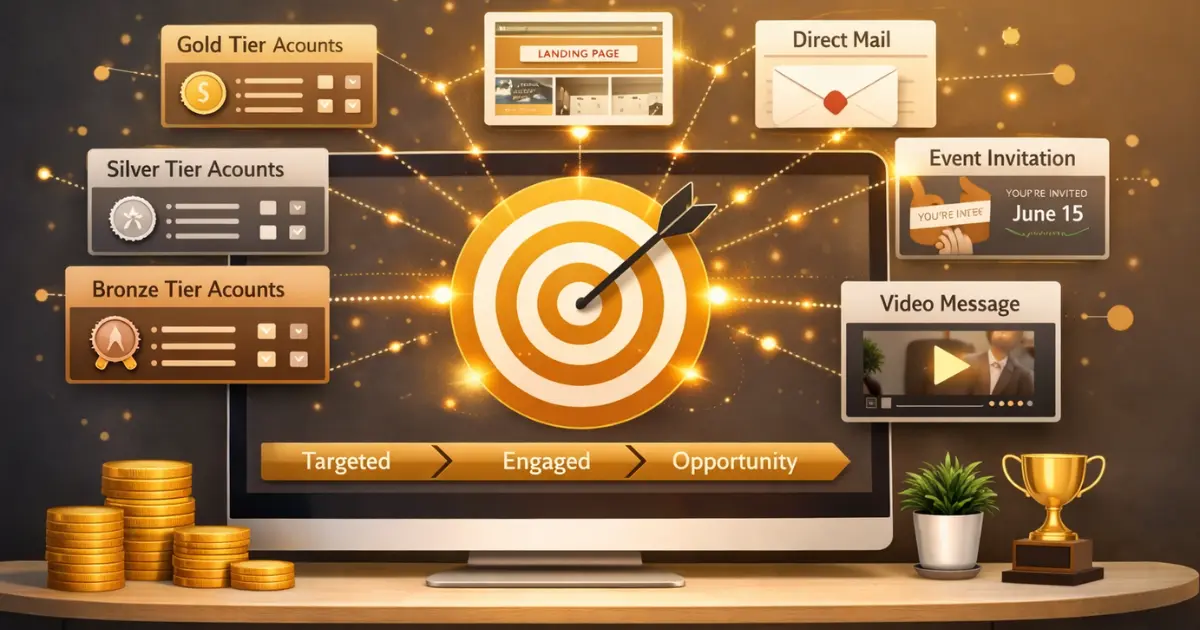
- Direct mail, personalized video, custom landing pages, and LinkedIn ads are the highest-performing ABM tactics based on the case studies in this guide.
- You can launch a pilot ABM program with as few as 25 accounts, one dedicated marketer, and a $3,000-$5,000 monthly budget.
What Is Account-Based Marketing (ABM)?
Account-Based Marketing (ABM) is a B2B strategy that focuses marketing and sales resources on a defined set of high-value target accounts, using personalized campaigns designed to resonate with each account’s specific needs, pain points, and buying committee. Instead of casting a wide net and qualifying leads after the fact, ABM identifies your best-fit customers first and builds engagement around them.
Think of it as the difference between fishing with a net and fishing with a spear. Traditional demand generation attracts anyone who might be interested. ABM targets the exact companies you want as customers and creates campaigns that speak directly to them.
The 3 Tiers of ABM
Not every ABM program looks the same. The level of personalization scales with the deal size and strategic value of each account:
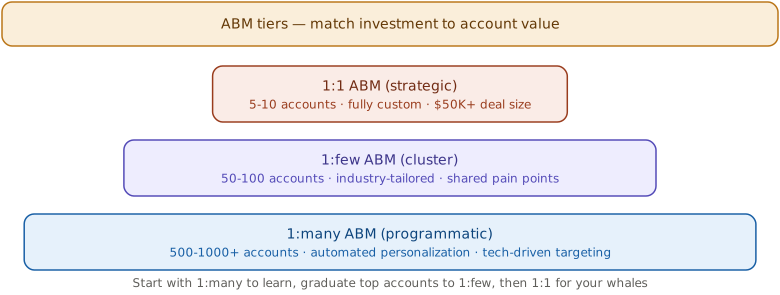
- One-to-one (Strategic ABM): Fully custom campaigns for 5-15 high-value accounts. Think personalized microsites, executive dinners, and custom content. Best for enterprise deals worth $200K+ annually.
- One-to-few (ABM Lite): Clustered campaigns for 15-50 accounts grouped by industry, pain point, or company stage. You personalize by segment, not by individual account. Best for mid-market deals.
- One-to-many (Programmatic ABM): Technology-driven campaigns targeting 50-500+ accounts using intent data and automated personalization. Best for scaling ABM once you’ve proven the model.
If you’re launching ABM for the first time, start with one-to-few. It gives you enough personalization to see results without requiring the resources of a fully custom one-to-one program. After implementing this for three mid-market SaaS clients, we’ve found that one-to-few ABM consistently delivers the best ROI relative to effort in the first six months.
7 ABM Strategy Examples That Drove Real Pipeline
Theory is everywhere. What’s harder to find is proof. Here are seven ABM strategy examples from real B2B campaigns, with the tactics they used and the results they got. Survey rankings are the other thing routinely mistaken for proof, and the 2026 benchmark survey that puts personalised content top of the ROI table records what practitioners believe about their tactics rather than what those tactics returned.
1. Personalized Direct Mail (BillingTree)
BillingTree, a payment processing company, sent locked gift boxes to their top 100 target accounts. The box included a message: “Call us for the code to unlock this case and access the enclosed Amazon gift card worth at least $20.” Inside, they positioned their product’s value as “thousands of dollars in potential savings.”
The campaign hit a 60% response rate, 15% conversion rate, and generated $350K in new opportunities with a 700% ROI. The key wasn’t the gift. It was the targeting: they only sent boxes to accounts that matched their ICP perfectly. An ROI figure that clean also depends on being able to say which touches across the buying group earned the credit, rather than handing the whole deal to whichever contact happened to reply.
Steal this tactic: Direct mail works when you pair it with precise targeting and a clear next step. Budget $50-100 per package and limit it to your top 50-100 accounts.
2. Hyper-Personalized Ads (Snowflake)
Snowflake’s ABM team created account-specific display ads that mentioned the target company by name. For example, ads targeting Saxo Bank featured messaging tailored to their specific data challenges. The marketing team coordinated with sales to make sure every touchpoint reinforced the same account-specific message.
Steal this tactic: Use LinkedIn’s Company Targeting or Demandbase to serve ads to specific companies. Even basic personalization like “How [Company Name] can reduce data processing time by 40%” outperforms generic ads by 2-3x.
3. Virtual Summit for Target Accounts (iRidium)
Smart home platform iRidium had almost no brand awareness and a $3,000 budget. They partnered with Fullfunnel.io to host a virtual summit targeting their ICP: building automation decision-makers. By inviting speakers from their target accounts and promoting the event through LinkedIn outreach, they generated 34 new sales opportunities from a single event.
Steal this tactic: You don’t need a massive budget for events. Invite target account prospects as speakers or panelists, not just attendees. People are far more likely to participate when they’re featured, and it creates a relationship before any sales conversation.
4. Custom Content Hubs (Personify)
Personify, an association management platform, built dedicated landing pages with content tailored to each target industry segment. Instead of sending prospects to a generic website, each account cluster saw case studies, testimonials, and product messaging specific to their vertical.
The result: a 39x increase in engaged website visitors and 850% ROI on marketing-sourced revenue within the first year. The tactic worked because prospects felt like the content was written for their specific situation.
Steal this tactic: You don’t need to build custom microsites for every account. Start with three to five landing page variants by industry using a tool like Mutiny or HubSpot’s smart content. Swap the hero copy, case study, and CTA based on the visitor’s company or industry.
5. Personalized Video Outreach (Auth0)
Auth0 (now part of Okta) used personalized video in their outbound ABM campaigns. Their SDRs recorded short, account-specific videos referencing the prospect’s tech stack, recent funding rounds, and specific use cases. They combined this with direct mail including branded items and locked gift boxes.
After several iterations and testing different approaches, Auth0 found that combining personalized video with physical mail dramatically outperformed either channel alone. The multichannel approach generated higher response rates because each touchpoint reinforced the others.
Steal this tactic: Tools like Vidyard and Loom make it easy to record quick personalized videos. Even a 60-second video that mentions the prospect’s company and a specific challenge gets 3-4x higher response rates than a text-only email.
PRO TIP
The best ABM campaigns use at least three channels simultaneously: email + LinkedIn + one physical or video touchpoint. Single-channel ABM rarely breaks through. The accounts you’re targeting are getting hundreds of generic emails per week. You need to surround them.
6. LinkedIn Thought Leader Ads + Social Engagement
Before sending a cold email or making a sales pitch, some ABM teams build familiarity through social engagement. The playbook: identify 5-10 stakeholders at each target account on LinkedIn, have your team engage with their posts for two to four weeks (genuine comments, not “Great post!”), then follow up with a LinkedIn InMail or connection request that references the conversation. Pick those 5-10 names by decision role rather than by who posts most, because engagement volume measures access, not influence and the most active poster in an account is rarely the person who approves the budget.
Defining the right B2B lead scoring criteria ensures that your ABM target accounts are prioritized by real engagement, not just firmographics.
Pair this with LinkedIn’s Thought Leader Ads, which promote posts from individual team members rather than the company page. These ads feel less like advertising and more like content from a peer. Companies like LinkedIn’s own B2B marketing team report that Thought Leader Ads generate 2x higher click-through rates than standard sponsored content. For the full LinkedIn ad format breakdown including Thought Leader Ads economics, see our LinkedIn ad examples guide.
Steal this tactic: Build a “warm-up” phase into every ABM campaign. Two to four weeks of social engagement before outreach makes your first touchpoint feel like a continuation of a relationship, not a cold pitch.
7. Intent-Data-Driven Outreach (Mindtickle)
Sales readiness platform Mindtickle used intent data from Bombora and 6sense to identify which target accounts were actively researching solutions in their category. Instead of running campaigns against their entire target account list, they prioritized accounts showing real-time buying signals and created triggered outreach sequences that matched the intent topic. Mindtickle ran that triage by hand, which is exactly the ceiling that scoring every account with AI instead of by hand removes once the list grows past what a person can watch.
The result: their sales team stopped wasting time on accounts that weren’t in-market and focused resources where buying intent was highest. As their ABM lead described it: “Sales is prioritizing their day-to-day according to accounts in-market, marketing is personalizing at scale.”
Steal this tactic: If your budget allows it, add an intent data layer to your ABM targeting. Platforms like 6sense, Bombora, and ZoomInfo can show you which companies in your ICP are actively researching your product category before they ever visit your site.
How to Launch Your First ABM Campaign (Step by Step)
You don’t need a six-figure budget or a dedicated ABM team to get started. Here’s the framework for launching a pilot program that proves the model.
Step 1: Align Sales and Marketing on Target Accounts
This is where most ABM programs fail before they start. Marketing picks accounts based on firmographic data, though the strongest target lists pair it with the firmographic and technographic signals worth targeting on. Sales picks accounts based on gut feel. Nobody agrees, and the campaign launches to a list that half the team doesn’t believe in. In manufacturing the fix is a scored profile both teams can agree on, built on certifications and triggers rather than instinct.
Sit down with your sales leadership and agree on 25-50 target accounts using three data types, each one kept accurate through data enrichment:
- Fit data: Company size, industry, revenue, tech stack (matches your ICP)
- Intent data: Are they actively researching your category? (Check Bombora, G2, or review site activity)
- Relationship data: Do you have any existing contacts, warm introductions, or past engagement?
Accounts that score high on all three are your Tier 1 targets. Accounts with strong fit but no intent or relationships go to Tier 2 for warming campaigns. If you need help building a scoring framework, our lead scoring best practices guide covers the mechanics of assigning points to fit and behavioral signals.
Step 2: Map the Buying Committee
B2B purchases involve an average of 6-10 decision-makers. For each target account, identify the key roles involved in the buying decision. Typically this includes the economic buyer (VP/C-level who controls budget), the champion (the person who will advocate internally for your solution), the technical evaluator, and the end user. That role map is the backbone of how an enterprise sales funnel is built around the committee, where consensus across all of them, not a single yes, is what moves the deal.
Use LinkedIn Sales Navigator and ZoomInfo to find the right people. Don’t just target the C-suite. In our experience, the Director or Senior Manager level is often the actual driver of the purchase process, even when the VP signs off.
Step 3: Build Your Content and Channel Mix
Based on the examples above, pick two to three channels and create content tailored to each account tier:
| Account Tier | Channels | Content | Investment per Account |
|---|---|---|---|
| Tier 1 (Top 10) | Direct mail + personalized video + LinkedIn | Custom landing page, account-specific case study, personalized email sequence | $200-500/account |
| Tier 2 (Next 15-25) | LinkedIn ads + email + retargeting | Industry-specific landing page, segment case study, targeted ad creative | $50-100/account |
| Tier 3 (25-50) | Programmatic ads + email nurture | Industry-relevant blog content, webinar invitations, generic retargeting | $10-25/account |
Step 4: Launch and Measure Account Engagement
ABM metrics are different from traditional demand gen. You’re not measuring MQLs. You’re measuring account-level engagement and pipeline progression. For a full breakdown of what to track, see our guide to ABM metrics and measurement. Here are the KPIs that matter most:
- Account engagement score: How many contacts at the account are interacting with your content?
- Pipeline created: How many target accounts entered your sales pipeline?
- Deal velocity: Are ABM-sourced deals moving faster than non-ABM deals?
- Win rate: What’s the close rate on ABM-targeted accounts vs your general pipeline?
- Average deal size: Are ABM deals larger than your average?
Give your pilot at least 90 days before drawing conclusions. ABM is a longer game than demand gen. You’re building relationships with specific accounts, and that takes time, especially for enterprise deals. Those relationships don’t end at the signature either, and an account-based experience that extends that relationship past the close into onboarding and expansion is where the account you worked to win actually pays back.
IMPORTANT
Set expectations with leadership before launching. ABM reduces lead volume but increases lead quality. If your executive team is used to seeing 500 MQLs/month reports, they’ll panic when ABM generates 30 deeply engaged accounts instead. Have the “volume will go down, quality will go up” conversation on day one.
Step 5: Build the Feedback Loop
Schedule weekly check-ins between marketing and sales during the pilot. Discuss which accounts are engaging, which aren’t responding, and what sales is hearing in conversations. Use this feedback to adjust your messaging, swap out underperforming content, and reallocate budget from Tier 3 to Tier 1 accounts that are showing traction.
The companies that succeed with ABM treat it as an ongoing experiment, not a set-and-forget campaign. Mindtickle, Snowflake, and every case study in this article iterated constantly based on what the data and the sales team told them.
ABM Strategy Template: Your First 90 Days
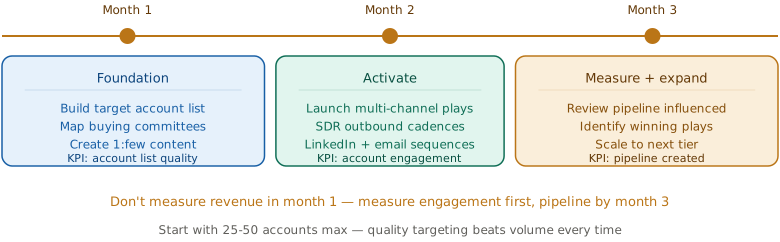
Here’s the timeline we recommend for launching an ABM pilot. Adjust the pace based on your team size and existing infrastructure.
| Week | Focus | Key Actions |
|---|---|---|
| 1-2 | Foundation | Align with sales on ICP, select 25-50 target accounts, map buying committees |
| 3-4 | Content creation | Build 2-3 industry landing pages, write personalized email sequences, create ad creative |
| 5-6 | Warm-up | Social engagement with target contacts, launch LinkedIn awareness ads, start Tier 3 email nurture |
| 7-8 | Activation | Launch Tier 1 direct outreach (video + mail), activate Tier 2 ad campaigns, trigger intent-based sequences |
| 9-10 | Engage | SDR follow-up on engaged accounts, send personalized content to warm leads, host invite-only webinar for target accounts |
| 11-12 | Review and scale | Analyze engagement data, calculate pipeline generated, present results to leadership, plan Phase 2 |
Common ABM Mistakes (and How to Avoid Them)
After watching dozens of B2B teams attempt ABM, these are the mistakes that kill programs before they produce results.
Targeting Too Many Accounts
If you’re targeting 500 accounts with a two-person marketing team, you’re running demand gen with a different label. True ABM requires enough resources to personalize. Start with 25-50 and expand only after proving ROI.
Running ABM Without Sales Buy-In
ABM is a joint program. If sales doesn’t agree on the target account list, doesn’t commit to following up on engaged accounts, and doesn’t share feedback with marketing, the program will stall. Get your VP of Sales in the room during account selection. That single meeting changes everything.
Measuring ABM Like Demand Gen
Counting MQLs from an ABM campaign misses the point entirely. ABM metrics are account engagement, pipeline velocity, and deal size. If leadership is grading your ABM pilot on cost-per-lead, you haven’t set expectations correctly.
Skipping the Warm-Up Phase
Jumping straight to a sales pitch without building any awareness is the fastest way to get ignored. The best ABM programs spend two to four weeks on social engagement and awareness ads before any outbound contact. Your prospects should recognize your brand name before your SDR reaches out.
84% of businesses using ABM say it delivers higher ROI than other marketing campaigns, according to Demandbase’s ABM market research. But that 84% represents the ones who stuck with it long enough to see results.
ABM Tools for Mid-Market Teams
For the contact, enrichment, and intent-data layer outside ABM platforms, use the lead generation tools guide to compare the broader stack.
You don’t need a $100K/year ABM platform to get started. Here’s what matters at each stage:
Account selection and data: ZoomInfo or Apollo.io for contact data and firmographics. Clearbit for enrichment. Bombora or G2 for intent signals.
Campaign execution: HubSpot or Marketo for email automation. LinkedIn Campaign Manager for account-targeted ads. Vidyard or Loom for personalized video.
Personalization: Mutiny for website personalization by account or industry. Sendoso or Reachdesk for direct mail and gifting.
Measurement: HubSpot’s ABM tools (included in Marketing Hub Professional) cover most mid-market needs. For enterprise, Demandbase or 6sense offer dedicated ABM analytics with account-level attribution.
For teams just getting started, HubSpot’s ABM software offers target account dashboards, company scoring, and buying role tracking out of the box. It’s the best entry point for mid-market B2B teams that already use HubSpot as their CRM.
Frequently Asked Questions
The most effective ABM strategies include personalized direct mail to target account decision-makers, hyper-personalized digital ads served to specific companies via LinkedIn or Demandbase, custom landing pages by industry or account, personalized video outreach from SDRs, virtual events where target prospects are invited as speakers, and intent-data-driven outreach that triggers campaigns when accounts show buying signals.
BillingTree sent locked gift boxes to their top 100 target accounts with a call-to-action to contact sales for the unlock code. The campaign achieved a 60% response rate, 15% conversion rate, and $350K in new pipeline with 700% ROI. The key was precise targeting: every recipient matched their Ideal Customer Profile, so the investment per account was justified by the deal size.
The four core B2B marketing strategies are inbound marketing (attracting leads through content and SEO), demand generation (creating awareness and interest at scale), Account-Based Marketing (targeting specific high-value accounts with personalized campaigns), and product-led growth (using the product itself to drive acquisition and expansion). Most B2B companies combine two or three of these, with ABM complementing demand gen for their highest-value accounts.
You can launch an ABM pilot for $3,000-$5,000/month covering tools (LinkedIn Ads, email automation, basic data enrichment) and content creation. Enterprise programs with dedicated ABM platforms like Demandbase or 6sense typically run $50K-$150K/year. Start small, prove the model, then invest in more sophisticated tooling as your program matures.
No. ABM works for any B2B company with a defined ICP and deal sizes that justify personalized outreach. Mid-market SaaS companies with average contract values of $10K-$50K/year are often the best fit for one-to-few ABM programs. The key requirement isn’t company size but whether you can identify a finite list of accounts worth targeting with personalized campaigns.