You’ve read about B2B marketing strategies. You’ve bookmarked guides on demand gen, ABM, and content marketing. But when it’s time to actually plan a campaign, you’re staring at a blank spreadsheet with no structure to connect any of it. That’s what a b2b marketing framework solves. Not more tactics. A system that ties your audience, channels, and metrics together so every marketing dollar traces back to pipeline.
Most B2B teams skip this step. They jump into execution: run LinkedIn ads, publish blog posts, send email blasts. Six months later, they can’t explain what worked or why. The companies that grow predictably aren’t doing more marketing. They’re running it through a framework that makes every activity accountable.
This article breaks down the six most proven B2B marketing frameworks, explains which one fits your situation, and walks through how to build a custom framework step by step.
Key Takeaways
- A B2B marketing framework is a repeatable system for planning, executing, and measuring campaigns. It replaces ad-hoc marketing with structure.
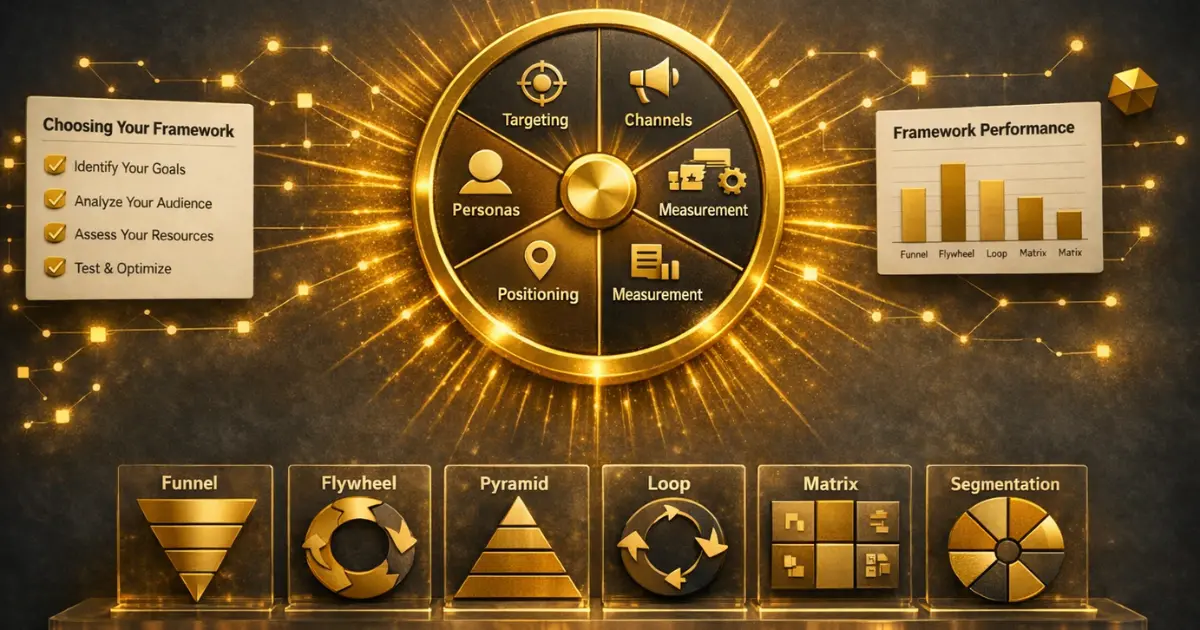
- Six proven frameworks dominate B2B: AIDA, TOFU-MOFU-BOFU, ABM, Flywheel, RACE, and the 7Ps. Each suits different business models and sales cycles.
- Most mid-market B2B companies get the best results combining TOFU-MOFU-BOFU for content planning with ABM for high-value target accounts.
- Building a custom framework starts with your ICP, maps the buyer journey, selects channels, and sets pipeline-focused KPIs.
What Is a B2B Marketing Framework?
A B2B marketing framework is a structured model that organizes how a company plans, executes, and measures its marketing activities for business buyers. It connects audience research, messaging, channel selection, campaign execution, and performance metrics into one repeatable system designed around longer sales cycles and multiple decision-makers.
Think of it as the operating system for your marketing team. Without one, every campaign starts from zero. With one, you have a consistent process for turning market research into pipeline revenue. The framework doesn’t dictate what content to create or which ads to run. It dictates how those decisions get made and how results get measured.
Tactics answer “what should we do?” A framework answers “how do we decide what to do, and how do we know if it worked?”
Why B2B Teams Need a Framework (Not Just a Strategy)
Strategy tells you where to go. A framework tells you how to get there repeatedly. That distinction matters because B2B marketing isn’t a one-time campaign. It’s an ongoing system that needs to produce results across quarters, product launches, and team changes.
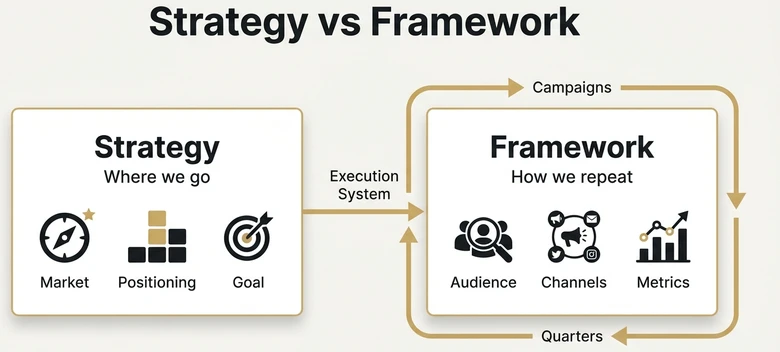
Without a framework, three problems show up consistently:
Wasted budget with no accountability. When there’s no structure connecting campaigns to outcomes, marketing becomes a cost center instead of a revenue driver. According to Gartner’s 2024 CMO survey, marketing budgets fell to 7.7% of overall company revenue, the lowest in a decade. Teams without a clear framework are the first to lose funding because they can’t prove ROI.
Misalignment between marketing and sales. Sales wants leads that convert. Marketing measures MQLs that don’t. A framework forces shared definitions for what a qualified lead looks like, how it gets scored, and when it moves to sales. Without that shared language, the two teams operate in parallel instead of together.
No way to scale what works. If your best campaign succeeded because one marketer had a great idea on a Tuesday, that’s luck. A framework captures what made it work (the audience targeting, the channel mix, the offer type) so you can repeat it without depending on individual inspiration.
6 Proven B2B Marketing Frameworks
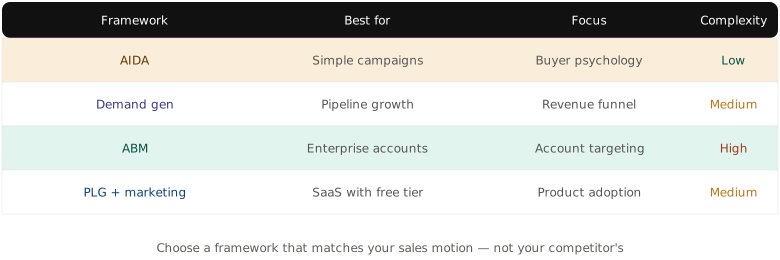
Not every framework fits every company. The right choice depends on your sales cycle length, deal size, team size, and growth stage. Here are the six models B2B marketing teams use most, with honest assessments of when each one works and when it doesn’t. The same fit logic applies to leadership AI strategy decisions: the model only works when the company knows its cycle length, constraints, and decision owner.
1. AIDA (Attention, Interest, Desire, Action)
AIDA maps the buyer’s psychological journey from first noticing your brand to making a purchase decision. Each stage requires different content: attention-grabbing ads at the top, case studies and ROI calculators in the middle, pricing pages and demos at the bottom.
Best for: B2B companies with shorter sales cycles (under 90 days) and simpler buying committees of one to three people. Works well for SaaS products under $500/month where a single decision-maker can sign off.
Limitation: AIDA treats the sale as the finish line. In B2B, especially SaaS, the real revenue comes after the sale through renewals and expansion. AIDA has no stage for customer retention or upselling.
2. TOFU-MOFU-BOFU (Top, Middle, Bottom of Funnel)
The funnel framework organizes content and campaigns by buyer stage. Top of funnel (TOFU) targets awareness with blog posts, social content, and educational resources. Middle of funnel (MOFU) handles consideration with comparison guides, webinars, and case studies. Bottom of funnel (BOFU) drives decisions with demos, free trials, and pricing pages.
Best for: Content-driven B2B companies that generate most leads through inbound marketing. If your team publishes regularly and needs a system for mapping content to buyer stages, this is the most practical starting point.
Limitation: The funnel assumes a linear journey. Real B2B buyers jump between stages, revisit content out of order, and involve new stakeholders mid-process. Use TOFU-MOFU-BOFU for content planning, but don’t expect buyers to follow the funnel in sequence. That messiness is easier to plan for once you map these models onto the non-linear reality of the customer journey, where buyers loop back and re-enter months later.
PRO TIP
Map your existing content to TOFU, MOFU, and BOFU in a spreadsheet. Most B2B blogs are 80%+ TOFU (awareness content) with almost nothing at MOFU or BOFU. Finding that gap is the fastest way to increase conversion rates without publishing more top-of-funnel content.
3. Account-Based Marketing (ABM)
ABM flips the funnel. Instead of attracting a broad audience and filtering down, you identify specific high-value accounts first and build personalized campaigns for each one. Marketing and sales collaborate on a shared account list, create custom content for each target, and measure success by account engagement rather than lead volume.
If you choose the ABM path, establish clear ABM metrics before launching your first campaign.
Best for: B2B companies with high average deal sizes ($50K+), long sales cycles (6+ months), and clearly defined target accounts. ABM works best when you can name the 50 to 200 companies you want as customers.
Limitation: ABM requires tight sales-marketing alignment and significant per-account investment. Teams with fewer than 50 target accounts may not generate enough pipeline. Companies selling to thousands of SMBs are better served by inbound or funnel-based approaches. According to LinkedIn’s ABM research, 87% of B2B marketers say ABM delivers higher ROI than other strategies, but only when applied to the right account tier.
If the framework work exposes stage leakage, map it against a B2B sales funnel so marketing and sales share the same conversion checkpoints.
4. Flywheel Model
HubSpot popularized the flywheel as a replacement for the traditional funnel. Instead of a linear path from lead to customer, the flywheel treats marketing, sales, and service as interconnected forces that feed each other. Happy customers generate referrals and case studies that attract new buyers, creating a self-reinforcing cycle.
Best for: SaaS and subscription businesses where customer retention directly impacts growth. If your net revenue retention rate matters more than new logo acquisition, the flywheel framework matches how your business actually grows.
Limitation: The flywheel is better as a philosophy than a tactical planning tool. It tells you that customer success matters, but it doesn’t give you a step-by-step process for planning next quarter’s campaigns. Most teams use the flywheel as an overarching model and pair it with TOFU-MOFU-BOFU or ABM for day-to-day execution.
5. RACE (Reach, Act, Convert, Engage)
Developed by Smart Insights, RACE covers four stages: Reach (build awareness through SEO, social, and paid), Act (encourage interactions on your site), Convert (turn leads into customers), and Engage (retain and grow accounts). Each stage has specific KPIs, making it naturally data-driven.
Best for: Digital-first B2B teams that want clear metrics at every stage. RACE works particularly well for teams reporting to data-minded leadership because it bakes measurement into the framework itself. The measurement layer is only as clean as the campaign URLs feeding it though, which means the URL-level review that has to happen on every campaign before those KPIs can be trusted is a pre-requisite to the data-minded reporting RACE promises.
Limitation: RACE is heavily weighted toward digital channels. If your B2B marketing relies on events, field marketing, or partner channels, you’ll need to extend it. It also doesn’t address the complexity of multi-stakeholder buying committees the way ABM does.
6. The 7Ps Framework
The 7Ps expand the classic 4Ps (Product, Price, Place, Promotion) by adding People, Process, and Physical Evidence. In B2B, this translates to: what you sell, how you price it, where buyers find you, how you promote it, who delivers it, what the buying process looks like, and what proof you provide (case studies, certifications, demos). In 2026, that proof increasingly includes the sustainability proof points buyers now expect, from an EcoVadis score to a lifecycle assessment.
Best for: B2B companies launching new products or entering new markets. The 7Ps force you to think through positioning and go-to-market strategy before spending on campaigns. It’s a planning framework more than an execution framework.
Limitation: The 7Ps don’t map directly to campaign planning or performance measurement. Once you’ve answered the seven questions, you still need an execution framework like TOFU-MOFU-BOFU or RACE to turn those answers into actual marketing activities.
Which B2B Marketing Framework Fits Your Company?
Picking the wrong framework wastes months. Here’s a quick decision guide based on deal size, sales cycle, and team maturity.
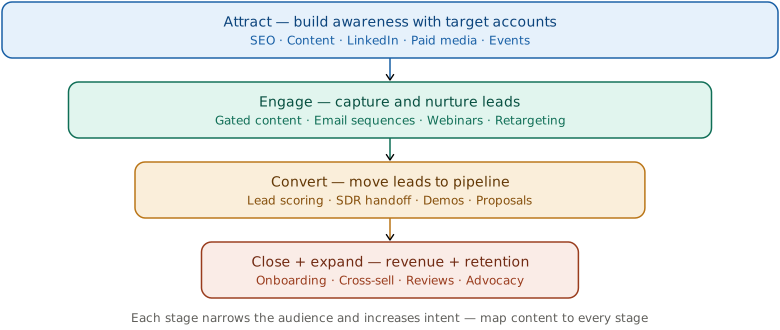
Startups with small teams (under 5 marketers): Start with TOFU-MOFU-BOFU. It’s the simplest to implement, works with limited resources, and gives your content strategy immediate structure. Add the flywheel mindset once you have enough customers to generate referrals.
Mid-market companies ($20K–$100K deals): Combine TOFU-MOFU-BOFU for content planning with ABM for your top 50 to 100 target accounts. Use the funnel for inbound lead gen and ABM for outbound, high-touch pursuits. This is the combination that works for most B2B SaaS companies in the 50 to 500 employee range. Whichever combination you land on, it still needs fuel, and a demand generation framework that feeds both is what keeps the funnel and the account list from running dry.
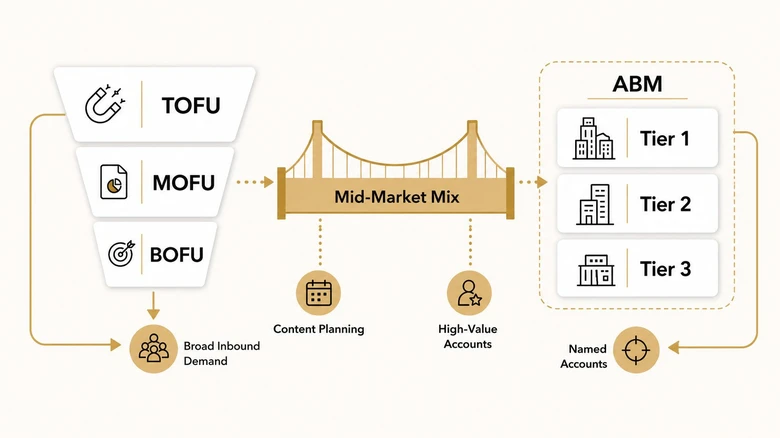
Enterprise companies ($100K+ deals, 6+ month cycles): Lead with ABM. Your deal sizes justify the per-account investment, and your buyers expect personalized engagement. Layer RACE on top for digital execution and measurement.
Companies launching a new product or entering a new market: Start with the 7Ps to nail positioning, then move to TOFU-MOFU-BOFU or RACE for execution.
IMPORTANT
No framework works in isolation. The most effective B2B marketing teams combine two: one for strategic planning (7Ps or ABM) and one for tactical execution (TOFU-MOFU-BOFU or RACE). Don’t pick just one and expect it to cover everything.
How to Build a Custom B2B Marketing Framework
Named frameworks are starting points, not final answers. Every B2B company eventually needs a framework tailored to its market, buyers, and growth stage. Here’s how to build one in five steps.
Step 1: Define Your ICP and Buyer Personas
Start with who you’re marketing to. Your Ideal Customer Profile (ICP) describes the companies that get the most value from your product. Buyer personas describe the individuals within those companies who influence the purchase.
For the ICP, document: industry, company size (revenue and headcount), geography, tech stack, and the specific business problem your product solves. Be ruthlessly specific. “Mid-market SaaS companies” is too broad. “B2B SaaS companies with 50 to 300 employees, $5M to $30M ARR, selling to enterprise buyers, struggling with outbound pipeline” is an ICP you can actually target.
For each persona, map: job title, reporting structure, goals, pain points, how they research solutions, and what objections they’ll raise. Most B2B deals involve three to five personas. At minimum, cover the champion (who wants your product), the economic buyer (who signs the check), and the blocker (who raises objections).
Step 2: Map Your Buyer Journey Stages
Document the stages a buyer moves through from first problem awareness to signed contract. A typical B2B journey looks like this:
- Problem aware: Buyer recognizes a pain point but hasn’t started researching solutions.
- Solution aware: Buyer is actively researching approaches and categories of solutions.
- Vendor evaluation: Buyer is comparing specific vendors, reading reviews, requesting demos.
- Decision and procurement: Buyer has chosen a vendor and is working through approvals, security reviews, and contracts.
For each stage, identify what questions the buyer is asking, what content would help, which channels reach them, and what signals they’re ready to move forward. This map becomes the backbone of your content strategy and lead scoring model.
Step 3: Select Your Channels
B2B marketing works across fewer channels than B2C, but the ones that work tend to work extremely well. The core channels for most B2B companies:
- SEO and content marketing: Your blog, resource center, and organic search presence. This is the engine for awareness and consideration content. Most B2B companies generate 40 to 60% of their pipeline from organic, according to BrightEdge research.
- Email marketing: Drip sequences, product updates, event invitations. Still the highest-ROI channel for B2B when segmented properly.
- LinkedIn: Paid and organic. The only social platform where B2B decision-makers consistently engage with professional content.
- Paid search (Google Ads): Bottom-of-funnel capture for buyers actively searching your category. High cost per click, but high intent.
- Events and webinars: Virtual or in-person. Strong for mid-funnel engagement and relationship building, especially for deals over $50K.
Don’t try to be everywhere. Pick three to four channels where your buyers actually spend time, go deep on those, and ignore the rest until you’ve maxed out what’s already working.
Step 4: Set Your KPIs by Stage
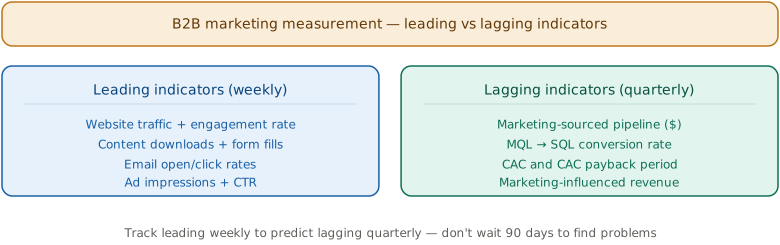
Each stage of your framework needs specific metrics. Here’s a baseline KPI set:
A strong RevOps framework ties each marketing framework to measurable revenue outcomes, and each framework implies a different metric set — the B2B marketing metrics piece covers the 15 KPIs that translate framework choice into a measurable dashboard.
Awareness: Organic traffic, impressions, share of voice, new contacts added to CRM.
Consideration: Content engagement (time on page, downloads), email open and click rates, webinar attendance, return visits.
Decision: Demo requests, free trial signups, proposal requests, sales-accepted leads (SALs).
Revenue: Marketing-sourced pipeline, marketing-influenced revenue, customer acquisition cost (CAC), payback period.
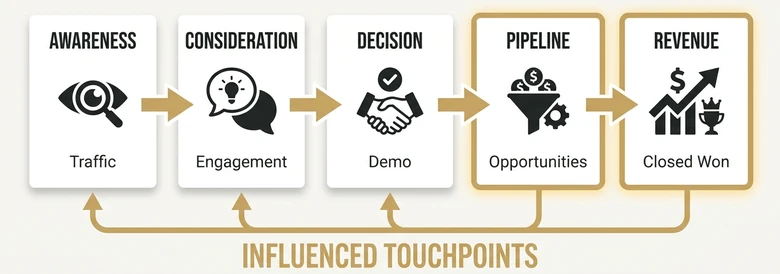
The metrics that matter most are in that last row. Traffic and MQLs are leading indicators, but pipeline and revenue justify your marketing budget. Set up attribution in your CRM (HubSpot, Salesforce, or whatever you use) to trace closed deals back to the touchpoints that influenced them.
PRO TIP
Use HubSpot’s multi-touch attribution reporting or Salesforce’s campaign influence to connect marketing activities to closed revenue. Single-touch models (first touch or last touch) always undercount marketing’s contribution because the typical B2B buyer journey involves 20+ touchpoints across three to six months.
Step 5: Build Your Execution Cadence
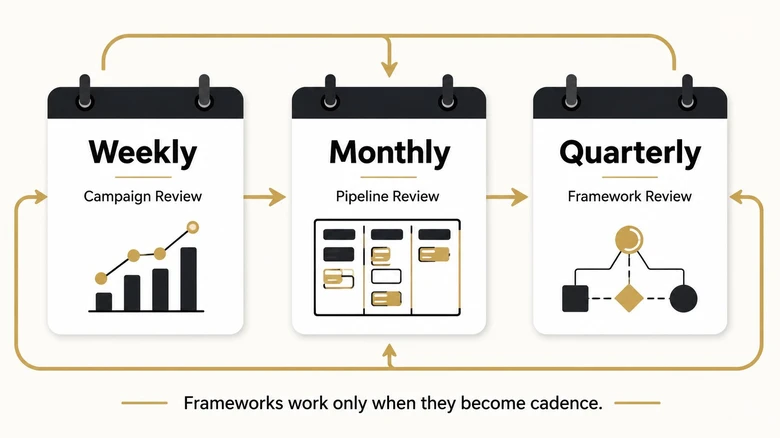
A framework without a rhythm becomes shelfware. Build a cadence around three cycles:
Weekly: Campaign performance review. What’s running, what’s converting, what needs adjustment. A 30-minute standup between marketing and sales.
Monthly: Pipeline review. How much pipeline did marketing generate and influence? Which channels and content types drove the most qualified leads? Where are the gaps?
Quarterly: Framework review. Are your ICP assumptions still valid? Has the buyer journey shifted? Are KPIs tracking to annual targets? This is where you update the framework itself, not just the campaigns inside it.
Document this cadence in a shared calendar. The framework only works if the team actually uses it on a schedule.
Common B2B Marketing Framework Mistakes
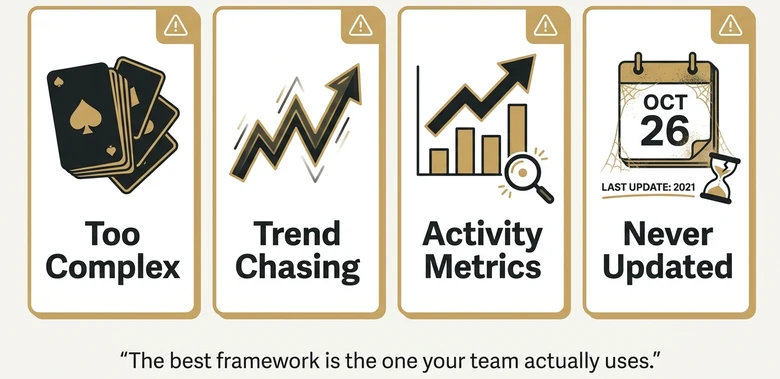
Overcomplicating it. A 40-slide framework deck nobody references is worse than a one-page model the team uses daily. Start simple. One ICP, one buyer journey map, three channels, five KPIs. Add complexity as you grow.
Choosing based on trends, not fit. ABM gets a lot of attention right now. That doesn’t mean it’s right for a startup with 10 customers and no sales team. Pick the framework that matches your deal size, sales cycle, and team capacity.
Measuring activity instead of outcomes. Blog posts published, emails sent, or webinars hosted are activities. They don’t tell you if marketing is generating revenue. Always tie framework metrics back to pipeline and closed deals.
Not updating it. Markets shift. Products evolve. The buyer journey changes.
A framework built 18 months ago might not fit the company you’re today. That quarterly review exists to catch this drift before it becomes a problem.
Frequently Asked Questions
A strategy defines your goals, target market, and competitive positioning. A framework is the operating model you use to execute that strategy repeatedly. Strategy is “what” and “why.” Framework is “how” and “how we measure.” You need both, and the framework should support the strategy.
They benefit the most. Small teams can’t afford wasted effort. A simple TOFU-MOFU-BOFU framework with three channels and five KPIs gives a two-person marketing team more clarity than a 20-person team running campaigns without any structure at all. Start with the simplest version and add complexity only when you outgrow it.
Expect 30 to 60 days to implement fully: ICP definition, journey mapping, channel selection, KPI setup. Initial performance data appears at 60 to 90 days. Meaningful results where you can confidently say “this is working” typically show at six months. Organic-heavy frameworks take longer than paid-heavy ones because SEO compounds over time.
Almost always yes. The most effective B2B teams use one framework for planning (7Ps or ABM for strategic direction) and one for execution (TOFU-MOFU-BOFU or RACE for day-to-day campaigns). A single framework usually leaves a gap in either strategy or execution.
Build Your Framework This Week
Open a spreadsheet and do one thing: list every piece of content and every campaign your team ran in the last 90 days. Tag each one as TOFU, MOFU, or BOFU. If more than 70% is TOFU (and it almost always is), that gap is the first problem your framework needs to solve. Fill the MOFU and BOFU holes with comparison content, case studies, and demo-focused landing pages. That single exercise will produce more pipeline impact in 30 days than any theoretical framework discussion.
For a deeper look at how frameworks connect to your broader B2B marketing campaign strategy, start with our pillar guide once your framework foundation is in place.