Most B2B companies have a sales funnel. Few have one that works. The typical problem isn’t missing stages or bad content. It’s the gap between marketing and sales where leads go to die. Marketing generates 1,000 MQLs, sales ignores 800 of them, and both teams blame each other at the quarterly review.
If your product uses free trials or product-led conversion, compare this with the SaaS trial-to-paid funnel before using a generic B2B stage map.
A working B2B sales funnel isn’t a diagram on a slide deck. It’s the system that turns strangers into customers by giving the right person the right message at the right time, then handing them to sales when they’re actually ready to talk. According to Gartner, B2B buyers spend only 17% of their buying journey meeting with potential suppliers. That means 83% of the decision happens before your sales team is even in the room.
This guide covers the six stages of a B2B sales funnel, the metrics and conversion benchmarks for each stage, and the step-by-step process for building one that closes deals instead of just collecting leads.
Key Takeaways
- A B2B sales funnel has six stages: Awareness, Interest, Consideration, Intent, Evaluation, and Purchase. Each stage requires different content, metrics, and team ownership.
- The funnel is not linear. Modern B2B buyers jump between stages, loop back when new stakeholders join, and conduct 83% of their research before talking to sales.
- The MQL-to-SQL handoff is where most funnels break. Align marketing and sales on shared definitions, scoring criteria, and SLAs before building anything else.
- Track conversion rates between each stage, not just top-of-funnel volume. A 2% improvement in mid-funnel conversion often produces more revenue than doubling top-of-funnel traffic.
- Retention is a funnel stage, not an afterthought. A 5% improvement in customer retention can increase revenue by 25-95%, according to Bain & Company research.
What Is a B2B Sales Funnel?
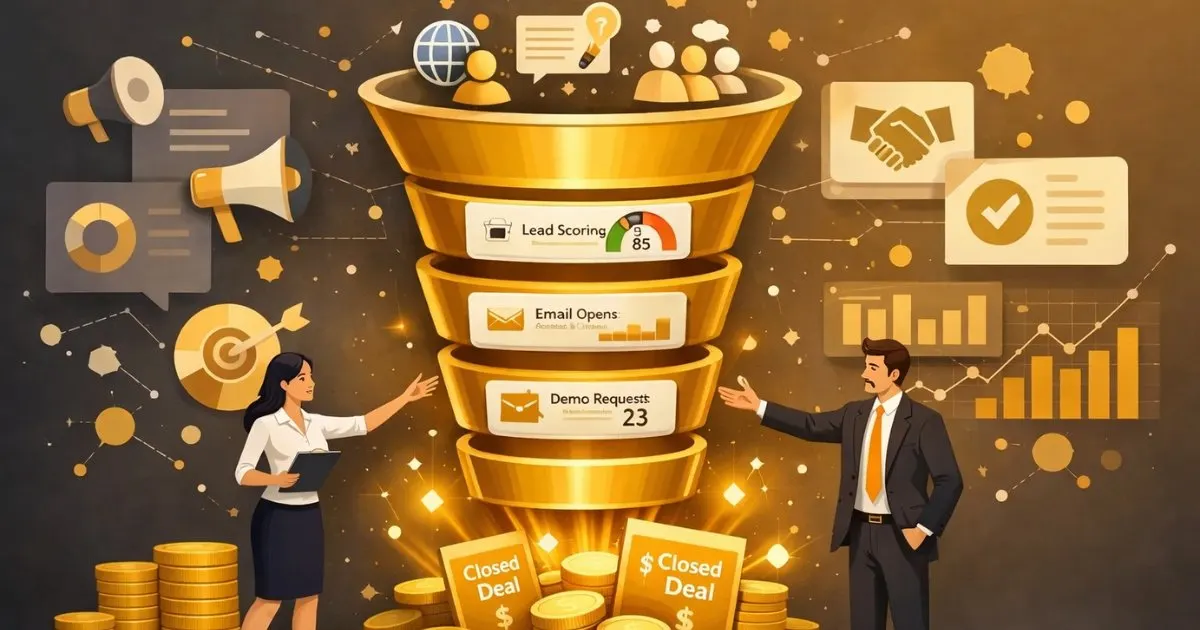
A B2B sales funnel is a structured process that maps how potential customers move from first discovering your company to becoming paying clients. It visualizes the buyer’s journey as stages, with the audience narrowing at each phase as unqualified prospects drop off and qualified ones move closer to a purchase decision.
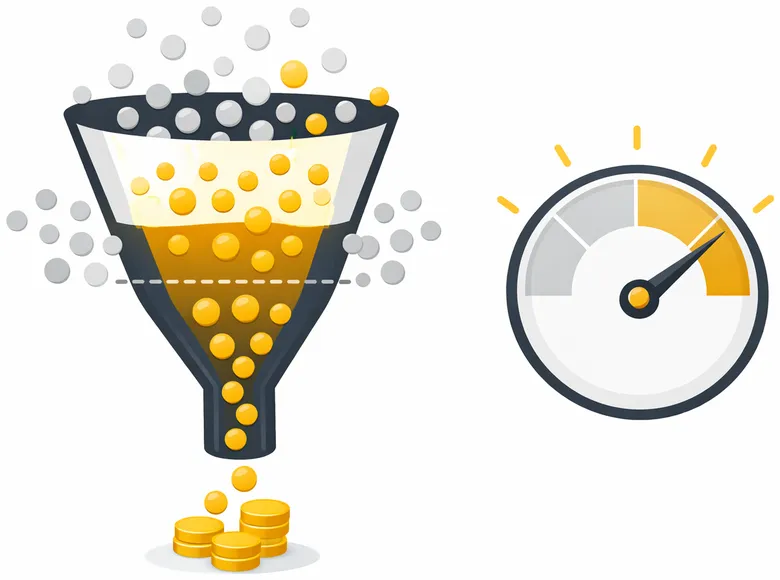
The funnel matters because it gives revenue teams a shared framework for prioritizing effort and measuring progress. Without one, marketing creates content nobody uses, sales chases leads that aren’t ready, and leadership can’t diagnose why pipeline is thin. With one, every team knows what happens at each stage, who owns it, and how to measure whether it’s working.
A critical distinction: a sales funnel is not the same as a sales pipeline. The funnel covers the entire buyer journey from first awareness through post-purchase retention. The pipeline only covers what happens after a lead is qualified, typically from SQL to closed-won. Marketing owns the top of the funnel. Sales owns the bottom. The middle is where alignment either happens or falls apart.
B2B Sales Funnel vs. B2C: Why It’s Different
B2B and B2C funnels look similar in theory but operate completely differently in practice. The differences change everything about how you build and manage yours.
| Factor | B2B Funnel | B2C Funnel |
|---|---|---|
| Decision makers | 6-10 stakeholders per deal | Usually 1-2 people |
| Sales cycle | 3-12 months typical | Minutes to weeks |
| Decision driver | ROI, efficiency, risk reduction | Emotion, price, convenience |
| Average deal size | $10K-$500K+ | $10-$500 |
| Content needed | Case studies, ROI calculators, demos | Reviews, product images, promotions |
| Buyer journey | Non-linear, loops back frequently | Mostly linear |
The non-linear nature of B2B buying is the biggest practical difference. A prospect might download a whitepaper (Awareness), attend a webinar (Interest), go quiet for three months, then return when a new budget cycle opens and immediately request a demo (skipping straight to Intent). Your funnel needs to accommodate this behavior, not force prospects into a rigid sequence. For the webinar touchpoint specifically, it helps to match the webinar type to the funnel stage you want to move, so a top-of-funnel panel and a bottom-of-funnel demo are not held to the same conversion bar. Because buyers move around like this, the tier you assigned an account last quarter goes stale, which is why a recurring sales reset re-classifies the whole list rather than trusting a label set months ago.
The 6 Stages of a B2B Sales Funnel
While every company’s funnel has nuances, these six stages cover the journey from stranger to customer. Each stage includes the content that works, the metrics to track, and the team that owns it. The funnel is the seller’s map of those stages, while what those stages look like from the buyer’s side is a wider arc that begins before anyone is a lead and continues through renewal. Once those stages are defined, the pipeline automation that moves deals between stages can gate each transition on real exit criteria rather than activity, which keeps the forecast honest.
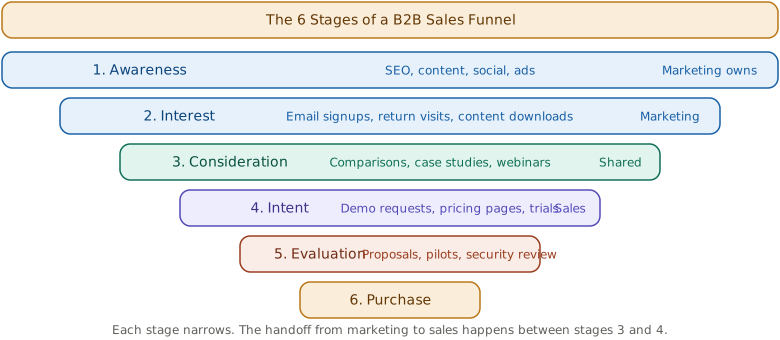
Stage 1: Awareness (TOFU)
The prospect discovers your brand exists. They have a problem but may not know your solution exists yet. At this stage, they’re researching the problem, not shopping for vendors. For outbound-led teams this discovery happens in the inbox, which makes email deliverability the real awareness gate, because a message filed in spam never creates awareness at all.
What works: Blog posts targeting pain-point keywords, LinkedIn thought leadership, podcast appearances, SEO-driven content, and industry reports. The goal is to be the answer when they search for their problem. Your content strategy for SEO directly feeds this stage.
Key metric: Website traffic by source, new users, and content engagement (time on page, scroll depth). Don’t measure leads here. Awareness content should educate, not gate.
Owner: Marketing
Stage 2: Interest (TOFU/MOFU)
The prospect knows you exist and starts engaging with your content more deliberately. They’re subscribing to your newsletter, following you on LinkedIn, or returning to your blog multiple times. They’re evaluating whether your perspective matches their situation.
What works: Email newsletters with practical insights, webinars, in-depth guides, and comparison content. This is where gated content (downloadable templates, benchmark reports, frameworks) can capture contact information without being pushy. A well-structured content-driven lead generation system matches each gated asset to the right funnel stage for maximum conversion.
Key metric: Email subscribers, content downloads, return visitor rate, and newsletter engagement. This is where you begin building your lead scoring foundation.
Owner: Marketing
Stage 3: Consideration (MOFU)
The prospect is actively evaluating solutions. They know they have a problem, they’ve researched approaches, and now they’re comparing vendors. At this stage, they’re looking at your product pages, reading case studies, and checking review sites like G2 and Capterra. Which of those touchpoints actually moves a prospect forward is a question for customer journey analytics rather than assumption.
What works: Case studies with specific results (“how Company X reduced churn by 34%”), product comparison pages, ROI calculators, and detailed product documentation. Pricing transparency helps here. Hiding your pricing pushes prospects to competitors who show theirs.
Key metric: Product page visits, case study views, pricing page visits, and demo request form starts. A prospect who visits your pricing page has higher intent than one who reads five blog posts.
Owner: Marketing + Sales (shared)
Stage 4: Intent (MOFU/BOFU)
The prospect signals they’re serious about buying. They request a demo, start a free trial, ask for a proposal, or engage directly with sales. This is the critical handoff point where marketing-qualified leads (MQLs) become sales-qualified leads (SQLs). Be careful how you count this stage, though: a requested demo and a held demo are two different events, and funnels that treat the booking as the conversion overstate this stage by whatever their no-show rate happens to be. Strictly speaking an acceptance step sits between those two labels, and teams that skip it lose the only number that distinguishes a lead sales never took from a lead sales took and disqualified.
What works: Personalized demos, free trials with guided onboarding, consultative sales conversations, and custom proposals. The MQL to SQL handoff must be clean here. A lead that requests a demo on Monday and doesn’t hear from sales until Thursday is a lead your competitor closes on Wednesday. Preventing exactly that is the job of a response standard measured in minutes, not days.
Key metric: Demo requests, trial starts, MQL-to-SQL conversion rate, and speed-to-lead (time from form submission to first sales contact). For high-intent inbound, five minutes is an aggressive internal SLA, not a verified current universal benchmark. Count the demo-request metric carefully too, because booked and held meetings are separate events with separate denominators, and in the most-cited public snapshot 17.3% of scheduled meetings carried no final outcome at all. When this stage underperforms, resist fixing the biggest drop-off first and try ranking each stage by the held meetings its loss actually costs, because a request lost before qualification was worth a fraction of one and a booking lost the night before the call was worth all of it.
Owner: Sales (with marketing support)
PRO TIP
Set a speed-to-lead SLA between marketing and sales. The 2007 Lead Response Management study reported 21 times higher qualification odds for web-generated leads called at five minutes rather than 30 across six companies. Treat that as dated, phone-based evidence for prompt routing, not as a guaranteed lift. Build the handoff into your CRM workflow so it happens automatically, not manually.
Stage 5: Evaluation (BOFU)
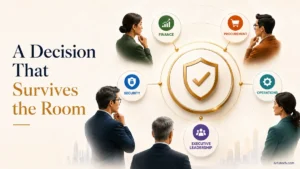
The prospect is in active negotiations. They’re comparing your proposal against 2-3 competitors, running it through legal review, building internal consensus, and securing budget approval. This is where deals stall most often because B2B purchases involve 6-10 decision-makers with different priorities. Keeping momentum across that committee is exactly what real-time journey orchestration coordinates across every stakeholder and channel, changing the next action the moment a deal goes quiet. Those 6-10 decision-makers are the buying committee whose competing priorities you have to reconcile, and the roles you never mapped are the ones that stall the deal at this stage.
What works: ROI business cases customized to their data, executive summary documents for the C-suite (the CFO who approves budget didn’t attend your demo), competitive battle cards for your champion to use internally, and security/compliance documentation for IT review. Each of those is a distinct writing job, and arming your champion with copy they can repeat in the room is what carries the deal through a committee you never meet. That committee dynamic is the whole game in a committee-led enterprise sales funnel, where six to thirteen stakeholders, not one buyer, decide whether the deal closes.
Key metric: Proposal-to-close rate, average deal cycle length, and win/loss ratio by competitor. If your win rate drops when a specific competitor is involved, you need better competitive positioning, not more leads. That instinct to add volume is worth naming, because opportunity count is the one lever that can flatter a failing pipeline: it lifts a velocity figure the moment you pull it, while the win rate and cycle length it damages only show up two quarters later.
Owner: Sales
Stage 6: Purchase and Retention (BOFU+)
The prospect becomes a customer. But the funnel doesn’t end here. Retention, expansion, and advocacy are where B2B companies build sustainable revenue. Acquiring a new customer costs 5-7x more than retaining an existing one, according to multiple studies, and a 5% increase in retention can boost profits by 25-95%. The retention side of the funnel has its own metrics; for the churn math and benchmarks see our SaaS churn rate guide.
What works: Smooth onboarding (the first 30 days define whether a customer stays or churns), regular check-ins, quarterly business reviews, upsell/cross-sell offers based on usage data, and referral programs. Happy customers become your best marketing channel.
Key metric: Net Revenue Retention (NRR), customer churn rate, time-to-value (how quickly customers achieve their first success milestone), and Net Promoter Score. For SaaS marketing teams, NRR above 110% means your existing customers are growing faster than you’re losing them.
Owner: Customer Success + Sales
How to Build a B2B Sales Funnel in 5 Steps
Step 1: Define Your Ideal Customer Profile
You can’t build a funnel without knowing who it’s for. Your ICP should specify: industry, company size (revenue and headcount), job titles of decision-makers and influencers, the specific problem your product solves for them, and the budget range they typically allocate.
The tighter your ICP, the fewer leads enter the funnel, but the higher percentage convert to customers. A funnel that converts 5% of 500 qualified leads produces more revenue than one that converts 0.5% of 5,000 unqualified leads. Define this before spending a dollar on content or ads. The same discipline applies to outbound, where a tightly targeted cold campaign feeds the top of this funnel with prospects who already match, which makes the cold email software you run that outbound motion on a funnel decision rather than just a sales-team convenience. Once those accounts enter the sequence, follow-up rules that keep qualified outbound from becoming noise protect that targeting advantage by adding a reason to reply, then stopping when the buyer or the data says to stop.
Step 2: Map Content to Each Stage
Audit your existing content and assign each piece to a funnel stage. Most B2B companies discover they have 80% Awareness content (blog posts) and almost nothing for Consideration or Evaluation. That imbalance explains why they generate traffic but not pipeline.
Fill the gaps. If you have no case studies, create three. If you have no ROI calculator, build one. If you have no competitive comparison page, write one. Mid-funnel and bottom-funnel content has a higher revenue impact per piece than top-of-funnel content.
Step 3: Align Marketing and Sales on Definitions
This is where most funnels fail. Marketing and sales need shared, written definitions for:
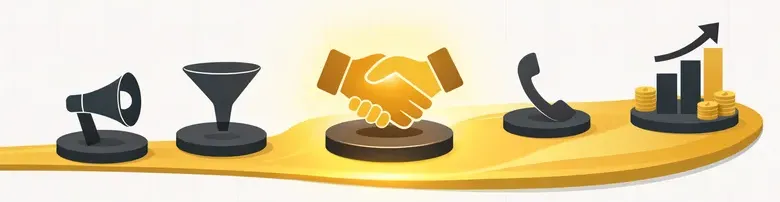
- MQL: What specific actions qualify a lead for marketing follow-up? (e.g., downloaded 2+ resources AND visited pricing page)
- SQL: What criteria must a lead meet before sales accepts it? (e.g., matches ICP, has budget authority, has expressed timeline)
- SLA: How quickly must sales contact an SQL? What happens if they don’t?
- Feedback loop: How does sales report back on lead quality so marketing can adjust?
Write these definitions down. Put them in a shared document. Review them monthly. The number one complaint from sales teams is “marketing sends us bad leads.” The number one complaint from marketing teams is “sales doesn’t follow up on our leads.” Shared definitions solve both.
Step 4: Implement Tracking Across the Full Funnel
You need visibility into how leads move between stages. At minimum, your CRM should track: lead source (which channel brought them in), lifecycle stage (which funnel stage they’re in now), stage transition dates (when they moved between stages), and conversion rates between each stage. The CRM records the movement, but the rep-execution tools that move deals between these stages are what generate the sequences, tasks, and logged activity that keep each lead progressing instead of stalling. Logging the source of one lead is the easy half; crediting the whole committee’s path means tying every touch across the account back to the closed-won deal, since a single contact rarely stands in for the six to ten people who really decided.
HubSpot and Salesforce both support this natively with lifecycle stage fields and reporting. The key is that every lead has a clear stage at all times, and no lead sits in a stage for longer than your defined SLA without triggering an alert. With stages enforced that tightly, the transitions between them become comparable, and what each boundary converts at by channel becomes a diagnostic rather than a status report.
Step 5: Measure, Find Leaks, and Fix
A funnel is only as strong as its weakest stage. Run a monthly funnel analysis:
- Pull the conversion rate between each stage
- Identify the stage with the biggest drop-off
- Diagnose why (content gap? slow follow-up? pricing objection? wrong ICP?)
- Implement one fix
- Measure the impact next month
A 2% improvement in your Consideration-to-Intent conversion rate compounds across every lead that enters the funnel. That single fix often produces more revenue than doubling your blog traffic. Knowing which stage’s two percent is worth chasing, rather than guessing, is what a stage-by-stage journey optimization pass settles by ranking every leak by the revenue it costs.
B2B Sales Funnel Benchmarks
These benchmarks give you a starting point for evaluating your funnel’s performance. Actual rates vary significantly by industry, deal size, and sales cycle length. They also move with how warm the lead was on arrival, since how warm a lead is on arrival can swing conversion five- to tenfold, which is why a funnel fed by referrals and inbound posts higher stage-to-stage rates than one fed by cold lists.
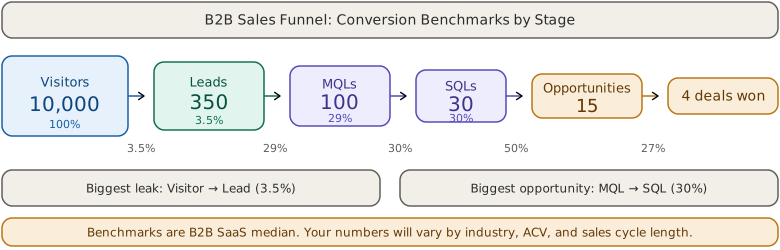
| Metric | Benchmark | What it tells you |
|---|---|---|
| Visitor-to-lead rate | 2-5% | Is your content converting traffic into contacts? |
| Lead-to-MQL rate | 15-30% | Is your scoring model filtering effectively? |
| MQL-to-SQL rate | 20-35% | Is the marketing-sales handoff working? |
| SQL-to-opportunity rate | 50-60% | Are qualified leads converting to real deals? |
| Opportunity-to-close rate | 15-30% | Is your sales team closing effectively? |
| Average B2B sales cycle | 3-6 months | Is your cycle getting longer or shorter? |
| Customer Acquisition Cost | Varies (track trend) | Is your funnel getting more or less efficient? |
IMPORTANT
Don’t benchmark against industry averages in isolation. Track your own conversion rates month-over-month and aim for consistent improvement. A team going from 18% MQL-to-SQL to 25% over two quarters is outperforming a team that’s “at benchmark” but flat. Response-time reporting punishes the same mistake even harder, because no two response-time studies share a denominator, so any industry average assembled from them describes a population you were never part of. That caution matters twice over with published benchmarks, because a published rate can move twenty points on denominator policy alone, without anyone booking a single extra meeting.
5 Mistakes That Break B2B Sales Funnels
Treating the Funnel as Linear
B2B buyers don’t march neatly from Stage 1 to Stage 6. They skip stages, loop back, go dark for months, and re-enter when budget opens. Your funnel needs to support re-engagement at any stage, not just top-of-funnel entry. Build re-engagement email sequences for leads that go quiet at each stage.
Gating Everything at the Top
Requiring an email address to read a blog post or view a basic overview kills your Awareness stage. Gate high-value mid-funnel content (templates, benchmark reports, ROI calculators). Keep top-of-funnel content open. Your SEO strategy depends on ungated content that ranks.
Ignoring Post-Purchase
A funnel that ends at “closed-won” leaves revenue on the table. Expansion revenue from existing customers is cheaper and faster than acquiring new ones. Add Retention and Expansion stages to your funnel, assign ownership to Customer Success, and track NRR as a funnel metric.
No Feedback Loop Between Sales and Marketing
If sales never tells marketing which leads converted and why, marketing can’t optimize. Build a weekly or bi-weekly meeting where sales reports on lead quality by source, and marketing adjusts targeting and scoring accordingly. This single meeting fixes more funnel problems than any technology.
Measuring Volume Instead of Velocity
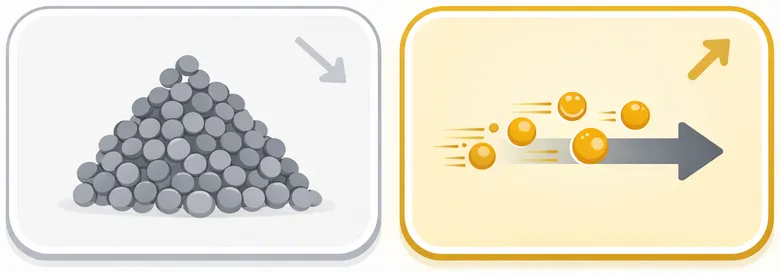
A funnel with 10,000 leads that takes 12 months to close is less valuable than a funnel with 2,000 leads that closes in 3 months. Track funnel velocity (how quickly leads move through stages) alongside volume. If a specific lead source produces fewer leads but they close 3x faster, that source deserves more budget.
B2B Sales Funnel Tools
HubSpot CRM and Salesforce handle funnel tracking with lifecycle stages, deal pipelines, and reporting dashboards. HubSpot is better for mid-market teams wanting fast setup. Salesforce fits enterprise teams needing customization.
Gong analyzes sales conversations to identify why deals win or lose at the Evaluation stage. It shows which talk tracks, objection responses, and competitor mentions correlate with closed deals.
Chili Piper solves the speed-to-lead problem by routing inbound demo requests directly to the right sales rep’s calendar. Leads book meetings in real time instead of waiting for manual assignment.
Frequently Asked Questions
A B2B sales funnel is a structured process that maps how potential business customers move from first discovering your company to becoming paying clients. It typically includes six stages: Awareness, Interest, Consideration, Intent, Evaluation, and Purchase. The funnel helps revenue teams prioritize effort, measure progress, and identify where prospects get stuck.
The 4 C’s of B2B marketing are Customer (understanding buyer needs and pain points), Cost (total value beyond just price, including implementation and ROI), Convenience (making it easy to buy and implement), and Communication (consistent messaging across the buyer journey). They replace the traditional 4 P’s with a buyer-centric framework. For the strategy layer above these stages, see the B2B marketing framework.
The most common five-stage model is Awareness, Interest, Consideration, Decision, and Action (based on the AIDA framework). In B2B, many teams expand this to six stages by splitting the Decision stage into Intent and Evaluation to account for the longer negotiation and approval process typical in business purchases.
The 10-3-1 rule is a sales prospecting guideline suggesting that for every 10 prospects you contact, 3 will show genuine interest, and 1 will become a customer. It translates to a 10% close rate from initial contact, which aligns with many B2B conversion benchmarks. The rule helps sales teams set realistic activity targets for pipeline generation.