Updated Q2 2026. All vendor pricing verified this quarter.
Most “sales automation” lists are quietly broken. They pile a CRM, a cold email sender, an AI SDR, a parallel dialer, and a data vendor into one ranking and pretend they answer the same question. They don’t. B2B sales automation is not one job, it’s five, and a tool that owns one of them is often weak at the other four. The result is a buyer who reads a list, picks the “#1” tool, and discovers three months in that it does not actually do the thing their reps needed automated.
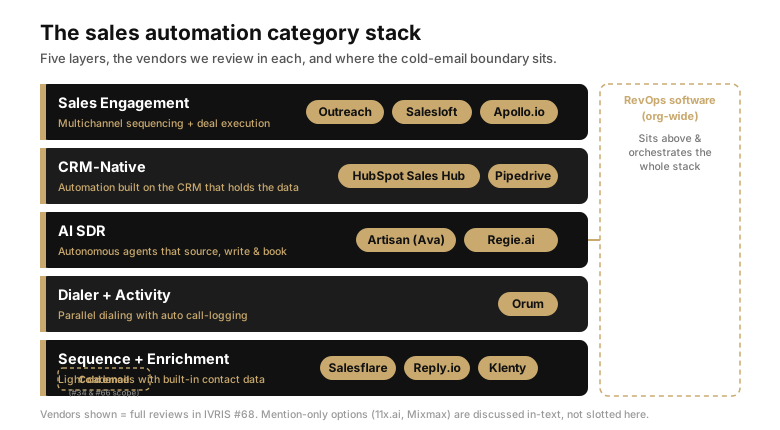
This guide fixes that by sorting tools by the job they automate at the rep-workflow altitude: the layer that moves an individual seller through outreach, logging, tasks, dialing, and enrichment. That is a narrower question than “how do we run revenue,” and a deliberately different one from how deals progress through the B2B sales funnel at the org level. Two boundaries are drawn on purpose. Cold email is one channel inside this workflow, so the tools that handle that one channel sit in a separate guide. RevOps software is the layer above this one, so the org-wide forecasting and attribution stack sits in its own guide too. Both lines are explained below, not hand-waved.
We review 11 tools across five categories, with verified Q2 2026 pricing, an honest limitation for each, and a use-case verdict. Two more tools, 11x.ai and Mixmax, were evaluated and left out of the picks for reasons stated where they matter. Read the table for the shortlist, then the reviews for the trade-offs that decide the choice.
Key Takeaways
- Sales automation is five jobs, not one: sequence execution, CRM activity logging, task creation, dialing and call logging, and contact enrichment. Match the tool to the job your reps actually lose time on.
- Best self-serve value: Apollo.io ($49/user/mo as of Q2 2026) is the only pick combining a native contact database, sequencer, and dialer with transparent public pricing.
- Engagement platforms are quote-gated: Outreach and Salesloft publish no prices. The figures here are third-party estimates (~$100-125/user/mo as of Q2 2026), and they bill annually with a demo, not a self-serve signup.
- AI SDRs split by buyer: Artisan is self-serve and SMB-accessible (Employee tier $600/mo as of Q2 2026), while Regie.ai is an enterprise buy ($180/user/mo with a 10-seat minimum, as of Q2 2026).
- This is the rep layer, not RevOps: these tools automate one seller’s motion. Org-wide forecasting, attribution, and pipeline governance live in RevOps software a level up.
What Sales Automation Software Actually Does
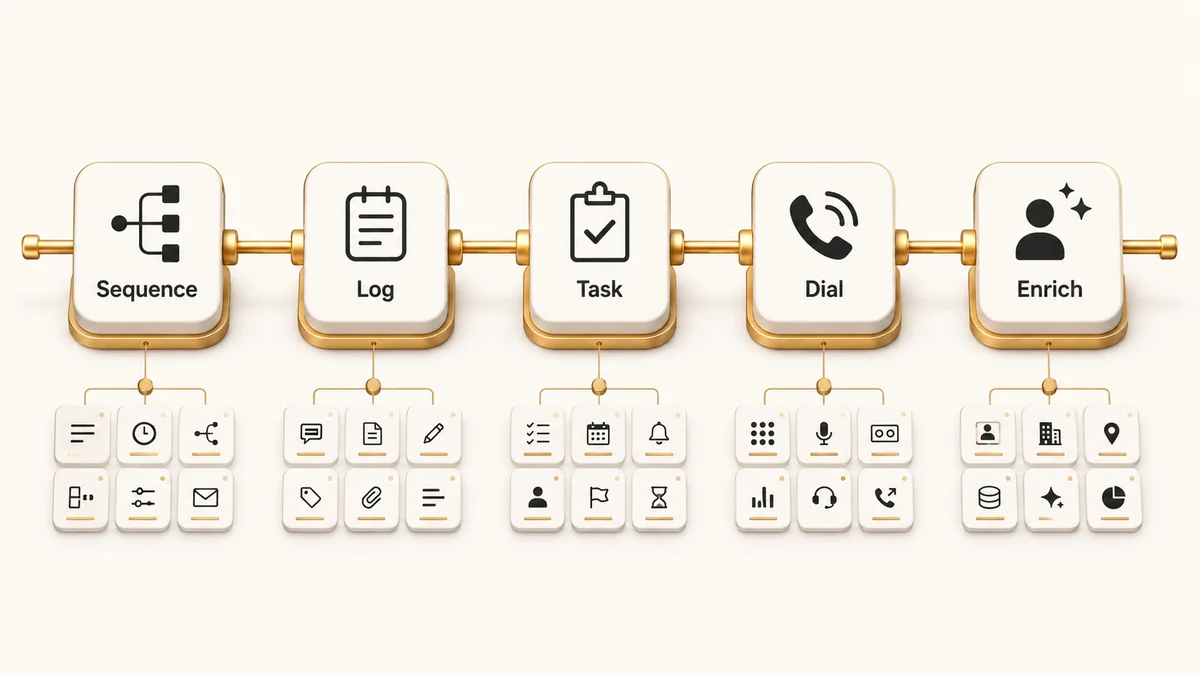
Sales automation software automates the repetitive parts of a sales rep’s day so the rep spends more time selling and less time on data entry and manual follow-up. It sits on top of the CRM rather than replacing it, and at the rep-workflow altitude it does five distinct jobs. Most tools are strong at two or three of them and lean on integrations for the rest. The AI demo-agent layer sits just before that rep workflow, qualifying buyers and showing product proof before a seller spends live time.
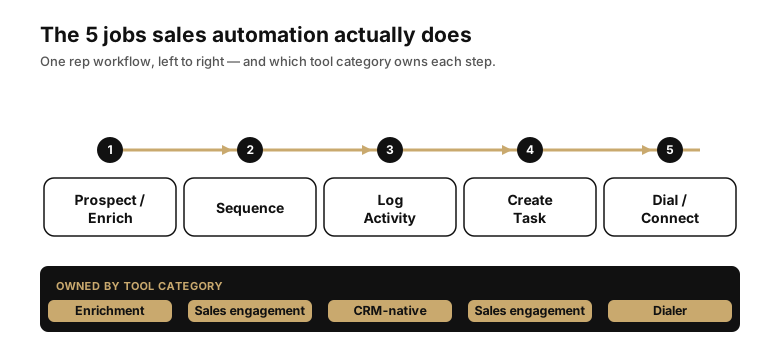
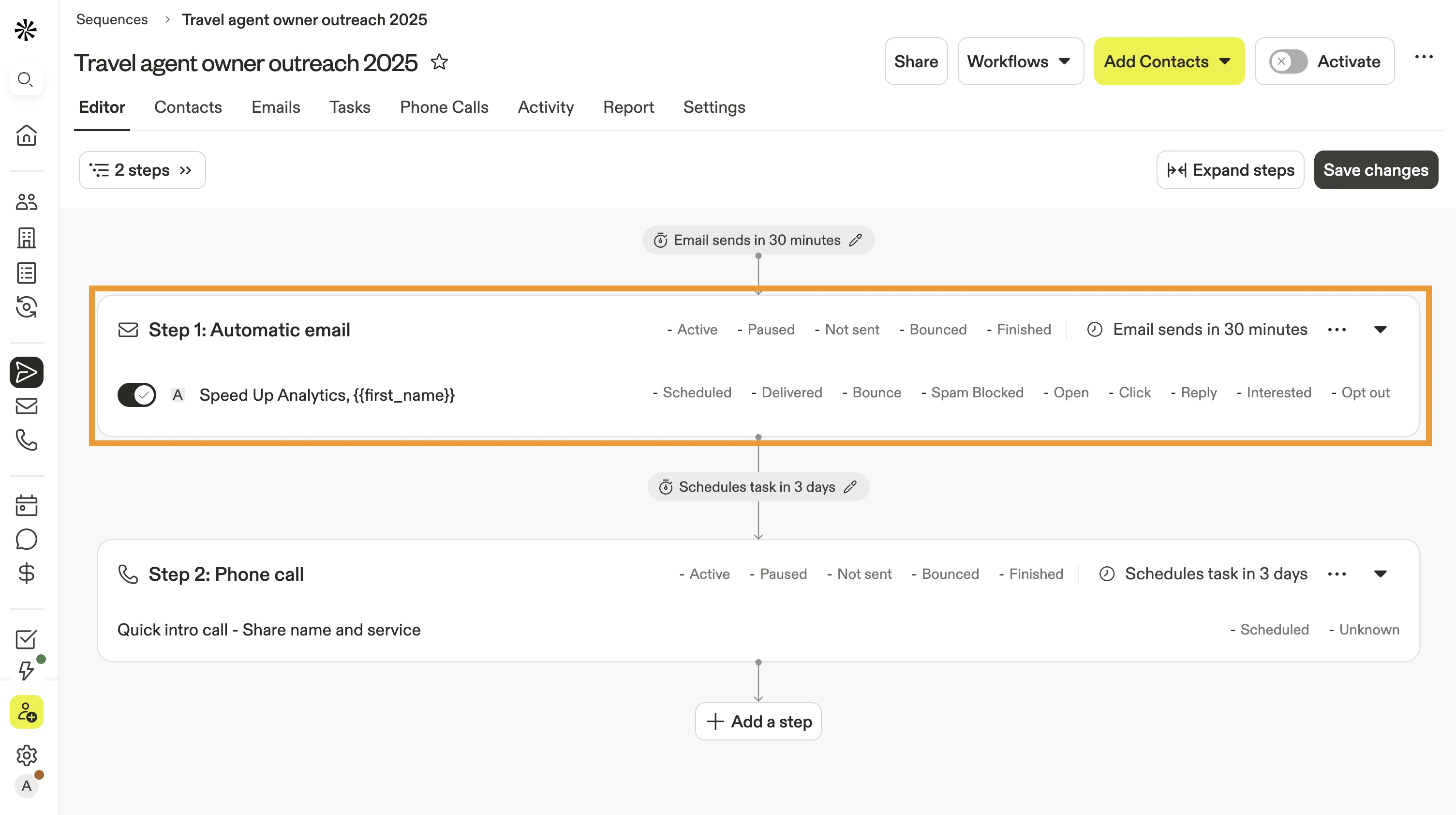
1. Sequence execution. Multi-step, multi-channel outreach that sends emails, queues LinkedIn touches, and schedules calls automatically across days or weeks. This is the engine of outbound, and it is where engagement platforms and sequence tools concentrate their depth. Email is one channel inside it, which is exactly why the cold email tools that handle that one channel are a separate purchase rather than the whole stack.
2. CRM activity logging. Every sent email, logged call, and completed task written back to the contact and deal record without the rep typing it. Manual logging is the tax reps quietly skip, which is how pipeline data rots. Tools like Salesflare and Orum make automatic capture their headline feature.
3. Task creation. Follow-up tasks generated from triggers: a reply lands, a sequence finishes, a deal stage changes, so nothing falls through. CRM-native tools build this directly into the record of truth.
4. Dialing and call logging. Outbound calling at volume, with connects, dispositions, and recordings logged automatically. Parallel dialers like Orum push this furthest by ringing several lines at once and logging the result the moment a call ends.
5. Contact enrichment. Pulling verified emails, phone numbers, and firmographics onto a record so reps work accurate data, not stale exports. A few tools carry a native database; most rely on a connected data source.
Where Sales Automation Ends and RevOps Software Begins
The cleanest way to keep this guide honest is to draw the line between rep automation and the layer above it. Sales automation works at the altitude of one seller’s motion. RevOps software works at the altitude of the whole revenue org. They are bought by different people to solve different problems, and conflating them is how teams overspend on the wrong tool.
The buyer tells you which one you are looking at. A Sales VP or an SDR manager buys sales automation because reps are losing hours to manual sequencing, logging, and dialing. A RevOps leader buys RevOps software because the org cannot forecast accurately, attribute pipeline across channels, or govern data quality at scale. The first is a rep-productivity problem; the second is a system-of-record and reporting problem. If you are weighing the two roles themselves, the distinction between sales ops vs RevOps maps almost exactly onto this altitude split.
The altitude tells you the same thing from the other direction. Rep workflow is sequences, tasks, calls, and enrichment for an individual seller. Org-wide forecasting, territory and quota design, attribution modeling, and pipeline governance sit a level up, and they pull from many rep tools rather than living inside any one of them. A sequencer does not forecast a quarter, and a forecasting platform does not dial a prospect. Buy the rep layer to make sellers faster, and buy the org layer to make the revenue engine legible. The tools below are firmly the rep layer.
How We Chose These 11 Tools
We screened against five criteria, and every pick clears all five.
1. Rep-workflow automation, not just storage. The tool has to automate at least one of the five jobs above, not merely store records. A pure CRM with no native sequencing, logging automation, or dialing was scored as infrastructure, not automation.
2. Built for B2B SaaS sales motions. The buyer is a B2B team selling software or services with multi-touch, multi-stakeholder cycles. Tools tuned for transactional B2C or single-channel blasts were dropped.
3. Honest, current pricing. We publish a real number for every tool and tag the quarter it was verified. Where a vendor is quote-gated (Outreach, Salesloft, Orum), we say the figure is a third-party estimate rather than dressing it up as official. Adjacent categories are worse on this than sales automation is: four of eleven routing products publish no price at all, and one of them had its own pricing page removed, leaving competitor blog posts to rank in its place.
4. Category clarity. Each tool has a primary job it does better than the field, so a buyer can match a tool to a bottleneck. Cold-email-only tools are excluded on this criterion, because cold email is one channel inside the workflow rather than the workflow itself, and purpose-built sales tools also beat the generic workflow builders like n8n and Zapier on this axis for non-technical sales teams.
5. Verified live in Q2 2026. The AI SDR category in particular churns fast, with funded names shipping, pivoting, or stalling inside a quarter. We confirmed each vendor here is operating and self-serve-reachable or sales-reachable as of Q2 2026, and we flag where a tool’s public pricing has shifted out from under older third-party estimates. The same caution applies to the numbers attached to the category, because the statistics quoted about this category churn just as fast, and two of the four most-repeated AI SDR adoption figures do not trace to any primary research.
The 11 Best Sales Automation Tools for B2B SaaS in 2026
Here are the 11 tools, grouped by the job they automate and numbered 1 to 11. Each gets an honest write-up, a best-for line, a standout, a Q2 2026 starting price, and a link.
Sales Engagement Platforms (1-3)
These run the sequence-execution layer for outbound teams: cadences across email, calls, and social, with the rep workflow standardized on top of whatever CRM you run.
1. Outreach: Best for Large Outbound Orgs Standardizing Rep Workflow
Outreach is the enterprise execution suite outbound orgs reach for when they need every rep running the same motion at scale. It bundles sequences, a native dialer, and deal and forecasting workflows into one layer, which is why large sales floors standardize on it rather than stitching point tools together. It is a pure engagement layer, so it assumes you bring your own data or enrichment tool alongside it. One housekeeping note that trips up buyers: the homepage migrated from outreach.io to outreach.ai this year via a 301 redirect, so link and bookmark the .ai domain. Pricing is the friction point. Outreach publishes no public pricing and sells through a demo, so the figure below is a third-party estimate, not an official tier, and you should treat it as a starting reference rather than a quote.
Best for: Large outbound orgs standardizing rep workflow at scale.
Standout: Enterprise execution suite: sequences, native dialer, deal and forecasting workflows in one layer.
Starting price (as of Q2 2026): ~$100-120/user/mo (third-party estimate; quote-gated, no public pricing) (as of Q2 2026). No free trial, demo only.
2. Salesloft: Best for Outbound Teams That Want Coaching Built In
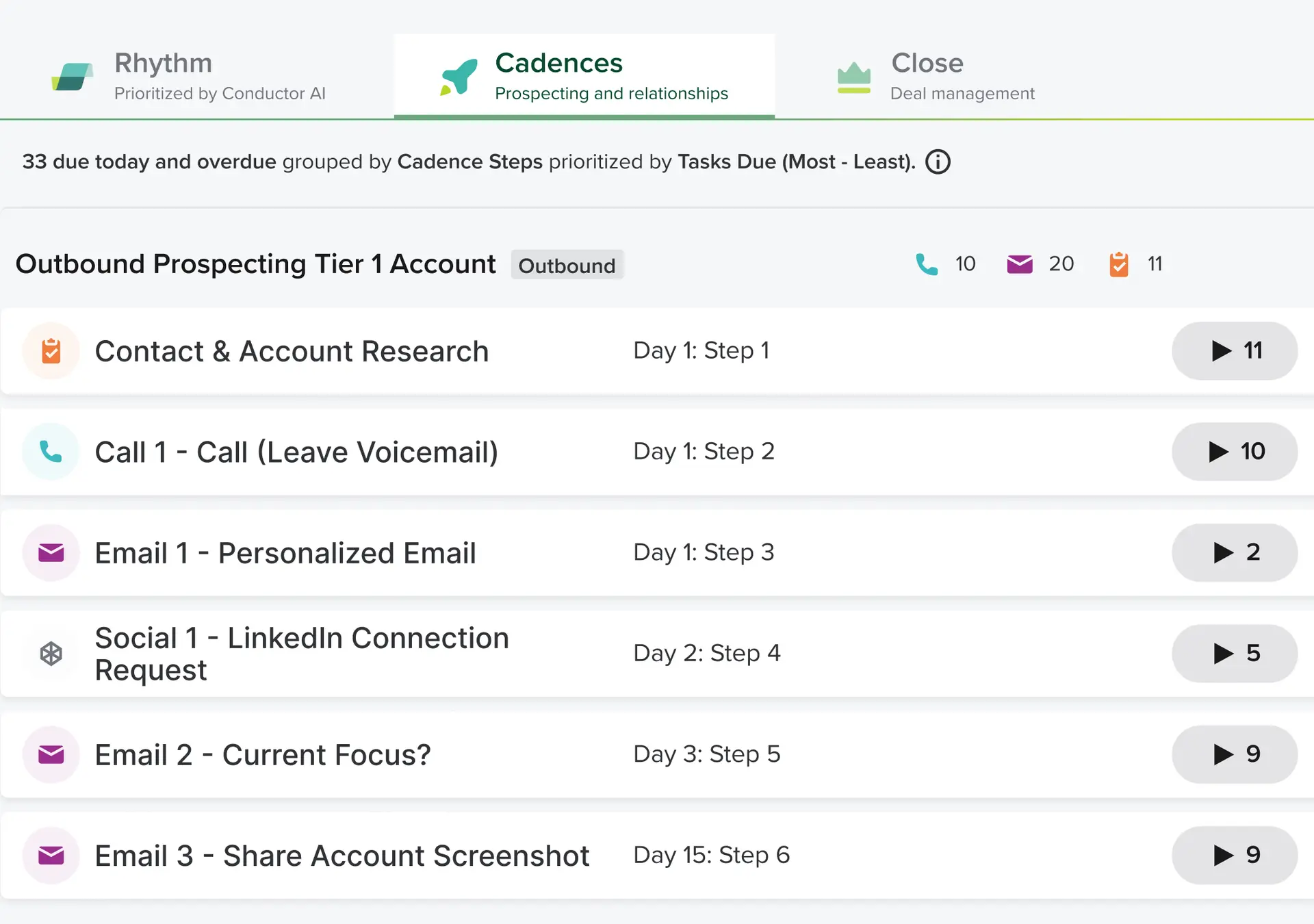
Salesloft sits in the same enterprise engagement category as Outreach, but its differentiator is coaching. Rhythm, its AI prioritization engine, ranks each rep’s next action, and call coaching and analytics are built into the cadence rather than sold as a separate product. For a team that cares as much about ramping reps and improving call quality as it does about raw send volume, that focus earns its place. Like Outreach, it is a pure engagement layer that expects a separate data source, and the dialer is a paid add-on rather than included. Pricing is quote-gated with no public tiers, so the number below is a third-party estimate from a demo-led sales process, not a published price.
Best for: Outbound teams that want coaching and analytics alongside execution.
Standout: Rep coaching and Rhythm AI prioritization built into the cadence.
Starting price (as of Q2 2026): ~$125/user/mo (third-party estimate; quote-gated) (as of Q2 2026). No free trial, demo only.
3. Apollo.io: Best All-in-One for Data Plus Engagement
Apollo is the only pick in this category that carries its own data. It pairs a native 230M+ contact database with a sequencer and a built-in dialer on the Professional tier, so a team can build a list and work it without buying a separate enrichment tool. To be precise about scope, this guide rates Apollo on its full engagement side, the sequencer, native dialer, and CRM-activity sync that automate a rep’s whole motion, not the cold-email subset it is sometimes pigeonholed into, which belongs with the cold email tools that focus on that one channel. The other reason it stands out is transparency: it is the only tool in this category with real self-serve pricing, including a usable free tier, while its rivals hide behind a demo. Pair it with structured lead generation tools upstream and Apollo becomes the engine that works the leads they produce.
Best for: Budget-conscious teams wanting data and engagement in one tool.
Standout: Only pick with a native 230M+ contact database plus sequencer and built-in dialer (Professional).
Starting price (as of Q2 2026): Free tier; Basic $49, Professional $79, Organization $119 per user/mo billed annually (as of Q2 2026). Free tier plus free trial.
CRM-Native Automation (4-5)
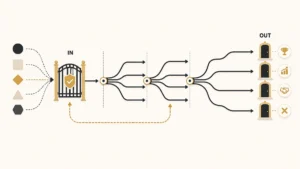
These build automation into the system of record itself, so sequences, tasks, and the MQL-to-SQL handoff all fire inside the CRM rather than syncing across a separate vendor contract. The marketing side of that same handoff, the scoring and lead nurturing that decide what reaches sales in the first place, is the job of B2B marketing automation. That handoff is the last node of a larger workflow that scores the lead and decides when to route it, not a standalone setting.
4. HubSpot Sales Hub: Best for Inbound-Heavy Teams Already on HubSpot
HubSpot Sales Hub automates the rep workflow natively inside the CRM of record, which is its whole advantage: no second vendor, no sync to babysit, and reporting that already lives where your marketing data does. For inbound-heavy teams running HubSpot, the sequences and workflow builder slot in without friction, and they tie cleanly to your lead scoring criteria so reps work the hottest records first. The honest caveat is pricing altitude. Free tools and the ~$20/seat Starter tier do not include the category-defining automation; sequences and the workflow builder require Professional at roughly $100/seat/mo billed annually (as of Q2 2026), which is a mid-tier spend rather than an entry price. If you are also weighing the CRM itself, the deeper trade-offs are in our HubSpot vs Salesforce comparison. These figures were cross-checked from 2026 third-party guides because the official pricing page blocks automated reads; the HubSpot guide was last verified April 2026.
Best for: Inbound-heavy teams already running HubSpot.
Standout: Automation native to the CRM of record, no separate vendor contract.
Starting price (as of Q2 2026): Free tools; Starter ~$20/seat/mo; sequences + workflow builder require Professional ~$100/seat/mo billed annually (as of Q2 2026). Free tier available.
5. Pipedrive: Best for Small B2B SaaS Teams on an SMB Budget
Pipedrive is the lightweight, visual-pipeline answer for small B2B SaaS teams that want workflow automation without HubSpot’s price step. The entry tier runs about $14/user/mo, and the automations and sequences land from the second tier up, somewhere in the ~$24-39/user/mo range (as of Q2 2026). That range is not vagueness on our part. Pipedrive’s knowledge base rebranded its plans to Lite, Growth, Premium, and Ultimate in November 2025, while many 2026 reviews still cite the legacy Essential, Advanced, and Professional names, so the cleanest honest answer is to state the automation tier as a price band rather than pin it to a single label that may already be stale. For a team that wants cheap, visible pipeline automation and can live with a smaller feature surface than the engagement platforms, it is the value pick in this category.
Best for: Small B2B SaaS teams wanting cheap pipeline automation.
Standout: Lightweight visual pipeline with workflow automation at an SMB price.
Starting price (as of Q2 2026): Entry ~$14/user/mo; Automations + Sequences from the 2nd tier ~$24-39/user/mo billed annually (as of Q2 2026). Free trial.
AI SDR Agents (6-7)
These push automation toward autonomous prospecting, where an agent drafts, sends, and follows up with less rep input. One name to watch but not buy yet: 11x.ai (Alice) is funded at $76M and operating, but with documented mixed product-market fit and user reviews citing generic messaging and churn, so we list it as a name-to-watch rather than a recommendation. Teams that lack the headcount to run these tools, or that would rather buy outcomes than software, often choose an outbound agency that runs prospecting with people, not software instead.
6. Artisan (Ava): Best for SMB Teams Wanting an AI SDR Without an Enterprise Contract
Artisan is the self-serve AI SDR. Its agent, Ava 2.0, runs autonomous prospecting end to end, and onboarding takes under 10 minutes, which is the opposite of the months-long enterprise rollout most AI SDR tools assume. That makes it the realistic entry point for an SMB team that wants an autonomous BDR without signing an enterprise contract or talking to a sales rep first. Worth correcting the record on price: stale third-party estimates still float $495 to $3,000/mo figures, but Artisan now publishes self-serve pricing that supersedes them, so use the official numbers below. There is a genuinely free $0 tier, an Intern tier at $250/mo, and an Employee tier at $600/mo billed annually, with a free trial and $300 in credits to start. It is live and healthy as of Q2 2026.
Best for: SMB teams wanting an AI SDR without an enterprise contract.
Standout: Self-serve autonomous AI BDR (Ava 2.0), onboarding under 10 minutes.
Starting price (as of Q2 2026): Free $0; Intern $250/mo; Employee $600/mo billed annually, free trial + $300 credits (as of Q2 2026).
7. Regie.ai: Best for Enterprise Teams Scaling AI Prospecting and Content
Regie.ai is the enterprise counterweight to Artisan. Where Artisan optimizes for self-serve SMB access, Regie.ai is built for scale and content depth: Auto-Pilot agents run autonomous prospecting, a 220M-contact RegieOne database feeds them, and a built-in AI dialer rounds out the motion. The standout is that prospecting and content generation scale together in one system, which suits a larger team producing high message volume across many accounts. The trade-off is the commercial model. This is an enterprise buy at $180/user/mo with a 10-seat annual minimum (as of Q2 2026), which puts the floor around $21,600 a year, and there is no trial. If you are an SMB testing the waters, Artisan is the accessible option; if you are an enterprise scaling AI prospecting and content together, Regie.ai is built for that weight.
Best for: Enterprise teams scaling AI prospecting and content together.
Standout: Auto-Pilot agents + a 220M-contact RegieOne database + built-in AI dialer.
Starting price (as of Q2 2026): $180/user/mo with a 10-seat annual minimum (~$21.6K/yr floor), no trial (as of Q2 2026).
Dialer + Activity Capture (8)
This category automates the calling job and the logging that usually trails it, killing the manual after-call data entry that eats high-volume teams.
8. Orum: Best for High-Volume Outbound Teams Killing Manual Call Logging
Orum is the AI parallel dialer for teams that live on the phone. It rings up to 10 lines at once with sub-0.5-second connects, and every call’s outcome logs to the CRM automatically, so reps stop hand-entering call notes between conversations. For a high-volume outbound team, that combination of connect speed and automatic activity capture is the entire pitch, and it is a strong one. Two honest constraints shape the fit. The scope is dialer-only, so it is a layer you add to a sequencer or CRM rather than a full workflow on its own, and that narrowness is the main buyer objection. Pricing is also quote-gated: the figure below is a consistent third-party estimate, not published pricing, and the plan is annual-only with no trial.
Best for: High-volume outbound teams killing manual after-call data entry.
Standout: AI parallel dialer (up to 10 lines, sub-0.5s connects) with automatic call-activity logging to the CRM.
Starting price (as of Q2 2026): ~$250/user/mo (third-party estimate; annual only, no trial) (as of Q2 2026).
Sequence + Enrichment (9-11)
These pair multichannel sequencing with automatic data capture for teams that want sequence depth without an enterprise contract. One tool we left out of the slots here is Mixmax: it does offer AI multichannel sequences at its $49/seat Engagement Copilot tier (as of Q2 2026), but a hard 1,500-recipient-per-month cap across all tiers, no A/B testing, weaker branching, and no real enrichment make it too shallow for a sequence-first pick, which is why Klenty took the slot.
9. Salesflare: Best for Solo Founders Wanting a Zero-Admin CRM with Sequences
Salesflare is the zero-admin pick. It captures CRM data automatically from email, calendar, and email signatures, then layers email sequences on top, so a solo founder or a small team gets a working CRM that fills itself in rather than one they have to feed by hand. For people who want pipeline visibility and light outbound without hiring an ops person to maintain it, that automatic capture is the whole appeal. The trade-off is ceiling rather than quality: it is built for solo and small-team use, so larger orgs outgrow its depth. Pricing on the Growth tier runs about $29/user/mo billed annually with a free trial (as of Q2 2026). We confirmed that figure via consistent 2026 review sources because the official page returned a 403 to automated reads.
Best for: Solo founders and small teams wanting a zero-admin CRM with sequences.
Standout: Automatic CRM data capture (email, calendar, signatures) plus email sequences.
Starting price (as of Q2 2026): Growth ~$29/user/mo billed annually; free trial (as of Q2 2026).
10. Reply.io: Best for Budget Multichannel Outbound Teams
Reply.io is the budget multichannel sequencer. Its strength is sequencing and engagement across email, LinkedIn, and calls or SMS in one cadence with AI assist, so a team running more than just email gets coordinated touches without an enterprise platform. To scope it precisely against the cold-email category it overlaps, this guide rates Reply.io on its multichannel sequencing and engagement, not on inbox deliverability, which is a different job handled by different tools. The honest cost note is that the headline entry price understates the real bill. Entry runs about $49-59/user/mo (as of Q2 2026) and scales by contact tier, but the channels that make it multichannel, LinkedIn, calls, and SMS, stack on as add-ons, so a genuinely multichannel setup costs more than the starting number suggests. A free trial lets you size that before committing.
Best for: Budget multichannel outbound teams.
Standout: Multichannel sequencing across email, LinkedIn, and calls/SMS (add-ons) with AI assist.
Starting price (as of Q2 2026): Entry ~$49-59/user/mo (scales by contact tier); free trial (as of Q2 2026).
11. Klenty: Best for Teams Wanting Genuine Sequence Depth at a Mid Price
Klenty earns the last slot on sequence depth at a price that does not jump to enterprise. It runs multichannel cadences with Action AI and Agentic Cadences plus native CRM sync, and that depth, real branching, genuine multichannel, agentic follow-up, is exactly what shallower tools like Mixmax give up. For a team that wants serious cadence capability at a mid price rather than a stripped-down sequencer, it is the practical choice. Entry runs about $50/user/mo billed annually with a free trial, and a dialer is available as an add-on for teams that want calling in the same tool. We verified it operating as of Q2 2026.
Best for: Teams wanting genuine sequence depth at a mid price.
Standout: Multichannel cadences with Action AI / Agentic Cadences and native CRM sync.
Starting price (as of Q2 2026): ~$50/user/mo entry billed annually; free trial; dialer add-on (as of Q2 2026).
Sales Automation Tools Compared (Q2 2026)
The table below lines up all 11 tools on category, best-fit buyer, starting price, free trial, standout, and a one-line verdict. Prices are the entry paid reference as of Q2 2026; quote-gated figures are third-party estimates.
| Vendor | Category | Best for | Starting price (as of Q2 2026) | Free trial | Standout | Verdict |
|---|---|---|---|---|---|---|
| Outreach | Sales engagement | Large outbound orgs at scale | ~$100-120/user/mo (est.) | No (demo only) | Sequences + dialer + forecasting in one | Enterprise execution suite |
| Salesloft | Sales engagement | Coaching-led outbound teams | ~$125/user/mo (est.) | No (demo only) | Rhythm AI prioritization + coaching | Engagement with built-in coaching |
| Apollo.io | Sales engagement | Data + engagement on a budget | Free; $49-119/user/mo | Yes (free tier + trial) | Native 230M+ database + dialer | Best all-in-one value |
| HubSpot Sales Hub | CRM-native automation | Inbound-heavy HubSpot teams | Free; Pro ~$100/seat/mo | Yes (free tier) | Automation native to the CRM | Best for HubSpot shops |
| Pipedrive | CRM-native automation | Small B2B SaaS on a budget | ~$14 entry; ~$24-39 for automation | Yes (free trial) | Visual pipeline at SMB price | Cheap pipeline automation |
| Artisan (Ava) | AI SDR | SMB teams wanting an AI SDR | Free; Intern $250; Employee $600/mo | Yes (free trial + credits) | Self-serve autonomous BDR, <10-min setup | Self-serve AI SDR |
| Regie.ai | AI SDR | Enterprise AI prospecting + content | $180/user/mo, 10-seat min | No | Auto-Pilot agents + 220M database | Enterprise AI prospecting |
| Orum | Dialer + activity | High-volume outbound callers | ~$250/user/mo (est.) | No | 10-line parallel dialer + auto-logging | Parallel dialer for volume |
| Salesflare | Sequence + enrichment | Solo founders, small teams | ~$29/user/mo (annual) | Yes (free trial) | Automatic CRM data capture | Zero-admin CRM + sequences |
| Reply.io | Sequence + enrichment | Budget multichannel outbound | ~$49-59/user/mo | Yes (free trial) | Multichannel sequencing + AI assist | Budget multichannel sequencer |
| Klenty | Sequence + enrichment | Sequence depth at a mid price | ~$50/user/mo (annual) | Yes (free trial) | Action AI / Agentic Cadences | Deep cadences, mid price |
Sales Automation Pricing Benchmarks for 2026
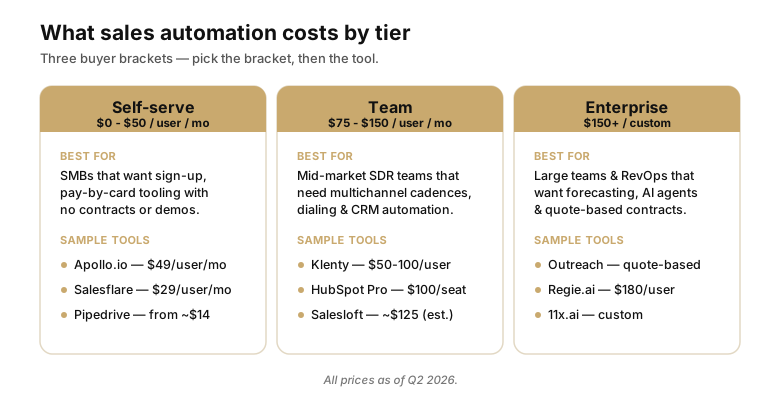
Sales automation pricing in 2026 falls into three tiers, and where a tool lands tells you more about its buyer than its quality. The figures below are all as of Q2 2026, and the engagement and dialer tools are usually quote-gated, so their numbers are third-party estimates rather than published prices.
| Tier | Price range (as of Q2 2026) | Example tools (as of Q2 2026) | Who it fits |
|---|---|---|---|
| Self-serve | $0-$50/user/mo (as of Q2 2026) | Apollo ($49), Salesflare ($29), Pipedrive entry (~$14) | Solo founders and small teams buying without a sales call |
| Team | $75-$150/user/mo (as of Q2 2026) | HubSpot Professional (~$100), Salesloft (~$125 est.) | Funded teams where outbound is a real channel |
| Enterprise | $150+/user or custom (as of Q2 2026) | Outreach (quote-based), Regie.ai ($180, 10-seat min) | Large orgs standardizing rep workflow at scale |
Two things distort the headline numbers. Add-ons stack: Reply.io’s channels, Orum’s annual-only commitment, and HubSpot’s jump from Starter to Professional all push real spend above the entry figure. And quote-gating hides the true price on the engagement and dialer tools, so the estimates above are starting references, not contracts. Whatever tier you land in, tie the spend to the metrics that prove it worked, cost per booked meeting and pipeline influenced, rather than the sticker price on the seat.
PRO TIP
Before you buy, price the tool at the tier where the automation you actually need turns on, not the entry tier. HubSpot’s sequences and Pipedrive’s automations both live above the cheapest plan, and Reply.io’s multichannel only works once you add the channel modules. Build your budget from the working tier up, and the quote-gated tools (Outreach, Salesloft, Orum) stop surprising you on the contract.
Which Sales Automation Tool Fits Your Team
The picks above sort cleanly by team type. Here are five quick verdicts to short-circuit the comparison.
Outbound SDR Teams: Outreach or Salesloft
If you run a real outbound floor and need every rep on the same standardized motion, the engagement platforms earn their price. Pick Outreach when execution and forecasting in one suite matter most, and Salesloft when coaching and call quality are the priority. Both are quote-gated annual buys, so budget for a demo cycle rather than a self-serve start.
Inbound-Heavy Teams: HubSpot Sales Hub
If your pipeline is mostly inbound and you already run HubSpot, automating the rep workflow natively inside the CRM beats bolting on a second vendor. Just budget at the Professional tier, because that is where sequences and the workflow builder actually switch on.
CRM-First Ops: Pipedrive or Salesflare
If you want the system of record and the automation in one lightweight tool, Pipedrive gives you cheap visual-pipeline automation and Salesflare gives you a CRM that fills itself in. Both keep the admin overhead low for small teams that do not have an ops hire to spare.
AI-First Teams: Artisan or Regie.ai
If you want an agent doing the prospecting, the split is by size. Artisan is the self-serve, SMB-accessible AI SDR you can start in an afternoon; Regie.ai is the enterprise build for scaling AI prospecting and content together, with the seat minimum to match.
Solo Founders: Salesflare or Reply.io
If it is just you or a tiny team, Salesflare gives you a zero-admin CRM with sequences, and Reply.io gives you budget multichannel outreach when email alone is not enough. Both start cheap and let you trial before paying.
IMPORTANT
Read the commercial fine print before you commit, because the sticker price is rarely the real one in this category. Regie.ai carries a 10-seat annual minimum (a ~$21,600/yr floor even if you need fewer seats, as of Q2 2026), Orum is annual-only with no trial, and Outreach and Salesloft are quote-gated demos with no public pricing and no self-serve path. Seat locks, annual contracts, and quote-gating can turn a tool that looked affordable per user into a five-figure yearly commitment. Confirm minimums, contract length, and trial availability in writing before you sign.
What We Did Not Cover
Three adjacent categories were left out on purpose, because each solves a different problem at a different altitude and earns its own guide.
Cold email software. Cold email is one channel inside the rep workflow, not the workflow itself, so the tools that handle that single channel, deliverability, inbox warm-up, and mailbox rotation, are a separate purchase rather than part of this rep-workflow stack.
RevOps software. The org-wide layer above rep automation, forecasting, attribution, and pipeline governance for the whole revenue team, is a different buyer and a different altitude, covered in our RevOps software guide.
Generic workflow builders. n8n, Make, and Zapier can automate sales steps, but they are general-purpose tools for technical teams that want to wire systems together by hand; the trade-offs are in our n8n vs Make vs Zapier comparison, and for most sales teams a purpose-built tool from this list is the faster path.
Frequently Asked Questions
Software that automates the repetitive parts of a sales rep workflow, multi-step outreach sequences, logging activity to the CRM, creating follow-up tasks, dialing and call logging, and contact enrichment, so reps spend more time selling. It sits on top of the CRM rather than replacing it.
A CRM is the system of record that stores contacts, deals, and history. Sales automation is the motion layer on top: it executes sequences, logs activity back into the CRM, and triggers tasks. Some CRMs (HubSpot, Pipedrive) build automation natively; engagement tools (Outreach, Salesloft, Apollo) bolt it onto whatever CRM you run.
For most teams they augment SDRs rather than replace them, automating the manual steps so each rep covers more ground. AI SDR agents (Artisan, Regie.ai) push further toward autonomous prospecting, but in 2026 they are best at top-of-funnel volume, with humans still owning qualification and relationships.
Three tiers (as of Q2 2026): self-serve at $0-$50/user/mo (Apollo $49, Salesflare $29, Pipedrive entry ~$14), team at $75-$150/user/mo (HubSpot Professional ~$100, Salesloft ~$125 est.), and enterprise at $150+/user or custom (Outreach quote-based, Regie.ai $180 with a 10-seat minimum). Engagement and dialer tools are usually quote-gated, and at any tier the rep layer stays distinct from the org-wide reporting you would build with RevOps best practices.
Your First Move
Start by naming the one job your reps lose the most time to, because that single answer collapses the list fast. If it is manual data entry, look at Salesflare or Orum for automatic capture. If it is outreach at scale, the engagement platforms or Klenty handle the sequencing. If it is prospecting volume, the AI SDRs do the top of funnel. If you just want data and a sequencer in one affordable tool, Apollo is the default, and it is the only pick here you can start on a free tier today.
Whatever you shortlist, price it at the tier where the automation actually turns on and confirm the contract terms before you sign, since seat minimums and quote-gating hide real cost in this category. Pick for the bottleneck you have now, not the feature list you might grow into, and the tool pays for itself in the hours it hands back to your reps.