Most B2B outbound does not fail because the team stopped trying. It fails because the list was wrong, the sending domain was cold, or the offer never matched the buyer. Hiring one of the best outbound agencies can fix all three, but only if you pick the model that matches how your revenue team actually works.
Outbound-as-a-service now covers three very different things: agencies that run a full SDR team for you, partners that build the system and hand you the wheel, and providers that sell the data and software so your own reps can prospect. The price gap between them runs from a few hundred dollars a month to thirty thousand. This guide sorts the market by model, names the agencies that fit each one, shows what they cost, and stays honest about when an outbound agency is the wrong call.
Direct answer — What are the best outbound agencies for B2B?
The best outbound agency depends on your model. For managed SDR-as-a-service, Martal Group suits B2B tech and SaaS, Belkins and SalesRoads lead on appointment setting, and Callbox handles enterprise and global campaigns. CIENCE offers transparent, itemized pricing, and SalesBread fits startups on a boutique budget. Expect roughly $2,000 to $30,000 per month depending on channels and rep seniority. If you already have an in-house rep, buying data and tooling often beats hiring an agency at all.
Key Takeaways
- Outbound agencies come in three models: managed SDR-as-a-service, done-with-you, and data plus tooling. Match the model to your team before you compare names.
- Pricing runs from about $2,000 per month (boutique, done-with-you) to $15,000 to $30,000 per month (enterprise managed pods). Only some agencies publish rates, so treat quote-only as a reason to ask harder questions.
- A managed program still takes three to four months to ramp, and the average B2B cold email reply rate sits under half a percent, so judge agencies on process and deliverability, not promises.
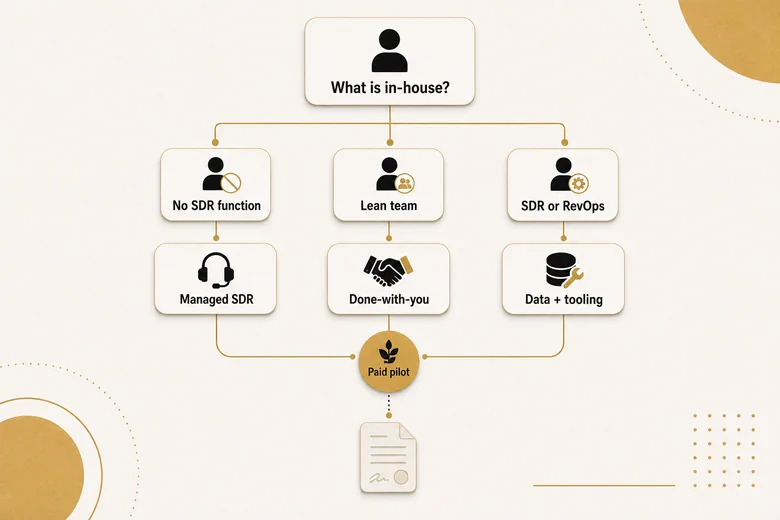
- Managed SDR fits teams with no sales-development function; done-with-you fits lean teams that want more output without new hires; data plus tooling fits anyone with an in-house rep who can run sequences.
- Outbound agencies fail most often on ICP fit, weak deliverability, and misaligned incentives, not on effort. Run a paid pilot before you sign an annual contract.
What an outbound agency actually does
An outbound agency runs proactive prospecting on your behalf: it builds targeted contact lists, writes and sends cold email and LinkedIn sequences, dials prospects, and books qualified meetings into your reps’ calendars. The best outbound agencies own the top of the funnel so your closers spend their time selling instead of sourcing.
This is one slice of a broader decision about outsourcing lead generation to a specialist partner, but outbound is a distinct discipline with its own failure modes. Where inbound lead generation waits for buyers to find you through content and search, outbound starts the conversation with accounts that match your ideal customer profile, whether or not they have heard of you. That difference is why an agency good at one is often mediocre at the other.
A typical engagement includes list building and data enrichment, message and sequence copywriting, the sending infrastructure (separate domains and warmed inboxes), multi-channel outreach, and meeting booking with basic qualification. What it does not include is closing. An outbound agency fills the calendar; your account executives still have to run the deal.
The three outbound agency models: managed SDR, done-with-you, and tooling
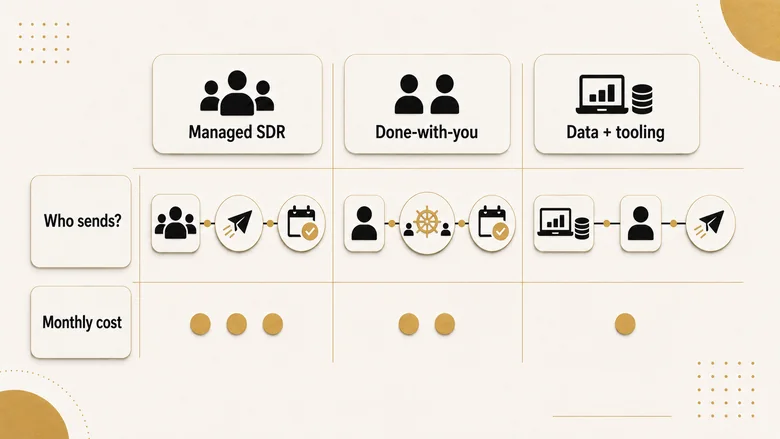
Outbound agencies split into three models that differ on one question: who actually runs the sending? Get this right and the shortlist of names almost writes itself.
Managed SDR-as-a-service means the agency supplies sales development reps who run the entire program on their own infrastructure. You receive booked meetings and reporting; you give up day-to-day control of the message and the list. This is the model most people picture when they say “outbound agency,” and it is where Martal Group, Belkins, Callbox, SalesRoads, and SalesHive operate.
Done-with-you sits one step back. The agency builds the strategy, the list, and the sequences, then either runs the program jointly or hands you the controls once it works. You pay less and keep more control, but the program needs a few hours of your team’s time every week. Boutiques like SalesBread lean this way.
Data plus tooling is not really an agency at all. You buy contact data, intent signals, and sequencing software, and your own rep runs the outreach. It is the cheapest option and gives you full control, along with full responsibility for deliverability and results. If you go this route, the spend moves from a retainer to your stack: the right cold email software for sending and warmup, plus sales automation tools for sequencing and CRM sync.
| Model | What they run | Who sends | Typical monthly cost (as of Q3 2026) | Best fit | Main risk |
|---|---|---|---|---|---|
| Managed SDR-as-a-service | Full program: list, copy, infrastructure, dialing, booking | The agency’s SDRs | $7,000 to $30,000+ | Teams with no SDR function that need meetings fast | Less control; meeting quality varies; ramp still takes months |
| Done-with-you | Strategy, list, and sequences, run jointly | Shared (you and the agency) | $2,000 to $8,000 | Lean teams with one or two sellers who want more reach | Needs your weekly time; ownership blurs if it stalls |
| Data plus tooling | Contact data, intent, and sequencing software | Your own team | $100 to $2,000 (software and data) | Teams with an in-house SDR or RevOps owner | You own deliverability, testing, and every result |
How we chose these agencies
Because this list is editorial, the selection logic is worth stating plainly. We grouped agencies by model and buyer rather than forcing a single 1-to-10 order, since the right outbound partner for a seed-stage startup is not the right one for a global enterprise. Four criteria shaped the shortlist.
- A clear model and channel mix. A good agency states whether it runs managed SDR, done-with-you, or data plus tooling, and which channels it sends on. Everything-to-everyone positioning is a warning sign.
- Pricing transparency. Agencies that publish rates (Callbox, CIENCE, SalesRoads, SalesBread) are easier to compare and cannot hide a thin offer behind a custom quote. Quote-only pricing is not disqualifying, but it earns more scrutiny.
- Deliverability discipline. The agencies worth hiring send from their own warmed domains and treat inbox placement as a core metric, because a partner that burns your sending reputation costs far more than its retainer.
- Fit over fame. Names that recur across independent 2026 rankings earned a look, but the tiebreaker is always which agency’s typical client resembles your company.
Because IVRIS runs no outbound agency of its own, none of these picks is a paid placement. The aim is a shortlist you can vet, not a winner we are pushing.
The best outbound agencies for B2B, by fit
The best outbound agency for you is the one whose ideal client looks like your company. The seven below show up consistently across 2026 outbound rankings, and each one fits a different buyer. Treat this as a shortlist to pressure-test, not a leaderboard, since the right pick depends on your channels, deal size, and budget.
Best for B2B tech and SaaS: Martal Group
Martal Group runs fractional SDR teams and North American lead generation across email, LinkedIn, and phone, which suits mid-market technology and SaaS companies selling into the US and Canada. Pricing is a flat monthly fee that the company quotes after a call rather than publishing, with higher tiers adding a sales commission.
Best for appointment setting: Belkins and SalesRoads
Belkins is an appointment-setting specialist with a strong reputation for deliverability management and multichannel prospecting, and it works across a broad range of B2B segments on a custom monthly retainer. SalesRoads takes the same job in a US-based, phone-led direction with dedicated SDRs and a supporting operations team, which fits complex sales where a native-speaking caller matters. SalesRoads publishes its pricing, starting at $9,950 per four-week engagement.
Best for enterprise and global campaigns: Callbox
Callbox runs multi-channel “campaign pods” spanning phone, email, LinkedIn, and social, with reach into APAC and other international markets. That makes it a fit for enterprise and complex, multi-region programs rather than a startup’s first outbound hire. Callbox is transparent about the cost: an estimated $15,000 to $30,000 per month for one campaign pod.
Best for transparent, flexible pricing: CIENCE and SalesHive
CIENCE is the most transparent name on this list. It publishes an itemized SDR marketplace (offshore reps from $1,500 per month, US reps up to $5,500) on top of a $2,000 monthly strategic team fee, a $499 platform license, and a one-time $5,000 setup, with month-to-month terms and no long contract. SalesHive takes a simpler shape: one flat monthly fee, no setup charge, and no long-term commitment, though it now quotes that fee privately. Both suit mid-market teams that want flexibility over a locked annual deal.
Best for startups and boutique budgets: SalesBread
SalesBread is a boutique LinkedIn and cold-email shop that targets roughly one qualified lead per day for $2,000 to $3,000 per month. That price and focus fit startups and small teams that want managed outreach without an enterprise retainer. It is closer to done-with-you than a full managed SDR operation, which is exactly why it costs less.
None of these are the only options. If your need is broader than pure outbound, the wider field of B2B lead generation companies includes full-funnel providers that blend inbound, paid, and outbound under one contract.
| Agency | Primary channels | Best for | Model | Pricing (as of Q3 2026) |
|---|---|---|---|---|
| Martal Group | Email, LinkedIn, phone | B2B tech and SaaS, mid-market | Managed SDR | Quote-only (flat monthly fee) |
| Belkins | Email, LinkedIn, calling | Appointment setting, broad B2B | Managed appointment setting | Quote-only (monthly retainer) |
| Callbox | Phone, email, LinkedIn, social | Enterprise, global and APAC | Managed multi-channel | $15,000 to $30,000 / mo per pod |
| SalesRoads | Phone, email | Mid-market and enterprise, US SDRs | Managed SDR / appointment setting | From $9,950 / 4 weeks |
| CIENCE | Phone, email, LinkedIn, AI | Mid-market tech wanting transparency | Managed SDR + platform | ~$7,499 first month; SDRs $1,500 to $5,500 / mo |
| SalesHive | Calling, email | SMB to mid-market, no contract | Managed SDR | Quote-only (flat monthly fee) |
| SalesBread | LinkedIn, cold email | Startups and boutique budgets | Done-with-you | $2,000 to $3,000 / mo |
What outbound agencies cost
Outbound agency pricing usually takes one of three shapes: a flat monthly retainer, a per-appointment or per-lead fee, or a pass-through model where you pay the SDR’s cost plus a management fee. Knowing which shape you are buying matters more than the headline number.
At the entry end, a boutique done-with-you program like SalesBread costs $2,000 to $3,000 per month for around one qualified lead a day. Mid-market managed programs sit higher: SalesRoads starts at $9,950 per four weeks, and CIENCE lands near $7,499 for a first month that bundles setup, a strategic team, and its platform, with individual SDRs billed at $1,500 to $5,500 depending on seniority and location. Enterprise multi-channel programs reach the top of the range, with Callbox estimating $15,000 to $30,000 per month for a single campaign pod. Martal Group, Belkins, and SalesHive keep their rates behind a quote, which is itself a signal: published pricing tends to mean a productized service, and a private quote means you should ask exactly what the number includes.
The comparison that decides most budgets is agency versus in-house. A single US sales development rep earns about $83,110 in total cash compensation, and the fully loaded cost climbs higher once you add tooling, management, and overhead. That rep also needs three to four months to reach full productivity, so a mis-hire is expensive twice. A managed agency can beat that math, but only when it ramps faster than a new hire and books meetings your team can actually close. Running the same comparison against an AI SDR is harder than it looks, because no credible source publishes a rate at which AI has replaced human reps, which leaves the human cost baseline as the only side of that equation with measured numbers behind it.
Pro tip: Ask every agency for its meeting-to-opportunity rate, not just meetings booked. A program that books 20 meetings a month sounds great until you learn only two become real opportunities. The rate you care about is qualified pipeline per dollar, not calendar volume.
When outbound agencies fail
Outbound agencies fail for reasons that have little to do with effort and everything to do with fit, deliverability, and incentives. Understanding these failure modes is the difference between a productive retainer and a wasted year.
Important: An agency cannot manufacture demand for a product buyers do not want. Outbound amplifies a working offer; it does not create product-market fit. If your in-house reps cannot book meetings for the offer, an agency sending more of the same message will not either.
The list is wrong. A great agency working from a bad ideal customer profile produces meetings that never close. If you cannot describe your best-fit account and buyer in one sentence, no agency can find them for you. This is the single most common reason engagements underperform, and it is almost always the client’s gap, not the agency’s.
Deliverability is harder than the pitch admits. Cold email is a tougher channel than most decks suggest. Across 2025 campaigns, the average B2B reply rate was just 0.45% on a like-for-like basis (unique replies divided by emails sent), according to Belkins’ analysis of 7.5 million emails. Inbox placement for cold sends also runs well below marketing email: GlockApps’ Q4 2025 tests put average Gmail placement near 57% and Outlook near 45%. An agency that skips domain warmup and list hygiene will quietly burn your sending reputation.
Single-channel dependence. Email-only sequences convert 0.8% to 2.0% to a meeting, while multi-touch programs that combine email, LinkedIn, and phone convert 4.0% to 7.0%, per Optifai’s SDR benchmark of 939 companies. An agency that runs one channel is structurally behind before it sends a single message. Ask how many channels the program uses and how they sequence together.
Incentives point the wrong way. Pure pay-per-meeting or commission-only models optimize for booked calls, not qualified ones. You end up with a full calendar and an empty pipeline. And when a program is billed on activity, nobody upstream is accountable for whether those meetings ever became revenue.
How to choose and vet an outbound agency
Choose an outbound agency by starting with your own team, not the agency’s pitch deck. The model you need follows directly from what you already have in-house.
- Hire managed SDR-as-a-service when you have no sales-development function and need meetings faster than you can recruit and train reps.
- Choose done-with-you when you have one or two sellers who can spend a few hours a week on outbound but lack the system, data, and infrastructure to run it well.
- Buy data and tooling when you already employ an SDR or RevOps person who can run sequences. The software and lists cost a fraction of a managed retainer, and you keep full control.
Once you know the model, vet the shortlist on process rather than promises. Ask for a named client in your space and the meeting-to-opportunity rate they delivered, not just meetings booked. Ask which domains and inboxes they will send from, since a competent agency never sends cold volume from your primary domain. Ask how they build lists and where the data originates. Ask how many channels the program runs and how they sequence. Then ask for month-to-month terms or a paid pilot before any annual commitment.
Pro tip: Run a 30 to 60 day paid pilot on a single, well-defined segment before signing anything longer. Judge it on qualified opportunities created, not on activity or booked meetings. Any agency confident in its process will take the pilot; the ones that only sell annual contracts are telling you something.
The best outbound agency is the cheapest one that reliably books meetings your team can close. Start with the model that fits your team, shortlist two or three names built for your segment and budget, and prove the fit on a paid pilot before you commit a year.
Frequently Asked Questions
Roughly $2,000 to $30,000 per month. Boutique done-with-you programs start near $2,000 to $3,000 (SalesBread), mid-market managed SDR runs about $7,000 to $16,000 (CIENCE, SalesRoads), and enterprise multi-channel pods reach $15,000 to $30,000 (Callbox). Some agencies publish rates; others quote only after a call.
Managed SDR-as-a-service means the agency’s reps run the whole program on their own infrastructure and hand you booked meetings. Done-with-you means the agency builds the strategy, lists, and sequences, then runs them jointly or hands you the controls, so you keep more control and pay less but invest more of your own time.
Skip an agency if you have no clear ideal customer profile, no proven offer, or an in-house rep who can already run sequences. Outbound amplifies a working offer; it cannot create demand for a product buyers do not want, and a strong agency working from the wrong list still produces meetings that never close.
Hire an agency when you need meetings faster than you can recruit, since a new SDR costs about $83,000 in cash compensation and takes three to four months to ramp. Build in-house when outbound is core and you can manage it daily. If you already have one rep, buying data and tooling often beats both options.
US-based SDRs cost more (often $3,500 to $5,500 per rep monthly versus $1,500 to $3,500 offshore) but suit complex, high-value B2B sales where accent, time zone, and buyer familiarity matter. For high-volume top-of-funnel prospecting, blended or offshore teams can deliver similar meeting volume at lower cost. Match rep seniority to deal size.