Only 2% of your website visitors fill out a form. The other 98% research, compare, and leave without a trace. That’s the reality of B2B lead generation in 2026, and it explains why so many marketing teams hit traffic goals while missing pipeline targets.
Use a broader B2B marketing campaign strategy to decide which offers and channels should feed that inbound engine.
Inbound lead generation flips the traditional sales model. Instead of chasing prospects with cold calls and purchased lists, you attract them by solving their problems through content, SEO, and digital experiences. When done right, the leads come to you, already educated on your category and primed for a sales conversation.
Even HubSpot is reframing the category now, with HubSpot retiring the INBOUND name as buyer journeys move beyond the old inbound label.
After building inbound engines for B2B companies across SaaS, professional services, and MarTech, we’ve found that the teams generating the highest-quality inbound leads share one trait: they treat inbound as a system with connected stages, not a collection of disconnected tactics.
This guide covers the inbound lead generation process from first touch to sales handoff, including the strategies that drive the most qualified leads and the metrics that actually predict pipeline.
Key Takeaways
- Inbound lead generation attracts prospects who initiate contact with your business after discovering your content. These leads close at 14.6% on average, far higher than cold outbound.
- The four-stage inbound process (Attract, Convert, Close, Delight) requires different content, CTAs, and tools at each stage. Most teams over-invest in Attract and under-invest in Convert.
- SEO content, webinars, and gated templates are the three highest-ROI inbound tactics for B2B companies. Webinars alone convert 20-40% of attendees into MQLs.
- Measure inbound success by cost per MQL, MQL-to-SQL conversion rate, and pipeline sourced from organic channels, not just traffic volume.
What Is Inbound Lead Generation?
Inbound lead generation is the process of attracting potential customers to your business through valuable content and digital experiences, then converting that interest into contact information your sales team can follow up on. Unlike outbound methods where you initiate contact (cold emails, cold calls, purchased lists), inbound puts the buyer in control of when and how they engage.
An inbound lead is someone who has already taken an action that signals interest: they downloaded your guide, registered for your webinar, requested a demo, or subscribed to your newsletter. Because they came to you, these leads are warmer, more informed, and closer to a buying decision than cold prospects. It is worth noticing that each of those is a separate capture point, and any one that fails to stamp its own source becomes untraceable the moment you try to measure where pipeline came from.
For B2B companies with long sales cycles, inbound is particularly effective. Buyers who discover your brand through helpful content during their research phase develop trust and familiarity before the first sales call. That pre-built trust translates into shorter sales cycles, higher close rates, and larger deal sizes. The complement to that long-game motion is the build-vs-outsource decision on the outbound side, where the cost-per-meeting math and the failure-mode taxonomy decide whether agency capacity, in-house SDR build, or an in-house AI stack is the right allocation for the current quarter.
Inbound vs Outbound Lead Generation
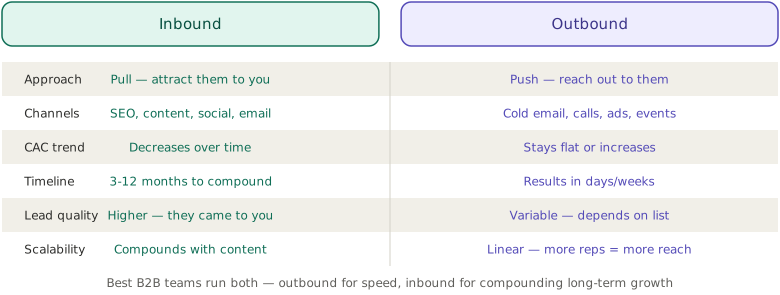
These aren’t competing approaches. Most successful B2B companies use both. But understanding the difference helps you allocate budget and set expectations correctly. The close-rate column in the comparison below compresses the whole argument into two numbers, and the warm-to-cold conversion multiplier that explains why those rates diverge is what should drive how you split spend between the two motions.
| Dimension | Inbound | Outbound |
|---|---|---|
| Who initiates | The prospect finds you | You reach out to the prospect |
| Lead quality | Higher (self-qualified) | Variable (depends on targeting) |
| Cost per lead | Lower long-term (content compounds) | Higher but faster |
| Time to results | 3-6 months to build momentum | Days to weeks |
| Close rate | ~14.6% average | ~1.7% average |
| Scalability | Compounds over time | Linear (more spend = more leads) |
| Best for | Long-term pipeline building | Immediate pipeline needs |
The critical insight: inbound costs 61% less per lead than outbound over time because content is an appreciating asset. A blog post published today continues generating leads for years. A cold email campaign stops producing the moment you stop sending. For the SMB and local service business angle on lead acquisition, see our local lead generation guide with 2026 channel CPL benchmarks.
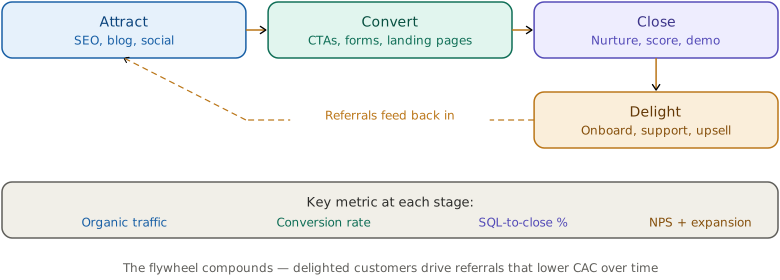
The 4-Stage Inbound Lead Generation Process
Every inbound lead follows a journey from stranger to customer. The strongest inbound programs design specific content, CTAs, and tools for each stage. Inbound is really the capture half of a larger system, and mapping it against a full framework for creating demand before you capture it shows why the Attract stage struggles when nothing upstream is building awareness first.
Stage 1: Attract
Bring the right visitors to your website through content that addresses their problems. The key word is “right”: traffic without intent is vanity. You want visitors who match your ICP and are actively researching topics related to your product category. Even on-ICP traffic fills forms with personal emails, stale titles, and the occasional bot, so raw inbound has to be validated before it counts as a lead. Sorting which on-ICP visitors are genuinely in-market from the ones just browsing is where intent data does its work. Even on-ICP traffic fills forms with personal emails, stale titles, and the occasional bot, so raw inbound has to be validated before it counts as a lead.
Primary tactics: SEO-optimized blog content targeting keywords your buyers search for — a structured content marketing lead generation approach ensures each piece connects to a conversion point. Organic LinkedIn content that builds thought leadership. B2B Google Ads targeting high-intent search terms. Podcast appearances that put you in front of engaged audiences. Guest posts on industry publications.
Stage 2: Convert
Turn visitors into leads by offering something valuable enough to justify sharing their contact information. This is where most B2B teams underperform: they drive traffic but don’t give visitors a compelling reason to identify themselves. That compelling reason is a copy problem before it’s an offer problem, and the words on the form and the page decide whether a strong offer ever gets read.
Primary tactics: Gated content (ebooks, templates, research reports) behind forms. Webinar registrations. Free tool or calculator access. Demo request forms on product pages. Chatbot-driven qualification on high-traffic pages. Newsletter signup with clear value proposition. For the full inventory of 18 B2B lead generation tools organized by category with 2026 pricing, see our lead generation tools guide. Every form on that list assumes the hidden-field capture works at submission time, which can fail in seven distinct ways — hidden-field capture is the place B2B teams actually lose attribution between the campaign URL and the CRM record. For the full inventory of 18 B2B lead generation tools organized by category with 2026 pricing, see our lead generation tools guide.
PRO TIP
Only gate content that’s genuinely worth the exchange. A repackaged blog post behind a form generates resentment, not leads. Gate your best, most actionable material: templates, frameworks, original research, and tools. Ungate everything else to maximize reach and build trust. Your demand gen strategy should produce the ungated content that warms visitors before your lead gen forms convert them. It helps to price the exchange against a real reference point, and our audit of 150 public B2B forms records what the median B2B form actually asks in return.
Stage 3: Close
Move qualified leads into sales conversations through targeted nurturing. Not every form fill is ready to buy. Your lead scoring model should separate high-intent leads (demo requests, pricing page visits, case study downloads) from low-intent ones (blog subscribers, single content downloads). Teams whose conversion bottleneck is top-of-funnel volume rather than nurturing capacity should also review the 12 B2B lead generation companies ranked by GTM motion for vendor-side options that can run cold-outbound alongside the inbound system above. Vertical-specific models shift which signals carry the highest weight — healthcare-specific scoring models rely on compliant proxies (gated whitepapers, KLAS attendance, EHR self-disclosure) because authenticated patient-portal tracking is restricted under the HHS OCR bulletins.
Primary tactics: Email follow-up sequences segmented by interest and stage. Sales follow-up on high-scoring leads within 5 minutes (speed-to-lead matters), though response speed is one stage of twelve, and rarely the one costing the most meetings once you weight each loss by what it would actually have produced. Retargeting ads to website visitors who didn’t convert. Personalized content recommendations based on behavior.
Stage 4: Delight
Turn customers into advocates who refer new leads. Satisfied customers are the highest-converting lead source because they bring built-in trust. Post-sale onboarding, ongoing education, and proactive support all feed the inbound flywheel by generating referrals, case studies, and word-of-mouth.
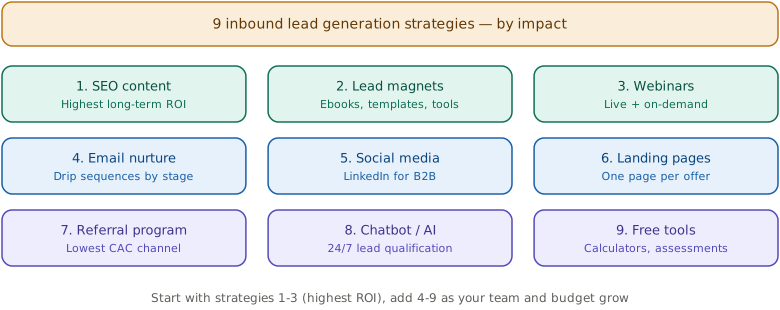
9 Inbound Lead Generation Strategies That Work in 2026
1. SEO Content Targeting Buyer-Stage Keywords
Content is the foundation of inbound. But not all content generates leads equally. Prioritize bottom-of-funnel keywords (comparison pages, “best X for Y” searches, implementation guides) over top-of-funnel educational content. A content strategy for SEO that maps keywords to buying stages will generate 3-5x more pipeline per article than one focused on volume alone.
2. Webinars and Virtual Events
Webinars remain one of the highest-converting inbound tactics in B2B. Registration rates from promotion run 30-50%, attendance rates hit 40-50%, and MQL conversion from attendees reaches 20-40%. That math produces some of the cheapest qualified leads in the inbound stack. The key: segment follow-up by engagement level. An attendee who stayed 75% and asked questions is a different lead than someone who registered and didn’t show up. Those three rates move the most when you run the webinar as a system instead of an event, which is the whole point of our playbook for scoring attendees and following up inside the first hour.
3. Gated Templates and Tools
Downloadable templates, calculators, and frameworks convert at 20-30% when targeted to the right audience. The best performers solve a specific, recurring problem: a lead scoring calculator with pre-built point values, a budget planning spreadsheet, or an RFP template for evaluating vendors.
4. Case Studies and Customer Stories
Prospects deep in the buying process actively seek case studies from companies similar to theirs. These are high-intent signals. Publish case studies ungated to maximize reach, but include a CTA that captures leads (“Want similar results? Let’s talk about your situation”). The case study itself builds the trust that makes the CTA convert.
5. Organic LinkedIn Content
LinkedIn is the primary research platform for B2B buyers in 2026. But effective LinkedIn lead generation isn’t about posting company updates. It’s about individual team members sharing insights, frameworks, and opinions that position them as experts. The company page supports, but personal profiles drive the engagement that creates inbound leads. LinkedIn Lead Gen Forms convert at 6-10%, roughly 2x the rate of external landing pages.
6. Email Newsletter With Genuine Value
A weekly or biweekly newsletter that curates insights, shares original data, and provides actionable advice builds a direct channel to your audience. Unlike social media, email is owned media: you control the distribution. The newsletter itself is the lead magnet, and every issue is an opportunity to drive readers to deeper conversion points like demos and consultations.
7. Free Trials and Freemium Access
If your product has a self-service component, a free trial or freemium tier is the most qualified lead source you can build. Trial users have experienced your product firsthand, making them Product Qualified Leads (PQLs) rather than Marketing Qualified Leads. PQLs convert to paid customers at 3-5x the rate of MQLs because the product has already done the selling. The scoring math behind that conversion lift is worth its own breakdown — the 24-signal PQL weight table for B2B SaaS assigns +35 to the activation event itself and +30 to multi-user invitations, with day-of-trial decay logic that scores a Day-2 activation higher than a Day-12 one.
8. Chatbots and Conversational Marketing
AI-powered chatbots on your website can qualify visitors in real time, answer common questions, and route high-intent prospects to sales immediately. The dated evidence supports moving quickly, but its scope matters: the 2007 Lead Response Management study reported 21 times higher odds of qualification for web-generated leads called at five minutes rather than 30 across six companies. Set against the full evidence record behind those numbers, that six-company result is both the oldest figure in circulation and the one most often restated as a conversion claim it never made.
9. Community Building
Creating or participating in communities where your buyers spend time (Slack groups, industry forums, Reddit, niche tool communities) builds visibility and trust at scale. Community members who see your team consistently providing helpful answers become inbound leads organically when they’re ready to evaluate solutions.
How to Measure Inbound Lead Generation
Traffic is an input, not an outcome. Here’s what to track at each level.
Activity metrics (weekly): Organic traffic by channel and content cluster. Form conversion rate by page and CTA. New contacts generated by source. Email open and click rates on follow-up sequences.
Quality metrics (monthly): MQL-to-SQL conversion rate (target: 20-30% for inbound). Cost per MQL by channel. Lead-to-opportunity conversion rate. Speed-to-lead (time from form fill to first sales touch). If those numbers show your conversion bottleneck is top-of-funnel volume rather than nurturing capacity, review the 12 B2B lead generation companies ranked by GTM motion for vendor-side options that can run cold-outbound alongside the inbound system above.
Revenue metrics (quarterly): Pipeline sourced from inbound vs. outbound. Close rate for inbound leads vs. outbound leads. Average deal size by lead source. Customer acquisition cost (CAC) for inbound vs. paid channels. Revenue attributed to organic content.
Common Inbound Lead Generation Mistakes
Gating Everything
When every piece of content sits behind a form, you optimize for contact collection at the expense of reach and trust. The most effective approach: ungate 80% of content to build awareness and authority, gate the 20% that’s genuinely worth exchanging contact info for. Watch the same trap on the conversational side, because replacing the form with a chat widget moves the gate rather than removing it, and a page whose only path to a human is a bot has gated the most valuable visitors of all.
Ignoring Speed-to-Lead
A lead that requests a demo at 10 AM and doesn’t hear from sales until 3 PM may already be evaluating another vendor. Set up automated routing so high-intent leads receive a prompt response, then compare your own lead-to-opportunity rate across response-time bands. Do not assume one routing change produces the same lift in every funnel.
Treating All Leads the Same
A blog subscriber is not the same as a demo requester. Build distinct follow-up paths based on lead score and behavior. High-intent leads get immediate sales outreach. Low-intent leads enter follow-up sequences. Mixing them together wastes sales time and annoys prospects who aren’t ready.
No Attribution Model
If you can’t trace a closed deal back to the blog post or webinar that started the relationship, you can’t optimize your inbound strategy. Implement multi-touch attribution (or at minimum, self-reported attribution with a “How did you hear about us?” field) from day one. Your RevOps team should own this infrastructure. Worth flagging though: attribution starts upstream of the click, at the campaign URL itself, and even the most elegant multi-touch model degrades when 30% of clicks arrive at GA4 with malformed UTMs.
Frequently Asked Questions
Inbound lead generation attracts prospects who find and contact your business on their own through content, SEO, social media, and referrals. Outbound lead generation involves your company initiating contact through cold emails, cold calls, ads, and purchased lists. Inbound leads are typically higher quality because they’re self-qualified, while outbound provides faster results and more control over targeting. Most B2B companies use both in combination.
Inbound lead generation is a marketing approach where you create valuable content and digital experiences that attract potential customers to your business. When visitors engage with your content and share their contact information (through form fills, demo requests, or trial signups), they become inbound leads. The method is built on providing value first and asking for contact information second, which produces warmer, more qualified leads than cold outreach.
A marketing manager at a mid-market SaaS company searches Google for “how to build a lead scoring model.” They find your blog post, read it, then download your lead scoring template by entering their email. They’re now an inbound lead. Over the next two weeks, they read three more articles, attend your webinar on pipeline management, and eventually request a demo. Because they initiated every interaction, they arrive at the sales conversation already educated and interested.
Inbound marketing pulls prospects toward your business by creating content they actively seek out during their research process. Outbound marketing pushes messages to prospects through direct outreach, advertising, and cold contact. The fundamental difference is who initiates: with inbound, the prospect comes to you; with outbound, you go to the prospect. Inbound typically produces higher close rates (14.6% vs 1.7%) but takes longer to build momentum (3-6 months vs days).