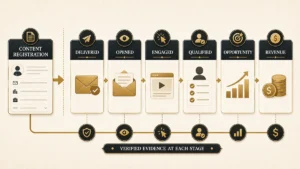
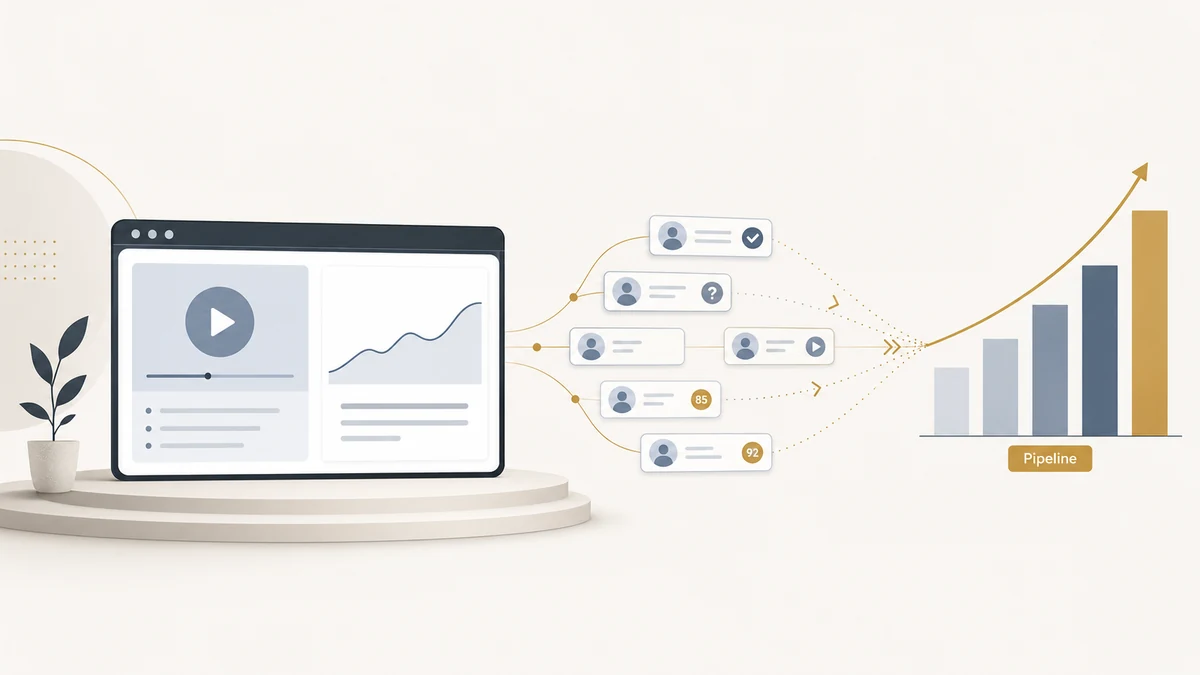
A B2B webinar can pull 300 registrations and still produce zero pipeline. The seats fill, the chat scrolls, the replay collects a few hundred passive views, and then the whole program evaporates because nobody decided, before launch, what a qualified lead actually looked like.
B2B webinar lead generation is the practice of using live and on-demand webinars to attract business buyers, capture their intent through live engagement, and convert the most interested attendees into sales-ready leads. Done with discipline, it is one of the highest-intent channels you have: in the Content Marketing Institute’s 2025 research, B2B marketers ranked webinars their most effective content distribution channel, tied with in-person events at 51% and ahead of email at 42%.
The trouble is that most teams run the event itself well and ignore the two stages that decide whether leads ever appear: a promotion system that fills the room with the right accounts, and a follow-up and scoring system that separates buyers from browsers. This guide walks the full lifecycle, the 2026 benchmarks worth measuring against, and the attendee-scoring model that turns a guest list into pipeline. Filling the room is a budget line as much as a process, and the promotion side is its own tool category, sitting alongside intent data and content syndication, each priced very differently per account reached.
Direct answer – What is B2B webinar lead generation and how does it work?
B2B webinar lead generation uses live and on-demand webinars to attract business buyers, capture intent through live engagement, and convert the most interested attendees into sales-ready leads. It works across three stages: pre-event promotion fills the room, the live event turns attention into intent signals like polls and questions, and post-event scoring and fast follow-up route hot attendees to sales. CMI’s 2025 research ranks webinars the most effective B2B content channel, tied with in-person events at 51%.
Key Takeaways
- Webinars tie with in-person events as the most effective B2B content channel (51%), but only when attendance and follow-up are run as a system, not an afterthought.
- Roughly 57% of registrants attend, and about half of all attendees watch on-demand, so your replay strategy matters as much as the live show.
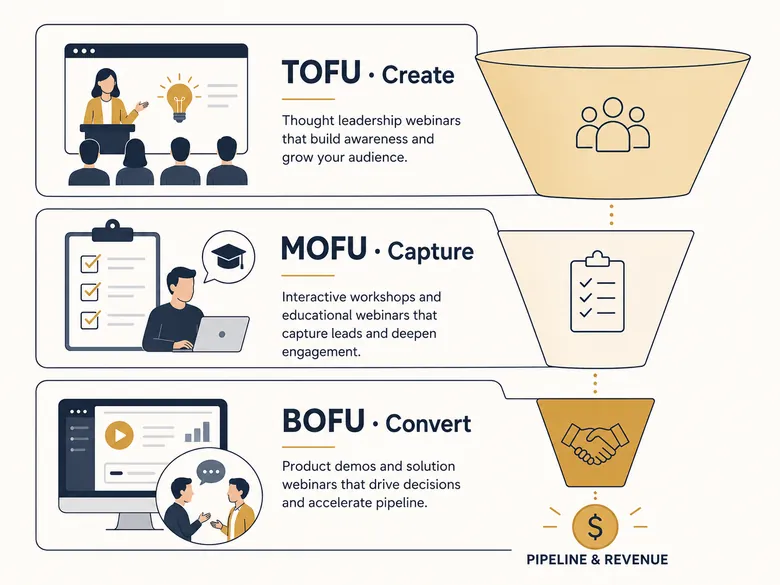
- Match the webinar type to a funnel stage: thought-leadership panels create demand at the top, product deep-dives capture it at the bottom.
- Score attendees on in-session behavior (polls, questions, watch time, demo clicks) instead of treating every registration as an MQL.
- Follow up within the first hour while intent is warm, then run a short, segmented sequence over the next two weeks.
- A webinar every four to six weeks turns a one-off tactic into a predictable pipeline source.
What makes webinars work for B2B lead generation
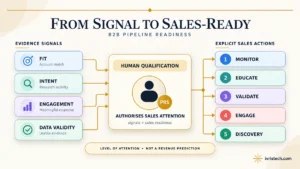
Webinars work for B2B lead generation because they trade real educational value for two things buyers rarely give up easily: 45 to 60 minutes of attention, and a set of behavioral signals that reveal intent. Few other formats ask a prospect to actively participate, and active participation is what makes a lead scoreable. A webinar’s real output is not a list of names; it is a ranked set of intent signals you can feed straight into a lead scoring model.
That participation is also why webinars sit on both sides of the demand equation. A live thought-leadership session creates demand among people who weren’t actively shopping, while a gated replay or product walkthrough captures demand from buyers already in research. If that split is fuzzy for your team, it pays to get clear on where demand creation ends and lead capture begins before you pick a single topic.
Webinars also fit inside an existing channel mix instead of replacing it. They are one of the strongest plays in a wider inbound lead generation engine, feeding email lists, retargeting pools, and sales conversations at once. The mistake is running them in isolation, disconnected from everything else that fills your pipeline.
One feature makes webinars unusually strong for B2B in particular: they reach buying groups, not just individuals. A single registration often stands in for a manager who forwards the invite to two colleagues, so one well-targeted session can surface an entire buying committee in a single sitting. That is rare in any channel, and it is why an attendee who brought their team is worth flagging the moment they register, long before a score is ever calculated.
2026 B2B webinar benchmarks worth measuring against
Before optimizing anything, anchor your program to current numbers. The benchmarks below come from ON24’s 2025 Webinar Benchmarks and the Content Marketing Institute’s 2025 B2B study. Together they describe what a healthy B2B webinar looks like heading into 2026, and they double as a measurement frame you can drop into your broader B2B marketing metrics.
| Metric | 2026 benchmark | Why it matters |
|---|---|---|
| Registration to attendance | ~57% of registrants attend (live or on-demand) | About 4 in 10 registrants never watch; reminders and replays recover them |
| On-demand share of attendance | ~50% watch the replay, not the live event | Your replay is half the program, not a leftover |
| Average viewing time | ~51 minutes | Engaged attendees stay close to an hour, so a 45 to 60 minute runtime fits |
| Most effective B2B channel | Webinars tie in-person events at 51% | Ranked above email and organic social by B2B marketers |
| Best days and times | Tuesday to Thursday, ~11am or 2pm local | Mid-week, mid-day windows draw the highest attendance |
| Investment trend | 32% of B2B marketers are increasing webinar spend | Competition for attention is rising, so a sharp angle matters |
| Engagement lift from personalization | Up to 4x more demo bookings | Personalized CTAs and follow-up out-convert generic ones |
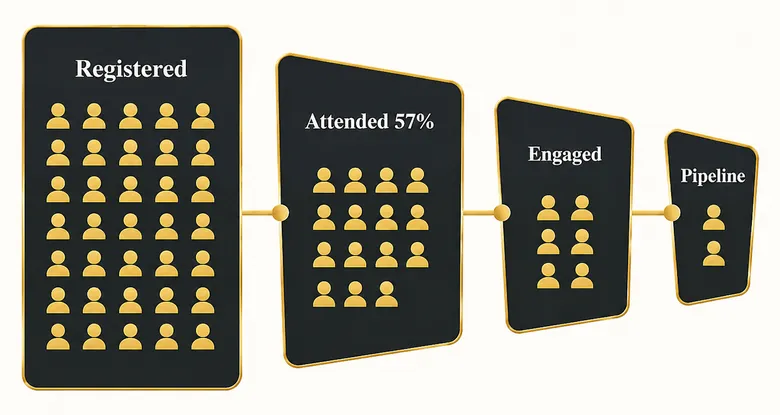
Read those numbers as a funnel, not a scorecard. If 1,000 people register, around 570 attend, a fraction of those engage deeply, and a smaller fraction again show real buying intent. Every best practice that follows exists to widen one of those steps. Widen the registration step and you get volume; widen the engagement and follow-up steps and you get quality, and the programs that compound do both at once. Note that a registration-based attendance rate is a different denominator from a booked sales meeting, so a 43% webinar drop-off is not comparable with a demo no-show figure however similar the two look on a dashboard.
The B2B webinar lead lifecycle: pre-event, live, post-event
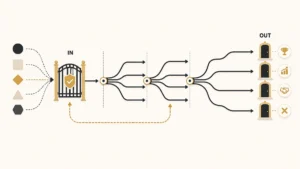
Every webinar that generates leads moves through three stages, and each stage has one job. Pre-event promotion fills the room with the right accounts. The live event converts attention into intent signals. Post-event follow-up and scoring turn those signals into sales-ready leads. Skip any one stage and the other two underperform.
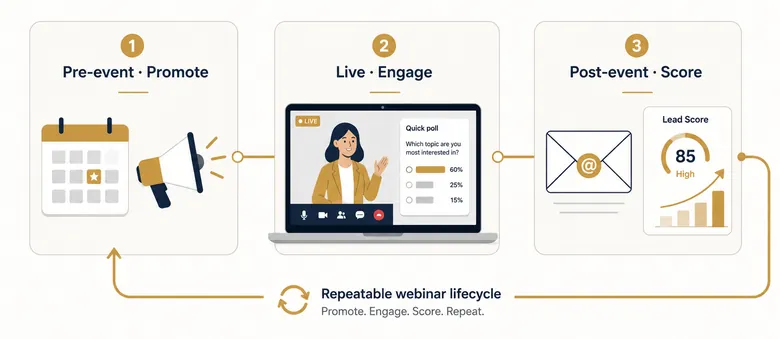
The sections below take each stage in order, and they are deliberately connected. The topic you choose pre-event determines which intent signals exist to score afterward, and the way you follow up determines whether the next webinar is easier or harder to fill. Run them as one loop, not three separate tasks.
That loop is also what makes the channel improvable. Because each stage hands measurable data to the next, you can find the weak link fast: low registrations point to the topic or promotion, low attendance to reminders or timing, and low MQL conversion to the offer or the follow-up. Fixing the right stage beats reworking the whole program at once.
Pre-event: planning and promotion best practices
The pre-event stage decides most of your lead quality before a single slide loads. Two choices carry the weight here: the topic, which determines who registers, and the promotion plan, which determines how many of the right people actually show up.
Pick a topic, then map it to a funnel stage
The most common webinar mistake is choosing a topic by what your product team wants to say instead of what a specific buyer is trying to solve. Pick one sharp pain point for one segment, then decide which funnel stage the webinar is built to move. A top-of-funnel panel and a bottom-of-funnel demo are different products with different lead signals, and holding them to the same conversion bar is how good programs get cut early.
| Webinar type | Funnel stage | Primary goal | Lead signal to score |
|---|---|---|---|
| Thought-leadership panel | Top (TOFU) | Create demand, build authority | Registration, topic, job title |
| Use-case workshop or how-to | Middle (MOFU) | Capture active researchers | Live attendance, poll answers |
| Product deep-dive or demo | Bottom (BOFU) | Convert to opportunity | Demo CTA click, questions asked |
This mapping is the backbone of a healthy program, and it tracks the stages in any B2B sales funnel: awareness at the top, evaluation in the middle, decision at the bottom. Once you know which stage a webinar serves, you know exactly which follow-up belongs to it.
Build a promotion system, not a single email
Attendance is won in the three weeks before the event, not on the day of. The webinars that fill up run a layered promotion plan across email, LinkedIn, partner audiences, and paid registration ads, with reminders timed to the moments people actually sign up and show up. One announcement email and a “starting soon” ping is not a promotion plan; it is a hope.
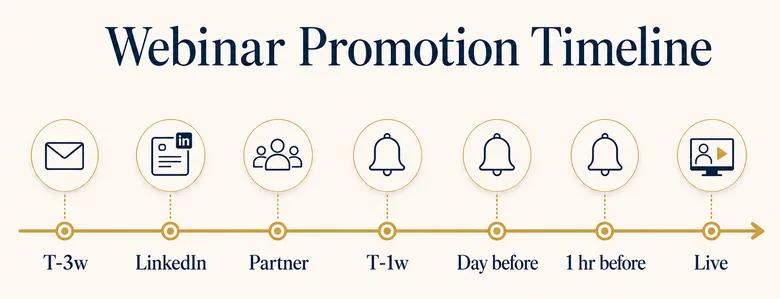
Timing the live slot well adds attendance for free. Recent 2025 scheduling research from Contrast puts the strongest windows on Tuesday through Thursday, around 11am or 2pm in your audience’s main time zone, when mid-week focus is highest and calendars are clearest. Treat that as a starting hypothesis and test it against your own audience’s behavior.
PRO TIP
Add a one-click calendar hold to your confirmation and reminder emails. It is a tiny touch that reliably lifts show-up rates, because the webinar now lives in the attendee’s calendar instead of their inbox.
Promotion is also where your registration page earns its keep. Keep the form short, lead with the single outcome the attendee walks away with, and name the speakers up top. Every extra field trims your registration rate, so ask only for what sales genuinely needs on day one and capture the rest through behavior later.
Two promotion moves consistently punch above their weight. Co-hosting with a complementary, non-competing company gives you instant access to their audience and roughly doubles your reach without doubling your budget, and the second logo lends credibility a solo invite cannot. Paid registration ads work best aimed at a tight job-title and industry list rather than a broad interest audience, because a smaller, better-matched room produces more scoreable leads than a packed one full of the wrong people. Layer reminders on top: one a week out, one the day before, and one an hour before the session, which is when most live attendees actually commit.
Live event: engagement that creates intent
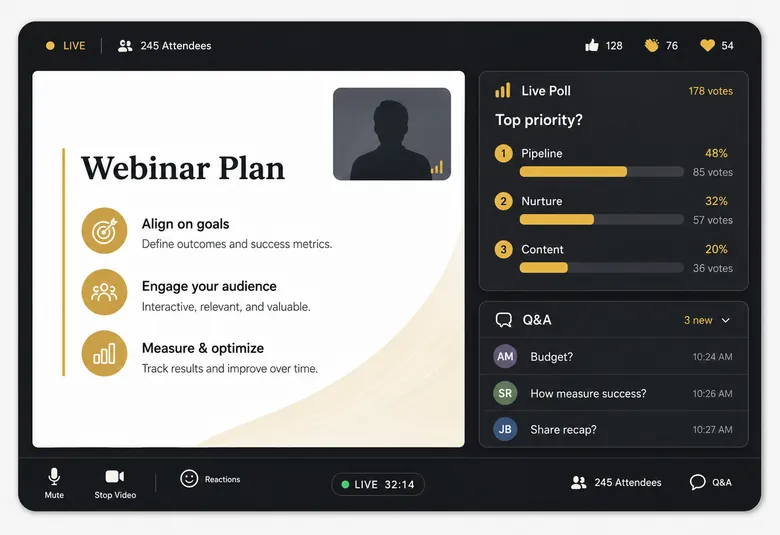
The live event has one lead-generation job: convert passive attention into scoreable intent. Every poll answered, question asked, and minute watched is a data point that tells your sales team who is actually in-market. A webinar with no interaction produces a list of names; a webinar built around participation produces a ranked list of leads. Sequel’s Agentic Engagement Cloud launch is a useful test of that model because it attempts to combine those in-session signals with first-party website behavior and buyer intelligence, rather than scoring webinar activity in isolation.
Open with a person on camera, not a title slide, and give away your best material instead of holding it back for a sales call. The strongest sessions are built around three or four teaching points with a poll between each, then one clear, optional next step at the end for the people who want to go deeper. Keep the runtime in the 45 to 60 minute range that matches how long engaged B2B attendees actually stay.
Treat the interactive moments as data collection, not filler. Each poll should ask something that reveals where an attendee sits in their buying process, not just a warm-up question, because those answers become scoring inputs the second the session ends. The live Q&A is the richest signal of all: a specific, situation-led question is usually a buyer thinking out loud about their own problem, and it deserves a same-day, personal reply rather than a slot in the bulk follow-up. Save any pitch for the final few minutes and make it optional, so the teaching never feels like bait.
Most teams run this on a dedicated webinar platform rather than a generic meeting tool, because the polls, CTAs, and engagement analytics are exactly what make attendees scoreable afterward.
Post-event: follow-up and attendee lead scoring
The post-event stage is where most B2B webinar pipeline is won or lost, and it is the stage teams most often rush. Two jobs matter: follow up fast while intent is warm, and score attendees by behavior so sales spends time on the right names.
Follow up within the hour, then segment by behavior
Send the first follow-up within an hour of the session ending, while the topic is still fresh. That first message is simple: the replay link, a two-line recap, and one clear next step. After that, the sequence should split by behavior. Someone who clicked the demo CTA gets a direct sales follow-up; someone who registered but never showed gets the replay and a softer re-engagement track over the next two weeks.
Routing only works when the handoff has rules. Agree with sales on a score threshold that turns a hot attendee into a sales-accepted lead, and on how quickly they will act on it, the same way you would define any MQL to SQL handoff. Without that agreement, high-scoring webinar leads sit in a queue cooling off while the intent you worked to create quietly expires.
IMPORTANT
Counting every registration as an MQL is the fastest way to make webinar pipeline look fake. Sales stops trusting the source, and your genuinely hot leads get buried under no-shows. Score first, then route.
Score attendees on in-session behavior
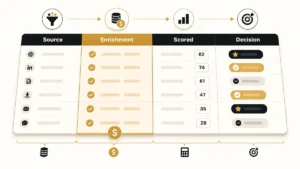
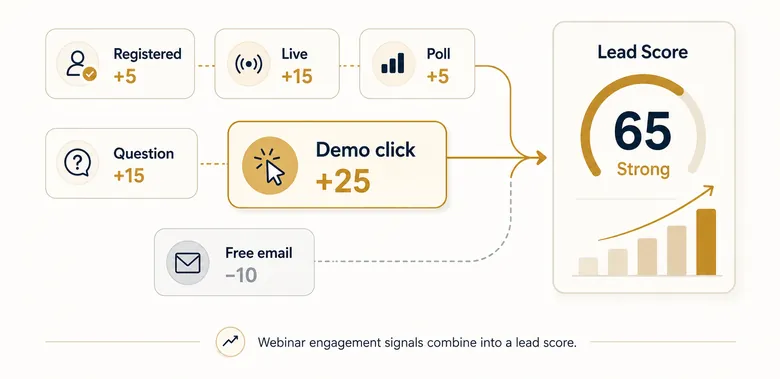
This is the practice that separates webinar programs that scale from the ones that quietly get defunded. Instead of a flat “attended a webinar” tag, assign points to the specific behaviors that predict buying intent, then let the total decide routing. The model below is a starting point you can tune to your own data.
| Engagement signal | Points |
|---|---|
| Registered | +5 |
| Attended live | +15 |
| Watched 25%+ of the replay | +10 |
| Answered a poll (each, cap +15) | +5 |
| Asked a question | +15 |
| Stayed past the halfway point | +10 |
| Clicked the demo or pricing CTA | +25 |
| Free-mail or student email domain | -10 |
Pair these behavioral points with firmographic fit so a perfect-fit account that asked a question outranks a hobbyist who happened to stay late. The full set of fit and negative-scoring rules lives in our breakdown of which lead scoring criteria to use and when to subtract points, and it maps cleanly onto the signals above.
Repurpose the session into on-demand assets
One live webinar should produce a month of content. Gate the full replay as a lead magnet, cut three or four short clips for social, and turn the transcript into a blog post and an email. Because roughly half of webinar attendance now happens on-demand, the replay is not a leftover; it is a lead source that keeps working long after the live date. This is the point where a webinar plugs directly into your wider content-driven lead generation system.
The replay also compounds your scoring data. Every on-demand view adds the same behavioral signals a live attendee produces, from watch time to CTA clicks and downloads, so a gated replay keeps feeding scored leads into the pipeline for months while you prepare the next live session. In practice it is the on-demand library, not the live broadcast, that turns a series of events into a steady lead source.
Measure webinar pipeline contribution, not registrations
The metric that quietly kills webinar programs is the registration count, because it looks impressive and means almost nothing. What earns budget is the line that connects attendees to qualified leads, opportunities, and closed revenue. Standardize on cost per qualified lead so you can compare a webinar against paid search, content, or events on equal terms.
Cost per Qualified Webinar Lead = Total Program Cost ÷ Sales-Accepted Leads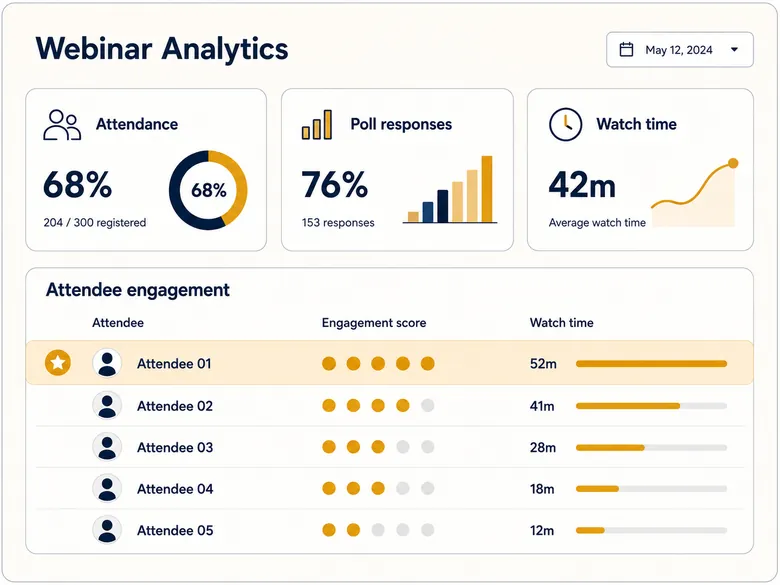
Track that figure per webinar and per quarter. A single event can look expensive in isolation, but a repeatable program with a growing replay library and a tightening follow-up sequence usually gets cheaper per lead over time as on-demand views accumulate. Judge the channel on the trend line, not on any one session.
Attribution is the other half of measurement. Because buyers rarely convert the day they attend, give the webinar credit across a sensible window: a first-touch view for net-new registrants and a meaningful assist for attendees already inside an open opportunity. A multi-touch model keeps webinars from looking weaker than they are, since their influence usually shows up weeks later as a warmer sales conversation rather than an instant form fill.
Build a repeatable webinar program
The teams that win with webinars stop treating them as launches and start running them as a cadence. A new session every four to six weeks keeps a steady flow of fresh registrations, builds an on-demand library that generates leads between live events, and produces enough data to actually improve.
Cadence compounds. Each webinar feeds the next one’s promotion list, each replay extends the shelf life of the content, and each follow-up sequence teaches you which topics and offers convert. Run four well-scored webinars and you have a pipeline source; run one and you have an event.
Start small. Pick one funnel stage, one segment, and one repeatable format, then commit to a fixed schedule for two quarters before you judge the channel. B2B webinar lead generation rewards consistency far more than production value, and the program that ships every month beats the perfect webinar that ships once.
If you change only one thing after reading this, make it the scoring step. The teams that turn webinars into reliable pipeline are rarely the ones with the slickest production; they are the ones who decided, in advance, exactly which behaviors count as intent and built a fast, segmented follow-up around them. Every other tactic in this guide exists to serve that single decision.
Frequently Asked Questions
Yes. In CMI’s 2025 research, B2B marketers ranked webinars their most effective content channel, tied with in-person events at 51%. They work because attendees give 45 minutes or more of attention and produce behavioral signals (polls, questions, watch time) you can score, which most content formats cannot offer.
It depends on volume and quality, not luck. With about 57% of registrants attending and only a fraction showing strong intent, a 300-registrant webinar might yield 150-plus attendees and a few dozen genuinely sales-ready leads once you score by engagement. How tightly you qualify matters more than the headline registration number.
2025 scheduling data points to Tuesday through Thursday, around 11am or 2pm in your audience’s primary time zone. Mid-week, mid-day windows draw the highest attendance because calendars are clearer and focus is higher. Always test these windows against your own audience before locking a recurring slot.
You need both. Roughly half of B2B webinar attendance now happens on-demand, so run the session live to capture engagement signals, then gate the replay to keep generating leads for months. The live event builds urgency and interaction; the replay builds reach and long-tail pipeline.
Send the first follow-up within an hour, while the topic is fresh, with the replay link and one clear next step. Then segment: hot, intent-showing attendees go to sales immediately, while passive registrants get a short re-engagement sequence over the next two weeks.