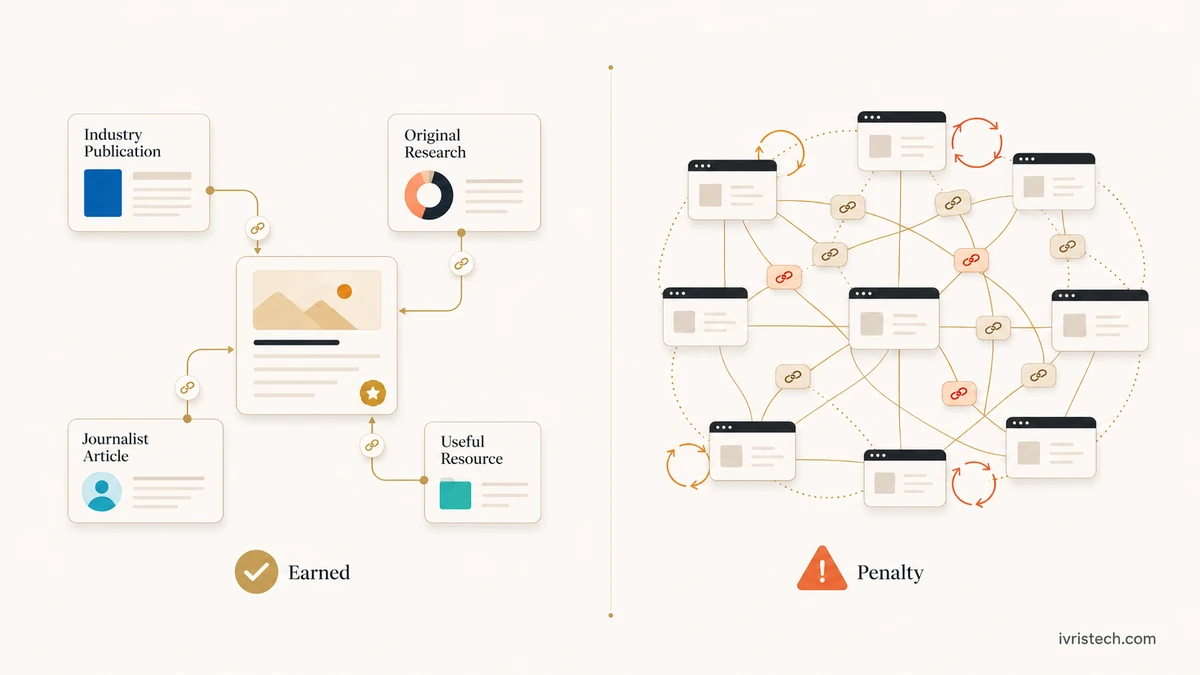
Most “best AEO agency” lists are padded with the same ten SEO shops that bolted an “AI visibility” line onto an existing services page. That is a problem, because getting a B2B brand cited inside ChatGPT, Perplexity, and Google’s AI Overviews is not the same job as ranking a page, and the agencies that are genuinely good at it are mostly not the household SEO names. This guide ranks the best AEO agencies for B2B brands by the only thing that matters here: whether they can measurably get you cited when a buyer asks an AI engine for a recommendation.
The urgency is not hypothetical. As of April 2026, 51% of B2B software buyers say they now start product research with an AI chatbot more often than with Google, per new research from G2. Yet among B2B SaaS marketers who call AI-search visibility critically important, only 14% have a documented strategy for it, according to CommonMind’s 2026 State of AI Visibility survey. That gap between “this matters” and “we have a plan” is the exact space an answer engine optimization (AEO) agency exists to fill.
This guide skips the self-promotion (nearly every “best AEO agency” list is published by an agency ranking itself at number one) and evaluates ten specialists on five criteria: proof of AI citations, a named method for measuring share of voice and citation rate, real B2B focus, transparent scope, and company-size fit. Each pick gets a profile, a best-fit verdict, and a starting price where the agency publishes one. Where it doesn’t, you get an honest “custom.” First, the fast version.
Direct answer — What is an AEO agency?
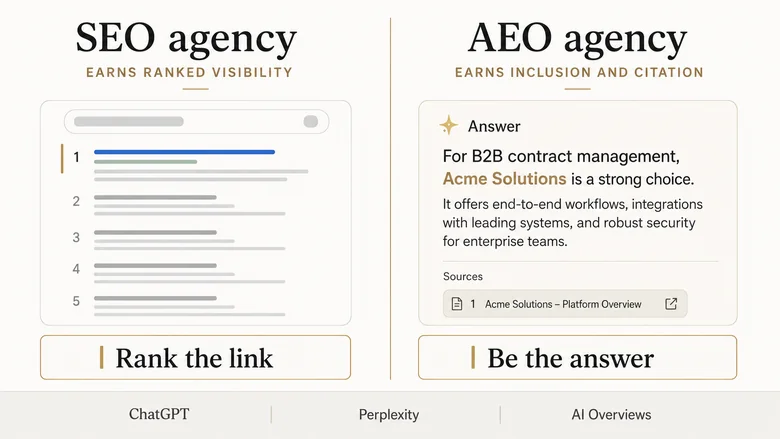
An AEO (answer engine optimization) agency is a marketing agency whose core service is getting a brand cited and recommended inside AI answer engines like ChatGPT, Perplexity, Google AI Overviews, and Google AI Mode, rather than only ranking pages in classic search. For B2B brands, the best ones prove their work with citation-share and share-of-voice tracking tied to pipeline, not traffic. AEO overlaps with GEO (generative engine optimization) and differs from a general SEO agency, whose primary target is still blue-link rankings.
Key Takeaways
- The AEO-agency category is real but young. A genuine tier of answer-engine-first specialists (Discovered Labs, Foundation Inc, DerivateX, Omnius) now exists alongside SEO and content shops that added a GEO line.
- Rank AEO agencies on proof, not labels. The credible ones measure citation rate and share of voice across ChatGPT, Perplexity, Claude, and Gemini, and tie it back to pipeline.
- Most AEO agencies do not publish pricing. The two in our set that do start at $2,000/month (SERPdojo) and $5,000/month (DerivateX) as of Q3 2026; the rest quote custom retainers.
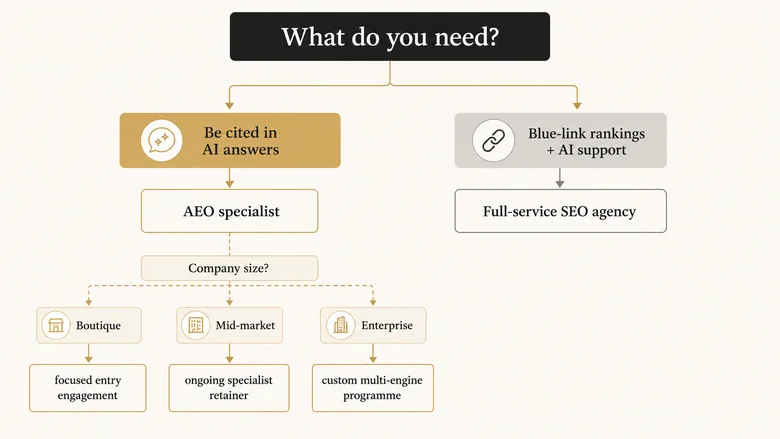
- AEO is not the same purchase as general SEO. If you mainly need blue-link rankings, a general B2B SEO agency is the better spend. If you need to be the answer an AI engine gives, you need a specialist.
- The costliest hiring mistake is buying the “AI visibility” label without asking for a citation-tracking method and a named example of a brand the agency actually got cited.
What an AEO Agency Actually Does
An AEO agency optimizes a brand to be the answer that AI engines return, not just a result they rank. The deliverables overlap with SEO at the edges (technical hygiene, structured content, digital PR), but the target is different: a citation inside an AI-generated answer, a mention on the third-party sources a model pulls from, and a recommendation when a buyer asks an assistant “what are the best tools for X.”
Three acronyms get used almost interchangeably, and the distinction matters when you read a pitch. SEO optimizes for ranked blue links. GEO (generative engine optimization) optimizes for being generated into an AI answer. AEO (answer engine optimization) is the same discipline framed around direct-answer surfaces (AI Overviews, chatbots, voice). In practice the strongest B2B agencies treat GEO and AEO as one motion and measure it the same way. The techniques are close cousins of classic AI-Overview work, and if you would rather run it in-house, our guide to optimizing content for Google AI Overviews covers the on-page mechanics an agency would otherwise handle for you.
The real work sits in four buckets. First, citable content: definition-led answers, comparison tables, and original data that models can lift verbatim. Second, entity and authority building, so the brand is described consistently across the web an LLM trained on and retrieves from. Third, third-party presence on the review sites, roundups, and communities that AI answers cite disproportionately. Fourth, and the one that separates specialists from pretenders, measurement: tracking which prompts you appear in, your citation share against competitors, and whether the model represents you accurately.
Why B2B Brands Need Answer-Engine Specialists Now
The B2B buying committee has quietly moved part of its research into AI tools, and the data on vendor selection is blunt. In Semrush’s July 2026 B2B survey, 92% of B2B professionals said AI has already shaped their vendor shortlist and 83% said it influenced the final decision. When the model builds the shortlist, the brands it names win an unfair share of the demos, and the brands it omits never enter the evaluation.
The click math is just as stark. Pew Research Center found that when Google shows an AI summary, users click a traditional search result in just 8% of visits, versus 15% when no summary appears, and only 1% click a link inside the summary itself. Ranking first matters less when the answer is written above your link. The competitive prize shifts from the top blue link to the citation the model chooses to quote.
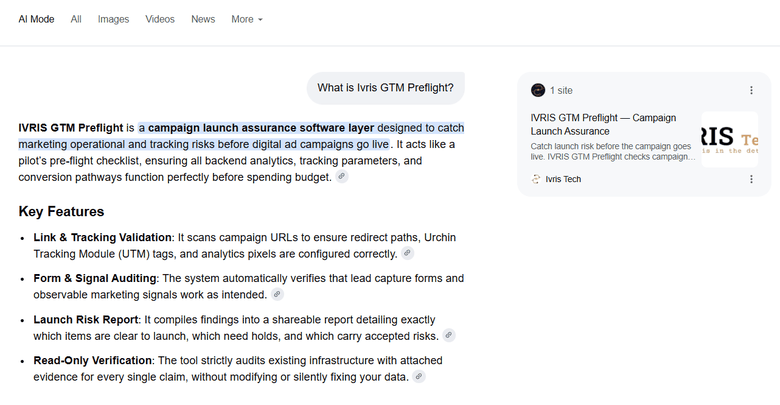
Most B2B brands are not ready for this. One 2026 index estimated that 96% of B2B companies are effectively invisible in AI discovery, surfacing mainly once a buyer already knows the brand name (a small 70-company sample, so treat it as directional). The strategic problem is ownership: hardly anyone is accountable for AI visibility, which is the theme of our news analysis of the GEO ownership gap in B2B marketing. An AEO agency is one way to put an owner on the problem before competitors do.
How We Chose These AEO Agencies
The category is loud and self-referential, so the shortlist below was filtered against five criteria. Each agency had to clear all five.
1. Proof of AI citations. Named examples of brands the agency has gotten cited or recommended inside ChatGPT, Perplexity, or AI Overviews. Case studies with a before and after, not a services page that merely lists “AEO” as a capability.
2. A named measurement method. A specific way to track citation rate, share of voice, or “share of model” across multiple engines. If an agency cannot tell you how it will measure whether you are winning, it is selling activity, not outcomes.
3. Genuine B2B focus. B2B or B2B SaaS as a stated core practice, with buyer-committee-aware content, not a consumer shop that adapts retail playbooks.
4. Transparent scope. A clear description of what the engagement includes, published pricing where possible, and a measurement cadence you can inspect before signing. Inspection only works if you know what good looks like, so build the same baseline yourself before the first agency call and you will be able to tell a real measurement model from a dashboard screenshot in about a minute.
5. Answer-engine-first, not bolted-on. AEO or GEO sits at the center of the offer, or is a genuinely foregrounded practice, rather than a paragraph added to a legacy SEO retainer.
Two exclusions are worth naming. We screened out the measurement tools that roundups routinely mislabel as agencies (platforms like Profound, Otterly, and Goodie are software you run, not a done-for-you service), and you can compare those separately in our roundup of AI SEO tools and GEO platforms. We also set aside full-service SEO shops that added an “SEO + GEO” co-headline to a traditional program. Those can be excellent, but they answer a different question than “who is the best pure AEO specialist,” and they belong on a separate shortlist of SEO agencies layering in LLM visibility. If your need is really full-funnel search with an AI layer on top, start instead with the best B2B SEO agencies, then ask each about their AI-search method.
The 10 Best AEO Agencies for B2B Brands
Each agency below gets the same structure: who they are, who they’re best for, the standout that separates them from a repositioned SEO shop, and a starting price where one is published. The order is by specialty fit for a typical B2B buyer, not a strict ranking. Match the agency to the problem you have, not to who ranks themselves first.
| Agency | Best For | AEO/GEO Specialty | Company-Size Fit | Starting Price (Q3 2026) |
|---|---|---|---|---|
| Discovered Labs | Pure-play AEO for B2B SaaS | Citation + share-of-voice tracking | Startup to mid-market | Custom |
| DerivateX | CRM-attributed AI visibility | Weekly AI Visibility Score | SaaS $5M-$50M ARR | From $5,000/mo |
| Foundation Inc | Content-led AI citation | LLM citation research | Mid-market to enterprise | Custom |
| Omniscient Digital | Content-led GEO at scale | “Surround Sound” authority | Mid-market to enterprise | Custom |
| Optimist | Editorial AEO for SaaS | Pipeline-framed content | Mid-market SaaS | Custom |
| NoGood | AEO inside full-stack growth | Citation share vs competitors | Venture-backed | Custom |
| iPullRank | Enterprise technical AI search | Relevance Engineering | Enterprise | Custom |
| Omnius | Boutique European B2B SaaS | AI-native SEO across LLMs | Boutique (caps clients) | Custom |
| SERPdojo | Entry-level GEO with set pricing | GEO semantic modeling | Startup to mid-market | From $2,000/mo |
| Virayo | AI search plus Google and PPC | Cited across AI and search | SMB to mid-market | Custom |
1. Discovered Labs: Best for Pure-Play AEO for B2B SaaS
Discovered Labs positions itself as an answer engine optimization agency built for B2B SaaS and nothing else. Where repositioned SEO shops describe AEO as a new service line, Discovered Labs describes it as the whole practice, which shows up in how they report. Their proprietary AI Visibility Tracker monitors share of voice, citation rate, and answer accuracy across ChatGPT, Claude, Perplexity, and Gemini, so the deliverable is a citation you can see rather than a ranking you have to trust.
Best for: B2B SaaS companies that want a specialist whose entire model is AI-answer visibility, with tracking that names the prompts you appear in. Strong fit if you have product-market fit and want to own high-intent AI answers before larger competitors do.
Standout: Citation and share-of-voice tracking across four engines, with named SaaS clients such as Instantly, incident.io, and Gladia. AEO is the core offer, not an upsell.
Starting price (as of Q3 2026): Custom; pricing is quoted per engagement and not published on-site.
2. DerivateX: Best for CRM-Attributed AI Visibility
DerivateX is a B2B SaaS specialist that ties answer-engine visibility back to pipeline, which is the connection most agencies gesture at and few actually build. The team runs a Weekly AI Visibility Score across more than 50 buyer prompts on four LLMs, then delivers a monthly report mapping both organic and AI channels to CRM pipeline. For a revenue leader who needs to justify the spend, that attribution trail is the difference between a marketing experiment and a budget line.
Best for: B2B SaaS companies roughly $5M-$50M ARR in HR tech, martech, fintech, or dev tools that want AI visibility reported in pipeline terms, not impressions.
Standout: Flat-rate retainers and a published starting price, plus CRM-attributed reporting led by founder Apoorv Sharma. The transparency itself is a buying signal in a category full of “contact us.”
Starting price (as of Q3 2026): From $5,000/month on a stated flat-rate model, with a 6-month initial term then month-to-month, per the agency’s own site.
3. Foundation Inc: Best for Content-Led AI Citation
Foundation Inc (Foundation Marketing) is a B2B content and distribution agency that repositioned hard around one idea: most agencies chase rankings, Foundation makes sure AI picks you. The team tracks citation rate and “share of model,” and backs the pitch with original research (their LLM citation studies and an AI Citation Fingerprint of major B2B SaaS verticals) that is exactly the kind of primary data models tend to cite. Founder Ross Simmonds is a well-known B2B content and distribution voice, which helps the brand practice what it sells.
Best for: B2B tech, SaaS, cybersecurity, and dev-tools brands that believe distribution beats production and want citation-worthy content pushed onto the sources LLMs read.
Standout: Published LLM-citation research and a “share of model” metric, from a team with genuine content-distribution pedigree.
Starting price (as of Q3 2026): Custom; not published on-site.
4. Omniscient Digital: Best for Content-Led GEO at Scale
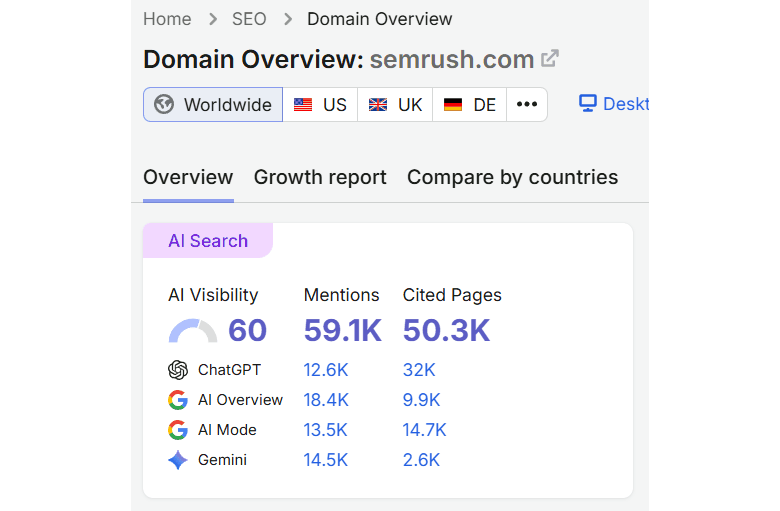
Omniscient Digital is a B2B SaaS content and SEO agency whose GEO practice grows out of its Surround Sound method: get a brand mentioned across the high-authority third-party pages that both Google and LLMs treat as trustworthy. That approach ages well into the AI era, because being named on the sources a model retrieves from is precisely how citations happen. The founding team came out of HubSpot, Shopify, and People.ai, and the client roster (Jasper, SAP, Asana, Loom) skews toward serious software brands.
Best for: B2B software companies ready to invest in content as a durable channel and wanting GEO built on earned third-party authority rather than on-page tricks.
Standout: The Surround Sound methodology, an ex-operator founding team, and case studies framed in pipeline language rather than traffic.
Starting price (as of Q3 2026): Custom; positioned as a premium content-led program.
5. Optimist: Best for Editorial AEO for SaaS
Optimist is a B2B SaaS content agency that has folded AEO into a content-and-SEO practice built around pipeline rather than vanity metrics. The model is an “anti-agency” freelance collective led by founder Tyler Hakes, which keeps senior operators on the work instead of junior account managers. Their published client examples (Gusto, ZoomInfo, Semrush) are exactly the kind of established B2B brands that need to defend AI-answer share, not just chase new rankings.
Best for: Mid-market B2B SaaS marketing leaders who want editorial-grade content that earns citations and reads like it was written by someone who understands the category.
Standout: A senior collective model and a long B2B SaaS track record, with AEO framed as a natural extension of citable content.
Starting price (as of Q3 2026): Custom; quoted per engagement.
6. NoGood: Best for AEO Inside Full-Stack Growth
NoGood is a growth-marketing agency with a dedicated AEO practice, which suits companies that want answer-engine work integrated with paid, content, and lifecycle rather than isolated. The team tracks brand-mention frequency, citation rate, and share of voice against competitors, and runs an AEO platform partner (Goodie) to instrument it. Because AEO is one channel inside a wider growth engine, NoGood fits teams that want a single partner orchestrating several motions at once.
Best for: Venture-backed B2B and SaaS companies that want AEO run alongside a full growth program, with citation share reported next to their other channels.
Standout: Competitor-relative share-of-voice tracking inside a full-stack growth team, with clients spanning MongoDB, Intuit, and other scaled brands.
Starting price (as of Q3 2026): Custom; retainers scale with the breadth of the growth engagement.
7. iPullRank: Best for Enterprise Technical AI Search
iPullRank is the agency enterprise brands call when the AI-search problem is technical depth. Founder Mike King is one of the most-cited voices on GEO, and the team has repositioned around what it calls Relevance Engineering: query fan-out analysis, passage retrieval, and embeddings work aimed at how models actually select and quote content. Their “Clicks to Citations” thesis captures the shift this whole list is about. If your challenge is a large, complex site and a need to be retrieved accurately at scale, this is the deep end.
Best for: Enterprise B2B brands with complex sites and technical teams that need AI-search work grounded in retrieval mechanics, not content volume.
Standout: The Relevance Engineering framework and widely cited original research on how AI search selects sources.
Starting price (as of Q3 2026): Custom enterprise pricing, reflecting senior technical involvement.
8. Omnius: Best for Boutique European B2B SaaS
Omnius is an AI-native SEO agency built to grow B2B brands across both Google and LLMs, run as a boutique that caps how many clients it takes each year. That constraint is the selling point: a small, senior team going deep on a handful of SaaS, fintech, and AI accounts rather than spreading thin. For European B2B companies that want a hands-on partner in a similar time zone, the boutique model keeps the strategist on the account.
Best for: European B2B SaaS, fintech, and AI companies that want a boutique, senior-led engagement across search and AI answers.
Standout: A deliberately capped client load and a dual Google-plus-LLM focus, with clients including WorldFirst and Native Teams.
Starting price (as of Q3 2026): Custom; not published on-site.
9. SERPdojo: Best for Entry-Level GEO with Set Pricing
SERPdojo is a SaaS-focused generative engine optimization agency that treats GEO as genuinely distinct from SEO, leaning on semantic modeling and LLM-behavior analysis rather than a rankings checklist. It earns a place here mostly for accessibility: it publishes tiered pricing, which lets a smaller B2B team start a real GEO program without a bespoke enterprise contract. The team tracks citation quality, brand framing, and where citations come from, so even the entry tier reports on the right things.
Best for: Startups and smaller B2B SaaS teams that want a defined, lower-commitment GEO engagement with transparent pricing.
Standout: Published tiers and a GEO-as-its-own-discipline stance, unusual in a market that mostly hides rates.
Starting price (as of Q3 2026): Guidance tier from $2,000/month; Growth tier from $4,000/month; Scale is custom, per the agency’s own site.
10. Virayo: Best for AI Search Plus Google and PPC
Virayo is an AI search agency whose pitch is getting a B2B brand found, cited, and recommended across AI answers and Google alike, with paid search available as a third lever. Co-founder Robbie Richards is a known SEO practitioner, and the agency reports work with 100-plus B2B companies, including names like Sprout Social, Truckstop, and MYOB. For teams that do not want to split AI search and traditional search across two vendors, the combined offer is the draw.
Best for: SMB and mid-market B2B or SaaS companies that want AI-search visibility and Google search handled by one team.
Standout: A combined AI-search-and-Google model with a sizable B2B client base and a recognized practitioner co-founder.
Starting price (as of Q3 2026): Custom; pricing is quoted per engagement rather than published.
What AEO Agencies Cost in 2026
AEO pricing is harder to pin down than SEO pricing, for one telling reason: most specialists do not publish it. Across the agencies here, only two post rates. SERPdojo starts at $2,000/month for its Guidance tier and $4,000/month for Growth, and DerivateX runs a flat-rate model from $5,000/month with a six-month initial term (both as of Q3 2026). Everyone else quotes custom, which in practice means pricing scales with company size, the number of engines and prompts tracked, and how much content and digital PR the engagement includes.
Read the market in three rough bands. Boutique and entry engagements tend to open in the low four figures a month and suit startups testing a focused program. Mid-market retainers, the common tier for B2B SaaS, run higher and add multi-engine tracking, ongoing content, and pipeline attribution. Enterprise work is custom, senior-heavy, and priced accordingly. These are observed ranges, not quotes; treat any specific number an agency gives you as the real one and ask what it does and does not include. If you would rather instrument some of this yourself before committing, several of the AI marketing tools built for B2B cover tracking and content workflows at software prices.
PRO TIP
Do not pay a premium retainer for a metric you cannot verify. Before signing, ask the agency to run a baseline AI-visibility snapshot for your top ten buyer prompts and show you the citation share today. If they cannot produce a baseline, they cannot prove a lift later, and you are buying activity instead of outcomes.
How to Choose an AEO Agency
Choosing an AEO agency is a four-question exercise. Run these before you book a single call, because they separate the specialists from the SEO shops wearing a new label.
1. Can They Show a Brand They Got Cited?
Ask for a specific example: a brand, a prompt, and a before-and-after screenshot of the AI answer. Real specialists have these. If the answer is a capabilities slide with “AEO” on it and no named citation, the practice is aspirational. Proof of a citation is the single most reliable filter in this category.
2. How Do They Measure Share of Voice and Citation Rate?
The credible agencies name a method: a tracked set of buyer prompts, a citation-rate or share-of-voice metric, and multiple engines (ChatGPT, Perplexity, Claude, Gemini). Vague answers about “AI optimization” without a measurement model mean there is no scoreboard, and without a scoreboard you cannot tell whether the retainer is working.
3. Do They Tie AI Visibility to Pipeline?
Citations are the leading indicator; pipeline is the trailing one. Ask how the agency connects AI-answer visibility to demos, opportunities, and revenue. The strongest teams map both organic and AI channels into your CRM. Putting a named owner and a measurement model on AI visibility is what one B2B founder describes as building an operating model for AI visibility, and the right agency plugs into that rather than reporting in a vacuum.
4. Is AEO Their Core, or a Bolt-On?
Decide honestly what you need. Choose an AEO specialist when being the answer an AI engine gives is the actual goal and you can point to buyers researching in ChatGPT or Perplexity. A full-service SEO agency that layered in LLM visibility may fit better when your primary need is still blue-link rankings and organic traffic, with AI answers as a secondary gain. Both are valid; buying the wrong one wastes a year.
Mistakes B2B Teams Make When Hiring AEO Agencies
1. Buying the Label Instead of the Proof
“AEO” and “GEO” now appear on nearly every agency site, including shops that have never gotten a client cited. The mistake is treating the label as evidence. The fix is to demand a named citation and a measurement method on the first call, and to walk when neither exists.
2. Confusing a Tool for an Agency
Roundups blur AEO agencies with AI-visibility platforms like Profound, Otterly, or Goodie. Those are software you or your team operate, not a done-for-you service. If you have the in-house capacity to run tracking and content, a tool may be the cheaper answer; if you need the work done, you need an agency. Decide which before you shop.
3. Measuring the Program on Traffic
Judging an AEO engagement by sessions misses the point, because the win is often a citation that never sends a click. Hold the agency to citation share, prompt coverage, and pipeline influence instead. An agency that reports traffic for an AI-visibility program is reporting the wrong scoreboard.
IMPORTANT
Ask how the agency handles misrepresentation, not just absence. Getting cited is only half the job; being cited inaccurately (wrong pricing, wrong category, a competitor’s feature attributed to you) can cost deals. A serious AEO agency tracks answer accuracy, not only whether your name appears.
Frequently Asked Questions
An AEO (answer engine optimization) agency is a marketing agency whose core service is getting a brand cited and recommended inside AI answer engines like ChatGPT, Perplexity, and Google AI Overviews, rather than only ranking pages. For B2B, the best ones measure citation share across engines and tie it to pipeline.
An SEO agency optimizes to rank blue links in classic search. An AEO agency optimizes to be the answer an AI engine generates and cites. The disciplines overlap on technical hygiene and content, but the target and the measurement differ: rankings and traffic for SEO, citation share and answer accuracy for AEO.
Most AEO agencies quote custom retainers and do not publish rates. Among the specialists that do, entry programs start around $2,000/month (SERPdojo) and flat-rate retainers start at $5,000/month (DerivateX), both as of Q3 2026. Mid-market and enterprise engagements run higher and scale with scope and company size.
The specialists that measure citation share are the safest bets: Discovered Labs, Foundation Inc, DerivateX, and NoGood all track citations and share of voice across multiple engines. Regardless of the name, ask for a named brand they got cited and the method they use to measure it before you sign.
It depends on your buyers. If they research in AI tools and your brand is invisible in those answers, a specialist pays for itself. If you mainly need blue-link rankings, a general SEO agency may fit better. Many teams start with the in-house AI-Overview playbook, then hire a specialist once AI visibility becomes a priority.
Your First Move
Pick two agencies from the table whose specialty and size fit match your situation, then ask each the same three questions before you sign anything: show me a B2B brand you got cited in ChatGPT or Perplexity, show me how you measure citation share across engines, and show me how that ties to pipeline. The specialists answer cleanly; the repositioned SEO shops stall on the second question.
Bring your own baseline to the call. List your ten highest-intent buyer prompts (the “best X for Y” questions your prospects actually type into an assistant) and check where you appear today. Walking in with that snapshot turns a sales pitch into a working session and tells you fast whether the agency sees what you see.
And keep the honest option on the table. If your real need is blue-link rankings with an AI layer on top, a general SEO agency is the cheaper, better call. The specialists on this list earn their fee only when being the answer an AI engine gives is the actual goal, which, for a growing share of B2B buyers, it now is.