
A year ago, “AI SEO tools” described one job: software that helped you research, write, and optimize pages faster. In 2026 the term covers two jobs, and most buyers now shop both shelves. The first is still content optimization, where a tool scores your draft against whatever already ranks and tells you what to add. The second is brand-new: GEO platforms that track whether ChatGPT, Perplexity, and Google’s AI Overviews actually cite your brand in their answers. (Updated Q2 2026.)
The problem is that almost every “best AI SEO tools” list still stocks only the first shelf. It compares Surfer to Clearscope to Frase and stops there, as if the only question that matters is how fast you can produce optimized copy. That made sense in 2024. It doesn’t now, because the place your buyers ask their first question has moved, and the tools that measure visibility on that new surface are a separate category with separate vendors.
This guide covers both. You get 11 tools split into two clear groups, each with its own comparison table: six AI content and optimization tools, and five GEO platforms built to track AI-engine citations. For each one, you get what it does, who it fits, the single feature that sets it apart, and starting price as of Q2 2026. Then a pricing-tier breakdown, a use-case decision guide, and the four mistakes that waste the most money. What you will not find here is a rehash of how to earn citations or how to crawl a site; those jobs belong to other tools and other guides, and the boundary is drawn clearly below.
Key Takeaways
- Two categories, not one. AI content tools (Surfer, Frase, Clearscope, MarketMuse, Scalenut, NeuronWriter) optimize what you publish. GEO platforms (Profound, Otterly, Scrunch, Semrush AI Visibility, BrightEdge) measure whether AI engines cite you. You likely need one from each.
- GEO is no longer optional for B2B. AI Overviews trigger on the majority of B2B technology queries, organic click-through drops sharply when they appear, and half of B2B software buyers now begin research inside an AI chatbot.
- Entry pricing splits wide. Self-serve AI content tools start at $23 to $49 per month. GEO tracking starts near $29 per month for SMBs but runs to custom enterprise contracts for the deepest platforms.
- Pick by job, not by brand. A solo SEO needs a different stack than an agency or an enterprise, and the right GEO platform depends on which AI engines your buyers actually use.
- The measurement gap is the real risk. Teams optimizing content with no way to see whether AI engines cite them are flying blind on the channel that now shapes the first half of the buying journey.
What AI SEO Tools and GEO Platforms Actually Do
AI SEO tools and GEO platforms solve two different problems that often get lumped together. AI SEO tools (more precisely, AI content and optimization tools) use machine learning to help you produce content that ranks: they analyze the pages already winning for a query, extract the terms and structure those pages share, and grade your draft against that target. GEO platforms (generative engine optimization platforms) work on the other end of the pipeline: they monitor large language models and AI search engines to report whether, where, and how your brand shows up in AI-generated answers.
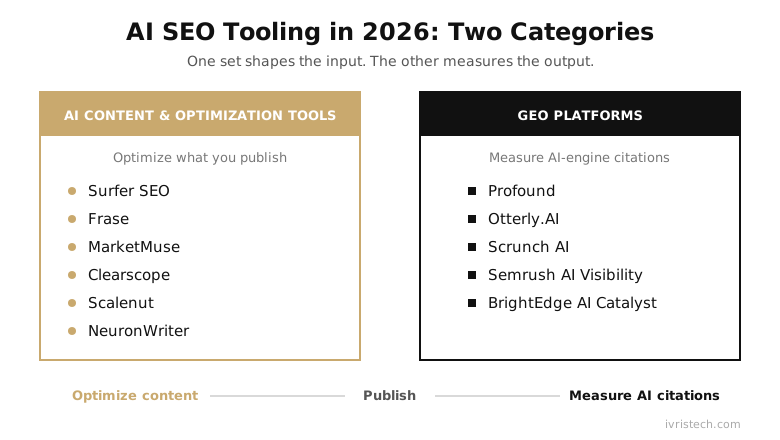
The cleanest way to hold the difference: one set of tools shapes the input, the other measures the output. A content tool like Surfer or Clearscope tells you what to write before you publish. A GEO platform like Profound or Otterly tells you what happened after you published, specifically whether ChatGPT or Google’s AI Overview started naming you when someone asked a question in your category. A few platforms now reach across both, but the core jobs stay distinct, and buying as if they were the same product is the most common mistake in this market.
What AI content and optimization tools do
These are the tools most people already mean when they say “AI SEO.” They pull the top-ranking results for a keyword, model the topics and entities those pages cover, and give your draft a score with a list of terms to add, questions to answer, and a target length. The better ones now layer in AI writing, brief generation, internal-link suggestions, and a first pass at the answer-first formatting that AI engines reward. They sit on top of a sound B2B SEO strategy; they make execution faster, but they do not replace the keyword and topic decisions that come first.
What GEO platforms do
GEO platforms are the response to a measurement gap that opened in 2025. Google Search Console does not tell you when an AI Overview cited you, and ChatGPT does not send a report when it recommended your product. These platforms fill that void: you give them the prompts and topics that matter in your category, and they query the AI engines on a schedule, log which brands and sources get named, track your share of those answers over time, and flag sentiment. The strongest ones cover ChatGPT, Perplexity, Google AI Overviews, Gemini, and Microsoft Copilot, and some push into automated fixes rather than reporting alone. Optimizely’s log-level Agent Visibility Analytics adds a separate signal by showing how AI agents actually interact with owned content after reaching the site. Jasper’s GEO Agent launch pushes that automation claim further by tying visibility signals to originate, optimize, and outrank workflows inside the same system.
Where this guide draws the line
Three adjacent jobs are deliberately out of scope, because each has its own dedicated tools and its own guide. This article does not teach the tactics for earning AI citations; for the answer-first structure, schema, and E-E-A-T work that actually gets you cited, read our guide on the tactics that earn those citations. It does not cover crawlers, log-file analyzers, or Core Web Vitals monitors; those live in our roundup of the best technical SEO tools, and they pair with the technical SEO checklist that keeps a site indexable in the first place. And it does not review agencies; if you would rather hand the whole program to a partner, start with the best B2B SEO agencies instead. This guide is about the software you run yourself.
Why GEO Matters in 2026
The case for adding a GEO platform to your stack is not hype, it is arithmetic. The surface where buyers ask their first question has shifted toward AI answers, and the data on what that does to traditional traffic is now hard to argue with.
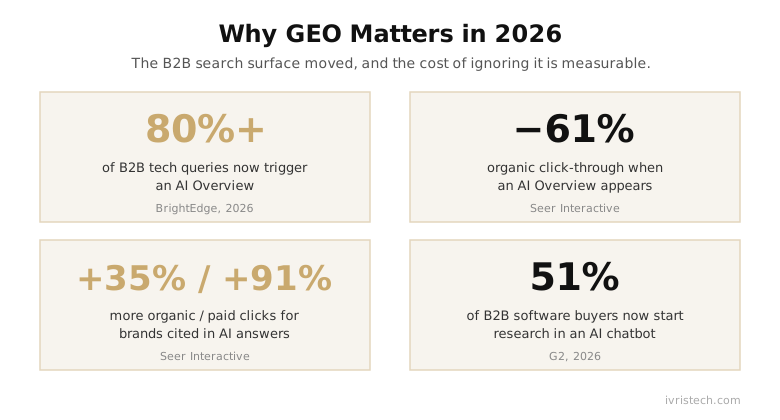
Start with reach. Across all tracked queries, AI Overviews now appear on close to half of searches, up 58% year over year, per BrightEdge’s one-year AI Overview tracking. On B2B technology queries specifically, BrightEdge’s segment data puts that rate far higher, past 80%, which means the typical B2B searcher now meets an AI-generated answer before any blue link.
Then the cost of that reach. When an AI Overview sits above the results, organic click-through on the underlying query falls about 61%, according to Seer Interactive’s CTR analysis of more than 3,000 queries. A page can hold its ranking and still lose most of its clicks, because the answer was served before the searcher ever scrolled. That is the mechanism quietly draining traffic from pages that look fine in a rank tracker.
The flip side is the opportunity, and it is the reason GEO tracking pays for itself. Brands that get cited inside the AI answer see roughly 35% more organic clicks and 91% more paid clicks than brands that rank but go uncited, on the same Seer dataset. Citation is the new position zero, and you cannot improve what you cannot see. A tool shows you the gap; if you would rather have it closed than staff it, the agencies that will run the whole answer-engine program for you pick up where the dashboard stops.
IMPORTANT
Ranking and being cited are now two different outcomes. You can sit at position three and never appear in the AI Overview above you, or rank on page two and get named in the answer. A rank tracker measures the first. Only a GEO platform measures the second, and in 2026 the second is where a growing share of qualified attention is decided. The gap is measurable rather than theoretical: across 15,000 queries the two outcomes overlap on only about 12% of URLs, which is why one tool cannot stand in for the other.
Behavior backs up the numbers. In G2’s 2026 AI Search Insight Report, 51% of B2B software buyers said they now begin their research inside an AI chatbot rather than a search engine, with ChatGPT the most-used at 63%. More striking for vendors: 69% said an AI chatbot steered them toward a different option than they had planned to pick, and a third bought from a company they had never heard of before the AI named it. If the model does not know you, you are not on the shortlist. The same shift is reshaping how teams think about discovery overall, which is why the move toward AI agents in marketing and answer-engine visibility now sits on the same roadmap as classic SEO.
How We Chose These Tools
The shortlist below was built against four criteria, and every tool had to clear all four. The goal was a buyer’s list, not a list of whatever ranks for the query, so a few popular names were left off on purpose and the reasons are noted where it matters.
1. The product is live and proven as of Q2 2026. Each tool was checked against its own current site for active status and real pricing. The AI search market spawns a new “GEO tool” most weeks; anything that launched in the last six weeks with no traction or track record was excluded, because recommending a tool that may not exist in a quarter helps nobody.
2. It does one of the two jobs genuinely well. A tool earns a place either as a content and optimization tool or as a GEO tracking platform. General SEO suites that bolt on a token AI feature did not qualify on that strength alone; the pick had to be a real reason to choose the tool, not a checkbox.
3. Pricing or a clear entry point is knowable. Buyers cannot plan around a black box. Tools with public pricing are quoted to the dollar and tagged to Q2 2026. Where a vendor sells only by quote, that is stated plainly rather than guessed, so you know which tools you can buy with a card and which need a sales call.
4. It fits B2B work. The use cases, integrations, and price points had to make sense for B2B marketing and SEO teams, the audience this guide serves. A tool aimed only at local listings or high-volume affiliate content was out of scope even if it is good at that. Picking the right tool also depends on getting the upstream B2B keyword research and content strategy right first, since no optimizer rescues a draft aimed at the wrong query.
The 6 Best AI SEO and Content Optimization Tools in 2026
These six tools share one job: helping you produce content that ranks and gets cited. Each review covers what the tool is, who it fits, the one feature that sets it apart, and starting price as of Q2 2026. They are ordered to move from the broadest, most popular pick toward the most specialized and the most affordable.
1. Surfer SEO: Best for Optimizing for Search and AI Answers Together
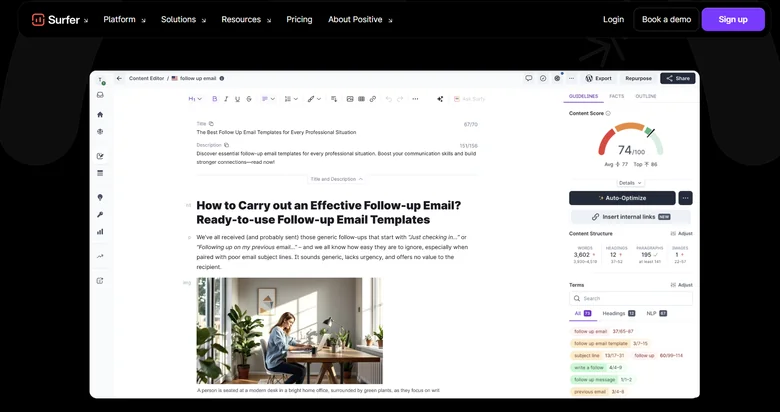
Surfer is the most widely used content-optimization tool in B2B, and in 2026 it has grown from a pure on-page optimizer into a content-intelligence platform that spans both classic search and AI answers. The Content Editor still does the core job well: enter a keyword, and Surfer models the top results, then scores your draft in real time against target terms, headings, and length as you write. What changed is an AI Tracker that watches whether your brand gets named inside ChatGPT, Perplexity, and Gemini answers, which makes Surfer one of the few content tools that also glances at the GEO side.
The writing experience is the smoothest in this group: a clean editor, fast AI drafting, brand-voice controls, and rank-drop detection that flags pages slipping before they crater. For a team shipping a steady cadence of articles, the speed from brief to optimized draft is the main payoff, and the AI Tracker means you are not fully blind on citations while you decide whether to add a dedicated GEO platform.
Best for: Content teams and agencies that want one tool to optimize for Google and keep a light eye on AI-answer mentions, without buying a separate GEO platform on day one.
Standout: A built-in AI Tracker reporting brand mentions across ChatGPT, Perplexity, and Gemini, rare in a content-first tool.
Starting price (as of Q2 2026): Discovery at $49/month billed annually; Standard $99, Pro $182, and Peace of Mind $299/month, with Enterprise at $999/month for larger teams.
2. Frase: Best for Research-to-Publish Automation with Built-In AI Visibility
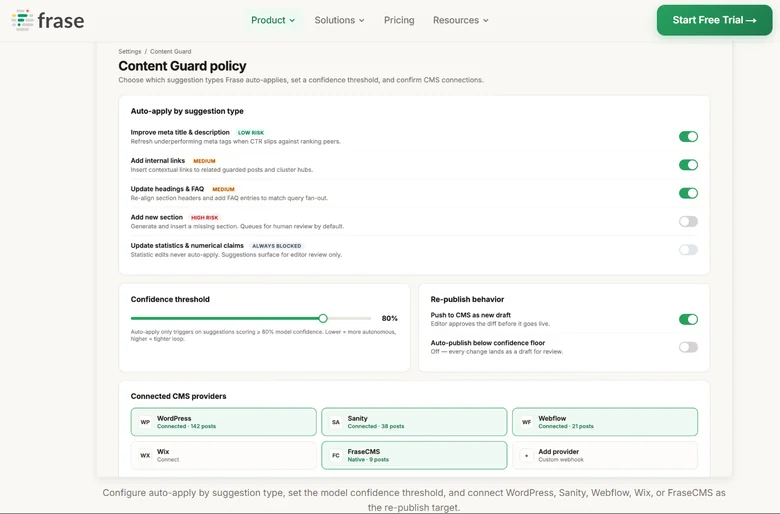
Frase brands itself an agentic SEO and GEO platform, and the description fits its workflow: it researches a SERP, builds an outline from the questions and headings competitors use, drafts with AI, and scores the result, all in one pass. The brief generation is its historical strength; few tools turn a query into a usable, citation-shaped outline as quickly. For solo operators and small teams, that compression of research time is the reason to buy.
The 2026 addition is AI visibility tracking that reports which AI engines cite your content, with coverage of up to eight platforms on the Enterprise tier. That makes Frase a genuine bridge product: content optimization on the front end, a real if lighter citation tracker on the back end, at a price well under the dedicated GEO platforms. A small team that cannot yet justify a standalone GEO contract often starts here.
Best for: Solo SEOs and lean content teams that want one affordable tool to go from SERP research to an optimized, AI-aware draft.
Standout: Fast, citation-shaped brief generation paired with AI-visibility tracking across multiple engines on higher tiers.
Starting price (as of Q2 2026): Starter at $49/month ($39.20/month billed annually); Professional $129, Scale $299, and Enterprise by quote.
3. MarketMuse: Best for Content Strategy and Topical Authority at Scale
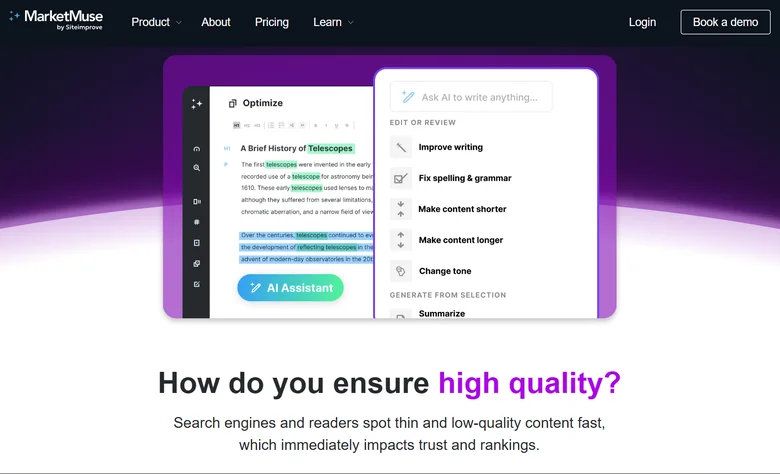
MarketMuse plays a level up from page-by-page optimization. Instead of scoring a single draft, it models your whole topic area and shows where your site is strong, where the gaps are, and which clusters to build to own a subject. Its topic modeling is proprietary and goes past the term-frequency approach most optimizers lean on, which is why strategists reach for it when the question is “what should we publish next” rather than “how do I improve this one page.”
That strategic bent makes it a planning tool first and an optimizer second. For an agency or in-house team mapping a quarter of content against competitive gaps, the inventory and planning views are the draw. Teams that only need to grade drafts will find lighter, cheaper tools enough; MarketMuse earns its keep when content strategy itself is the job and the question is which clusters to build next, not how to polish one page.
Best for: Agencies, publishers, and in-house teams planning content programs and building topical authority across many clusters.
Standout: Proprietary topic modeling that surfaces cluster-level gaps and priorities, not just single-page term lists.
Starting price (as of Q2 2026): A free tier exists for limited use; the Optimize, Research, and Strategy plans are quote-based, so budget a sales conversation for team pricing.
4. Clearscope: Best for Editorial Teams That Want Signal, Not Clutter
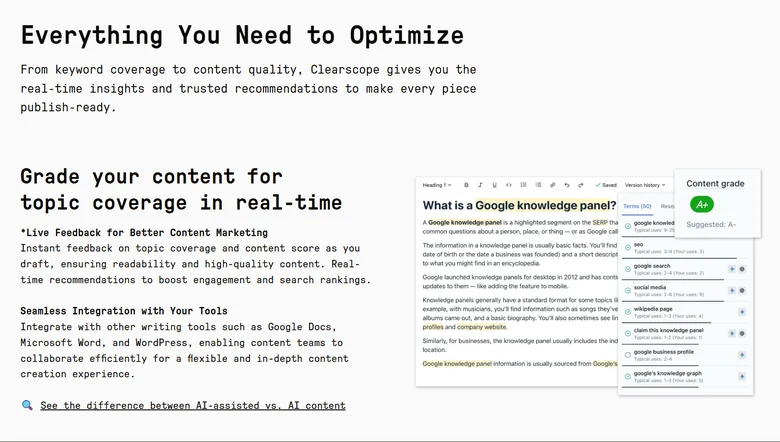
Clearscope has long been the premium pick for content quality, favored by editorial teams that want a clean, high-signal report rather than a dashboard stuffed with metrics. You paste a draft, and it returns a tight content grade, a focused term list, and readability guidance, with almost no learning curve. That simplicity is the product philosophy, and it is why agencies hand Clearscope to writers who are not SEOs.
In 2026 Clearscope added awareness of query fan-out, the set of related searches an AI engine fires when it assembles an answer, so optimization now accounts for the broader question space a model explores rather than a single keyword. Combined with brand-mention tracking, it nudges editorial work toward the formatting that gets lifted into AI answers without burying writers in configuration.
Best for: Editorial and content teams, and the agencies serving them, that prize writer-friendly simplicity and consistent output quality over breadth of features.
Standout: Query fan-out awareness that optimizes for the cluster of questions AI engines explore, not just the head term.
Starting price (as of Q2 2026): Essentials at $129/month; Business at $399/month; Enterprise by quote.
5. Scalenut: Best for End-to-End Content Workflows on a Budget
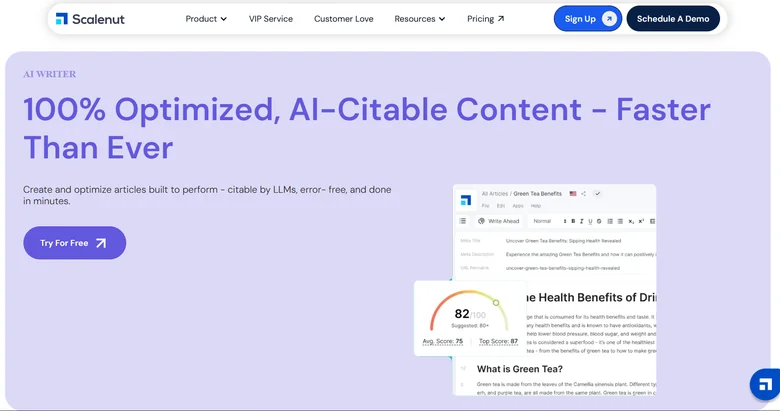
Scalenut bundles the whole content motion, plan, research, write, and optimize, into one platform aimed at teams that want an assembly line rather than a single optimizer. Its Cruise Mode drafts a full long-form article from a keyword in minutes, and the optimizer scores it against NLP-derived terms. For teams treating AI visibility as a growth channel that needs volume, the appeal is producing optimized drafts at pace without stitching three tools together.
The 2026 standout is its GEO Action Center, which packages ready-to-rank articles with the term integration and structure that answer engines favor, an explicit nod to the citation game. Pricing is among the most accessible in the category, though the headline promotional rate is temporary; plan against the regular Starter price so the number holds after the promo ends.
Best for: Lean teams and growing brands that want an affordable, end-to-end content workflow with a GEO-aware output step.
Standout: A GEO Action Center that turns drafts into citation-shaped, ready-to-rank articles inside one workflow.
Starting price (as of Q2 2026): Starter at $59/month regular pricing (frequently discounted on promotion); Plus $89 and Professional $199/month, with a custom VIP tier.
6. NeuronWriter: Best for Solo SEOs Who Want Semantic Optimization Cheaply
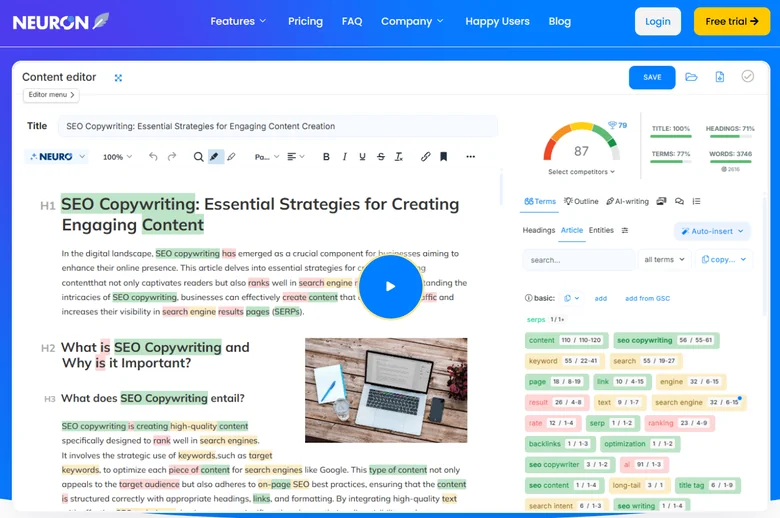
NeuronWriter is the value pick of the group, a semantic content optimizer that covers the core job, competitor analysis and real-time term scoring as you write, at a fraction of the price of the premium tools. It models the SERP, builds a term and question list, and grades your draft live, with AI drafting available on top. For a freelancer or a small agency running many small projects, the math is hard to beat.
It has kept pace with the shift toward AI Overviews and answer engines, tuning its recommendations toward the extractable, answer-first structure those surfaces reward. The interface is denser and less polished than Surfer or Clearscope, which is the trade you accept for the price, but the optimization signal is sound and the per-project cost is the lowest here.
Best for: Solo SEOs, freelancers, and budget-conscious agencies that want credible semantic optimization without a premium subscription.
Standout: Automatic competitor analysis with live optimization scoring at the lowest entry price in this group.
Starting price (as of Q2 2026): Bronze at $23/month ($19/month billed annually); Silver $45, Gold $69, Platinum $93, and Diamond $117/month as usage scales.
Other AI Content Tools Worth Knowing
The six above are the core picks, but a few others come up often enough to name so your shortlist is complete. Search Atlas pairs content optimization with an OTTO engine that auto-deploys site fixes, which appeals to teams that want automation over manual edits. Writesonic and AirOps lean into AI content generation and repeatable workflows at volume, useful when production scale is the binding constraint. SE Ranking folds AI features into a broader, affordable SEO suite, a fit for teams that want rank tracking and optimization under one login. Rankability positions itself as a focused optimizer with expert coaching attached, aimed at teams that want a human in the loop. None displaced the six on the four criteria above, but each is a fair addition to a shortlist depending on what you weigh most.
AI Content Tools Compared
The table below lines up all six content and optimization tools on the dimensions buyers weigh: the job each fits best, its standout capability, starting price as of Q2 2026, and whether a free tier or trial lets you test before committing.
| Tool | Best For | Standout | Starting Price (Q2 2026) | Free Tier / Trial |
|---|---|---|---|---|
| Surfer SEO | Search + AI-answer optimization in one | AI Tracker for ChatGPT, Perplexity, Gemini mentions | $49/mo (Discovery, annual) | Money-back guarantee; no free tier |
| Frase | Research-to-publish for solo and small teams | Citation-shaped briefs + AI visibility tracking | $49/mo (Starter) | Low-cost trial |
| MarketMuse | Content strategy + topical authority | Proprietary cluster-level topic modeling | Custom (free tier available) | Free tier |
| Clearscope | Writer-friendly editorial optimization | Query fan-out awareness | $129/mo (Essentials) | Demo only |
| Scalenut | End-to-end content workflow on a budget | GEO Action Center for ready-to-rank drafts | $59/mo (Starter, regular) | Free trial |
| NeuronWriter | Low-cost semantic optimization for solos | Auto competitor analysis + live scoring | $23/mo (Bronze) | 7-day trial |
The 5 Best GEO Platforms for AI Citation Tracking in 2026
A GEO platform answers one question: when someone asks an AI engine about your category, do you show up, and how are you described? These five are the platforms built to measure and improve that, ordered from the deepest enterprise system to the most accessible, with the two suite-and-enterprise options last. Engine coverage varies, so match the list to the engines your buyers actually use. Tracking only matters if the engines can read you in the first place, and an AI crawler skips what it cannot render, so GEO visibility starts with the technical foundation an audit confirms.
7. Profound: Best for Enterprise Brands That Want the Deepest AI-Search Coverage
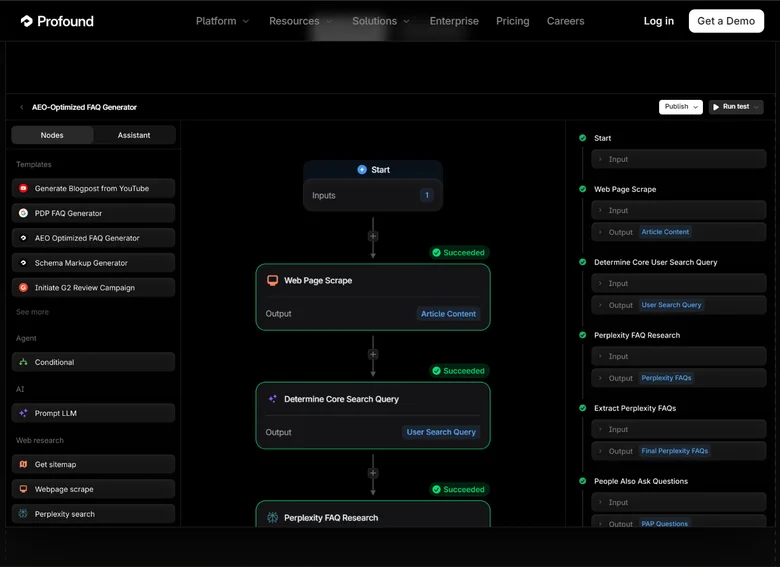
Profound is the most ambitious platform in this group, a full-stack AI-search visibility system used by brands that treat answer engines as a primary channel rather than an experiment. It tracks brand presence across the widest engine set here, ChatGPT, Perplexity, Claude, Gemini, Microsoft Copilot, Grok, Meta AI, DeepSeek, and Google AI Overviews, and reports not just whether you appear but how the models describe you when they do. For a category where perception gets set inside a conversation you never see, that representational view is the whole point.
Where Profound separates from pure monitors is automation. Its autonomous Agents act on findings, handling answer-engine optimization, content, and digital PR tasks rather than only charting them, which suits enterprise teams that need movement, not another dashboard. Reading that data against your own analytics, the referral and branded-traffic signals you pull in Google Analytics for B2B, gives a fuller picture than either source on its own.
Best for: Enterprise and well-funded B2B brands making AI search a core channel and wanting automation, not just reporting.
Standout: The broadest engine coverage in this guide, plus autonomous Agents that act on what the tracking finds.
Starting price (as of Q2 2026): Custom, quote-based; Profound sells through its team rather than a self-serve checkout.
8. Otterly.AI: Best for SMBs and Agencies That Want Affordable Daily Tracking
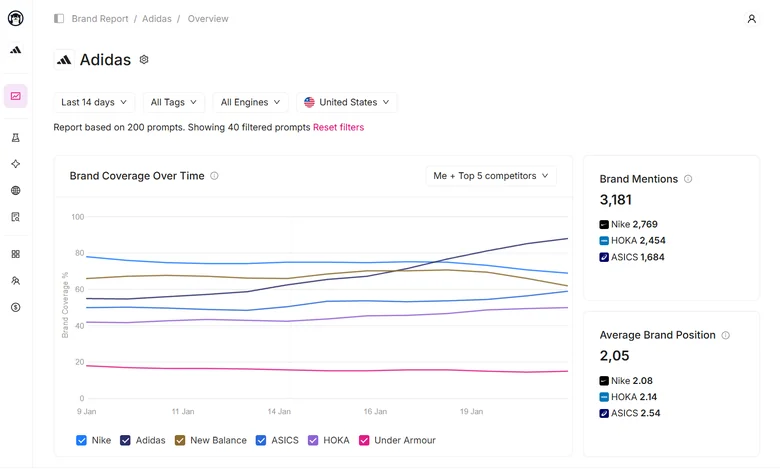
Otterly is the accessible entry point to GEO, and the one most SMBs should try first. It tracks your visibility across ChatGPT, Google AI Overviews, Perplexity, and Microsoft Copilot from a single dashboard, with daily monitoring on every tier rather than gating frequency behind enterprise pricing. You feed it the prompts that matter in your category, and it reports which brands and sources get named, how often you appear, and how that share moves week to week.
The product stays deliberately focused on tracking and reporting rather than trying to be a full marketing platform, which keeps it cheap and easy to run. Gemini and Google AI Mode coverage come as add-ons, so map your buyers’ preferred engines before picking a tier. For an agency that wants to show clients an AI-visibility report without an enterprise contract, Otterly is the practical choice.
Best for: SMBs, startups, and agencies that need credible daily AI-visibility tracking at the lowest entry price.
Standout: Daily multi-engine monitoring available on every plan, including the entry tier.
Starting price (as of Q2 2026): Lite at $29/month ($25/month billed annually); Standard $189 and Premium $489/month, with Enterprise by quote.
9. Scrunch AI: Best for Teams Optimizing for AI Agents, Not Just AI Answers
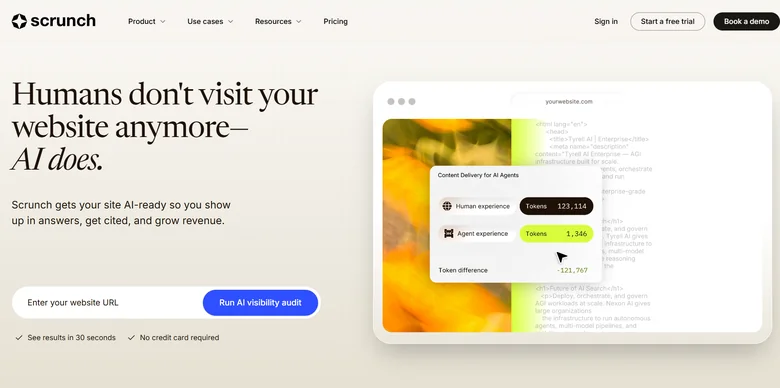
Scrunch AI, now at scrunch.com after operating as scrunchai.com, has pushed past pure visibility tracking into what it calls an Agent Experience Platform. Alongside monitoring brand presence across ChatGPT, Perplexity, Claude, Gemini, and Copilot, it generates machine-readable versions of your pages built for AI agents to parse, betting that the next wave of traffic comes from agents acting on a user’s behalf rather than humans reading results. It is the most forward-leaning thesis in this group.
For companies that believe agent-driven discovery is coming, that positioning is a feature rather than a gimmick: you are shaping the experience an AI has of your site, not only measuring it. The trade is that the product spans more than tracking, so the buying decision is broader than “which monitor is cheapest.” It suits teams ready to treat AI readability as its own discipline.
Best for: Companies and agencies that want to improve citation inclusion and optimize their site for AI agents, not only track mentions.
Standout: An Agent Experience Platform that produces machine-readable page versions for AI agents.
Starting price (as of Q2 2026): Custom, quote-based, with a short free trial; book a demo for scoped pricing.
10. Semrush AI Visibility Toolkit: Best for Existing Semrush Users Adding a GEO Layer
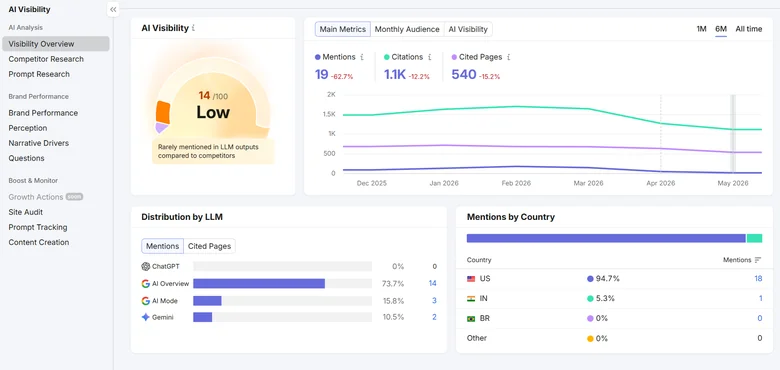
If your team already lives in Semrush, the AI Visibility Toolkit is the path of least resistance into GEO. It is an add-on, distinct from the Semrush Site Audit module that belongs in the technical-tools conversation, focused on measuring how your brand appears in AI-generated answers. Its Prompt Tracking watches a set of prompts daily and reports your presence, so the AI-visibility data sits beside the keyword, backlink, and rank data you already pull, with no new login to learn.
The product page names Google AI Mode and ChatGPT explicitly, while Semrush’s own documentation describes broader coverage across engines, so confirm the current engine list against your needs before relying on it. The value here is consolidation: one suite, one bill, one place to read AI visibility next to traditional SEO, which is worth more to an embedded Semrush shop than a standalone tool’s extra polish.
Best for: Teams already standardized on Semrush that want AI-visibility tracking inside the suite they use daily.
Standout: Daily Prompt Tracking that reports AI-answer presence alongside the rest of the Semrush data set.
Starting price (as of Q2 2026): $99/month as a standalone toolkit, and also bundled within Semrush One plans.
11. BrightEdge AI Catalyst: Best for Enterprises Tracking Presence and Sentiment Together
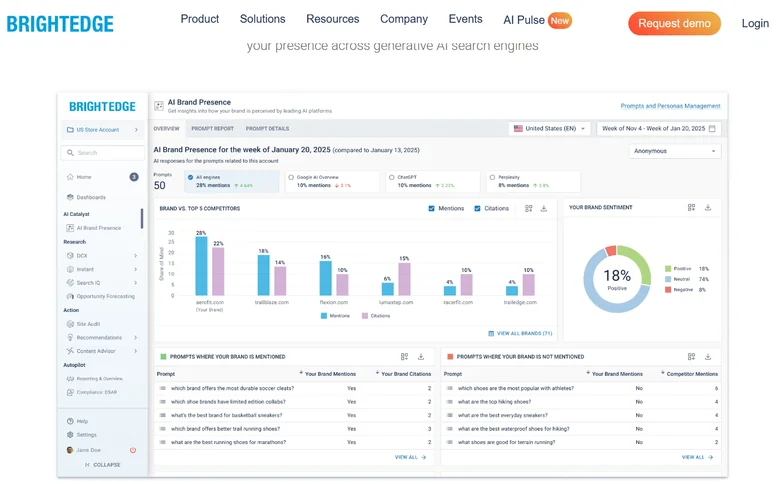
BrightEdge AI Catalyst is the enterprise pick, a module inside the wider BrightEdge SEO platform rather than a standalone subscription. It tracks brand presence across Google AI Overviews, ChatGPT, and Perplexity, and its differentiator is reading sentiment at the same time, so you learn not only whether the model named you but whether it framed you favorably. For a regulated or reputation-sensitive B2B brand, that second signal can matter as much as the first.
Its AI-Powered Prompt Research, driven by the BrightEdge Copilot, helps large teams find the prompts worth tracking in the first place, a non-trivial problem at enterprise scale. Catalyst comes bundled with the BrightEdge platform, so it fits organizations already invested at that level rather than teams shopping for a single tool. Pricing is enterprise and quote-only.
Best for: Enterprise and mid-market brands, especially reputation-sensitive ones, that want presence and sentiment tracked together inside a full SEO platform.
Standout: Simultaneous presence-and-sentiment tracking, with prompt research driven by the BrightEdge Copilot.
Starting price (as of Q2 2026): Custom enterprise pricing, included with the BrightEdge SEO platform; quote only.
GEO Platforms Compared
The table below lines up the five GEO platforms on what matters most for this category: which AI engines each one tracks, the buyer it fits, starting price as of Q2 2026, and its standout capability. Engine coverage is the first filter, because a platform that does not watch the engines your buyers use cannot help you. That first filter is not a quality test: IAB’s AI visibility measurement guidance adds prompt design, reproducibility, validation, platform weighting, and baseline management to the buyer’s test.
| Platform | AI Engines Tracked | Best For | Starting Price (Q2 2026) | Standout |
|---|---|---|---|---|
| Profound | ChatGPT, Perplexity, Claude, Gemini, Copilot, Grok, Meta AI, DeepSeek, Google AI Overviews | Enterprise brands wanting the deepest AEO + automation | Custom / quote | Widest engine coverage + autonomous Agents |
| Otterly.AI | ChatGPT, Google AI Overviews, Perplexity, Copilot (Gemini, AI Mode as add-ons) | SMBs and agencies tracking affordably | $29/mo (Lite) | Daily multi-engine monitoring on every tier |
| Scrunch AI | ChatGPT, Perplexity, Claude, Gemini, Copilot | Teams optimizing for AI agents + citation inclusion | Custom / quote | Agent Experience Platform with machine-readable pages |
| Semrush AI Visibility | Google AI Mode, ChatGPT (broader per Semrush docs) | Existing Semrush users adding AI visibility | $99/mo | Daily Prompt Tracking inside the Semrush suite |
| BrightEdge AI Catalyst | Google AI Overviews, ChatGPT, Perplexity | Enterprises tracking presence + sentiment | Custom / quote | Presence and sentiment tracking via BrightEdge Copilot |
How AI Content Tools and GEO Platforms Work Together
The two categories are not alternatives; they are two halves of one loop, and the teams getting cited in 2026 run them together rather than choosing between them. Teams that would rather not run the loop at all hand both halves to an agency that owns the whole SEO-and-AI-visibility program. Here is the workflow in practice.
It starts on the content side. You research a query and build a draft, then a tool like Surfer, Clearscope, or Frase scores it against what already ranks and pushes it toward the answer-first structure AI engines lift from. That gets you a page worth citing. Publishing it is the midpoint, not the finish line.
The GEO platform takes over from there. Once the page is live and indexed, a tracker like Otterly or Profound watches whether ChatGPT, Perplexity, and Google’s AI Overviews start naming you for the prompts that matter, and how your share of those answers moves over the following weeks. That is the feedback a content tool cannot give you, because it grades the input while the GEO platform measures the outcome.
Then the loop closes. The prompts where you are absent or described poorly become the next content brief: a new page, a sharper definition, a data point worth quoting. The content tool shapes that work, you publish again, and the GEO platform reports whether it landed. Run that cycle for a quarter and you stop guessing which optimization moved AI visibility, because production and measurement start feeding each other instead of running blind.
Pricing Benchmarks: What AI SEO and GEO Tools Cost in 2026
AI SEO tooling prices into four clear bands in 2026: solo, team, agency, and enterprise. The important thing to plan for is that content optimization and GEO tracking are separate line items. A realistic starting stack is one tool from each side, so a solo operator might pair a $23 optimizer with a $29 tracker, while an enterprise runs a quote-based content platform alongside a quote-based GEO system.
| Tier | Typical Monthly Range (Q2 2026) | Best For | Sample Tools |
|---|---|---|---|
| Solo / Entry | $20-$50 | Freelancers, solo SEOs, small projects | NeuronWriter, Otterly Lite, Surfer Discovery, Frase Starter |
| Team / Growth | $90-$300 | Content teams, growing B2B brands | Surfer Standard/Pro, Frase Pro, Clearscope Essentials, Scalenut Plus, Otterly Standard, Semrush AI Visibility |
| Agency / Premium | $300-$1,000 | Agencies and multi-client or larger teams | Clearscope Business, Surfer Enterprise, Otterly Premium, Scalenut Professional |
| Enterprise | Custom / quote | Enterprises, regulated brands, deep AEO programs | MarketMuse, Profound, Scrunch AI, BrightEdge AI Catalyst |
Two patterns are worth calling out. First, the content side has a real self-serve floor: you can run a credible optimizer for the price of a couple of streaming subscriptions, and the jump to premium buys polish and collaboration more than a fundamentally different result. Second, GEO pricing is bimodal. There is an accessible SMB tier around $29 to $189 a month for tracking, and then a leap to enterprise quotes for the platforms that add automation, sentiment, and the widest engine coverage. There is little in between, so decide early whether you need tracking or a full program.
PRO TIP
Buy the content tool first if you are not yet publishing on a consistent schedule, because optimizing nothing is pointless. Buy the GEO platform first if you already publish steadily but cannot see whether AI engines cite you, because that blind spot is where the money leaks. Sequence the purchase to the gap you actually have.
Which AI SEO Tool or GEO Platform Should You Pick?
The right choice follows the job and the team, not the brand with the loudest marketing. Use the verdicts below to match a tool to your situation, then test one from each category before committing budget.
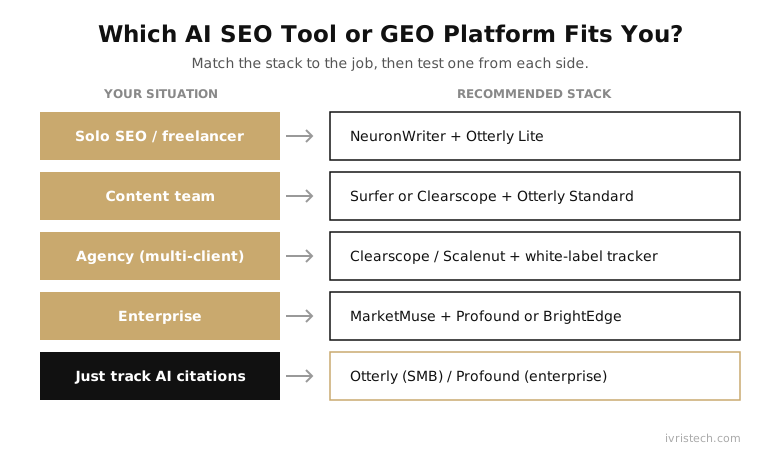
Best for a solo SEO or freelancer: Pair NeuronWriter for low-cost semantic optimization with Otterly Lite for citation tracking. The combined cost stays near $50 a month, and you still get both jobs covered.
Best for a content team: Surfer or Clearscope on the optimization side, depending on whether you value workflow speed or editorial simplicity, paired with Otterly Standard for tracking across the engines your buyers use.
Best for an agency: Clearscope or Scalenut for repeatable client output, plus a tracker you can white-label into reporting. Tie the tooling back to the B2B marketing metrics clients actually judge you on, so the AI-visibility data shows up in language leadership respects.
Best for an enterprise: MarketMuse for content strategy across many clusters, paired with Profound or BrightEdge AI Catalyst for deep, multi-engine citation and sentiment tracking. This is the stack for teams treating AI search as a board-level channel.
Best for pure AI citation tracking: Otterly if you are an SMB or agency that wants affordable daily monitoring, Profound if you are an enterprise that needs the widest engine coverage and automation on top of the data.
Common Mistakes When Buying AI SEO Tools
1. Buying a GEO platform before you publish anything worth citing
A tracker measures whether AI engines cite you. If you have almost no content for them to cite, the dashboard will read zero for months and tell you nothing you did not already know. Get a publishing habit and a content optimizer in place first, then add GEO tracking once there is a body of work whose citation rate is worth watching.
2. Treating AI writing volume as the goal
The tools that draft fast make it tempting to measure success in articles shipped. AI engines reward the opposite: depth, original data, and answer-first structure, not a flood of thin, templated posts. Volume without substance is exactly the pattern that gets skipped in AI answers. Use the speed to publish better, not merely more.
3. Optimizing content but never measuring citations
This is the most expensive mistake in 2026, and the most common. Teams pour effort into optimization scores while staying blind to whether any of it moved their presence in AI answers. Optimization without measurement is a guess. Pairing a content tool with even an entry-level GEO tracker closes the loop and tells you which work is actually landing.
4. Assuming a tool replaces the fundamentals
An optimizer raises a page’s score; it does not earn the authority that citations still depend on. AI engines lean heavily on the same trust signals as search, including links from sources buyers respect. That work lives in B2B link building strategies, and when it outpaces what an in-house team can do, in dedicated B2B SaaS link building services. No tool in this guide substitutes for it.
Frequently Asked Questions
There is no single best AI SEO tool; the right pick depends on the job. Surfer and Clearscope lead for content optimization, MarketMuse for content strategy, and NeuronWriter for budget solo work. For tracking AI citations, Otterly suits SMBs and Profound suits enterprises. Most B2B teams need one content tool plus one GEO platform.
A GEO (generative engine optimization) platform tracks whether and how your brand appears in AI-generated answers from engines like ChatGPT, Perplexity, and Google’s AI Overviews. You supply the prompts that matter in your category, and it reports which brands get cited, your share of those answers over time, and often the sentiment attached to each mention.
No. GEO extends SEO rather than replacing it. The same content quality, structure, and authority that earn rankings also earn AI citations, and the sites cited in AI answers are overwhelmingly the ones already ranking well. Treat GEO as a measurement and optimization layer on top of solid SEO, not a separate or competing strategy.
Yes, but you need a GEO platform for that job, not a content optimizer. Tools like Profound, Otterly, Scrunch, Semrush AI Visibility, and BrightEdge query these engines on a schedule and report when your brand is named. A few content tools, including Surfer and Frase, now bundle lighter mention tracking as well.
Your First Move
The shift is simple to state and easy to underestimate: your buyers now ask their first question somewhere you cannot see, and ranking for it is no longer the same as winning it. The tools in this guide split that problem in two. Content optimizers help you publish work worth citing. GEO platforms tell you whether the citation actually happened.
Do not try to buy the whole stack at once. Pick the single gap that is costing you most right now. If you publish inconsistently, start with an optimizer in the $23 to $49 range and build the habit. If you already publish but have no read on AI visibility, start with a tracker like Otterly and finally see what the engines say about you. Then add the second tool once the first is earning its keep, and let what the data shows, not the vendor with the best demo, decide where the budget goes next.