Most “best local SEO tools” lists mix four different jobs into one ranking and hope you won’t notice. A citation builder, a Google Business Profile optimizer, a geo-grid rank tracker, and a white-label reseller platform solve different problems, and treating them as interchangeable is how a solo consultant ends up paying for a multi-location enterprise suite. This guide separates the tools by the job they actually do, then adds the part every other list skips: the reseller and white-label programs agencies use to sell local SEO under their own brand.
Local SEO software is a tool, or a stack of tools, that helps a business rank in Google’s local pack, Maps, and “near me” results by managing citations, Google Business Profile, reviews, and local rankings. It answers the questions a general SEO tool can’t: is the business listed consistently across directories, where does it rank on the map grid by neighborhood, and what are customers actually saying in reviews.
Below are nine tools vetted against five criteria, each with real Q2 2026 pricing, honest pros and cons, and a verdict on who it fits, followed by four reseller programs screened for legitimacy. After the reviews you get two comparison tables, a pricing-tier breakdown, a decision framework, and the buying mistakes that push teams into the wrong tier. Updated Q2 2026.
Key Takeaways
- The category splits into four jobs: citation and listing management, Google Business Profile optimization, geo-grid rank tracking, and review management. Most businesses need two tools that cover different jobs, not one tool that claims all four.
- Google Business Profile (free) is the baseline every local business should claim and fully complete before paying for anything.
- BrightLocal (from $39/mo as of Q2 2026) is the most common all-in-one starting point; Local Falcon (from $24.99/mo as of Q2 2026) owns geo-grid map-pack tracking.
- Reviews now drive local visibility as much as citations: 97% of consumers read online reviews, per the BrightLocal Local Consumer Review Survey, and 45% now use ChatGPT or other AI tools for local business recommendations, up from 6% a year earlier.
- Reseller and white-label programs (Vendasta, BrightLocal, Boostability, Synup) let agencies sell local SEO under their own brand, but the field is full of guaranteed-ranking operators worth avoiding.
What Local SEO Software Does (and What It Doesn’t)
A local SEO tool inspects and improves the signals that decide whether a business shows up when someone nearby searches for what it sells: Google Business Profile completeness, citation and NAP (name, address, phone) consistency across directories, review volume and ratings, local rankings by location, and the on-page signals search engines and AI engines read. These are the local-search equivalent of the checks in our technical SEO checklist, applied to a storefront or service area instead of a whole site.
What local SEO software does not do is national keyword research, backlink analysis, or site-wide crawling. That line matters when you read a generic roundup. Tools like Semrush and Ahrefs are built around national keyword and rank data with local features bolted on, which is why a dedicated local tool usually beats them at the local job. If the work is finding which local terms to target, that belongs to local keyword research, and the local effort sits inside a wider B2B SEO strategy rather than replacing it.
Local search is also where the buying intent lives. Around 46% of Google searches have local intent, and 76% of people who run a “near me” search on a phone visit a business within a day, per BrightLocal’s local search statistics. Showing up in the local pack is often the difference between a phone call and a competitor’s phone call, which is why local visibility feeds directly into local lead generation.
Citation Builders vs Rank Trackers vs Review Tools vs Reseller Platforms
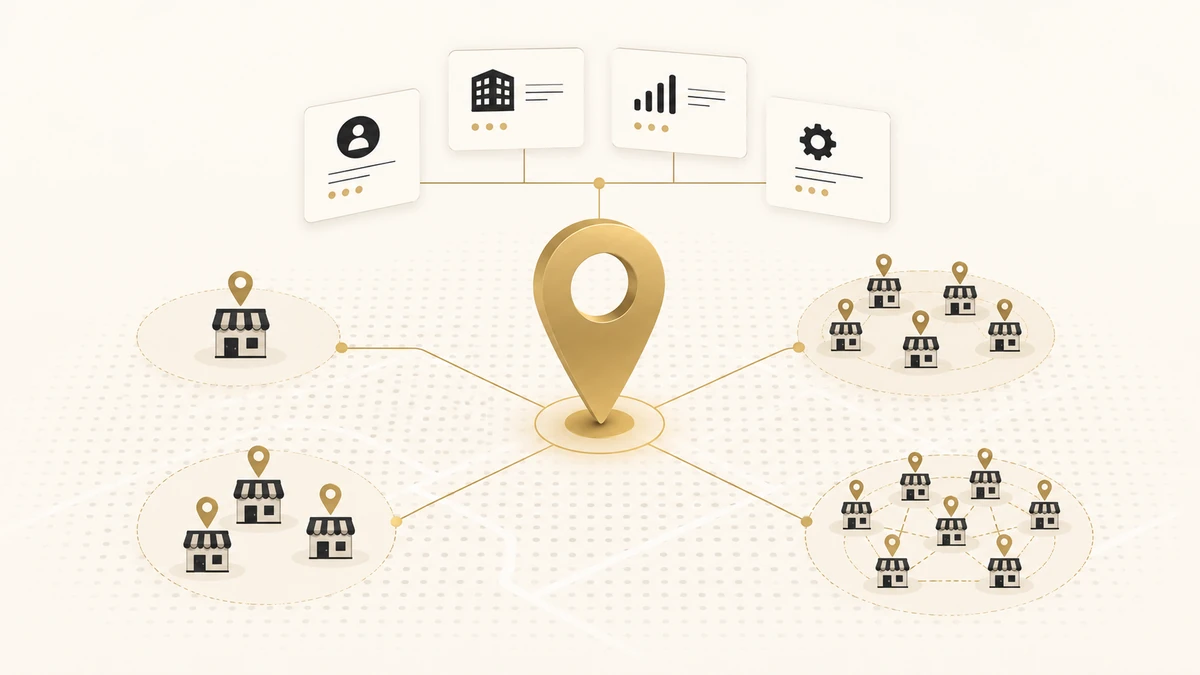
The fastest way to choose is to name the job first. Local SEO tools fall into four buckets, and the strongest setups pair one tool from two different buckets rather than buying a single platform that markets all four.
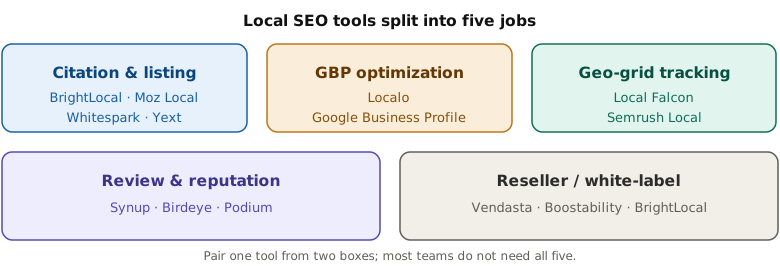
Citation and listing managers push a consistent name, address, and phone number to directories like Google, Bing Places, and Apple Business Connect, then catch duplicates and errors. Google Business Profile optimizers focus on the single most important local asset, improving categories, posts, photos, and Q&A to win the map pack. Geo-grid rank trackers show where a business ranks on Maps from many points across a city, not one blended number. Review and reputation tools collect, monitor, and respond to reviews across platforms.
A fifth group sits apart: reseller and white-label platforms, which package these jobs so an agency can sell local SEO under its own brand. Those are different tools from the crawlers and auditors we cover separately, which inspect site infrastructure rather than local presence. AI search is reshaping this layer too: Google’s review share fell from 83% to 71% between 2025 and 2026, per the BrightLocal review survey, so tools that manage listings and reviews everywhere matter more, the same way getting cited in AI Overviews now matters for local queries.
How We Chose These Tools
Every tool below cleared five criteria. Tools that failed even one were left off, however well-known.
1. A genuine local-SEO core. The tool’s primary job is local: citations, Google Business Profile, local rank tracking, or reviews, not a national SEO suite with a local tab attached.
2. Real use by local SEOs and agencies. The tool shows up in working local-search audits and agency stacks, not only in affiliate roundups.
3. Maintained in 2026. Active development and current coverage of Google Business Profile changes, AI-search signals, and map-pack updates.
4. A distinct job or tier. Each pick covers a different business size, budget, or capability rather than duplicating another tool on the list.
5. Verifiable pricing. Either published pricing or a transparent quote model. Every figure is tagged as of Q2 2026 so a refresh can find it later.
FREE AND BUDGET TOOLS WORTH KNOWING
Three free tools sit beneath the paid list. Google Business Profile is the non-negotiable baseline; Bing Places for Business and Apple Business Connect extend the same listing to Bing, Copilot, and Apple Maps at no cost. Reputation-first platforms like Birdeye and Podium overlap with review management, though they cost more than a dedicated local tool.
The 9 Best Local SEO Tools in 2026
Each tool gets the same structure: what it is, who it is best for, the standout that separates it, and a starting price as of Q2 2026. The order runs from the broadest all-in-one tools to the specialists. Match the tool to the job and the business size you actually have.
1. BrightLocal: Best All-in-One for Agencies and SMBs
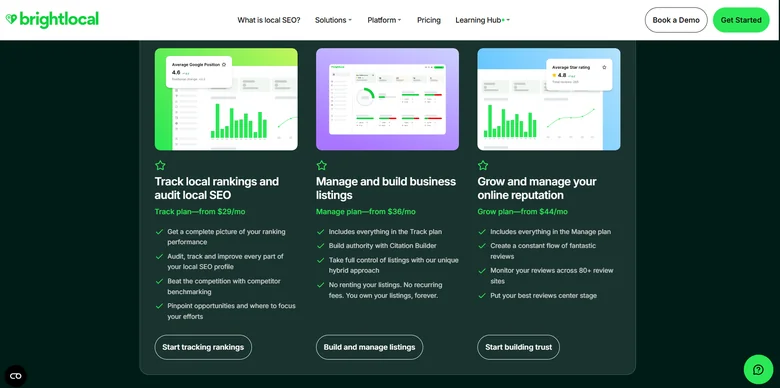
BrightLocal is the tool most local SEOs reach for first. It bundles the four core jobs (citation building, local rank tracking, review management, and local audits) into one dashboard priced for small businesses and agencies alike. The Local Search Grid shows map-pack rankings across a geo-grid, the Citation Builder submits to directories, and the reporting is white-label from the entry tier, which is why it doubles as a reseller platform later in this guide. For an agency, that all-in-one breadth is what turns local-pack visibility into the calls and form fills a local lead-gen program depends on.
Best for: Agencies and SMBs that want citations, rank tracking, reviews, and audits in one affordable dashboard.
Standout: Four local jobs in one tool, with white-label reports from the cheapest plan.
Starting price (as of Q2 2026): $39/month on the Track plan for one location, or about $29/month billed annually; the 14-day free trial needs no card. BrightLocal has announced a 5-10% increase from July 1, 2026, so this is the pre-increase rate.
2. Whitespark: Best for Citation Building
Whitespark is the name local SEOs trust for citations. Its Local Citation Finder surfaces the directories that already rank competitors, and it offers both a do-it-yourself tool and a done-for-you build service, alongside a clean, affordable Local Rank Tracker.
Best for: Consultants and agencies that want high-quality manual citation building plus local rank tracking.
Standout: The deepest citation-finding data on this list, backed by a done-for-you build service.
Starting price (as of Q2 2026): The Local Rank Tracker starts around $25/month and the Local Citation Finder around $33/month, each billed monthly, with a free trial on the rank tracker.
3. Semrush Local: Best for Existing Semrush Users
Semrush Local is the local add-on to the wider Semrush suite. It pairs a geo-grid Map Rank Tracker with Listing Management and a Google Business Profile AI assistant for posts and replies. The reason to pick it is consolidation: if your team already runs its keyword research in Semrush, the local layer stays under one login.
Best for: Marketing teams already paying for Semrush that want local tracking and listings in the same platform.
Standout: A geo-grid Map Rank Tracker and a GBP AI assistant inside the suite you already use.
Starting price (as of Q2 2026): The Local Base add-on is $30/month per location; Listing Management requires the Local Pro add-on at $60/month. Both sit on top of a paid Semrush plan.
4. Moz Local: Best for Listing Distribution
Moz Local is a set-and-forget listing tool. It pushes a verified profile to 90-plus directories and data aggregators, monitors them for accuracy, and flags duplicates. It is lighter than BrightLocal on rank tracking, but for keeping listings consistent everywhere it is clean and inexpensive.
Best for: Small businesses that mainly need accurate, automated listing distribution and monitoring.
Standout: Automated sync to 90+ directories and aggregators with duplicate detection.
Starting price (as of Q2 2026): $199/year (about $16/month) on the Lite plan per location, or $20/month billed monthly. There is no free trial, but a free listing checker is available.
5. Local Falcon: Best for Geo-Grid Rank Tracking
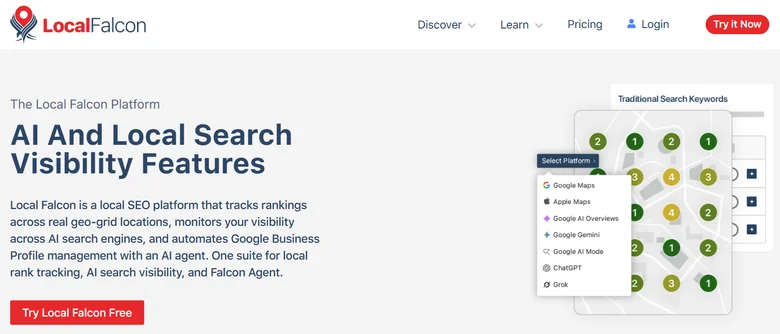
Local Falcon does one thing better than anyone: it shows where a business ranks on Google Maps from a grid of points across its service area. Instead of a single blended position, you get a heat map of pins, green where you win the map pack and red where you don’t, which makes proximity problems obvious. Its Falcon AI layer summarizes each scan.
Best for: Anyone who needs to see local rankings by neighborhood rather than one citywide average.
Standout: Visual geo-grid scans of Maps rankings by pin, the clearest local-rank picture available.
Starting price (as of Q2 2026): $24.99/month on the Starter plan (7,500 credits), with annual billing at $299.88; pay-as-you-go runs $0.05 per credit, and signup includes 100 free credits.
6. Yext: Best for Enterprise and Multi-Location
Yext is the enterprise answer for brands with dozens, hundreds, or thousands of locations. Its Knowledge Graph syncs business data in real time across 200-plus publishers, so a holiday-hour change updates everywhere at once. It is the most capable listing platform here and the most expensive, sold through a sales-led process.
Best for: Multi-location brands and franchises that need real-time listing control at scale.
Standout: Real-time sync across 200+ publishers from a single source of truth.
Starting price (as of Q2 2026): Custom, quote on request. Yext does not publish a flat list price; public benchmarks for its SMB listings plans have historically run roughly $199 to $999 per location per year.
7. Localo: Best for Solo Operators and GBP Optimization
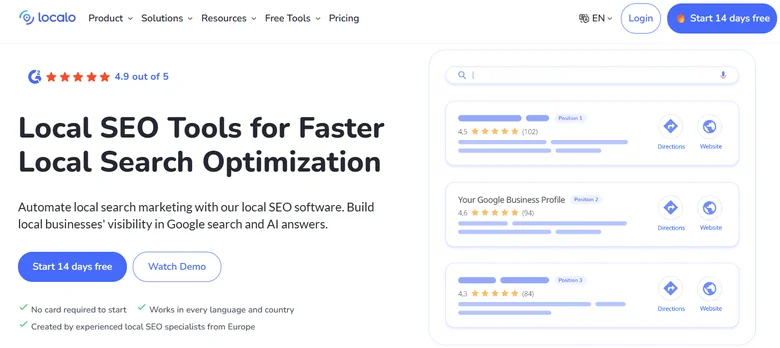
Localo (formerly Surfer Local) is built for the non-specialist improving one Google Business Profile without learning an enterprise tool. It hands you a prioritized profile task list, a local rank grid, and AI-generated posts and replies in a friendly interface. For a solo consultant or single-location owner, it is the gentlest on-ramp here.
Best for: Solo operators and small businesses optimizing one or a few Google Business Profiles.
Standout: AI-driven, plain-language GBP task lists that do not assume SEO expertise.
Starting price (as of Q2 2026): $49/month for a single business, or $39/month billed annually, with a 14-day free trial (no card) and a 30-day money-back guarantee.
8. Synup: Best for Multi-Location Listings and Reputation
Synup sits between the SMB tools and Yext’s enterprise tier. It manages listings and reviews across locations with bulk actions, per-location dashboards, and modular add-ons, so a regional chain runs both from one place. Pricing is built around locations and the modules you enable.
Best for: Regional multi-location businesses and agencies that need listings plus reputation at mid scale.
Standout: Per-location listings and review management with modular, scalable pricing.
Starting price (as of Q2 2026): $79/month on the Startup platform plan billed annually ($99 monthly), with per-location Listings add-ons from $35 per location per month. Demos are sales-led.
9. Google Business Profile: Best Free Baseline
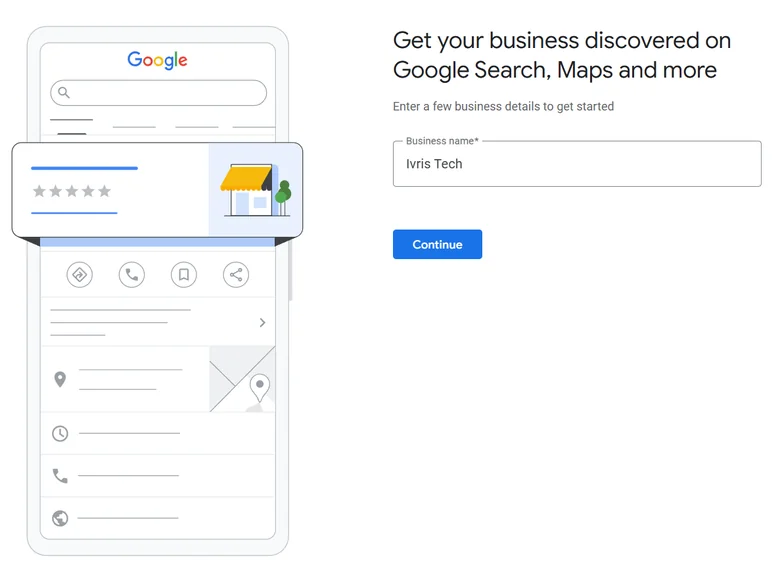
No paid tool replaces Google Business Profile, because it is the local listing every other tool optimizes toward. It controls how a business appears in Google Search and Maps: the photos, hours, categories, posts, products, Q&A, and the reviews customers leave. Claiming and fully completing the profile is the single highest-return local-SEO move, and it costs nothing. Pair it with Google Analytics to see what the resulting traffic does once it reaches your site.
Best for: Every local business. This is the baseline beneath any paid tool you buy.
Standout: Direct control of the Google listing that decides local-pack and Maps visibility, for free.
Starting price (as of Q2 2026): Free for every verified business.
Local SEO Tools Comparison Table
The table below lines up all nine tools on the dimensions buyers actually weigh: the job they are best for, starting price as of Q2 2026, whether a free tier or trial exists, the standout capability, and a one-line verdict.
| Tool | Best For | Starting Price (Q2 2026) | Free Tier / Trial | Standout | Verdict |
|---|---|---|---|---|---|
| BrightLocal | All-in-one for agencies and SMBs | $39/mo (Track), ~$29/mo annual | Yes, 14-day trial | Four local jobs + white-label reports | The default first tool |
| Whitespark | Citation building | Rank Tracker ~$25/mo; Citation Finder ~$33/mo | Yes, free trial | Deepest citation data + done-for-you | Best for citations |
| Semrush Local | Existing Semrush users | $30/mo per location (Local Base); $60/mo (Local Pro) | Add-on to paid Semrush | Geo-grid tracker + GBP AI in the suite | Best if you already use Semrush |
| Moz Local | Listing distribution | $199/yr (~$16/mo) per location | Free checker, no trial | Sync to 90+ directories + dedupe | Best for set-and-forget listings |
| Local Falcon | Geo-grid rank tracking | $24.99/mo (Starter); $0.05/credit PAYG | Yes, 100 free credits | Visual map-pack heat maps by pin | Best for rank tracking |
| Yext | Enterprise / multi-location | Custom quote (~$199-$999/loc/yr est.) | No public trial | Real-time sync across 200+ publishers | Best at true enterprise scale |
| Localo | Solo operators / GBP | $49/mo (or $39/mo annual) | Yes, 14-day trial | Plain-language AI GBP task lists | Best on-ramp for non-experts |
| Synup | Multi-location listings + reviews | $79/mo (annual) + $35/loc/mo add-ons | Demo-led | Modular per-location pricing | Best for mid-scale chains |
| Google Business Profile | Free baseline | Free | Free | Direct control of the Google listing | Mandatory for every business |
Reseller and White-Label Local SEO Programs
If you run an agency, the question is not only which tool to use, it is whether to resell local SEO under your own brand. White-label and reseller programs handle that, either as software you rebrand or as fulfillment a partner delivers in your name. The field is crowded, and parts of it are sketchy: programs that promise guaranteed number-one rankings, guaranteed domain authority jumps, or “powered by PBN” links belong on a blocklist, not a shortlist, the same logic that keeps the B2B SEO agencies worth hiring honest. Outfits like AgencyPlatform, DashClicks, and The HOTH circle this space; the four below earned a place by selling real software or white-hat fulfillment, with no guaranteed-rank language on their own sites.
1. Vendasta: Best White-Label Platform
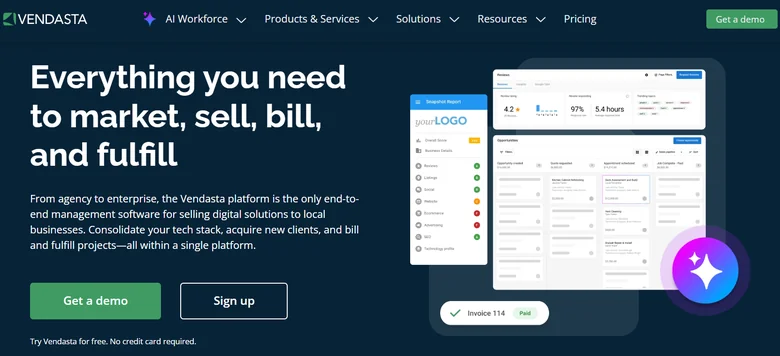
Vendasta is the broadest white-label play here, a platform and marketplace that lets an agency resell local SEO alongside dozens of other products under one branded client portal. You get a white-label dashboard, fulfillment options, and a storefront, so a small agency can offer enterprise-style services without building them.
Best for: Agencies that want to resell local SEO plus a wider marketing stack under their own brand.
Standout: A fully white-label marketplace and client portal across many products, not just local.
Pricing (as of Q2 2026): No subscription floor to start, with paid tiers from a $99/month minimum (Starter), $499/month (Pro), and $999/month (Premium), plus custom enterprise; a 14-day trial is available.
2. BrightLocal: Best White-Label Tools for Lean Agencies
BrightLocal earns a second mention because its agency features are a reseller program in their own right. Reports and review-request emails are white-label from the entry tier, and the Citation Builder runs pay-as-you-go, so an agency can deliver citation campaigns under its own brand without a managed-service contract. It is the cheapest credible white-label route for a lean agency.
Best for: Small agencies that want white-label local reports and citation building without a fulfillment partner.
Standout: White-label reporting from the cheapest plan, plus pay-as-you-go citation building.
Pricing (as of Q2 2026): From $39/month (Track), with white-label reports across tiers; the Citation Builder is pay-as-you-go at roughly $3.20 per citation site.
3. Boostability: Best Done-for-You Fulfillment
Boostability is a fulfillment partner rather than software. Agencies resell its managed local services under their own brand, with a branded dashboard and a revenue-share model, while Boostability’s team does the work. Its published material advocates white-hat methods and states plainly that no one can guarantee rankings, the posture you want from a partner. The trade-off is less direct control than doing the work yourself.
Best for: Agencies that want to resell local SEO without hiring or running a delivery team.
Standout: White-hat managed fulfillment with a branded reseller dashboard and revenue share.
Pricing (as of Q2 2026): Managed plans run roughly $200 to $300 per client per month at entry, scaling to $1,000-plus, with revenue share up to about 50%.
4. Synup: Best Partner Program for Software Resellers
Synup’s partner and reseller tiers let an agency rebrand its listings and reputation software as its own. The white-label depth is real: your brand stays in front of the client across dashboards and reports, and the per-client economics improve as you add accounts. It suits an agency that wants to resell software rather than outsource fulfillment, and that already likes Synup as a tool.
Best for: Agencies reselling listings and reputation software under their own brand.
Standout: A complete white-label software layer with pricing that scales down per client as you grow.
Pricing (as of Q2 2026): Tiered partner pricing that decreases as your client base grows; Synup quotes the reseller tier rather than publishing a flat rate.
Reseller Program Comparison Table
The reseller table weighs the dimensions an agency cares about: what the program is, who it fits, the pricing model as of Q2 2026, how deep the white-label goes, and the standout.
| Program | What It Is | Best For | Pricing Model (Q2 2026) | White-Label Depth | Standout |
|---|---|---|---|---|---|
| Vendasta | White-label platform + marketplace | Agencies reselling a full stack | From $99/mo, up to $999/mo + enterprise | Full (portal + products) | Resell many products, one brand |
| BrightLocal | White-label tools + citation building | Lean agencies keeping work in-house | From $39/mo; Citation Builder ~$3.20/site | Reports + emails white-labeled | Cheapest credible white-label route |
| Boostability | Done-for-you managed fulfillment | Agencies outsourcing delivery | ~$200-$300/client/mo, rev-share to ~50% | Branded dashboard + reporting | White-hat managed delivery |
| Synup | White-label software (partner tier) | Agencies reselling listings + reviews | Tiered quote, drops as clients grow | Full software white-label | Per-client economics improve at scale |
Local SEO Pricing Benchmarks for 2026
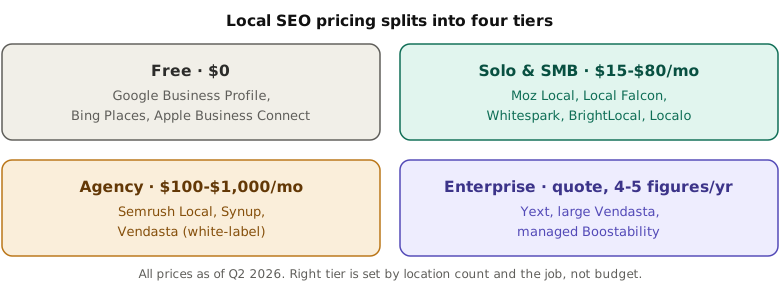
Local SEO pricing splits into four tiers, and the right tier is set by how many locations you manage and which jobs you need, not by the biggest number you can spend. The same “best tool by job” logic runs through our roundup of lead generation tools, and it applies just as cleanly to local.
Free Tier: $0 (as of Q2 2026)
Google Business Profile, Bing Places for Business, and Apple Business Connect cover more than most owners realize. Claiming and completing all three puts a consistent listing in front of Google, Bing, Copilot, and Apple Maps at no cost. Every local business should run this tier before paying for anything, and a single-location shop in a low-competition area can sometimes stop here.
Solo and SMB Tier: $15 to $80 per Month (as of Q2 2026)
This is where most single-location businesses and small agencies land. Moz Local (about $16/month), Local Falcon ($24.99/month), Whitespark (from about $25/month), BrightLocal ($39/month), Localo ($49/month), and Synup’s entry plan ($79/month) all sit here. The sensible pattern is one tool that fixes your biggest gap plus the free Google Business Profile underneath it, not three overlapping subscriptions.
Agency and Multi-Location Tier: $100 to $1,000 per Month (as of Q2 2026)
Costs climb once per-location fees and white-label features stack up. Semrush Local bills $30 to $60 per location, Synup adds $35 per location per month, and reseller platforms like Vendasta run $99 to $999 per month. An agency managing ten or more client locations lives here, and the white-label reporting usually justifies the jump.
Enterprise Tier: Quote-Gated, Four to Five Figures a Year (as of Q2 2026)
Yext, large Vendasta deployments, and managed Boostability programs occupy the quote-gated top tier, where the figure depends on location count, publishers, and contract length. This tier earns its cost at hundreds or thousands of locations, or when an agency resells at volume; below that, the tiers above do the same job for far less.
IMPORTANT
Quote-gated local tools price on location count and contract length, not on a public rate card. Before a sales call, have your exact location count ready, ask for the annual figure rather than the monthly headline, and ask what happens to the price when you add locations or exceed a listing quota. A vendor that will not give a starting range until the second call is signaling that the price tracks your perceived budget, not your scope.
How to Choose Local SEO Software
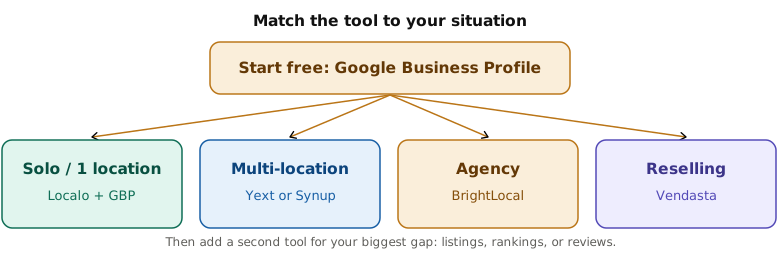
Choosing local SEO software is a four-question exercise. Answer them in order and the shortlist narrows itself.
1. How Many Locations Do You Manage?
Location count sets the tier. For one location, Google Business Profile plus Localo covers it. For a few locations or clients, BrightLocal or Whitespark handles it affordably. For dozens or hundreds, Synup or Yext is built for bulk actions and real-time sync across every listing.
2. Which Job Is the Gap: Listings, Rankings, or Reviews?
Name the gap and the tool follows. If listings are inconsistent, Moz Local or Yext fixes distribution. If you cannot see where you rank by neighborhood, Local Falcon shows it. If reviews are thin or unmanaged, Synup or a reputation tool like Birdeye closes it. Support those listings with local landing pages too, a job for your wider content strategy rather than any local tool.
3. Are You Using It Internally or Reselling It?
Internal use points to the standalone tools above. Reselling points to the white-label programs: Vendasta for a full stack, BrightLocal to keep fulfillment in-house under your brand, Boostability to outsource delivery, or Synup to rebrand the software. Decide this before you buy, because retrofitting white-label means switching tools later.
4. Standalone Tool or All-in-One Suite?
If you want the best dedicated local experience, buy a standalone tool and pair it with the free Google Business Profile. If you would rather keep local inside a platform you already run, Semrush Local adds the layer to a suite your team knows. The trade-off is depth versus consolidation, and for local the dedicated tools tend to win on map-pack and citation detail.
QUICK VERDICTS BY USE CASE
Best free option: Google Business Profile. Best for a solo consultant or single location: Localo. Best all-in-one for an agency: BrightLocal. Best for citation building: Whitespark. Best for map-pack rank tracking: Local Falcon. Best for a multi-location franchise: Yext or Synup. Best for a local service business already running a CRM, like the ones in our best CRM for a small construction business guide: BrightLocal plus Google Business Profile. Best reseller platform for agencies: Vendasta.
Mistakes Teams Make Buying Local SEO Tools
1. Buying an Enterprise Platform for One Location
The most expensive mistake is paying Yext-tier prices for a single storefront when Localo and a fully completed Google Business Profile would rank it. Real-time sync across 200 publishers is wasted on a business listed in twenty places. Size the tool to the location count you actually have.
2. Treating Google Business Profile as Optional
Some teams buy a paid suite and leave the free profile half-finished, which is backwards. Google Business Profile is the listing every paid tool is trying to influence, and completing it well is the highest-return move in local SEO. Start there, then buy a tool to scale or measure what the profile starts.
3. Expecting One Tool to Do All Four Jobs
Citations, GBP optimization, rank tracking, and reviews are different jobs, and a tool that markets all four usually does one or two well and the rest thinly. The stronger pattern is two tools from different buckets: an all-in-one like BrightLocal plus a dedicated rank tracker like Local Falcon, or a listing tool plus a reputation tool.
4. Trusting a Reseller That Guarantees Rankings
No one can promise a number-one ranking or a fixed domain authority, and a reseller that does is selling a risk, often private blog network links that can get a client’s site penalized. Screen any white-label partner for white-hat language, transparent reporting, and the absence of guarantees. The four programs above passed that screen; many that advertise loudly do not.
5. Ignoring Reviews
Reviews now drive both human clicks and AI recommendations, yet plenty of local programs still treat them as an afterthought. With 97% of consumers reading reviews and a growing share asking AI tools for local picks, a tool that collects and responds to reviews is no longer optional for a competitive local business. Treat review management as a core job, not a nice-to-have.
Frequently Asked Questions
Local SEO software is a tool, or stack of tools, that helps a business rank in Google’s local pack, Maps, and “near me” results. It manages citations and listings, optimizes the Google Business Profile, tracks local rankings by location, and handles reviews. It differs from general SEO tools, which target national keywords and backlinks rather than local presence.
Google Business Profile is the best free local SEO tool, because it directly controls how a business appears in Google Search and Maps. Bing Places for Business and Apple Business Connect extend the listing to Bing, Copilot, and Apple Maps at no cost. Together these three cover the foundational local presence most small businesses need before paying for anything.
As of Q2 2026, most local SEO tools cost $15 to $80 per month for a single location: Moz Local from about $16, Local Falcon from $24.99, and BrightLocal from $39. Multi-location and white-label tiers run $100 to $1,000 a month, and enterprise platforms like Yext are quote-gated. Google Business Profile is free.
A white-label local SEO reseller program lets an agency sell local SEO under its own brand, either as software it rebrands (Vendasta, BrightLocal, Synup) or as fulfillment a partner delivers in the agency’s name (Boostability). Reports and dashboards carry the agency’s branding. Avoid any reseller promising guaranteed rankings, guaranteed domain authority, or PBN links.
Your Next Step
Start free today. Claim and fully complete your Google Business Profile, add Bing Places and Apple Business Connect, and run a free local rank scan with Local Falcon’s signup credits. Those steps surface the listing gaps and proximity problems that matter most before you spend anything. When you hit the limit, use the decision tree above to pick the tier that matches your locations and the job you actually need, and buy the one tool that closes the gap you have.