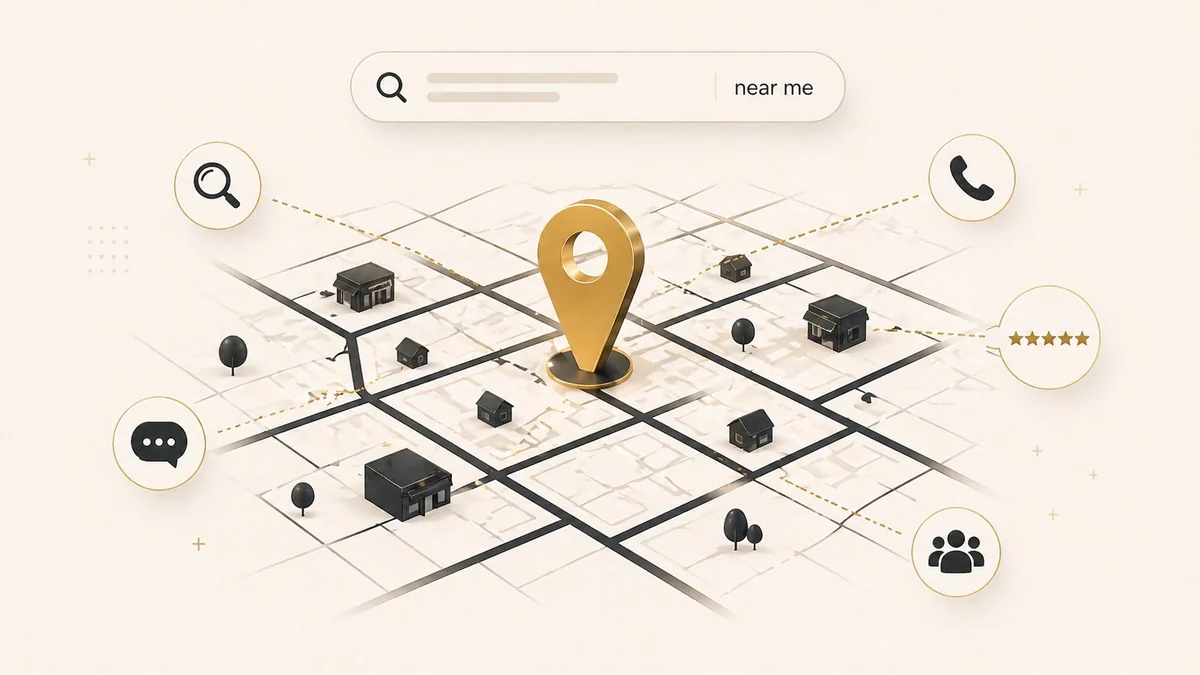
Local lead generation is the process of attracting customers within a specific geographic area to a service business that needs them — your HVAC company, your dental practice, your plumbing service, your law firm. The math is demanding in 2026: average cost per lead in home services hit $144 (B2C average), while published plumbing estimates range from $30 to $98 per lead and vary widely by market. Get the channel mix or follow-up process wrong and paid inquiries can fail to become booked work.
This guide walks the 7 channels that actually drive local leads in 2026 (with current cost-per-lead and conversion benchmarks for each), the 5 mistakes that drain SMB marketing budgets, and a stage-based plan that tells you whether you should be optimizing your Google Business Profile or your paid search bids based on where your business sits today. Written for local service business owners and the marketers who help them, not for agency-pitch consumption.
Direct answer – What is local lead generation and which channels work in 2026?
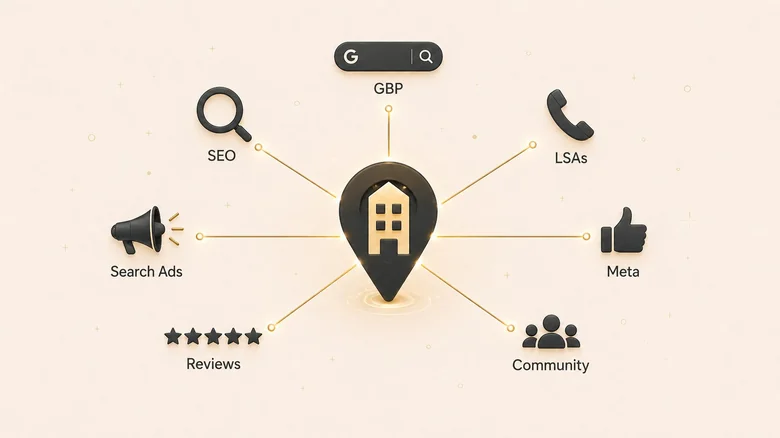
Local lead generation is the process of attracting customers within a specific geographic area and converting their interest into qualified inquiries for a local service business. Seven channels drive it in 2026: Google Business Profile, local SEO, Google Local Services Ads, Google Search Ads, Meta Ads, referrals and reviews, and community marketing. Each has different cost-per-lead economics, from free (Google Business Profile) to $149+ on non-branded search. The right mix depends on your revenue stage and average ticket size.
Key Takeaways
- The 7 channels that drive local leads in 2026: Google Business Profile, Local SEO, Google Local Services Ads (LSAs), Google Search Ads, Meta Ads, Referrals & Reviews, and Local Community Marketing. Each has very different CPL economics.
- 2026 CPL benchmarks: home services blended CPL averages $90-$144; HVAC non-branded search CPL is $149; plumbing $167; LSAs run $50-$60; branded search $34. Match your channel mix to your average ticket size.
- Response speed is an operating lever, but there is no single verified uplift that applies to every home-service category. Set a response target and measure booked-job conversion by response-time band.
- Stage-based strategy: Pre-revenue local business should focus on Google Business Profile + reviews + Meta Ads. Established businesses ($500K-$2M annual) layer in LSAs + Google Search Ads. Mature businesses ($2M+) add SEO + community + referral programs as compounding moats.
- The 5 local lead generation mistakes: chasing keyword volume instead of intent, no review-generation system, slow lead response time, generic landing pages instead of service-specific ones, and tracking CPL without tracking cost per booked job.
- For most local service businesses, $500-$2,000 per month on combined channels is the entry budget. Service-line segmentation (separate campaigns per service) cuts CPL by 15-25%.
The 7 Local Lead Generation Channels at a Glance
| Channel | Cost / CPL (2026) | Key benchmark | Best for |
|---|---|---|---|
| Google Business Profile | Free to set up | 20-50 leads/month; 40% lower cost per sale than paid ads in top-3 Map Pack | Every local business — the single biggest lever |
| Local SEO (beyond GBP) | Under $40 CPL once ranking | Takes 3-6 months; lowest-CPL channel once it kicks in | Mature businesses building a compounding moat |
| Google Local Services Ads (LSAs) | $50-$60 per call | 55% close rate; ~$110 cost per booked job; pay-per-lead | LSA-eligible categories (HVAC, plumbing, electrical, more) |
| Google Search Ads (non-LSA) | Branded $34; non-branded $149; PMax $72 | Service-line segmentation cuts CPL 15-25% | High-intent emergency and big-ticket keywords |
| Meta Ads (Facebook / Instagram) | ~$36 per lead on offers | 5.22% avg home-services conversion rate; ~$120 cost per sale | Lower-ticket offers and service-radius awareness |
| Referrals & Reviews | $50-$100 incentive only | 15-20 new customers/month; 4.5+ stars get 2-3x higher Map CTR | Highest-ROI investment under $5M revenue |
| Local Community Marketing | ~$75 cost per sale (time-valued) | 12-15 leads/month; 60% close rate from local groups | Established businesses earning neighborhood trust |
What Is Local Lead Generation?
Local lead generation is the process of attracting potential customers within a specific geographic area (typically a city, metro, or service radius) and converting their interest into qualified inquiries for a local service business. The geographic constraint is the defining feature: a plumber in Austin doesn’t care about leads in Dallas, and the marketing channels that work locally are different from the ones that work nationally.
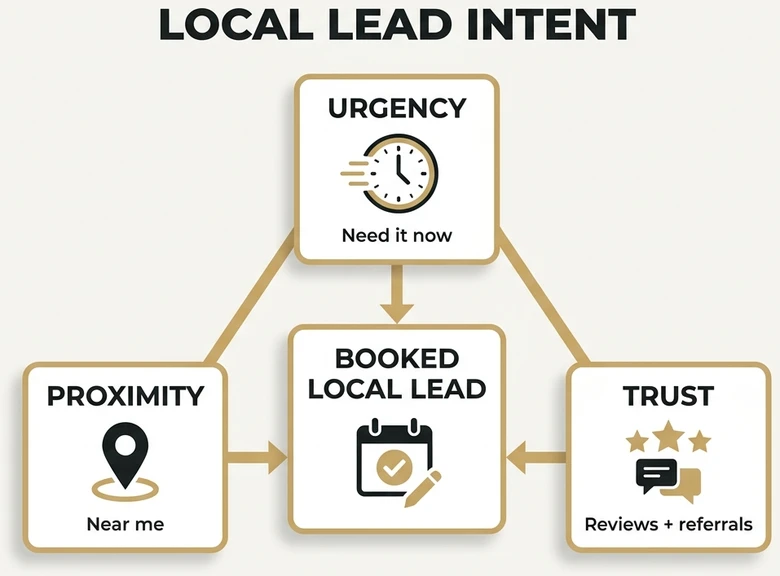
Local lead generation is a subset of general lead generation, but with a sharper focus on intent (people searching “plumber near me” are ready to buy now), urgency (most local service inquiries are time-sensitive), and proximity (the business has to physically serve the location). For the broader strategic context, see our inbound lead generation guide and demand gen vs lead gen comparison, which cover the wider lead-acquisition framework local lead gen sits inside.
How Local Lead Gen Differs From National Lead Gen
Three structural differences shape every channel decision. First, search intent is hyper-immediate: someone Googling “emergency AC repair” wants service today, not next quarter. Second, channel options narrow: LinkedIn ads, content syndication, and most B2B channels don’t apply. Third, trust signals are local: reviews, neighborhood reputation, and word-of-mouth weigh more than brand recognition. A national B2B SaaS with 10,000 LinkedIn followers means nothing if the homeowner can’t find you on Google Maps.
The 7 Channels That Drive Local Leads in 2026
Below are the 7 channels with the strongest CPL economics for local service businesses in 2026, organized roughly by the order most businesses should adopt them. Each section includes the cost benchmark, the conversion benchmark where one exists, and the gotcha most operators trip on.
1. Google Business Profile (GBP)
Free to set up, single biggest lever for most local businesses. Companies ranking in the top 3 Google Map Pack results average 40% lower cost per sale than paid ads, per HVAC contractor benchmarks. A properly optimized GBP generates 20-50 leads monthly for established contractors.
The non-negotiables: complete every profile field, maintain consistent NAP (name, address, phone) across the web, post weekly updates, respond to every review within 24 hours, and add 10+ photos updated quarterly. The gotcha: most local businesses set up GBP once in 2019 and never touched it. Stale profiles lose Map Pack ranking to competitors who post weekly.
2. Local SEO (Beyond GBP)
Local SEO covers everything that helps you rank in the regular organic results for “[service] near me” or “[service] in [city]” queries. The mechanics are the same as general SEO but with three local-specific layers: location pages for each service area, schema markup for LocalBusiness, and citation building (NAP consistency across Yelp, Yellow Pages, BBB, industry directories). Each of those layers is where a dedicated tool earns its place, and we line up the tools that handle citations, rank tracking, and reviews against the white-label programs agencies use to run them at scale.
SEO takes 3-6 months to show results, but once it kicks in, it’s the lowest-CPL channel available. Established local businesses with strong organic rankings often see CPL under $40, compared to $150+ on paid search. The foundational moves are the same as the ones our B2B SEO strategy piece walks through — keyword intent mapping, on-page structure, internal linking — with local modifications layered on top.
3. Google Local Services Ads (LSAs)
LSAs are pay-per-lead ads that appear at the very top of search results with Google’s “Google Guaranteed” badge. Average cost per call: $50-60. Typical close rate: 55%. Cost per booked job: roughly $110, predictable and profitable. You only pay when someone actually contacts you, and Google pre-screens the leads.
LSAs require Google Guaranteed verification (background checks, license verification, insurance proof) which takes 2-4 weeks. The category eligibility is limited: HVAC, plumbing, electrical, locksmiths, garage doors, roofing, pest control, lawn care, house cleaning, and a growing list of professional services (lawyers, real estate, financial advisors). If your category is eligible, LSAs almost always belong in your top-3 channel mix.
4. Google Search Ads (Non-LSA)
Standard Google Ads remain essential for high-intent emergency keywords and big-ticket installations. Per SearchLight’s January 2026 dataset of $14.9M in HVAC and plumbing ad spend across 816 contractors: branded search CPL averages $34, non-branded search CPL averages $149, Performance Max CPL averages $72. Service-line segmentation (separate campaigns for “heating repair,” “AC install,” “plumbing repair” instead of one generic “HVAC” campaign) reduces CPL by 15-25%. Those CPL splits stay defensible only when the service-line campaigns each carry a clean UTM tag that passes pre-launch review; otherwise the reported CPL by service drifts because GA4 attributes some clicks to the wrong service-line bucket.
The gotcha: most contractors don’t run branded campaigns because they assume they’ll get those clicks organically. Allocating even 5-10% of budget to branded search at $34 CPL brings down blended CPL significantly while defending your brand from competitors bidding on it.
5. Meta Ads (Facebook and Instagram)
Meta Ads work best for local lead gen as either (a) lower-ticket service offers (“$49 AC tune-up” campaigns generate leads at $36 each with 30% close rates, ~$120 cost per sale, with many tune-ups upsold to $2,400+ repair jobs) or (b) brand awareness in your service radius. They underperform Google for emergency-intent search but outperform on cost when the offer is right.
Average Facebook Ads conversion rate for home services: 5.22%. The format that wins is local Lead Form ads (similar to LinkedIn Lead Gen Forms — pre-filled, in-platform). The gotcha: Meta’s targeting precision has degraded since iOS 14. Combine geo-targeting with detailed life-event or interest layers to avoid spending on clicks from outside your service radius.
6. Referrals and Reviews
The cheapest channel and the one most local businesses underuse. A Denver HVAC contractor offers $100 account credit for successful referrals; their program generates 15-20 new customers monthly at zero acquisition cost beyond the credit. The structure: train techs to ask for referrals during routine maintenance (when customers are happiest), offer a meaningful incentive ($50-100 typical), and make redemption frictionless (text-message link, no app download).
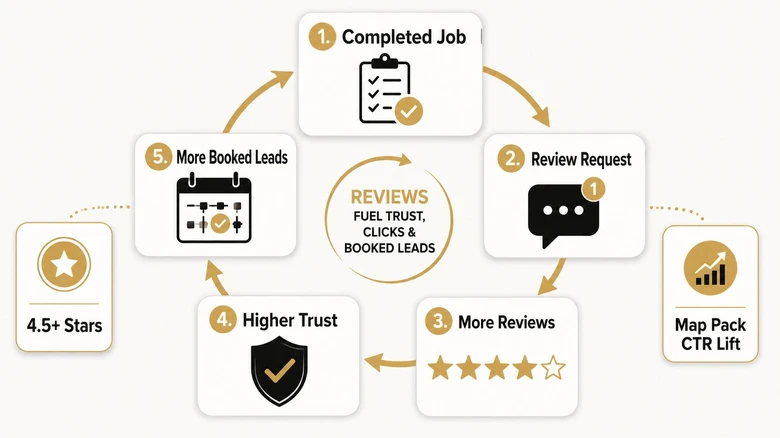
Reviews are the trust amplifier on every other channel. The math: businesses with 4.5+ star ratings see Google Maps click-through rates 2-3x higher than businesses at 4.0 stars. Active review generation (text follow-up after every job, 30-day automated nudge) is the single highest-ROI marketing investment for any local service business under $5M revenue.
7. Local Community Marketing
Most contractors think social media is for teenagers. Wrong. Homeowners aged 35-65 are extremely active in local Facebook groups, Nextdoor, and neighborhood community sites, and they trust neighbor recommendations over ads. A Phoenix HVAC contractor posts helpful HVAC tips in 8 local Facebook groups weekly: 2 hours/week, 12-15 monthly leads, 60% close rate, ~$75 cost per sale (counting time at $50/hour).
The rule: provide value first, sell second. Be the helpful neighbor, not the pushy salesperson. Sponsoring local Little League teams, donating to fundraisers, and showing up at chamber-of-commerce events still works in 2026 because the audience is small, the trust is earned, and competitors aren’t doing it.
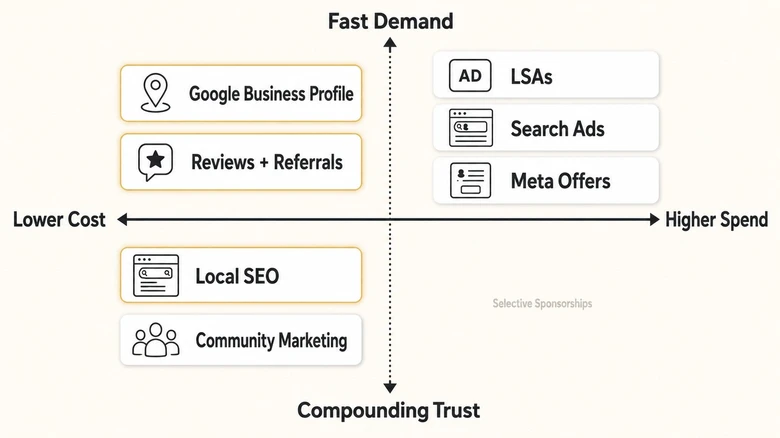
How to Choose Channels by Business Stage
The right channel mix depends on your stage. A pre-revenue local startup spending $1,500/month on Google Search Ads is throwing money away; a $3M HVAC company ignoring SEO is leaving 40% of its CPL efficiency on the table. The framework below has worked across hundreds of local service businesses. For non-local B2B teams making the equivalent vendor-mix decision at the agency level rather than the channel level, the 12 B2B lead generation companies ranked across DFY, AI SDR, and specialty categories cover the parallel comparison.
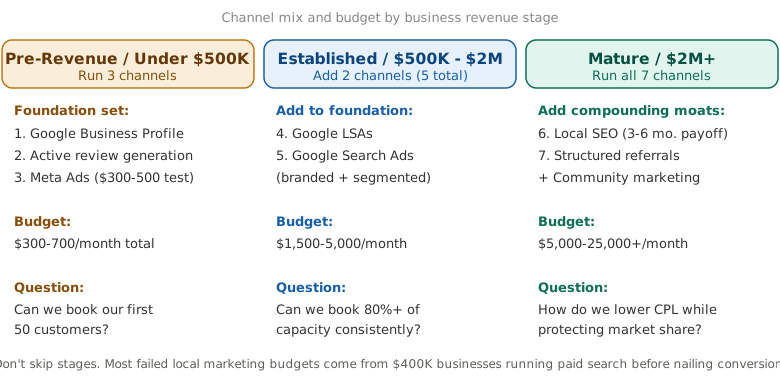
Stage-Based Channel Prioritization
- Pre-revenue / Under $500K annual revenue (start with 3 channels): Google Business Profile (free), active review generation (free, just systematic), Meta Ads with $300-500/month test budget. The question is “can we get our first 50 customers?” Don’t touch Google Search Ads yet — the CPL will eat your margin before you can dial in conversion.
- Established / $500K-$2M annual revenue (layer in 2 more): add Google Local Services Ads (LSAs) and Google Search Ads with branded + service-line-segmented campaigns. Total monthly marketing budget typically $1,500-$5,000. The question shifts to “can we book 80%+ of capacity?” Now CPL efficiency and channel diversification matter.
- Mature / $2M+ annual revenue (run all 7 channels): add Local SEO (3-6 month payoff but compounds for years), structured referral programs, and community marketing. Monthly marketing budget $5,000-$25,000+. The question becomes “how do we lower blended CPL while protecting market share?” Owned channels (SEO, reviews, community) become defensive moats.
PRO TIP
Don’t skip stages. Most failed local marketing budgets come from $400K-revenue businesses trying to run paid search at $150 CPL when their close rate isn’t dialed in yet. Master Google Business Profile and review generation first, get your speed-to-lead under 5 minutes, then layer in paid channels on a foundation that converts.
Local Lead Generation Cost Benchmarks (2026)
The numbers below come from LocaliQ’s 2025-2026 home services advertising benchmarks, SearchLight’s HVAC and plumbing dataset (January 2026), and WebFX’s 2026 home services marketing benchmarks. Use them as bands, not targets — your actual CPL depends on geography, season, competition, and conversion infrastructure.
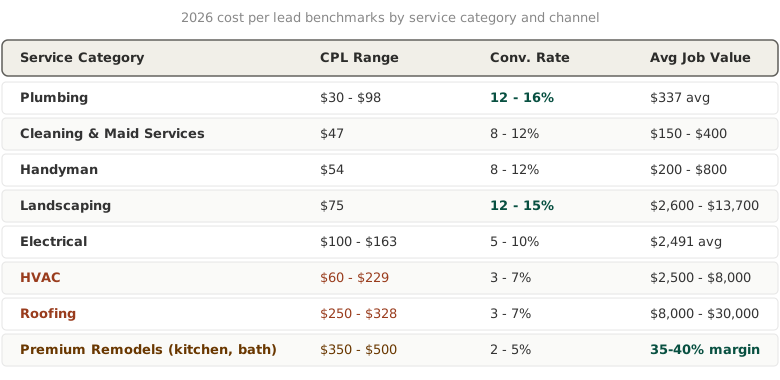
Industry-average CPL ranges (blended channels, 2026): Plumbing $30-$98, Pools & Spas $45, Cleaning & Maid Services $47, Handyman $54, Exterior Painting $45-$100, Electrical $100-$163, HVAC $60-$229, Landscaping $75, Roofing $250-$328. Premium services (kitchen, bath, roofing) run $350-500 CPL but deliver 35-40% margins. Geography matters: Colorado Springs plumbing CPL targets $103-$176 while Denver runs $176-$327, a 70%+ premium for the same service in a higher-cost-of-living metro.
Conversion rate estimates: Published ranges put plumbing around 12-16% and HVAC or roofing around 3-7%, but definitions and samples vary. Response speed should be measured against your own booked-job outcome. The widely cited 2007 Lead Response Management study examined web-generated leads and phone attempts across six companies; it was not a home-services benchmark and does not prove a universal 60-second uplift.
5 Local Lead Generation Mistakes That Drain Budget
Five mistakes show up in nearly every local marketing audit. Each is fixable in under a week, and fixing them typically cuts blended CPL by 30-50%.
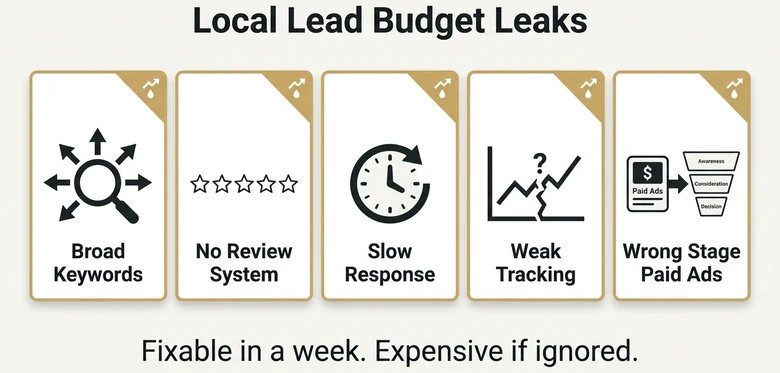
1. Chasing keyword volume instead of intent. “AC repair” has 10x the search volume of “emergency AC repair Phoenix,” but emergency-intent leads convert 4-5x better. The trap is bidding on broad service terms because the impression count looks good. Specific service-line keywords with location modifiers cost more per click but produce dramatically higher booked-job rates.
2. No systematic review generation. Reviews are the single biggest local SEO ranking factor and the single biggest trust signal on any landing page. Yet most local businesses leave it to chance. The fix is a 30-second post-job text message with a direct review link; even a 20% response rate produces meaningful weekly review velocity.
3. Slow or unmeasured lead response. Route urgent inquiries quickly, record the first genuine response, and compare booked-job rates across response-time bands. The commonly repeated “78% choose the first responder” and universal 50-70% loss claims do not have a traceable primary source suitable for a home-services benchmark.
4. Generic landing pages instead of service-specific ones. A landing page for “plumbing services” converts at 1-2%. A landing page for “emergency drain cleaning Austin” with a clear price range, photos of recent jobs, and a 60-second contact form converts at 8-12%. Generic pages don’t match search intent specifically enough to close the visitor.
5. Tracking CPL without tracking cost per booked job. A $40 lead that books at 20% costs $200 per booked job. A $120 lead that books at 60% costs $200 per booked job. Identical economics, but most operators only track the first number and pick the cheap-CPL channel that produces unbooked leads. B2B teams hit the same trap priced for B2B, where published cost-per-lead figures vary a hundredfold because some count form fills and others count sales-qualified leads. For the broader measurement framework, see our B2B marketing metrics guide.
IMPORTANT
The 2026 shift most local businesses haven’t adapted to: AI-generated answers in Google AI Overviews now consume a meaningful share of “near me” search impressions without sending clicks. Track AI Overview citations alongside organic clicks, and double down on Google Business Profile (which AI Overviews still cite heavily) as the channel most resistant to AIO traffic erosion.
Local Lead Generation Tools
The five tools below cover the local lead gen workflow from listing management through conversion tracking. The first two are free; the rest pay for themselves at $1,500+ monthly marketing spend. Local stacks stay lean — if you’re running B2B alongside local, the full lead generation tools roundup covers the six-category stack (database, email, LinkedIn, capture, engagement, AI) that scales beyond service-area work.
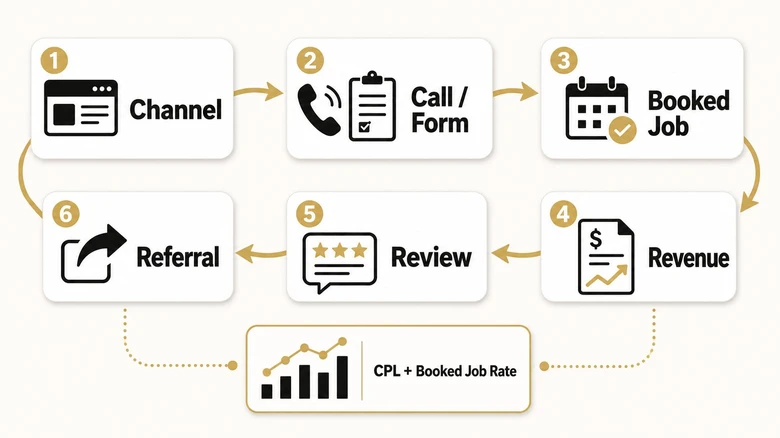
The broader acquisition strategy these tools support comes down to two questions: which channels match your service area’s buyer behavior, and how do you score the leads that come in so you spend follow-up time on the ones likely to book. Local lead gen rewards operators who answer both questions explicitly and revisit them quarterly. Thryv’s new platform is one attempt to join those decisions: its AI Lead Insights feature scores intent and traces campaigns to revenue while integrations pass leads into existing service-business workflows.
Frequently Asked Questions
Local lead generation is the process of attracting potential customers within a specific geographic area and converting their interest into qualified inquiries for a local service business. It typically targets customers searching “[service] near me” or “[service] in [city]” through channels like Google Business Profile, local SEO, Google Local Services Ads, Google Search Ads, Meta Ads, referrals, and community marketing.
Cost per lead varies dramatically by industry and channel. 2026 benchmarks: home services blended CPL averages $90-$144; HVAC non-branded search CPL is $149; plumbing $167; LSAs run $50-$60 per lead; branded search $34. Most local service businesses spend $500-$2,000 per month on combined channels. Premium services (roofing, kitchen remodels) run $350-$500 CPL but deliver higher per-job margins.
Start with the 3 free or low-cost channels first: optimize your Google Business Profile fully, set up systematic review generation (post-job text with review link), and run a $300-$500 monthly Meta Ads test with a service-specific offer. Once you book 80%+ of capacity from those channels, layer in Google Local Services Ads for predictable lead flow, then Google Search Ads with branded + service-line-segmented campaigns. SEO and community marketing come last because they take 3-6 months to compound.
For most local service businesses, the highest-ROI channel is a properly optimized Google Business Profile combined with active review generation. It’s free to set up, generates 20-50 leads monthly for established businesses, and ranks in the Map Pack with 40% lower cost per sale than paid ads. For paid channels, Google Local Services Ads typically deliver the best cost per booked job at $50-$60 per lead with 55% close rates, especially for HVAC, plumbing, electrical, and other LSA-eligible categories.
Not directly. ChatGPT and similar AI tools help draft local marketing copy, but they don’t generate leads themselves. Where AI is changing local lead generation in 2026: AI Overviews in Google search now consume a share of “near me” search impressions without sending clicks, which makes Google Business Profile (still cited heavily in AI Overviews) more strategically important than ever.
Your First Move
If you’re under $500K annual revenue, audit your Google Business Profile against the 10 fields in your profile dashboard, set up a post-job review-request text message, and budget $300-$500 for a 30-day Meta Ads test on your highest-margin service. Three actions, under $500, no agency required. The “no agency required” rule holds harder for local than for B2B SaaS, because GBP and LSAs reward owner-operated profiles, but if you’re considering it anyway, the broader outsource-vs-in-house calculus walks through the five scenarios where outsourcing wins and the five where it almost always fails.
If you’re $500K-$2M, your one move this week is service-line segmentation in your Google Search Ads account. Pull your current generic campaigns, build separate ad groups for each service (“emergency plumbing,” “drain cleaning,” “water heater repair”), and watch CPL drop 15-25% in 30 days. Same budget, more booked jobs.
If you’re $2M+, your one move is a structured referral program with $50-$100 incentives. The infrastructure is two text-message templates and a tracking spreadsheet. Most contractors at this stage already have the customer base; what they’re missing is the system that asks for the referral.
The measurement layer is what separates local operators who compound from the ones who churn through agencies year after year. Track cost per booked job — not cost per lead — by channel, review monthly, kill the worst channel every quarter and reallocate to the best. Two years of that discipline and your CPL benchmarks stop mattering because your channel mix is already self-selecting toward what works for your specific service area.