Thryv launched the Thryv Growth Platform on August 4, 2026, recasting its small-business software around online visibility, AI lead prioritization, marketing attribution, and optional expert support for local service companies.
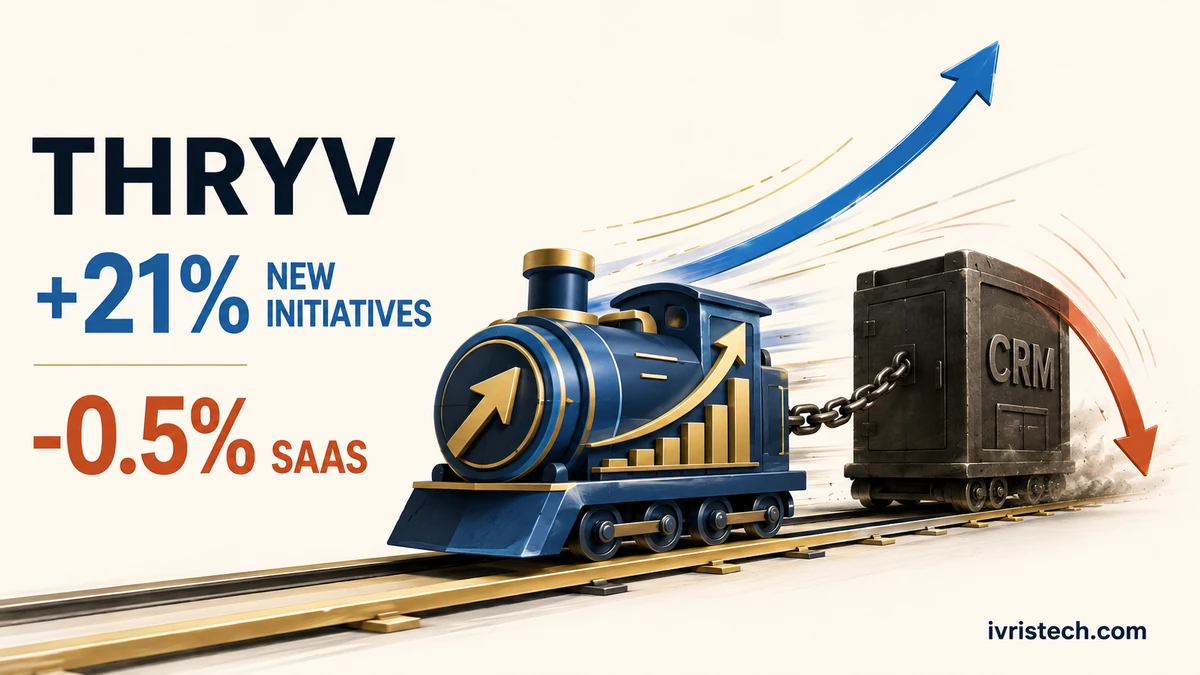
The same-day second-quarter results made the launch more consequential. SaaS revenue was $114.5 million, down 0.5% year over year. Thryv said its newer Market, Sell and Grow initiatives increased 21%, but that growth was offset by headwinds in legacy CRM products.
For B2B SaaS and martech teams, this is a product-mix test: can the new platform outrun contraction in the installed base, improve retention, and restore operating margins?
Direct answer – what does the Thryv Growth Platform launch mean for SaaS revenue?
Thryv launched an AI-native platform that connects local visibility, lead scoring, campaign attribution, and existing business systems. The business case is still unsettled: Market, Sell and Grow initiatives rose 21% year over year, but legacy CRM headwinds left total SaaS revenue down 0.5%. The proof point is whether adoption lifts 90% seasoned NRR and converts higher ARPU into revenue and margin growth.
Key Takeaways
- Thryv launched its redesigned AI-native Growth Platform for local service businesses on August 4, 2026.
- Q2 SaaS revenue was $114.5 million, down 0.5% year over year, even as Market, Sell and Grow initiatives increased 21%.
- Seasoned net revenue retention was 90%, while monthly SaaS ARPU rose 11.9% to $394 and the quarter ended with 95,000 SaaS clients.
- Thryv’s internal analysis of about 6,000 potential customers associated AI scoring with 40% more revenue per client and 1.5 times the lead conversion rate, but the evidence is company-generated.
- The restructuring plan carries $20 million to $25 million in charges and targets $55 million to $60 million in annualized savings.
What Thryv Actually Launched
The platform is organized around three jobs. “Get Found” combines listings, AI-powered websites, social posts, reputation tools, and a Digital Marketing Score. “Grow with Boosts” adds campaigns managed by Thryv experts. “Invest Smarter” uses AI Lead Insights to score intent, summarize conversations, recommend next actions, and connect marketing activity to recorded revenue.
Thryv is positioning the platform as an integration layer rather than a mandatory CRM replacement. The announcement names Jobber among the field-service systems that can receive AI-driven leads and says the platform works with existing CRMs. That puts it on the automation and growth side of the CRM and marketing automation boundary, even though Thryv also sells customer-management tools.
The commercial value is not simply another source of inquiries. It is the attempt to connect local lead-generation economics to lead quality, follow-up priority, and booked revenue inside one workflow. For a service business, that connection matters more than an AI label because a low-cost lead still destroys margin when it never becomes a job.
Why 21% Growth Still Produced Flat SaaS Revenue
Thryv’s 21% figure does not describe the full SaaS segment. It excludes Keap and covers Marketing Center plus additional marketing value-added services. Legacy CRM headwinds were large enough to leave total SaaS revenue 0.5% below the prior-year quarter. The release does not disclose the exact legacy decline or the migration rate.
The supporting metrics show the same tension. Seasoned NRR was 90%, so revenue from clients with at least two years of SaaS history was 10% below the comparable base under Thryv’s definition. Monthly ARPU still rose 11.9% to $394, and the quarter ended with 95,000 SaaS clients. This is why SaaS metrics have to be read as a system: rising ARPU can coexist with sub-100% NRR and flat revenue.
The pressure also reached profitability. SaaS Adjusted EBITDA fell 42% to $13.6 million, and margin declined from 20.3% to 11.8%. Thryv’s restructuring plan is expected to cost $20 million to $25 million. Savings should begin in 2027 and build to $55 million to $60 million annually after completion.
The Hidden Catch Is Retention, Not AI Branding
Our read: the launch will matter when it changes the cohort economics, not when it adds another AI feature list. A platform can generate strong growth in selected products while the consolidated SaaS line stays flat if older customers contract, leave, or fail to migrate at comparable value.
Thryv’s early product evidence is promising but narrow. Its internal analysis covered about 6,000 potential customers active from January 1 to April 22, 2026, comparing AI-scored with non-scored leads inside Thryv systems. It found 40% more revenue per client and 1.5 times the lead conversion rate. The analysis does not show feature adoption across the Q2 SaaS base or retention beyond the measured cohort.
The case also fits the pattern in our earlier reporting on the 2026 martech squeeze: established vendors are rebuilding around AI while carrying products designed for an earlier operating model. Thryv’s advantage is that it can sell the new platform into an existing base. Its risk is that legacy contraction can absorb that growth before the transition appears in headline revenue.
What B2B SaaS and Martech Teams Should Watch
- Migration: Track how many legacy CRM customers move to the Growth Platform, their post-migration spend, and client-count stability.
- Retention: Watch seasoned NRR. A move toward 100% would show expansion catching contraction in the existing base.
- Revenue quality: ARPU growth should lift total SaaS revenue and margin, not merely offset attrition.
- Product proof: Ask for adoption, control-group, cohort-retention, and attribution details behind AI Lead Insights.
- Cost execution: Separate product traction from restructuring benefits that are scheduled to start in 2027.
Thryv has scheduled a Growth Platform investor demo for August 6. The most useful disclosures will be migration, attach-rate, retention, and attribution measures, not another tour of the AI interface.
Frequently Asked Questions
The Thryv Growth Platform is an AI-native system for local service businesses. It combines online visibility tools, AI-powered websites and social content, expert-managed marketing options, lead-intent scoring, conversation summaries, recommended follow-up actions, campaign-to-revenue reporting, and integrations with CRM and field-service systems already used by customers.
The 21% figure applies to Market, Sell and Grow initiatives, excluding Keap, rather than the full SaaS segment. Thryv said headwinds in legacy CRM products offset that growth, leaving total Q2 SaaS revenue at $114.5 million, down 0.5% year over year. The company did not disclose the exact legacy decline.
Seasoned net revenue retention was 90% in Q2 2026, excluding Keap clients. Monthly SaaS average revenue per unit was $394, up 11.9% year over year. Read together, those figures show higher revenue per active unit alongside contraction in the seasoned customer base, which helps explain the flat headline SaaS result.
Watch the migration rate from legacy CRM products, seasoned NRR, SaaS client count, ARPU, total SaaS revenue, and segment margin. Product-level AI claims become more persuasive when Thryv reports adoption and retention by cohort and shows that higher-value platform use is no longer being absorbed by contraction in older products.