
Thomson Reuters published the first benchmark results for Thomson on July 31, 2026. The proprietary large language model starts from an open-source foundation, then uses mid-training and post-training on content from Westlaw, Practical Law, Checkpoint, and Reuters. Its first deployment is scheduled for August as the default model behind Tabular Analysis in CoCounsel Legal.
The benchmark table is strong but not a clean sweep. Thomson-1-Large led three of seven rows: PrBench Legal Hard, instruction following, and long context. Gemini 3.1 Pro led Stanford LegalBench and reasoning, while Claude Opus 4.8 led the Harvey Legal Agent Benchmark and coding. The models used different inference settings, and Thomson Reuters designed and scored a separate 53-query legal-research test.
The bigger B2B story is not whether one model won a leaderboard. Reuters reported on August 5 that Thomson Reuters sees legal, tax, accounting, audit, sovereign-AI, and possible news applications for the model. Our read: Thomson is a useful test of the vertical-AI moat, but buyers should demand workflow evidence before treating proprietary data and benchmark scores as proof of production value.
Direct answer: What is the Thomson Reuters Thomson LLM?
Thomson is Thomson Reuters’ proprietary model for professional work, built on an open-source foundation and trained further with the company’s legal, tax, and news content. Company-run benchmarks show competitive performance against leading general models, but not across every test. B2B buyers should evaluate the model’s data rights, benchmark design, workflow accuracy, accepted-output cost, privacy controls, and fallback options before relying on the headline results.
Key Takeaways
- Thomson Reuters announced Thomson’s first public benchmark results on July 31, 2026.
- Thomson led three of seven rows in the published comparison, not every legal or general benchmark.
- The 53-query research test used internal questions, proprietary Thomson Reuters sources, and LLM-as-judge scoring calibrated against expert review.
- Tabular Analysis in CoCounsel Legal is scheduled to become Thomson’s first production deployment in August.
- The buyer decision should turn on accepted workflow outcomes, evidence traceability, cost, controls, and fallback design.
What Thomson Reuters Actually Built
Thomson begins with an open-source base, then adds domain training using Thomson Reuters content and feedback from hundreds of subject-matter experts. The company says customer data is not used for training and that less than 10% of its content has been used so far.
Thomson also sits inside a broader multi-model strategy. CTO Joel Hron described the model as portable across open-source foundations and said Thomson Reuters would continue working with frontier-model providers. Ownership can improve routing flexibility without locking the application to one foundation.
What the Benchmark Results Do and Do Not Prove
The published table supports a narrow conclusion: Thomson is competitive on the selected tests. It does not establish that Thomson is the best model for every professional workflow. The table mixes public and internal benchmarks, and the models were not run with identical reasoning settings.
The 53-query research comparison has another important boundary. Thomson used Westlaw and Practical Law through an in-house agentic harness, while competing models searched the public web through Brave. Completeness and factuality were scored with LLM judges calibrated against subject-matter-expert scoring. That setup tests the value of Thomson Reuters’ full data-and-tool system, not the isolated model alone.
This is still useful disclosure. It names the tests, reports scores, identifies several settings, and explains the internal evaluation. In our earlier reporting, we argued that proof-led positioning only works when buyers can separate a checkable claim from its limits. Independent replication, customer outcomes, error rates, latency, and operating cost remain undisclosed.
Why the Vertical-Model Strategy Matters Beyond Legal
Thomson brings four assets into one stack: licensed content, expert evaluation, workflow distribution, and model control. That combination is harder to copy than a model endpoint alone. Reuters reported that generative-AI products supported about 32% of Thomson Reuters’ underlying contract value in the second quarter, up from 30% in the first, so the model is tied to an existing commercial distribution engine rather than a standalone research project.
Ownership can also change procurement leverage. Thomson Reuters says its model can improve speed, scalability, and cost, while its multi-model architecture preserves optionality. That extends the AI vendor-concentration question: buyers should know whether an application depends on one model provider, can route across providers, or owns a domain model that can move between foundations.
What B2B Buyers Should Test Before Trusting a Vertical LLM
Match the evaluation to the workflow. Build a blinded test set from real documents and decisions. Score factual accuracy, citation support, completeness, format compliance, latency, and escalation rate. A public legal benchmark cannot substitute for the failure modes in your contract review, tax, audit, or research process.
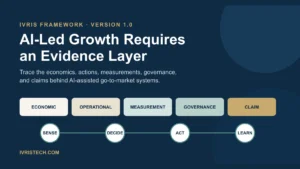
Trace the evidence chain. Ask which sources the system can access, whether rights cover AI use, how citations are verified, and whether customer data enters training or retention. An evidence layer should connect each claim to its source, measurement, owner, and correction path, not merely record that a model produced an answer.
Measure cost per accepted outcome. Model size and operating cost were not disclosed in the announcement. Track inference, retrieval, tool calls, retries, human review, and rejected outputs. Benchmark cost and accepted-task cost answer different questions, even when a vendor reports a strong capability-to-cost result.
Test control and exit paths. Require version notices, rollback terms, data-location details, service levels, incident response, and a fallback model. Verify whether the vendor can switch foundations without changing the application contract, and whether your team can export prompts, evaluations, and audit records if the model changes.
Frequently Asked Questions
Thomson is a proprietary large language model for professional work. Thomson Reuters says it starts from an open-source foundation and is further trained with content from Westlaw, Practical Law, Checkpoint, and Reuters, plus evaluation by subject-matter experts. Customer data is not used to train the model.
Not across every published test. Thomson led PrBench Legal Hard, instruction following, and long context. Gemini 3.1 Pro led Stanford LegalBench and reasoning, while Claude Opus 4.8 led the Harvey Legal Agent Benchmark and coding. The results are company-run and used different inference settings.
Thomson Reuters says the first integration will launch in August 2026, when Thomson becomes the default model for Tabular Analysis in CoCounsel Legal. The company plans broader legal and tax integrations over the following year. Accounting, audit, sovereign-AI, and news applications were discussed, but no deployment dates were provided.
Request workflow-specific evaluation results, source and data-rights documentation, customer-data rules, citation verification, error and escalation rates, latency, cost per accepted outcome, model-version controls, and fallback options. The strongest proof is a representative production test with agreed acceptance thresholds, not a broad benchmark or vendor claim alone.