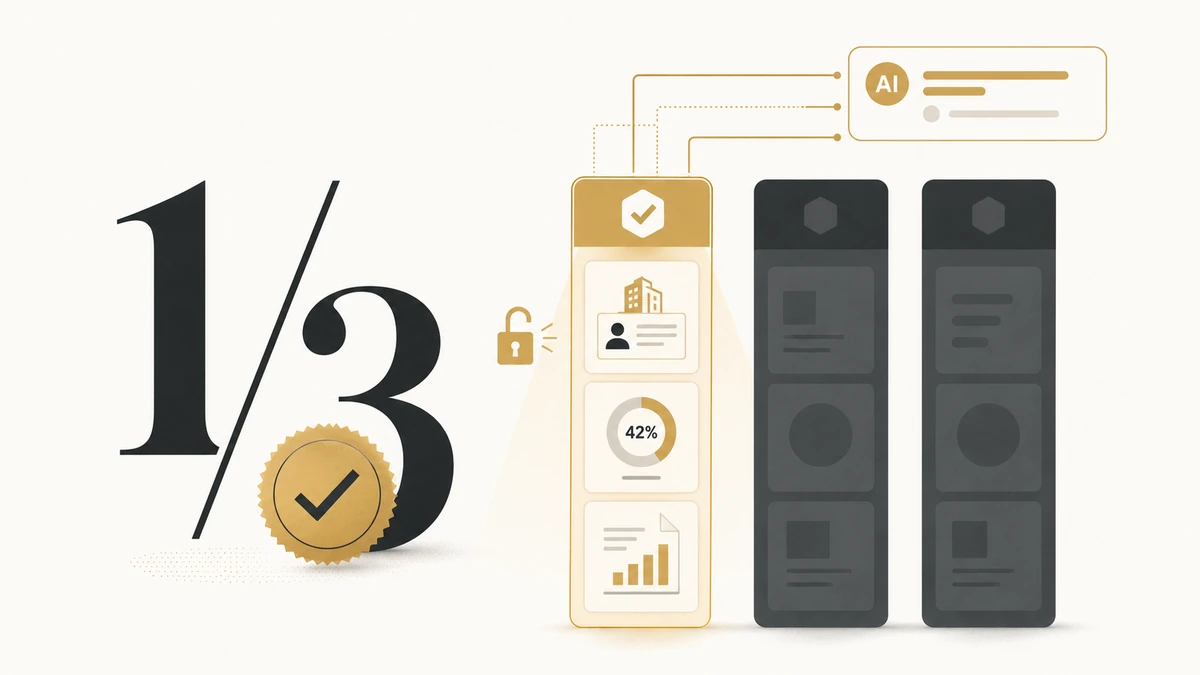
5W Public Relations released The AI Company Comms Study 2026 on May 28, the first structured benchmark of how the 15 leading AI companies communicate implementation, adoption, and proof to enterprise buyers. Its quietest finding is the one B2B marketers should sit with: only about a third of those companies regularly disclose concrete user numbers, revenue, or named customers. The rest run on adjectives.
The third that do disclose are the names you would expect to lead. OpenAI is deployed at 92% of the Fortune 500. Anthropic discloses 8 of the Fortune 10 as customers. Microsoft Copilot has crossed 15 million paid seats inside a 400-million-plus Microsoft 365 base. 5W founder Ronn Torossian framed the gap bluntly: the AI industry is “the most-hyped and least-benchmarked” sector in tech. The study ranks OpenAI, Anthropic, Microsoft, Google DeepMind, and Perplexity as the most transparent; Midjourney, xAI, Meta AI, Stability AI, and Character AI as the most opaque despite real scale.
Our read: the study is about AI vendors, but the lesson is general B2B. Buyers and AI answer engines now reward the same thing, and it is not better adjectives. It is verifiable proof: named customers, deployment percentages, methodology-backed numbers. Proof-led positioning has quietly become the default for the companies winning recognition, and the comms study is the cleanest evidence yet that disclosure and category leadership travel together.
Key Takeaways
- 5WPR’s AI Company Comms Study 2026 (released May 28) benchmarked 15 leading AI firms on implementation messaging, adoption disclosure, and founder voice. Only ~1 in 3 regularly disclose concrete user, revenue, or customer numbers.
- The disclosers are the recognized leaders: OpenAI (92% of the Fortune 500), Anthropic (8 of the Fortune 10), Microsoft Copilot (15M+ paid seats).
- Most transparent: OpenAI, Anthropic, Microsoft, Google DeepMind, Perplexity. Most opaque despite scale: Midjourney, xAI, Meta AI, Stability AI, Character AI.
- The B2B lesson is not AI-specific: buyers and AI answer engines both reward verifiable proof over claims, which makes proof-led positioning the new default.
- Founder Ronn Torossian called AI “the most-hyped and least-benchmarked” sector in tech — the same hype-over-proof gap most B2B categories still run on.
What the Study Measured
5W scored 15 companies (OpenAI, Anthropic, xAI, Google DeepMind, Microsoft AI, Meta AI, Perplexity, Mistral, Cohere, Character AI, Stability AI, Runway, Midjourney, Inflection AI, and Hugging Face) on three dimensions: implementation messaging, usage and adoption disclosure, and founder voice posture. The disclosure dimension is the one with a clean B2B read. A company either puts numbers on the table (seats, revenue, named logos) or it does not.
The split is stark. Roughly five of the 15 disclose concrete metrics with any regularity. The strongest enterprise rosters belong to Anthropic, OpenAI, Microsoft, Google DeepMind, and Cohere, and those are largely the same firms that disclose. The companies sitting on real scale but withholding the proof (Midjourney, xAI, Meta AI, Stability AI, Character AI) score as opaque, and the study’s framing is that opacity reads as weakness even when the underlying numbers are strong.
This is a vendor-comms study, so the natural instinct is to file it under PR. That undersells it. The same instinct to publish hard numbers showed up earlier this month when OpenAI published its own B2B Signals usage benchmark rather than wait for an analyst to characterize its adoption. Disclosure is a positioning choice, and the leaders are making it on purpose.
Why Proof-Led Positioning Wins Now
Two shifts make disclosure more valuable than it was even a year ago. The first is buyer behavior. When we covered the finding that 73% of B2B buyers now use AI tools during purchase research, the underrated detail was that brand mentions correlate with AI citation roughly three times more strongly than backlinks. What earns those mentions is verifiable, repeatable claims, not marketing copy. Named customers and deployment numbers travel through the open web and into AI answers; “industry-leading” does not.
The second shift is the validation step. Gartner’s May survey found 69% of B2B buyers still escalate AI-generated insights to a human rep to verify them, because more than half had encountered misleading AI output. Proof is what survives that verification. A buyer cross-checking an AI summary against your site rewards the page with the named case study and the deployment figure, and discounts the one with three paragraphs of positioning language. Proof-led content is the content that holds up at the moment of doubt.
Put the two together and the picture is consistent. G2’s Answer Economy data showed AI chatbots now build 54% of B2B software shortlists, with review citations as the top trust signal that makes a chatbot confident enough to recommend a vendor. The AI leaders disclosing Fortune 500 penetration are not being generous. They are feeding the exact signal that gets a brand named in an answer and trusted on validation. Every B2B category is converging on the same mechanic, just earlier in AI’s curve than most teams have noticed.
The Catch: Proof Is Not the Same as Disclosure Theater
Two honest limits. First, disclosure has real costs. Private companies have competitive and legal reasons to withhold revenue and customer names, and a startup without a Fortune 500 logo cannot manufacture one for a press release. The study rewards disclosure, but disclosure is easier at scale, and reading “be more transparent” as “publish numbers you do not have” is the wrong lesson.
Second, proof and vanity metrics are not the same. “Trusted by thousands of teams” is a claim, not proof. A named customer with a verifiable outcome, a deployment percentage a buyer can sanity-check, or a benchmark with a stated methodology is proof. The opaque-despite-scale group in the study often does publish numbers, just not the ones that withstand scrutiny. Buyers and AI engines both discount the difference, so the move is not “disclose more” in the abstract. It is “disclose the specific, checkable claims a skeptic could verify.” Thomson Reuters’ release makes that distinction concrete: a buyer-level read of the Thomson LLM benchmarks separates disclosed scores from evaluation settings, proprietary-data access, and production evidence. The 72% AI brand-misrepresentation warning shows the cost of leaving those claims inconsistent: a visible brand can still be summarized with stale positioning.
There is also a ceiling worth naming. Disclosure earns recognition; it does not by itself close deals. The 5W study measures comms posture, not pipeline. Treat proof-led positioning as the entry ticket to the AI-influenced shortlist, not as a substitute for the rest of the buying experience. INFUSE’s Voice of the Buyer 2026 trust-gap data sharpens that ceiling: proof has to help buyers decide, not only help AI engines name the vendor.
What B2B Teams Should Do Now
Four moves, in order.
Inventory the proof you already have but do not publish. Most B2B companies sit on named-customer outcomes, retention numbers, and usage data that never make it past a sales deck. Pull that inventory first. The gap between the leaders and everyone else in the 5W study is rarely the existence of proof; it is the decision to put it on a public page.
Lead pages with the checkable claim, not the adjective. Replace “industry-leading platform” with the specific figure: the deployment percentage, the named logo, the benchmark result with its methodology. The same discipline that earns a Google “Highly Cited” reputation also earns the AI-answer mention, because both reward original, verifiable claims over restated positioning.
Structure proof for extraction. Put numbers in clean sentences, name the customer and the metric, and date the figure. An AI engine lifting your proof into an answer needs it in a form it can quote. Buried in a PDF case study, the same proof never surfaces. The leaders disclose in formats that travel.
Feed the surfaces that feed the chatbot. Reviews, analyst mentions, and third-party citations are where AI engines source their confidence. Forrester’s argument that buyer trust is the scarce resource points the same way: the proof on your own site matters, but the proof other credible sources repeat about you matters more. Pitch the verifiable numbers outward, not just onto the homepage. 5W’s finance software AI Visibility Index turns that outreach into a measurable citation-share play, showing how review platforms and comparison pages shape which vendors AI systems name.
Frequently Asked Questions
It is a benchmark released by 5W Public Relations on May 28, 2026, scoring the 15 leading AI companies on how they communicate implementation, adoption, and proof to enterprise buyers, developers, and regulators. The study measures implementation messaging, usage and adoption disclosure, and founder voice posture, and finds that only about a third of the 15 regularly disclose concrete user, revenue, or customer numbers.
Proof-led positioning is a B2B approach that leads with verifiable, checkable claims (named customers, deployment percentages, methodology-backed benchmarks) instead of adjective-heavy positioning language. It matters in 2026 because both AI buyers and AI answer engines reward specific, repeatable proof over generic claims, and because buyers increasingly cross-check vendor pages against AI summaries.
The 5W study ranks OpenAI, Anthropic, Microsoft, Google DeepMind, and Perplexity as both the most transparent and among the strongest on enterprise adoption. Disclosure and leadership travel together because verifiable proof (Fortune 500 penetration, named logos, seat counts) is the signal that earns AI-answer mentions and survives buyer validation, which compounds into recognition over time.
Disclose the proof you do have. A verifiable retention number, a dated benchmark with a stated methodology, or a named mid-market customer with a concrete outcome all qualify as proof. The goal is checkable specificity, not a Fortune 500 logo. Structure those claims for extraction and reinforce them through reviews and third-party citations the AI engines already trust.