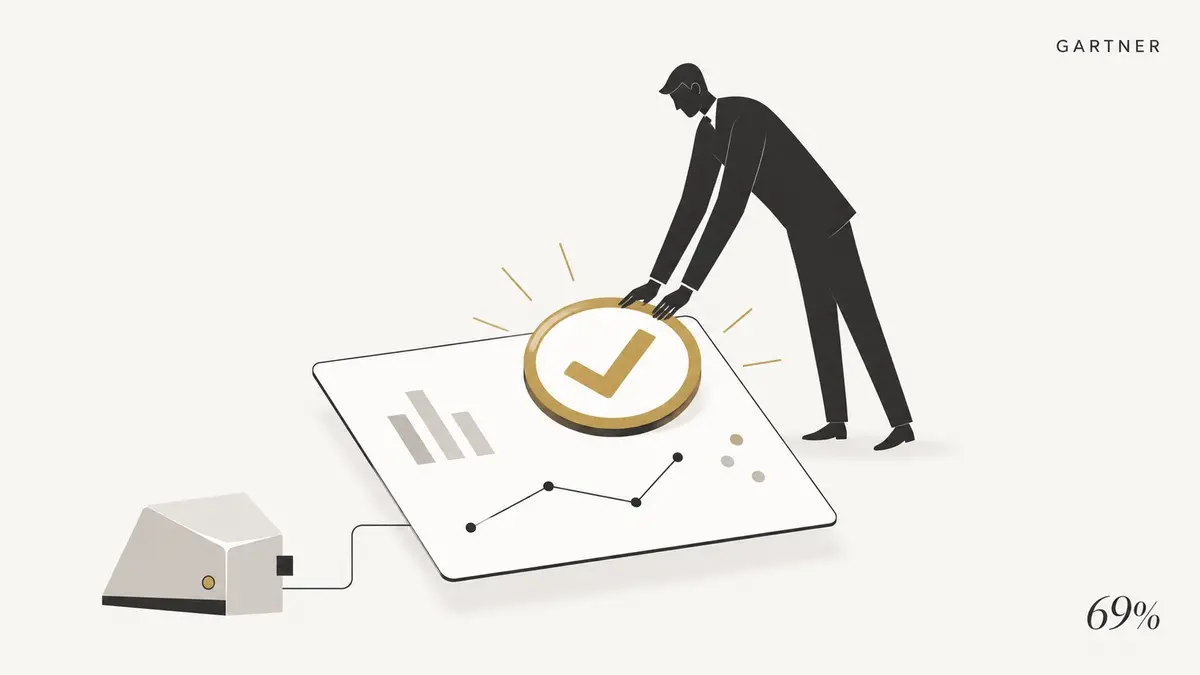
Gartner published a survey on May 20, 2026 finding that 69% of B2B buyers turn to sales representatives to validate AI-generated insights before acting on them. The data comes from a survey of 645 B2B buyers conducted August through September 2025, presented this week at the Gartner CSO and Sales Leader Conference in Las Vegas. The same dataset also found that B2B buyers now use an average of seven information sources during a purchase decision and that 45% use generative AI primarily to gather vendor and product information.
The number that gives this survey its weight is not the 69%. It is what the 69% sits next to in Gartner’s own prediction stack. In November 2025, Gartner forecast that by 2028, 90% of B2B buying would be AI-agent intermediated, with more than $15 trillion of B2B spend flowing through agent-to-agent exchanges. Six months later, the same research firm is reporting that more than two-thirds of buyers still want a human in the loop to verify what AI told them. Both data points are from Gartner. Both are presented as forward-looking guidance. They do not point in the same direction.
For B2B marketing and sales-enablement teams, this is the survey that should pause any content strategy currently being rebuilt around the assumption that agents will handle the buying decision. The agents will handle the research. The validation step is moving back to humans, not away from them, and the operational implications for sales-enablement content, rep training, and marketing-to-sales handoff have just changed.
Key Takeaways
- Gartner’s May 20, 2026 survey of 645 B2B buyers finds 69% turn to sales reps to validate AI-generated insights before acting on them.
- The same study reports B2B buyers use seven information sources per purchase and that 45% use generative AI primarily to gather vendor and product information.
- The 69% stat sits in direct tension with Gartner’s November 2025 prediction that 90% of B2B buying would be AI-agent intermediated by 2028, channeling $15 trillion in B2B spend through agent exchanges.
- More than half of B2B buyers in the survey report receiving misleading information from AI tools during research, which is the operational reason validation is moving back to humans.
- Gartner also predicts that by 2027, 95% of seller research workflows will begin with AI, meaning the sales-side enablement gap is now a question of where AI ends and humans begin, not whether to adopt.
What Gartner’s New Survey Actually Says
The survey was fielded August through September 2025 and presented Wednesday at the Gartner CSO and Sales Leader Conference. The 645-buyer sample is mid-sized for Gartner research and skews toward enterprise B2B buyer roles across software, manufacturing, financial services, and professional services. The 69% headline is the share of buyers who reported turning to sales representatives to validate AI-generated insights during a recent purchase, which Gartner positions as evidence that human reps remain the trust anchor in the buying process even as AI tools take over the research layer.
Two supporting numbers carry the operational weight. First, the seven-information-sources-per-purchase figure documents that B2B buying has become a multi-channel research exercise where no single source carries the decision. AI is one of seven, not the whole funnel. Second, the 45% who use generative AI specifically to gather vendor and product information is the share of buyers actively running AI-driven vendor research. That figure aligns directionally with earlier reporting showing 73% of B2B buyers using AI somewhere in their evaluation process by early 2026, with the gap reflecting the difference between “use AI at any point” and “use AI specifically for vendor research.”
The misleading-information data point is the one most B2B marketers should write down. More than half of buyers in the survey reported encountering misleading AI-generated information during their research. That is the mechanical reason the validation step is moving back to humans. Buyers do not trust the AI to be reliably accurate, so they use AI to compress the research phase and then escalate to a rep for verification. The funnel is not collapsing. It is restructuring with AI at the top and humans at the bottom of the final decision.
Why the $15T Forecast and the 69% Survey Live in Direct Tension
The November 2025 Forecast: 90% Agent-Intermediated by 2028
Gartner’s November 18, 2025 press release predicted that by 2028, 90% of B2B buying would be AI-agent intermediated and that more than $15 trillion of B2B spend would flow through agent-to-agent exchanges. The framing was unambiguous: machine customers, autonomous negotiations, partner programs becoming obsolete as agent-to-agent exchanges take over. That forecast has been the anchor citation for every “agentic commerce is coming” deck circulating in B2B marketing strategy meetings for the last six months.
The May 2026 Reality Check: Buyers Still Want Humans
The May 20 survey does not retract the $15T forecast. It does, however, sit in operational tension with it. If 69% of buyers in 2026 are escalating to humans to validate what AI told them, the bridge from today’s behavior to a 90%-agent-intermediated 2028 has to either (a) involve a sharp jump in AI trust, (b) involve a sharp drop in misleading AI output, or (c) involve agents handling decisions where the buyer simply skips the validation step Gartner is now measuring. None of those three transitions is documented in the survey, and none is forecast in the November release. The two data points coexist; the path between them is not specified.
Our read: the $15T forecast is Gartner’s view of where the infrastructure is going. The 69% survey is Gartner’s view of where buyers actually are. Both are useful, but the operational mistake B2B teams have been making is treating the forecast as a near-term planning assumption rather than a 2028 endpoint. The 69% number is the planning assumption for 2026, and it tells a different story. Gartner’s own 2026 CMO Spend Survey already documented that only 30% of CMOs feel ready to scale AI investments despite 70% saying AI leadership is a critical goal. The survey-versus-forecast gap is consistent across Gartner’s own research stream this year. The marketing-team work is to plan around the gap, not pretend it isn’t there.
What This Means for B2B Marketing and Sales Enablement
The structural implication is that the human-rep moment is being repositioned, not eliminated. Buyers are doing the research themselves with AI tools, then arriving at the rep conversation with a partial shortlist and specific verification questions. The rep is no longer the source of category education. The rep is the source of decision validation. That is a different conversation, with different content needs, different rep training requirements, and a different marketing-to-sales handoff. Cite this one precisely when you use it, because three unrelated studies in this space all report 69% and only this one is about validating AI output with a human.
Three operational consequences fall out of that repositioning. First, generic product collateral loses value because the buyer has already extracted the product specs from an AI tool before the conversation starts. Second, comparative and tradeoff content gains value because the validation conversation is about “is this AI summary actually accurate for my use case” and the rep needs material that addresses that question directly. Third, sales enablement content shifts from explaining what the product does to defending what an AI tool already claimed about it. Salesforce’s State of Sales 2026 data showed the same pattern from the sales-team side: top-performing reps were the ones who had stopped using AI to draft pitch decks and started using it to anticipate buyer objections.
The credibility-signal investment also has to move. If buyers are encountering misleading AI output more than half the time, then content that helps them spot the misleading parts becomes a competitive asset. Detailed case studies, named-customer quotes, version-specific feature documentation, and live-data integrations on product pages all become more valuable because they are the surfaces a buyer can cross-reference against an AI summary. Forrester’s GTM singularity argument from April pushed the same conclusion from the strategic-alignment angle: buyer trust is the scarce resource, and the firms that consolidate marketing, sales, customer success, and product around buyer-trust delivery will win the AI-era B2B buying cycle. The AI vendors are modeling the move themselves: the proof-led positioning playbook the AI leaders are running leans on disclosed customer counts and deployment data precisely because those are the claims a buyer can verify against an AI summary. INFUSE’s Voice of the Buyer 2026 trust-gap data adds the buyer-side version of the same argument: more information has not produced more confidence.
The Skeptical Read
The survey has limits worth naming. The fieldwork was August through September 2025, which means the data captures buyer behavior before the most recent wave of AI-tool maturation (ChatGPT 5 broad rollout, Claude 4 enterprise, Gemini 3.5 Flash default in AI Mode after Google I/O 2026). If buyer trust in AI tools has climbed since then, the 69% figure may be a lagging indicator overstating today’s human-validation share. Gartner has not published a Q1 2026 or Q2 2026 refresh, so the trend direction is not yet visible in the dataset.
The “validate with sales reps” framing also bakes in an assumption worth questioning. Buyers may turn to reps to validate AI insights because they currently do not have a better validator available, not because reps are inherently the right validator. If competing AI tools, third-party review aggregators, or peer-network validation surfaces (G2 community, Reddit threads, specialized analyst services) build out their own AI-cross-check capability, the validation step could move back to digital channels without humans being the destination. Gartner’s own April 2026 prediction that 40% of agentic AI projects will face cancellation by 2027 suggests the agent-side capability is itself fragile, which would push validation toward humans in the near term but not necessarily in the medium term.
None of those caveats reverse the planning implication. The 69% number is the buyer-behavior data point for 2026. The validation step is moving back to humans this year regardless of what 2028 looks like. B2B marketing teams that rebuilt their content stack on the $15T forecast and stripped out sales-enablement investment to fund agent-readiness work have just been told by Gartner that the forecast is not the planning assumption.
Frequently Asked Questions
Gartner surveyed 645 B2B buyers between August and September 2025 and presented the findings May 20, 2026 at the Gartner CSO and Sales Leader Conference. The headline result: 69% of B2B buyers turn to sales representatives to validate AI-generated insights before acting on them. The survey also found that B2B buyers use an average of seven information sources per purchase and that 45% use generative AI primarily to gather vendor and product information, with more than half reporting they encountered misleading information from AI tools during research.
The two Gartner data points sit in direct tension. The November 2025 forecast predicted that by 2028, 90% of B2B buying would be AI-agent intermediated and that more than $15 trillion of B2B spend would flow through agent-to-agent exchanges. The May 2026 survey reports that 69% of buyers today escalate to humans to validate AI output. Gartner has not retracted the $15T forecast, but the trajectory between today’s 69%-human-validation rate and a 2028 90%-agent-intermediated end state is not specified in either release. B2B teams should treat the 69% as the current planning assumption and the $15T as a longer-horizon scenario, not a near-term forecast.
Three operational moves. First, shift sales-enablement content from product education to AI-output validation, since reps are now answering “is this AI summary accurate for my use case” rather than “what does your product do.” Second, invest more heavily in credibility signals buyers can cross-reference against AI output: named customer quotes, version-specific documentation, detailed case studies, live integration data on product pages. Third, do not strip sales-enablement budget to fund agent-readiness work; the 2026 buying cycle still runs through human validation in 69% of decisions.
Possibly, but the data does not yet support the assumption. Gartner’s fieldwork was August through September 2025, so the survey predates several major model releases. If buyer trust climbs as AI tools become more accurate, the figure could fall by the time Gartner refreshes the dataset. The countervailing pressure is that more than half of buyers reported encountering misleading AI output during research, which is the mechanical reason validation moved to humans in the first place. Until AI accuracy in B2B vendor research demonstrably improves, the 69% figure is the planning assumption for 2026 budgeting and content investment decisions.