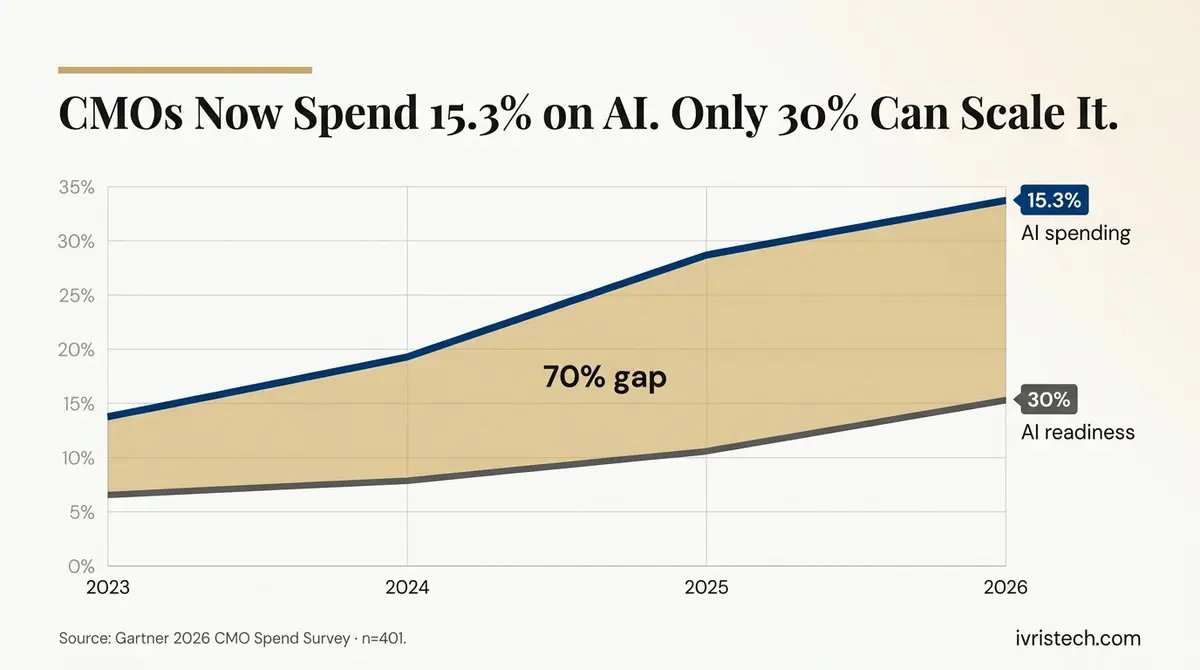
Gartner released its 2026 CMO Spend Survey on May 11 at the Gartner Marketing Symposium/Xpo in London, with the central finding that marketing leaders are allocating 15.3% of their budgets to AI initiatives while only 30% of marketing organizations have the readiness to scale those investments. The survey covered 401 CMOs and senior marketing leaders across North America, the UK, and Europe, fielded January through March 2026.
Beneath the readiness gap is a flat budget environment. Marketing spend as a share of company revenue moved from 7.7% in 2025 to 7.8% in 2026, effectively unchanged, while 56% of CMOs say their organization lacks the budget required to deliver the 2026 strategy and 54% report insufficient resources. The AI premium for the mature cohort is real, though: organizations with optimized AI programs allocate 21.3% of their marketing budget to AI on average, and they receive 8.9% of company revenue instead of the 7.8% survey-wide figure.
For B2B marketing teams under pressure to prove AI ROI before the next budget review, the survey is less a celebration of AI spending than a diagnostic. The 15.3% number is the easy part. The 30% readiness number is what determines whether that spend converts to anything the CFO will sign off on twice. GrowthLoop’s 2026 Index, released two days later, names the same gap from the measurement side: only 23% of marketers can causally link marketing actions to business outcomes, which is the proof layer the 30% readiness cohort actually has and the 70% doesn’t.
Key Takeaways
- 15.3% of marketing budgets now go to AI initiatives on average, per Gartner’s 2026 CMO Spend Survey of 401 marketing leaders fielded January through March 2026.
- Only 30% of CMOs report mature AI readiness, even though 70% say becoming an AI leader is a critical 2026 goal.
- Marketing budgets remain flat at 7.8% of company revenue, up marginally from 7.7% in 2025.
- 56% of CMOs say they lack the budget to deliver their 2026 strategy; 54% report insufficient resources.
- Organizations with optimized AI programs allocate 21.3% of marketing budget to AI and pull a 8.9% share of company revenue, a measurable readiness premium.
What the Survey Found
The headline is the readiness mismatch. Gartner surveyed 401 CMOs and senior marketing leaders, the majority working at organizations with annual revenue over $1 billion, and the gap between AI ambition and AI execution is now the defining feature of the marketing budget. Seventy percent of CMOs say AI leadership is a critical 2026 goal. Thirty percent say their organization has the infrastructure to deliver on that goal. The remaining 40 percentage points is the cost the next budget review will price in.
Ewan McIntyre, vice president analyst and chief of research in Gartner’s Marketing practice, framed the risk plainly in press materials: “CMOs recognize AI’s potential as a force multiplier for growth, efficiency and transformation, but most marketing organizations are not yet built to capture that value. The risk is that CMOs invest in AI tools faster than they build the data foundations, processes, governance and talent required to scale them.” Translation: the 15.3% line item is buying AI tools, not AI outcomes, in the majority of marketing organizations.
The mature-cohort numbers are the most operationally useful data in the release. Organizations Gartner classifies as having mature or fully developed AI readiness allocate 21.3% of marketing budget to AI, six points above the 15.3% survey average. They also pull 8.9% of company revenue into marketing instead of the 7.8% baseline. That premium isn’t a coincidence: leadership funds the programs that produce attributable outcomes, and the mature cohort has the data foundations and processes to produce attributable outcomes.
Why the Budget Is Flat
The 7.8% of revenue figure is the macro story. Marketing budgets have now sat in the 7.5%-7.8% band for four consecutive years, which is a different posture from the 9-10% the discipline saw before 2023. Several pressures combine here: economic caution at the C-suite, AI-driven efficiency expectations replacing headcount asks, and a CFO discipline that increasingly treats marketing as a margin lever rather than a growth investment.
Inside that flat envelope, the AI line item is competing with everything else for share. The 15.3% allocation is roughly 1.19% of total company revenue going through marketing into AI, which is meaningful in absolute dollars but small relative to the strategic weight CMOs are putting behind it. The 56% lack-of-budget signal and the 54% lack-of-resources signal say the same thing from two angles: the AI ambition has outrun the funding envelope. This pattern echoes McKinsey’s State of Marketing 2026 finding that only 6% of marketing teams have reached high AI maturity, a number Gartner’s 30% AI-ready figure now triangulates from the CMO-budget side.
The Readiness Premium, Decoded
The 21.3% mature-cohort allocation is the operational target most CMOs should reverse-engineer from. The cohort isn’t spending more on AI because they have bigger budgets. They have bigger budgets because they spend on AI in a way leadership can connect to outcomes. The data foundations come first, the process maturity comes second, the tool purchase comes third, not the other way around. Gartner’s earlier prediction that 40% of agentic AI projects will be canceled by 2027 is the same problem looked at from the project side: most of those cancellations will come from organizations that bought the tool before they built the foundation.
Our read: the survey is most useful as a self-diagnostic. If your marketing organization is allocating something close to 15.3% to AI and your last quarterly review couldn’t produce an attributable revenue impact from that allocation, you are in the 70% that isn’t ready. That’s not a tooling problem. It’s a sequencing problem. The 21.3% cohort sequenced foundations before tools. The 15.3% cohort is sequencing tools before foundations and hoping the foundations show up by the next budget cycle. Gartner’s May 20 buyer-side data added the demand-side mirror of the same finding: 69% of B2B buyers still escalate AI insights to humans for validation, which means the readiness investment is not just about scaling AI internally but about earning the credibility buyers will check the AI’s work against. The operating-side companion is the eClerx Marketing Report’s activation-maturity test: measure whether an insight can actually trigger a decision before adding another tool. Gartner’s new media-spend split shows the allocation consequence, with less mature teams favoring easily optimized acquisition while AI-mature teams protect more loyalty and retention investment.
What B2B Marketing Teams Should Do Before the Next Budget Review
The next budget conversation is going to be uncomfortable for any marketing organization that can’t answer the simple question: what did the 15.3% buy us. Four moves are defensible right now:
- Audit the AI spend against attributable revenue, not productivity. Productivity gains read as soft to a CFO. Pipeline contribution, conversion uplift, and customer-acquisition-cost reduction read as hard. Supermetrics’ AI adoption gap analysis shows that the teams converting AI use into measurable ROI are the ones that built the measurement infrastructure first, not the AI workflow.
- Stop scaling pilots that don’t have attribution baked in. If a pilot was scoped without a clear revenue-attribution mechanism, scaling it just increases the proof-less surface area. Kill it, redesign it with attribution as the first design constraint, then re-pilot.
- Route the next AI dollar toward process maturity, not another tool. The 21.3% cohort isn’t outspending, it’s out-sequencing. Data foundations, governance frameworks, and talent on the operating side compound. A seventh AI tool does not.
- Build the CFO narrative in advance. Gartner is now publishing the maturity gap. CFOs read Gartner. Bring a position on where your organization sits in the readiness curve and what the 12-month plan is to move five points toward the mature cohort, before the CFO asks. The B2B marketing framework we use uses three readiness anchors that map directly to Gartner’s cohort classification: data, attribution, and process. Lead with those, not with the AI roadmap itself.
The 30% readiness cohort isn’t doing anything mysterious. It’s funding foundations before features. The 70% has roughly four budget cycles to close the gap before the AI line item starts getting reallocated to teams that can prove it works. The diagnostic layer that maps where the foundation gap actually sits on the AI-visibility surface arrived May 14: the Ignite X Credibility Score’s six-dimension framework is the kind of input-layer audit the readiness premium runs on, scoring brand presence across the surfaces AI engines actually cite rather than the legacy brand framework most marketing diagnostics still inherit.
The Wider Context
Gartner paired the CMO Spend release with a second survey finding the same day: marketing leaders expect AI-driven automation of marketing work to roughly double, from 16% in 2026 to 36% by 2028. That trajectory makes the readiness question existential rather than tactical, the marketing organizations that haven’t built the foundations by 2028 will be running a process where more than a third of the work is automated by tools they don’t have the data or governance to control. Forrester’s GTM singularity argument sits on top of this: when marketing-sales-CS-product alignment becomes a revenue prerequisite, the marketing organization that hasn’t operationalized AI becomes the weak link in the unified GTM motion. The skills problem is closing fast on the budget problem, Gartner’s February 2026 research found that only 32% of marketers believe they need to update their AI skills, which is the leading indicator of the readiness gap the May 11 survey just measured. OpenAI’s first B2B Signals report measures the same gap from the usage side, finding that frontier firms now consume 3.5x more AI intelligence per worker than typical firms, with two-thirds of that advantage attributable to depth of use rather than message volume. The 16%-to-36% automation curve Gartner published the same day is the operational deadline behind every readiness investment described here, the data foundations, governance frameworks, and AI-supervisor roles are what determine which side of the 36% number the team lands on in 2028. Wynter’s role-level read on AI efficiency shows the workforce effect arriving before that deadline: 47% of B2B companies already reduced marketing roles through cuts, attrition, or stopped backfills.
The same release noted that Gartner now expects half of agencies’ proprietary AI platforms to be obsolete by 2029, a structural warning to any CMO using an agency’s AI stack as a substitute for building internal readiness. That substitution is exactly the shortcut the 70% non-ready cohort is taking. The 30% mature cohort built internal capabilities precisely because they didn’t want to be exposed to a vendor obsolescence curve they couldn’t control.
Frequently Asked Questions
CMOs are allocating 15.3% of marketing budgets to AI initiatives on average, but only 30% of marketing organizations report the maturity needed to scale those investments. The 40-point gap between the 70% of CMOs naming AI as a critical 2026 goal and the 30% who are ready to deliver on it is the central finding. The survey covered 401 marketing leaders across North America, the UK, and Europe, fielded January through March 2026.
Marketing budgets sit at 7.8% of company revenue in 2026, effectively flat from 7.7% in 2025. Organizations Gartner classifies as having mature AI readiness receive a higher share at 8.9%. More than half of CMOs (56%) say even the 7.8% baseline is below what they need to deliver their 2026 strategy.
Per Gartner’s chief of research Ewan McIntyre, most marketing organizations have invested in AI tools faster than they have built the data foundations, processes, governance, and talent needed to scale them. The 30% readiness figure measures process and infrastructure maturity, not AI tool deployment. Tool purchases are the easy part of AI adoption; the foundations that turn tool use into attributable revenue impact take longer to build.
Four moves are defensible: audit existing AI spend against attributable revenue rather than productivity gains, kill pilots that don’t have revenue attribution built in, route the next AI dollar toward process and data maturity instead of another tool, and prepare the CFO narrative around readiness-gap progress before the CFO asks. The mature 30% cohort allocates 21.3% of marketing budget to AI because they built the foundations first, not because they have bigger budgets.