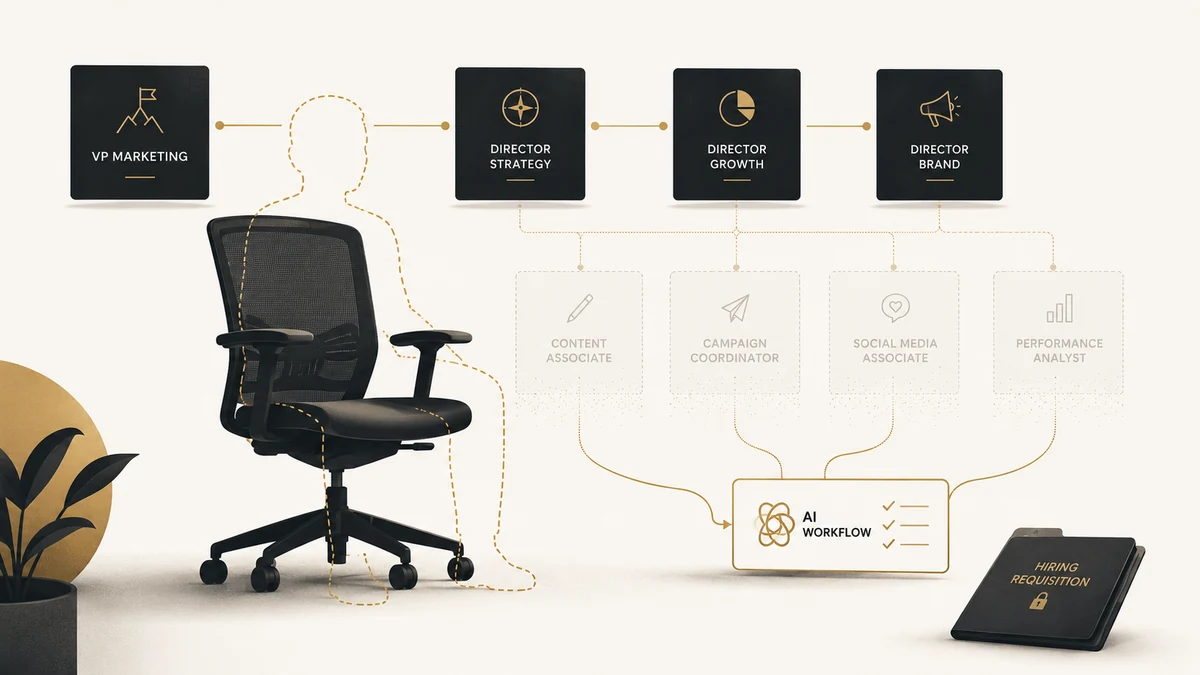
Wynter’s May 2026 research on how B2B marketing teams actually use AI found that 47% of mid-market and enterprise SaaS companies eliminated, reduced, or stopped backfilling marketing roles because of AI during the last 12 months. Only 7% reported visible team shrinkage. The other 40% happened through attrition and unfilled requisitions.
The study surveyed 100 verified Directors, VPs, and Heads of Marketing at B2B SaaS companies from May 18 to May 22. The role compression is not evenly distributed: 60% named content and copywriting as the function most likely to be cut, while 20% explicitly named junior and entry-level positions. At the same time, 94% of leaders expect their own role to survive the next 24 months.
Our read: the headline is not “AI replaced marketing.” It did not. The headline is that AI changed the staffing ratio before most companies changed the org chart. Senior marketers are absorbing more execution, junior seats are disappearing quietly, and the career ladder underneath the senior layer is narrowing. B2B leaders need a role audit before the next hiring plan, not another blanket promise that AI will make everyone more productive.
Key Takeaways
- 47% of B2B companies reduced, eliminated, or stopped backfilling marketing roles due to AI in the last 12 months.
- Only 7% reported visible team shrinkage; the other 40% happened through attrition and unfilled requisitions.
- Mid-market companies cut harder than enterprise companies: 52% versus 40%.
- 94% of marketing leaders think their own role survives the next 24 months, while 60% name content and copywriting as the function most exposed.
- 41% admit using personal AI accounts around corporate restrictions, and 53% say AI has not delivered ROI.
The AI Cuts Already Happened Quietly
Wynter’s most useful distinction is between layoffs and role removal. A public layoff is visible. A requisition that never reopens is not. A contractor budget that quietly disappears is not. A junior seat absorbed by a senior marketer using Claude for first drafts is not. The outcome is still a smaller team, but it arrives without a restructuring announcement or a single event a newsroom can point to.
The mid-market split sharpens the pattern. Wynter found 52% of mid-market companies reduced roles, compared with 40% of enterprise companies. Mid-market teams have enough workflow volume for AI to remove repetitive work but fewer layers of approval protecting each seat. The same dynamic appeared at a much larger scale when Oracle redirected workforce costs toward AI infrastructure, but Wynter’s data shows the quieter version happening inside marketing departments with no press release attached.
The staffing change also explains why the debate keeps missing the point. The question is not whether an AI tool can complete a whole marketing job. It is whether a senior marketer with an AI workflow can absorb enough first-draft, research, QA, and production work that the next junior role never gets approved. Wynter’s 40-point invisible-cut gap says that threshold has already been crossed in nearly half the market. The broader labor-market version appears in Revelio Labs’ 42% exposed-role demand decline, which sits alongside 27% greater headcount growth at AI-adopting firms than at non-adopters.
Senior Marketers Feel Safe. The Career Ladder Does Not.
Wynter’s second finding is more uncomfortable than the first. Ninety-four percent of marketing leaders think their own role will still exist in roughly the same form two years from now. Sixty percent identify content and copywriting as the function most at risk. Design and creative follow at 37%, product marketing management at 26%, junior and entry-level roles at 20%, marketing operations at 19%, and analytics at 18%.
The pattern is a senior-heavy operating model. Strategic judgment, stakeholder management, customer trust, and cross-functional ownership remain human-intensive. The execution beneath those responsibilities is compressing. That puts the entry ramp at risk. Companies can hire fewer juniors today and still hit the quarter. Two years later, they may discover they also trained fewer people to become the seniors they still need.
This is where the productivity story becomes an operating-model story. Our guide to agentic AI marketing workflows separates repetitive coordination from strategic work for the same reason. Good automation removes manual drag. Poor workforce design removes the apprenticeship layer and calls the result efficiency.
The Role Audit: Automate, Protect, Redesign
B2B marketing leaders should audit workflows before they audit headcount. The useful unit is not the job title. It is the recurring task, its review cost, and the judgment needed when the output is wrong.
| Bucket | Typical Work | Team Decision |
|---|---|---|
| Automate | First-draft repurposing, transcript summaries, research collection, formatting, routine QA | Build repeatable prompts, templates, and review checkpoints |
| Protect | Customer interviews, positioning decisions, pricing narrative, executive communication, final approval | Keep named human ownership and measure decision quality |
| Redesign | Campaign planning, account research, content briefs, lifecycle orchestration, analytics reviews | Split machine preparation from human judgment and document the handoff |
The redesign bucket is where most teams should spend the quarter. OpenAI’s B2B Signals report found frontier firms pull ahead through depth of use, delegated workflows, governance, and enablement, not raw message count. Wynter’s ROI data says the same thing from the employee side: 53% of companies say AI has not delivered ROI, while the 23% reporting ROI built workflows around a strategy and a stuck backlog.
A role audit should produce three concrete outputs: the work that can be automated now, the work that requires accountable human judgment, and the redesigned workflows that need a senior owner plus a training path for junior staff. Measure the result against SaaS marketing metrics tied to revenue and retention, not seat reductions alone. The last item matters. If junior roles become review-only jobs with no path to independent judgment, the company has postponed a talent problem rather than solved it. OpenAI’s newer evidence sharpens the review question: 53% of marketers’ occupation-specific AI messages crossed into work associated with another occupation, so wider task range needs named specialist review rather than assumed authority.
The Governance Problem Is Already Inside the Team
Wynter found 41% of marketers openly admit using personal accounts to bypass corporate AI restrictions, even though 90% of their companies have at least partial restrictions in place. That makes shadow AI the default operating model, not an edge case. Employees will route around slow procurement when the work still has to ship.
The risk is not only data leakage. It is invisible process design. Teams cannot improve, govern, or measure workflows that happen through personal accounts and undocumented prompts. Gartner’s AI-readiness gap showed that tool access is running ahead of data foundations, process, governance, and talent. Wynter shows what that gap feels like from inside the marketing team: people already changed how the work happens, while the operating model still pretends they did not.
B2B leaders should replace prohibition-only policies with a usable approved path: sanctioned tools, clear data classes, a lightweight prompt library, a review rule for external-facing work, and one owner for each delegated workflow. Then measure the staffing effect honestly. If AI reduces a role, name the task that disappeared and the training path that replaces it. Quiet cuts may avoid headlines. They do not avoid consequences. Canva’s AI slop research makes the customer-facing side of that policy visible, because audiences can feel the loss of human judgment even when the company never announces a staffing change.
Frequently Asked Questions
Wynter found that 47% of surveyed mid-market and enterprise B2B SaaS companies eliminated, reduced, or stopped backfilling marketing roles because of AI during the last 12 months. Only 7% reported visible team shrinkage. The other 40% happened quietly through attrition and unfilled requisitions.
Content and copywriting ranked first at 60%, followed by design and creative at 37%, product marketing management at 26%, junior and entry-level roles at 20%, marketing operations at 19%, and analytics at 18%. The data points to execution compression beneath senior roles, not the elimination of whole marketing functions.
The Wynter study measured role reduction, elimination, and stopped backfills. It does not show that whole marketing workloads disappeared. The more common pattern is that senior marketers use AI to absorb first-draft and execution work, allowing companies to remove or avoid filling the seat below them.
Audit workflows before headcount. Sort recurring work into automate, protect, and redesign buckets. Keep named human ownership for strategic decisions, document machine-to-human handoffs, approve a governed tool path so shadow AI becomes visible, and preserve a training path for junior marketers who still need to develop judgment.