Canva’s 2026 State of Marketing and AI report finds that AI is now standard inside marketing teams, but consumer trust is not keeping pace. Ninety-seven percent of marketing leaders use AI in daily creative work, and 99% plan to increase AI investment in 2026.
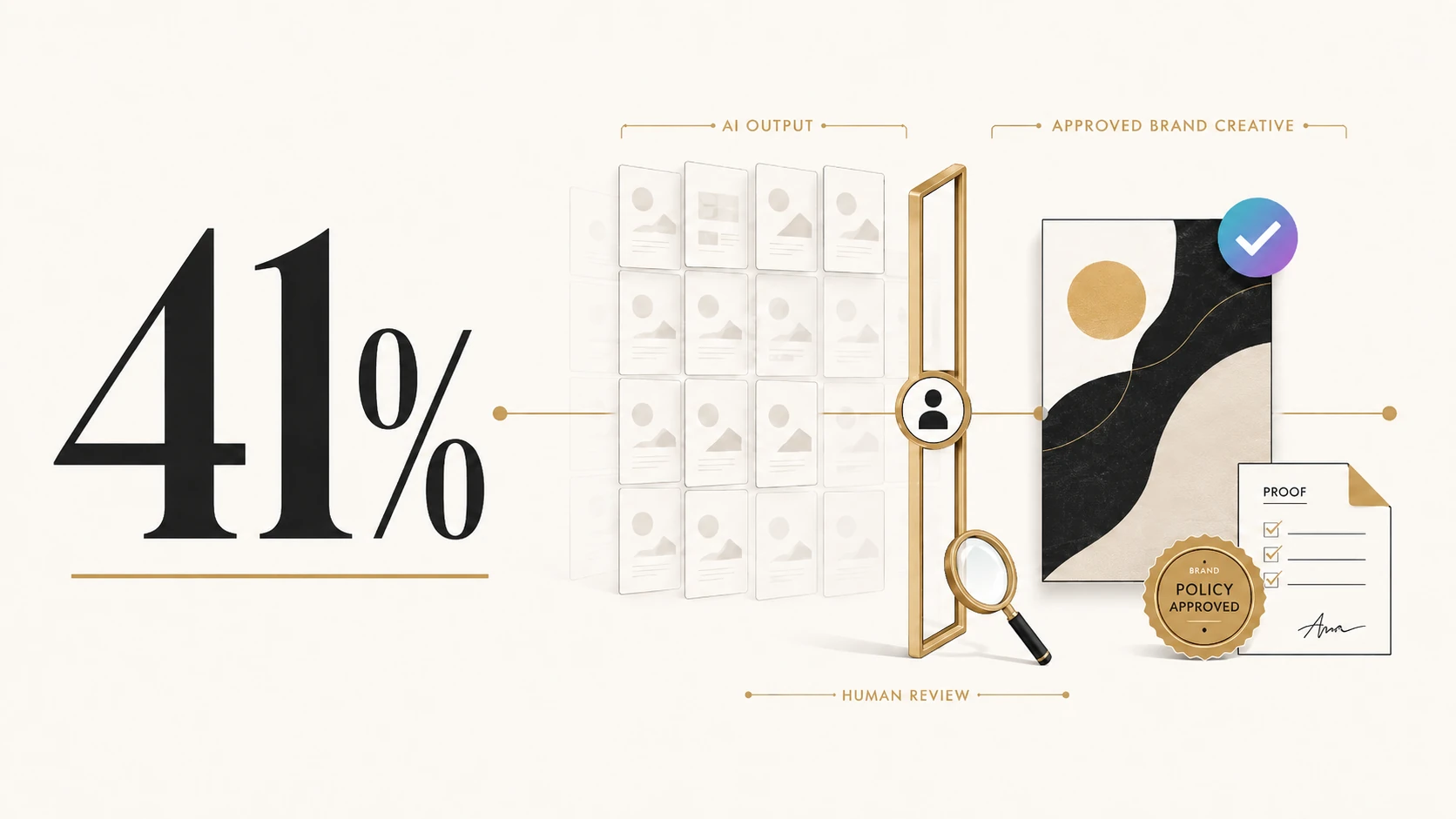
The trust numbers cut the other way. Mentions of “AI slop” have increased ninefold, and 41% of marketing leaders say it is becoming a real challenge. Canva also found that 70% of consumers say AI-generated ads feel like something is missing, while 87% say the best advertising still requires a human touch.
For B2B marketers, the report is less a warning against AI than a warning against unmanaged AI volume. The gap in the SERP is operational: teams need creative standards, disclosure rules, and brand review loops before faster content production turns into weaker trust. Cashew’s marketer differentiation-anxiety study shows the next consequence of unmanaged volume: teams can publish faster and still sound less distinct.
Key Takeaways
- Canva’s 2026 report surveyed 1,415 marketing leaders and 3,547 consumers across seven countries.
- 97% of marketing leaders use AI daily, and 99% plan to increase AI investment in 2026.
- Mentions of “AI slop” rose ninefold, and 41% of marketing leaders say it is a real challenge.
- 70% of consumers say AI-generated ads feel like something is missing; 87% say the best advertising still needs a human touch.
- 74% of consumers would feel more comfortable with AI advertising if formal company policies governed its use.
What Canva’s 2026 Report Found
Canva’s report landing page frames the new operating tension plainly: AI makes creative work faster, but consumers are pushing back against low-effort AI output. The research was conducted with The Harris Poll and spans the United States, United Kingdom, Australia, France, Germany, Japan, and India.
The adoption side is almost complete. Canva says 41% of marketing leaders describe AI as functioning like a director, and 39% describe it as a collaborator. Eighty-nine percent say AI saves their team time, and 68% say it has increased marketing-influenced business decisions.
That is why this piece belongs next to McKinsey’s State of Marketing 2026. McKinsey measured the maturity gap. Canva measures the audience reaction when AI maturity lags behind AI output.
AI Slop Is a Governance Problem
The phrase “AI slop” is doing real work in the report. It names the visible sameness, low judgment, and weak emotional signal consumers are learning to detect. Canva says media mentions of the phrase increased ninefold, which means the label has moved from internet complaint to boardroom risk. EU AI Act label enforcement now turns some disclosure decisions into auditable compliance questions, not only brand-trust choices.
The Next Web’s read sharpens that point: the hard problem is not production, it is permission. Consumers may accept useful AI-generated ads, but they still want to know when AI was used, how their data was handled, and whether a person made the creative judgment. the EU AI transparency code Meta is signing turns part of that expectation into a provider-and-deployer compliance framework without making every AI-assisted ad a visible-label case.
For B2B teams, this is the same operating gap we saw in Supermetrics’ AI adoption data. Marketers feel pressure to use AI, but the systems that prove quality, governance, and ROI are weaker than the adoption curve. More AI output will not fix that. accessiBe’s AI-content accessibility findings add another release criterion: customer-facing output needs evidence of accessibility review before volume scales.
The Trust Gap Is Bigger Than Disclosure
Disclosure matters. Canva found that 52% of consumers cite AI-use disclosure as a trust builder, and 53% cite data protection. But disclosure alone does not solve the problem if the output still feels generic or intrusive. New York’s synthetic-performer disclosure law now turns one part of that trust preference into a production requirement for covered advertising. Skyword’s 29% brand-trust finding shows the next failure mode: when AI and brand claims conflict, disclosure does not prevent buyers from looking outside both sources for proof. Sprout’s brand crisis response data adds the live-channel version of the same trust problem: audiences expect the correction where the issue is unfolding, not only in a static statement.
The personalization numbers show the tension. Fifty-two percent of consumers say it feels invasive when an ad seems to know what they are about to buy before they search for it, and 58% do not want brands using AI to predict their needs. B2B buying committees may not react to consumer ads the same way, but the trust mechanic is familiar: helpful personalization wins only when it feels earned. DoubleVerify’s chat-context findings sharpen that boundary: highly personal chat placements produced more negative than positive brand sentiment, while highly relevant placements reversed the balance.
The workforce angle also matters. Wynter’s B2B marketing roles data showed how AI is already compressing roles through attrition and stopped backfills. Canva adds the audience side of the same shift: consumers want assurances that AI is not simply replacing human judgment.
What B2B Marketers Should Change
- Write an AI creative policy before scaling volume. Name which assets can be AI-assisted, which require human creation, and where disclosure appears.
- Move brand review earlier in the workflow. Do not review only the final asset. Review the prompt, source material, claim set, and approval path.
- Measure trust signals, not only output speed. Track unsubscribe language, reply sentiment, sales-call objections, complaint themes, and pipeline conversion by AI-assisted campaign.
- Keep human evidence visible. Use named experts, customer quotes, product proof, and original research so AI helps assemble the story instead of becoming the story.
- Connect creative quality to business outcomes. GrowthLoop’s 2026 index found only 23% of marketers can reliably link actions to outcomes. AI content should face the same causal test as every other campaign asset.
Canva’s report is useful because it does not argue that marketers should stop using AI. The numbers show that the market has already made that decision. The question for B2B teams is whether AI is governed by taste, evidence, and policy, or whether the team is just making more content that feels easier to ignore. The TikTok Symphony Agent brand-safety test belongs in the same trust-gap conversation, because faster ad generation helps only if claim review, brand control, and measurement improve with it.
Frequently Asked Questions
Canva found that 97% of marketing leaders use AI in daily creative work and 99% plan to increase AI investment in 2026. At the same time, consumer trust is strained: 70% say AI-generated ads feel like something is missing, and 87% say the best ads still need a human touch.
AI slop refers to low-effort, visibly machine-generated content that feels generic, emotionally flat, or disconnected from real creative judgment. Canva says media mentions of the phrase have increased ninefold, and 41% of marketing leaders now see it as a real challenge.
No. Canva found that many consumers accept AI if it makes ads more helpful or relevant. The concern is trust: consumers want disclosure, data protection, control over personalization, and clear evidence that human judgment still shaped the work.
B2B teams should set AI creative policies, move brand review earlier, keep human proof visible, and measure trust signals alongside speed. The immediate fix is not less AI. It is clearer standards for when AI assists, when humans decide, and how the team proves the output worked.