Direct answer – What did the McKinsey State of Marketing 2026 report find?
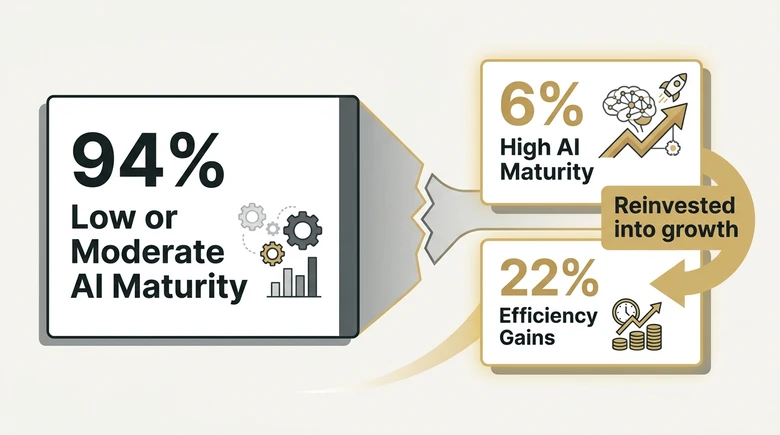
The McKinsey State of Marketing Europe 2026 report surveyed 500 senior marketing leaders across France, Germany, Italy, Spain, and the UK. It found that 94% of marketing organizations have only low or moderate AI maturity, while the 6% with high maturity report 22% efficiency gains. CMOs ranked generative AI 17th of 20 priorities, even though McKinsey estimates AI could drive $463 billion in marketing productivity. The gap between leaders and laggards is widening.
McKinsey surveyed 500 senior marketing leaders across five European markets and found something that should concern every B2B team: 94% of marketing organizations haven’t moved past low or moderate AI maturity. Not in adoption. In actual maturity — the ability to generate measurable, repeatable results from AI at scale.
The 6% who have? They’re reporting 22% efficiency gains and reinvesting the savings into growth. They expect that number to hit 28% within two years. The gap between these two groups isn’t closing. It’s widening.
Key Takeaways
- 94% of European marketing organizations have low or moderate AI maturity, according to McKinsey’s State of Marketing Europe 2026 report.
- The 6% with high AI maturity report 22% efficiency gains, with 57% of them projecting 30%+ gains in the next two years.
- CMOs ranked generative AI 17th out of 20 priorities for 2026. McKinsey says this underestimates the urgency.
- Branding is the #1 CMO priority. 72% plan to increase budgets. But AI could drive $463 billion in total marketing productivity.
What the Report Found
The McKinsey State of Marketing Europe 2026 report surveyed CMOs and senior marketing executives across France, Germany, Italy, Spain, and the United Kingdom. It ranked 20 marketing topics by importance, and the results cut against the AI hype cycle. Gartner’s 2026 CMO Spend Survey triangulates the same gap from the budget side, finding that only 30% of marketing organizations have the AI readiness to scale the spending that 70% of CMOs are already committing to.
Branding came in first. Budget management second. ROI measurement sixth. Generative AI and agentic AI? Seventeenth. That ranking puts AI behind brand building, customer experience, content strategy, and performance marketing on most CMOs’ priority lists.
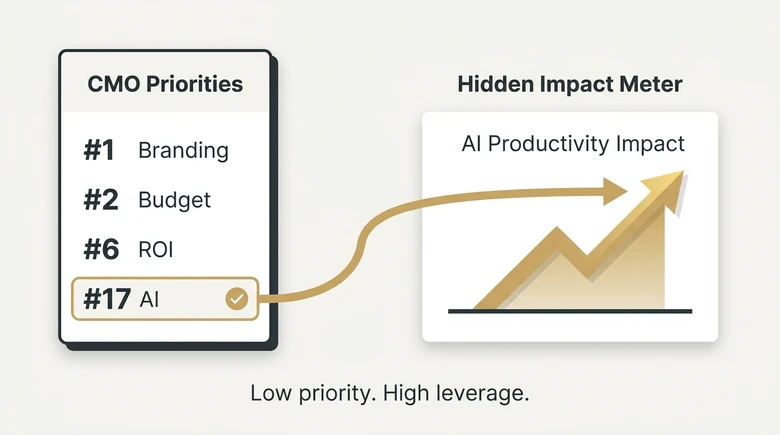
But McKinsey’s own analysis argues that ranking is dangerously misleading. The firms that do treat AI as a top-five priority are pulling ahead fast. They’ve redesigned workflows, not just adopted tools. They’re using AI for content strategy, media optimization, and personalization at scale. And the efficiency gains they’re seeing compound — because they reinvest savings into more growth, which widens the gap further. Gartner’s 36% by 2028 forecast puts a calendar on the gap McKinsey describes here: the firms treating AI as a top-five priority are the ones that will reach the 36% target by 2028, and the 94% stuck at low or moderate maturity are racing a deadline they have not formally acknowledged.
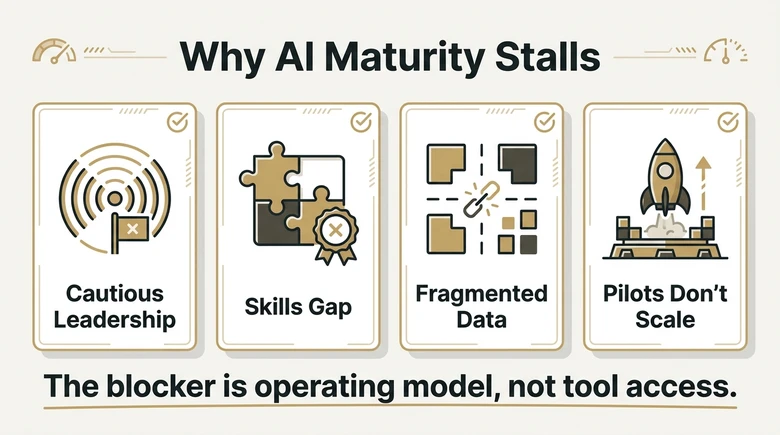
The barriers holding back the other 94% aren’t about tools. They’re structural: cautious leadership, limited in-house AI skills (flagged by 51% of B2B marketers), fragmented data, and scattered pilot projects that never reach production scale. Supermetrics research confirms this exact pattern — 70% of marketers want to optimize spend with AI, but only 17% actually do it.
The $463 Billion Number
McKinsey estimates AI could drive $463 billion in total marketing productivity, with agentic AI powering over 60% of that value. That’s not a five-year projection. That’s the current addressable opportunity based on existing technology.
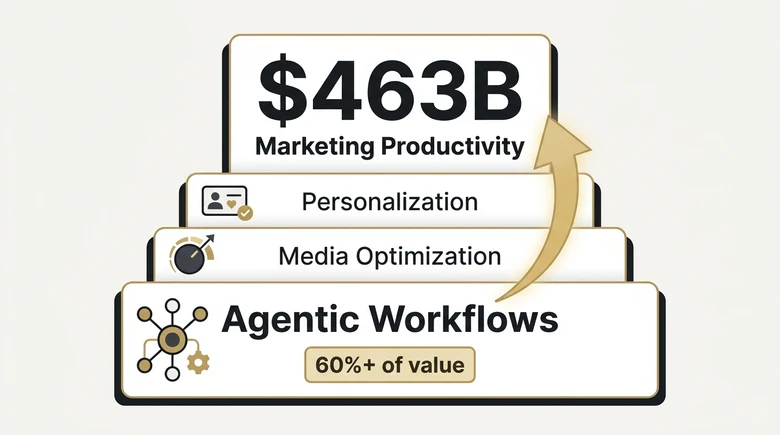
For B2B teams specifically, the implications are practical. AI-driven personalization already improves marketing efficiency by 10-30%, according to McKinsey’s research. Fast-growing companies derive 40% more revenue from personalized experiences. And agentic AI in revenue operations is moving from pilot to production at companies that have the data infrastructure to support it.
But there’s a significant cautionary note: Gartner predicts 40% of agentic AI projects will be canceled by 2027, primarily due to dirty data and misapplied use cases. The $463 billion opportunity is real, but only for teams that build the foundation first.
The report also flags a trust problem. When consumers notice AI-generated content, they’re four times more likely to trust a brand less than more, according to eMarketer’s April 2026 research. For B2B companies where trust is the currency of long sales cycles, that stat should change how teams think about AI content — use it for efficiency, not as a replacement for expertise. Canva’s AI slop and trust-gap findings add the consumer-side proof: marketers can increase AI output quickly, but trust still depends on human judgment, disclosure, and brand standards.
What B2B Teams Should Take From This
The report confirms what most RevOps and marketing ops teams already feel: the problem isn’t access to AI tools. It’s organizational readiness. Three actions stand out from the data:
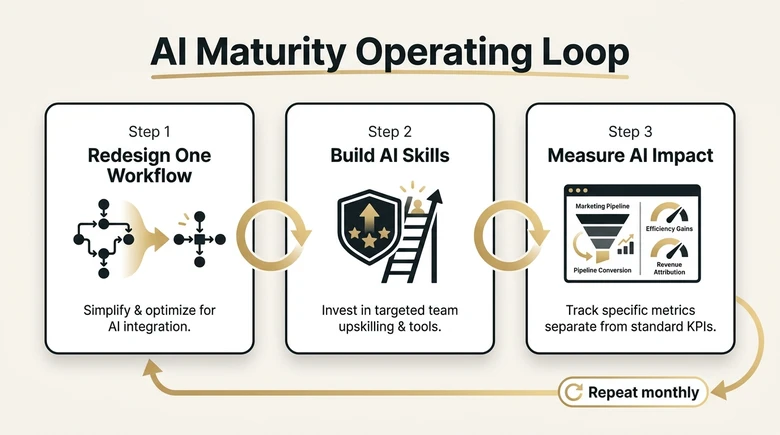
- Pick one workflow to redesign, not ten tools to adopt. High performers don’t just use AI. They fundamentally rethink how work gets done around it. Start with your most repetitive, data-heavy process.
- Invest in skills, not subscriptions. The 51% skills gap is the highest-impact fix. Organizations that provide targeted AI education see 43% higher project success rates.
- Measure AI separately. Track AI-sourced conversions, AI-generated content performance, and AI-assisted pipeline contribution as distinct metrics. If you can’t isolate AI’s impact, you can’t scale it.
The contrast with the sales side is striking. Salesforce’s 2026 State of Sales report shows 87% of sales organizations now use AI, with top performers 1.7x more likely to deploy agents. Marketing is significantly behind sales in AI operationalization — and this McKinsey data explains why. The B2B CMO Project’s April 28 Imperative report extends this pattern, naming AI visibility and measurement reform as two of the five imperatives separating CMOs winning C-suite trust.
The full McKinsey report covers 20 marketing priorities across brand building, budget rigor, and technology adoption. For B2B marketing teams building their 2026 strategy, it’s worth reading the complete findings.
Frequently Asked Questions
It’s a survey of 500 senior marketing leaders across France, Germany, Italy, Spain, and the UK. The report ranks 20 marketing topics by priority and analyzes how AI maturity, branding, and budget decisions are shaping marketing strategy in 2026.
Most CMOs are dealing with economic uncertainty and shrinking budgets, so they’re prioritizing proven levers like branding and ROI measurement. McKinsey warns this ranking underestimates AI’s urgency — the 6% who prioritize AI are already seeing 22% efficiency gains.
B2B companies with mature AI practices are redesigning workflows, improving personalization, and reinvesting efficiency gains into growth. Those stuck in pilot mode risk falling behind as competitors use AI to move faster with the same or smaller teams.
McKinsey estimates AI could drive $463 billion in total marketing productivity, with agentic AI powering over 60% of that value. It reflects the current addressable opportunity from existing technology, not a future projection — but capturing it requires clean data and redesigned workflows first.