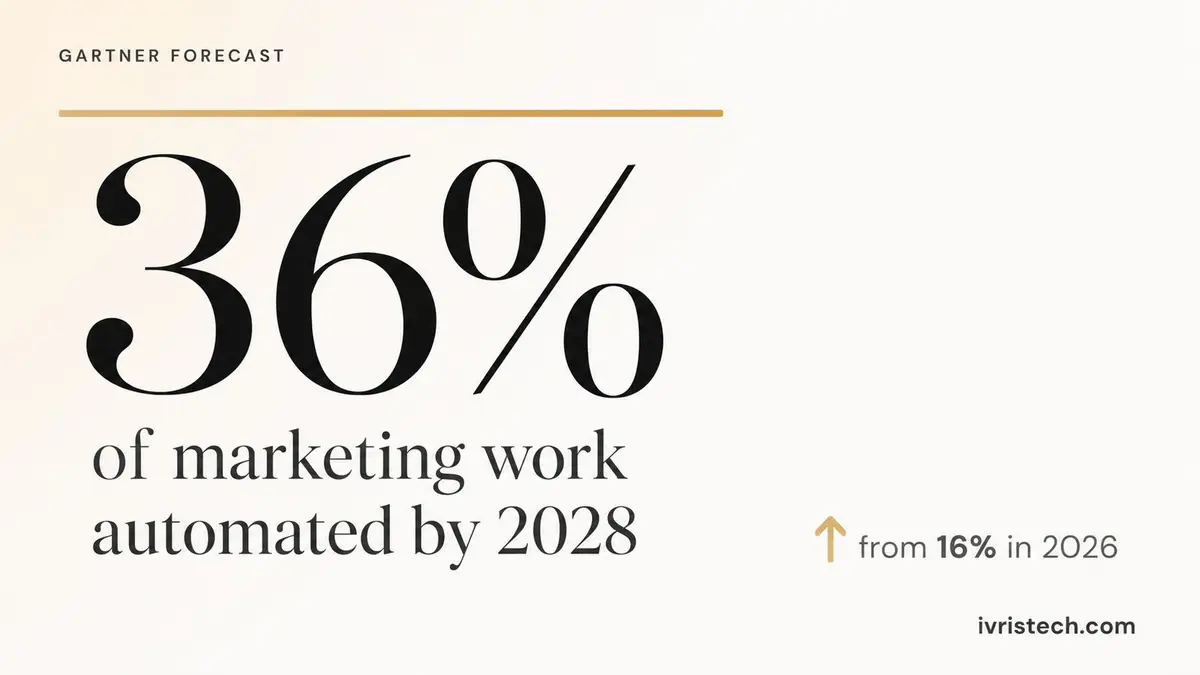
Gartner says AI will automate 36% of marketing work by 2028, more than double the 16% marketing leaders report today, according to a survey released May 11 at Gartner Marketing Symposium/Xpo. The forecast lands a year after Salesforce, Anthropic, and OpenAI shipped agentic AI tooling that promised the same outcome and rarely delivered past 20%.
The doubling is steeper than it sounds. Marketing teams have to add 20 percentage points of automation across briefing, copy, segmentation, campaign QA, and reporting in roughly 30 months. That is the kind of curve that breaks org charts before it breaks budgets.
For B2B marketing leaders, this is less a “what AI can do” forecast and more a “how fast can your team absorb change” warning. The gap between leaders who plan for 36% and those still budgeting for 16% will define the next two CMO performance cycles. Our read: the headline number is the distraction. The org-design problem underneath it is the news.
Key Takeaways
- Gartner survey released May 11, 2026 says AI will automate 36% of marketing work by 2028, up from 16% today — a 20-point swing in 30 months.
- The forecast was presented at the opening keynote of Gartner Marketing Symposium/Xpo, alongside a CMO skill-gap analysis the headline buries.
- The 16% baseline is itself contested. Supermetrics and McKinsey research put real daily AI usage closer to 11-13%, making the 36% target steeper than the press release implies.
- Reaching 36% requires reorganizing teams around AI-supervisor roles, not adding more AI tools to an unchanged org chart.
What the Survey Actually Found
Gartner asked marketing leaders globally two questions: how much marketing work is currently automated by AI, and how much will be automated by 2028. The reported responses average to 16% today and 36% by 2028. Those figures came from self-report, which historically inflates current adoption and deflates future expectations. The direction is right; the precise numbers should be treated as a forecast band, not a fixed point.
The survey was released to coincide with the keynote at Gartner Marketing Symposium/Xpo, where the framing was that CMOs need new skills and competencies to operate inside an AI-automated workflow. That framing matters. Gartner is not saying AI replaces marketing work. It is saying the residual 64% becomes higher-skill, higher-judgment work, and most CMOs are not staffed for it.
Why the 16% Today Number Deserves Skepticism
The 16% baseline sits at the upper end of recent third-party measurements. Our earlier reporting on the Supermetrics AI adoption gap showed only 17% of marketers using AI for campaign optimization despite 84% saying they want to. The McKinsey State of Marketing 2026 numbers we covered in McKinsey’s State of Marketing 2026 put deep, daily AI usage closer to 11% across enterprise marketing teams.
If the real adoption number is 11-13%, the climb to 36% in 30 months is steeper than Gartner’s headline implies. That is the lens B2B marketing leaders should read this through. The forecast is not “do a bit more of what you are doing.” It is closer to “rebuild how briefing, segmentation, and reporting flow through your team.”
The Skill Gap Gartner Did Not Quantify
The keynote spent more time on CMO skill development than the press release headline suggests. Gartner’s framing names three competencies CMOs need to build: agentic system supervision, AI output quality control, and cross-functional rebuild authority. None of those are easy hires in 2026. Our coverage of Gartner’s earlier CMO spend survey already flagged the budget side of this gap. The skills side is the harder fix because it requires either external hiring against a thin talent pool or aggressive internal upskilling against active resistance. The retention warning inside Gartner’s media data shows why supervision matters: an automated system can optimize measurable acquisition while quietly underfunding long-term customer value.
The companies that hit 36% will not be the ones with the biggest AI budgets. They will be the ones that solved the org-design problem first.
What B2B Marketing Leaders Should Do This Quarter
Baseline your real number. Audit how much marketing work is actually AI-automated today, not what your tools promise. Most teams will find a 5-12% range, not 16%. Knowing the real starting point is the only honest way to plan for 36%.
Pick one workflow to fully automate before adding another. The 36% target is reached by depth in 3-5 workflows, not breadth across 15. Common high-yield starting points: campaign brief generation, audience segmentation refresh, and post-campaign reporting drafts.
Add an AI supervision role to your 2027 org chart. Whether you call it AI Operations, Marketing AI Lead, or Workflow Steward, someone owns the quality, governance, and routing of AI output. Without that role, the 20-point automation jump fails on quality control before it fails on technology.
Re-cost your agency relationships against the 2028 number. If your agency is still pricing 2024-model retainers against 2026 deliverable volumes, the cost structure will not survive contact with 36% automation. Renegotiate now while you still have negotiating room. Forrester’s GTM singularity argument already pointed at the same compression; Gartner’s number gives you a concrete date to negotiate around.
Frequently Asked Questions
Gartner’s survey, released May 11, 2026 at the Gartner Marketing Symposium/Xpo keynote, found that marketing leaders expect AI to automate 36% of marketing work by 2028, more than double the 16% reported today. The survey also highlighted a CMO skill gap, naming agentic system supervision, AI output quality control, and cross-functional rebuild authority as the three competencies most marketing leaders need to develop.
The 16% figure sits at the upper end of recent measurements. Self-reported surveys typically inflate current adoption. Third-party research from Supermetrics and McKinsey puts deep, daily AI usage closer to 11-13% across enterprise marketing teams. If the real baseline is lower, the climb to 36% by 2028 is steeper than the headline suggests, which makes the org-design implications more urgent rather than less.
Four moves matter in the next 90 days: baseline your actual AI automation percentage by audit, not vendor claims; pick one workflow to fully automate before adding another; add an AI supervision role to the 2027 org chart; and renegotiate agency contracts before the 2028 deliverable volume curve sets in. Depth in 3-5 automated workflows reaches 36% more reliably than breadth across 15.
Gartner’s survey covered marketing leaders broadly, not B2B-specifically, but the operational implications hit B2B harder. B2B marketing workflows depend on segmentation, ABM list refresh, content briefing, and pipeline reporting, all of which are high-yield automation targets. B2B teams that build AI-supervisor roles into RevOps now will hit the 36% mark earlier than B2C peers because the workflows are more structured.