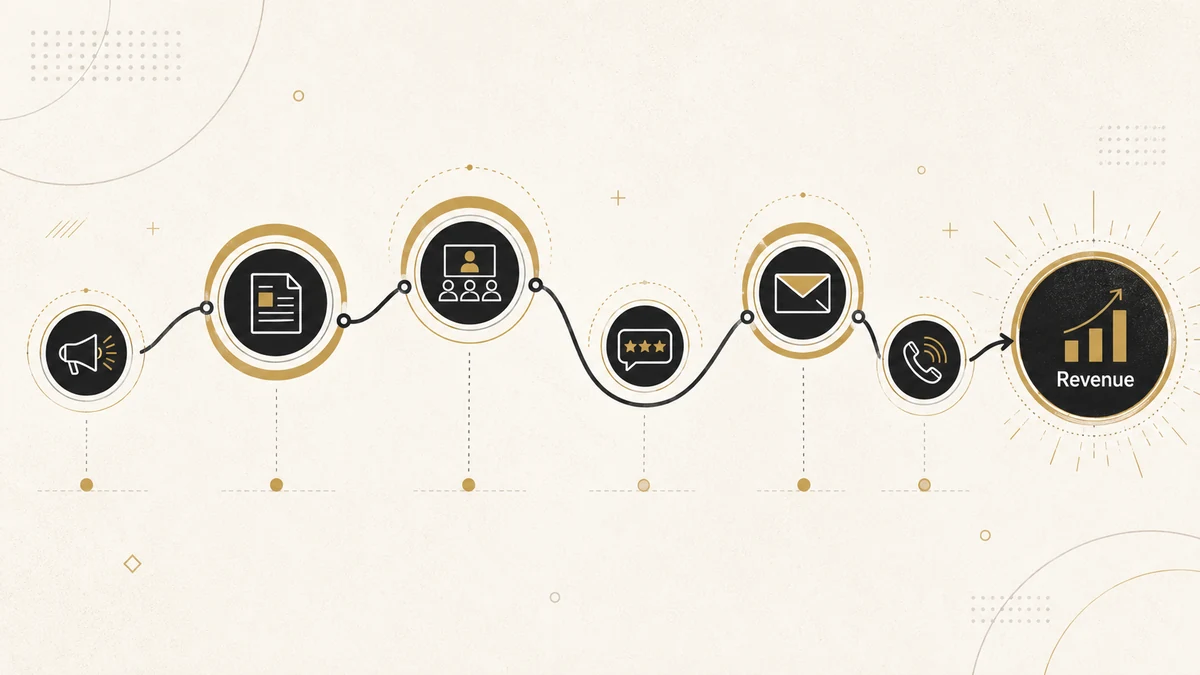
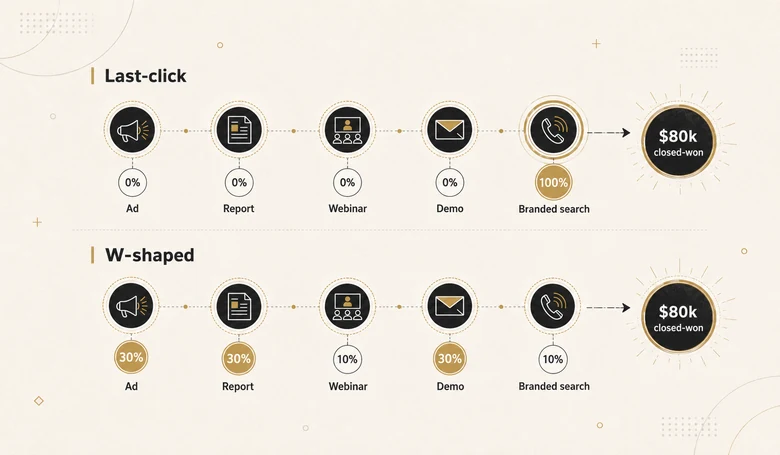
A B2B deal closes for $80,000 in annual recurring revenue, and the first question from finance is the one marketing dreads: which campaign brought it in? The honest answer is that no single campaign did. The account touched dozens of things on the way to signing, and the branded search someone typed the day before the contract went out, the one your last-click report crowns as the hero, created almost none of that value. Customer journey attribution exists to close the gap between what actually built the revenue and what your reporting gives credit for.
Attribution is how you assign credit for a sale to the touchpoints a buyer moved through, across the whole journey rather than at the finish line. In B2C that journey might be three ads and a checkout. In B2B it’s a buying group working months of research across channels you mostly can’t see, which is why single-touch reporting quietly misleads almost every team that leans on it.
This guide covers the models that split credit across the journey, from first-touch to data-driven, and then the part most ranking pages skip: how to connect those touchpoints to pipeline and closed-won revenue instead of counting form fills. If you take one position from it, take this one. In B2B, last-click attribution isn’t the safe, conservative choice. It’s the wrong one.
Direct answer — What is customer journey attribution?
Customer journey attribution is the practice of assigning credit for a sale across all the marketing and sales touchpoints a buyer engages with, from the first anonymous visit to closed-won revenue, rather than to a single click. It uses models, first-touch, last-touch, linear, time-decay, position-based, and data-driven, to divide that credit. In B2B it runs at the account level for a buying group of many people, and ties touches to pipeline and revenue, not just form fills or MQLs.
Key Takeaways
- Customer journey attribution assigns revenue credit across every touch in the journey, not to the last click, which is why it beats single-touch reporting for B2B deals.
- Models fall into two families: single-touch (first or last) and multi-touch (linear, time-decay, position-based, data-driven). Multi-touch fits long B2B cycles.
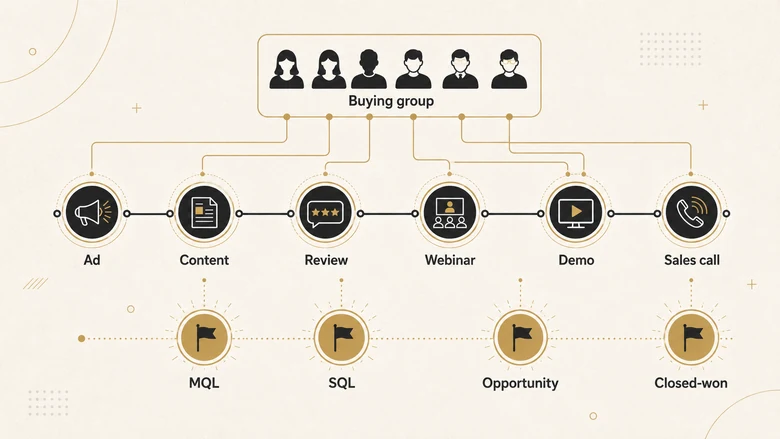
- The B2B unit of analysis is the account and its buying group of five to 16 people, so attribution stitches many people’s touches into one deal.
- The point is connecting touchpoints to pipeline and closed-won revenue, not counting form fills or MQLs.
- Position-based (U-shaped) and W-shaped models map cleanly to B2B milestones: first touch, lead creation, and opportunity creation.
- Dark-funnel, offline, and self-reported touches never appear in tracking, so no model is complete until you feed them in by hand.
What customer journey attribution actually measures
Customer journey attribution is the method marketers use to assign credit for revenue to the sequence of touchpoints a buyer engages before and after they purchase. Instead of rewarding the last ad clicked or the form submitted, it distributes credit across the whole journey, so you can see which channels, content, and campaigns actually created pipeline. The unit it works on is the journey, not the click.
That distinction matters more in B2B than anywhere else. Conversion attribution answers a small question: what triggered this form fill? Journey attribution answers the one that pays the bills: what moved this account from stranger to signed contract? Those are rarely the same touch. A gated report might create the lead six months before a pricing-page visit converts it, and a last-click model hands all the glory to the pricing page while the report that started everything gets nothing.
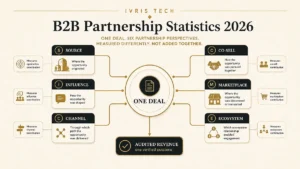
The scale of the problem is easy to underestimate. Dreamdata’s benchmarks show the average B2B deal is shaped by 76 touchpoints across 3.7 channels before it closes. No single-touch report can represent 76 touches honestly, and no human can hold that path in their head. Reconstructing and scoring that sequence is the job of customer journey attribution, and measuring the sequence itself is the wider discipline of journey analytics that tracks the real route buyers walk.
Single-touch vs multi-touch attribution
Attribution models split into two families. Single-touch models hand all the credit to one interaction. Multi-touch models share credit across several, or all, of the touches in the journey. The choice between them decides whether your reporting flatters one channel or reflects the real path a buyer took.
Single-touch is fast and legible, which is why it survives. It’s also structurally wrong for any journey with more than a couple of touches, because it deletes every interaction except one. Multi-touch is harder to set up and depends on connected data, but it’s the only family that can describe a months-long, many-channel B2B purchase without lying by omission.
| Approach | How it assigns credit | Use it when | Avoid it when |
|---|---|---|---|
| Single-touch (first or last) | 100% to one interaction | You need a quick directional read or your data is thin | You run long, multi-touch B2B cycles |
| Multi-touch (rules-based) | Splits credit by a fixed rule across touches | You want every stage represented and the logic explainable | You lack connected cross-channel data |
| Data-driven (algorithmic) | A model learns credit from conversion patterns | You have high conversion volume and clean data | Deal volume is low, which describes most B2B |
| Marketing mix modeling (MMM) | Statistical, top-down on aggregate spend | You need to measure offline and brand, privacy-safe | You need touch-level, person-level detail |
Which family when: reach for single-touch only for a fast directional read or when data is too thin to trust anything else, rules-based multi-touch for explainable full-journey credit, data-driven when you have the conversion volume to train it (few B2B teams do), and marketing mix modeling when offline and brand spend dominate and you can’t track at the person level.
The 7 customer journey attribution models, and when to use each
An attribution model is a rule for dividing credit among touchpoints. Seven models cover almost every B2B situation: two single-touch models and five multi-touch approaches. The differences come down to which touches get rewarded and how much.
| Model | How credit is split | Best B2B fit |
|---|---|---|
| First-touch | 100% to the first touch | Judging which channels create demand and awareness |
| Last-touch | 100% to the final touch before conversion | Quick, thin-data reads; almost never a full B2B journey |
| Linear | Equal credit to every touch | A simple, fair baseline when every stage matters |
| Time-decay | More credit to touches closer to the close | Sales-led deals where late-stage touches push the decision |
| U-shaped (position-based) | 40% first touch, 40% lead-creating touch, 20% the middle | Demand-gen teams crediting acquisition and conversion |
| W-shaped | 30% first, 30% lead-created, 30% opportunity-created, 10% the rest | Most B2B: it credits the three milestones that matter |
| Data-driven (algorithmic) | A model learns each touch’s weight from patterns | High-volume programs with clean, connected data |
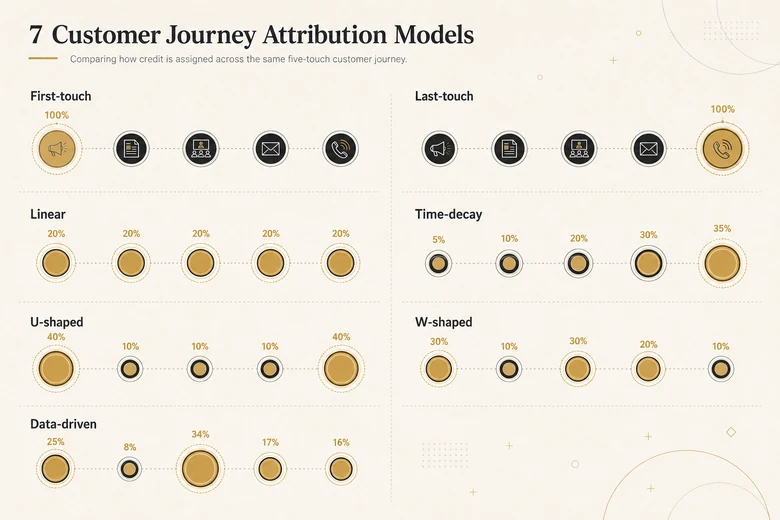
First-touch and last-touch are the two single-touch models, and they answer opposite questions. First-touch tells you what created demand, which makes it useful for judging top-of-funnel channels even though it ignores everything that closed the deal. Last-touch tells you what was nearby when the deal converted, which feels like causation and rarely is. Linear and time-decay are the gentle multi-touch options: linear treats every touch as equal, and time-decay assumes the touches nearest the close did the most work.
U-shaped and W-shaped: the B2B attribution models
The two models built for B2B are U-shaped and W-shaped. W-shaped is the pragmatic default for most B2B teams because it credits the three moments that define a real pipeline: the first touch that started the relationship, the touch that created the lead, and the touch that created the opportunity.
Credit = 30% First Touch + 30% Lead Created + 30% Opportunity Created + 10% All Other Touches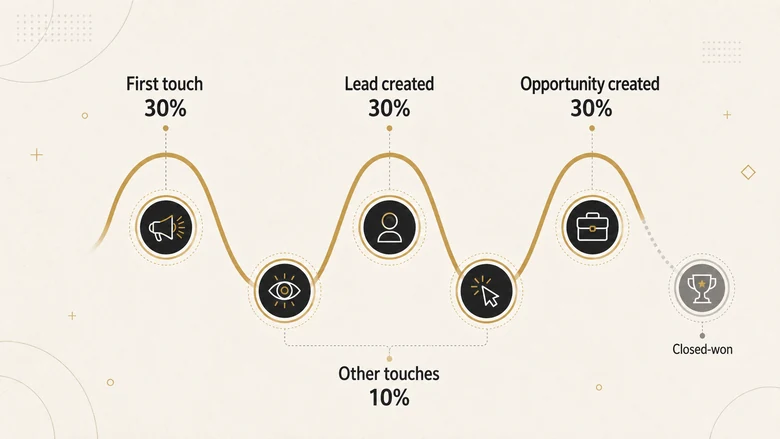
When data-driven attribution actually works
Data-driven attribution sounds like the obvious winner because an algorithm assigns the weights instead of you. In practice it needs thousands of conversions to train on, and most B2B programs close dozens of deals a quarter, not thousands. That’s the trap: the model that’s technically best for consumer volumes is usually the worst fit for B2B data, and a well-built W-shaped model beats a starved algorithm every time. Which platform runs which model out of the box is its own decision, and our rundown of the B2B attribution software that supports W-shaped and data-driven scoring compares the platforms tool by tool.
Which model when: first-touch to value demand creation, last-touch only for a throwaway directional check, linear as a neutral baseline, time-decay for short sales-led cycles, U-shaped for demand-gen teams, W-shaped as the B2B default, and data-driven only once your conversion volume and data hygiene can actually support it.
Connect touchpoints to revenue, not conversions
In B2B, the job of customer journey attribution is to tie touchpoints to pipeline and closed-won revenue, not to form fills or MQLs. A model that stops at “this campaign generated 40 leads” tells you nothing about whether those leads turned into money. The version that changes decisions maps every touch forward through the funnel: MQL, then SQL, then opportunity, then closed-won revenue booked in the CRM.
This is where most attribution setups quietly fail. They credit the touch that produced a conversion event and never reconcile it against the deal that actually closed. The fix is to anchor attribution to CRM objects, so a touch earns credit against a specific opportunity and its closed-won value in Salesforce or HubSpot, not against an anonymous form submission. When attribution shares the CRM’s revenue numbers, marketing and finance finally argue from the same spreadsheet.
A worked example: last-touch vs W-shaped credit
Here’s what that looks like on a single deal. The first touch is a LinkedIn post that pulls someone to a benchmark report. Three months later, a webinar registration creates the lead. Six weeks after that, a sales-led demo creates the opportunity. Between those milestones sit a dozen smaller touches: pricing-page visits, a comparison article, two follow-up emails. When the deal closes for $60,000, last-touch attribution hands the entire $60,000 to the branded search someone ran the morning the contract went out. W-shaped splits it the way the deal actually happened: $18,000 to the LinkedIn post, $18,000 to the webinar, $18,000 to the demo, and $6,000 across everything else. One version of that story wins marketing more budget for demand creation. The other gets it cut.
The reporting gap here is stark. Nielsen found that 84% of marketers say they’re confident measuring ROI, yet only 38% actually measure it across all channels together. That confidence gap is exactly what full-journey, revenue-anchored attribution closes, and it’s why attribution belongs next to the pipeline and revenue KPIs on your board, not in a separate channel dashboard. If you want the wider scoreboard those numbers live on, the 15 B2B marketing KPIs worth tracking set the context attribution has to feed.
Attribute at the account level, not the lead
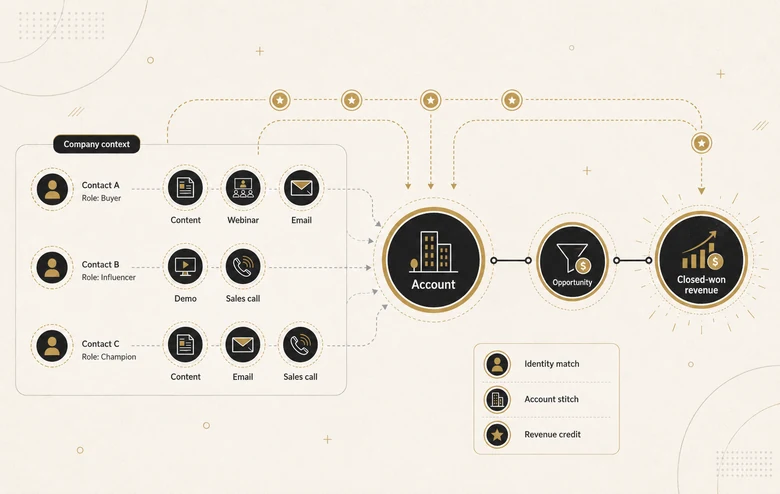
One more B2B-specific move separates good attribution from generic web analytics: it works at the account level, not the lead level. A buying group leaves a trail of separate contacts, anonymous sessions, and offline touches, and lead-to-account matching pulls them into one record so the account, not a single person, gets the credit. Tie that to expansion and retention and you can attribute revenue the same way you track the SaaS growth metrics like CAC and LTV that decide whether the motion is even profitable. Getting that rollup right is only one of the layers that decides the final number, and the four places B2B attribution silently loses credit also include the lookback window and the touches that never produced a record at all.
Why B2B attribution is harder than it looks
B2B attribution is harder than consumer attribution for three reasons: the buyer is a committee, the cycle runs for months, and most of the journey is invisible. Each one breaks an assumption that single-touch tools quietly depend on.
Start with the committee. Gartner now puts the typical B2B buying group at five to 16 people across as many as four functions. A model that credits one lead is scoring one voice in a room of a dozen. Then add time: Dreamdata clocks the average journey at 272 days from first touch to revenue, which outlasts the default 30- or 90-day lookback window in most analytics tools. If your window is shorter than your sales cycle, you’re deleting the touches that started the deal.
By the time a buying group talks to you, most of the deciding is already done, and you either made the shortlist in the dark or you didn’t.
The dark funnel and offline touches
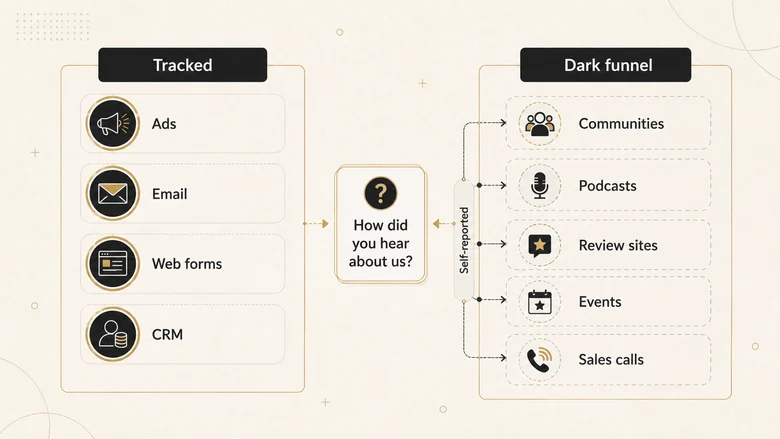
The invisibility is the hardest part. 6sense found that 94% of buying groups rank their shortlist before ever contacting a vendor, and that buyers don’t reach out until roughly 61% of the way through the journey. All the review-site reading, peer Slack conversations, and podcast mentions that built the shortlist are the dark funnel, and no cookie or UTM will ever capture them. The same goes for offline touches: the conference booth, the webinar, the sales call, the dinner. These are the touches that most often create demand, and they’re the ones your tracking is blindest to. Self-reported attribution, the simple “how did you hear about us?” field on a demo form, is the cheapest way to drag some of that dark-funnel activity into the light.
IMPORTANT
If your model only credits touches it can track with a cookie or UTM, it will systematically over-credit branded search and demo forms and under-credit the dark-funnel and offline work that actually created demand. Signal loss makes this worse, not better: even after Google reversed its third-party-cookie deprecation in 2025, consent-gated tracking keeps thinning the digital trail. Plan to feed offline and self-reported touches in by hand. The reversal moved the deadline without removing the work, because what actually survives signal loss is a collection layer where every touch carries its own source, timestamp and permission state, which is the job a first-party data operating model exists to do.
These constraints are why attribution is one node in a bigger measurement system rather than a standalone report. It sits on top of everything a team already does to understand the full B2B customer journey from first anonymous touch to renewal, and it only works when the stages beneath it are mapped honestly.
How to build a customer journey attribution model
To build customer journey attribution for B2B, connect your data to the account, define the revenue outcome, capture every touch, choose a model that fits your cycle, and validate against real deals. The sequence below produces a first working model you can defend to finance, not a perfect one.
Workflow · about half a day
How to build a B2B customer journey attribution model
A first working model that ties marketing and sales touches to pipeline and closed-won revenue, not form fills.
Define the revenue outcome you are attributing
Pick one outcome: sourced pipeline, influenced pipeline, or closed-won revenue. The outcome decides which CRM object every touch has to connect to and stops the model drifting toward vanity conversions.
Unify identity to the account
Stitch anonymous web sessions, form fills, CRM contacts, and product data into one profile, then run lead-to-account matching so the account, not one person, holds the journey.
Capture every touch, including offline and self-reported
Log events, webinars, sales calls, and “how did you hear about us?” answers alongside the digital touches. The touches you skip are the ones the model will silently under-credit.
Choose a model that fits your cycle and volume
Default to W-shaped for most B2B. Use time-decay for short sales-led cycles, and reach for data-driven only if you have the conversion volume to train it.
Map credit to CRM objects
Write attributed credit back to opportunities and closed-won revenue so marketing and finance read the same numbers instead of arguing over two dashboards.
Validate against known deals and set the lookback window
Check the model against a handful of deals you understand end to end, then fix the lookback window to your real cycle length so early touches are not deleted.
Most of this lives in tools you already run. The touch data flows out of your CRM and your marketing automation platform, once its targeting and data hygiene are sound, which is why fixing the plumbing usually matters more than buying a dedicated attribution app on day one.
Turn attribution into budget decisions
Attribution earns its keep only when it changes where the next dollar goes. A model that produces a pretty journey chart and no reallocation is a hobby. The whole reason to credit the full journey is to defend the channels that create pipeline and cut the ones that only sit near conversions taking credit they didn’t earn.
The market is already moving this way. EMARKETER found that just 21.5% of marketers are confident last-click reflects a channel’s real business impact, and most are actively moving off it. That skepticism is healthy, but it only pays off if the replacement model actually reroutes spend. When W-shaped attribution shows that a webinar series creates a third of your opportunities, the budget conversation writes itself.
Resist the urge to chase a perfect model. The teams that win with attribution pick a defensible model, wire it to revenue, and use it to make three or four real budget calls a quarter. A rough model that moves money toward demand creation beats an elegant one that just decorates a slide.
Attribution also isn’t the only lens, and treating it as gospel is its own mistake. Two cross-checks keep it honest. Marketing mix modeling measures channels top-down from aggregate spend and catches the brand and offline effects that touch-level models miss. Incrementality testing holds out a market or audience to prove a channel caused conversions rather than just sitting near them. Run one of them each quarter and you’ll know whether your attribution model is describing reality or flattering it.
Frequently Asked Questions
Customer attribution is the practice of assigning credit for a conversion or sale to the marketing and sales touchpoints a buyer interacted with. Customer journey attribution extends it across the entire journey, crediting many touches instead of one, which is what long B2B buying cycles actually require.
Single-touch attribution gives 100% of the credit to one interaction, either the first touch or the last. Multi-touch attribution splits credit across several touches using a rule or an algorithm. Single-touch is simpler but deletes most of the journey; multi-touch is the only honest option for multi-step B2B deals.
W-shaped is the pragmatic default for most B2B teams because it credits the first touch, the lead-creating touch, and the opportunity-creating touch, the three milestones that define a pipeline. Reach for data-driven only if you close enough deals to train the algorithm, which most B2B programs do not.
Anchor every touch to CRM objects rather than form submissions. Map touches forward through MQL, SQL, opportunity, and closed-won, then write attributed credit back to the opportunity and its revenue in Salesforce or HubSpot. When attribution shares the CRM’s numbers, marketing and finance measure the same thing.
Not automatically. Cookies and UTMs miss review sites, peer conversations, events, and sales calls, which is where most B2B demand is actually built. The workaround is self-reported attribution, a “how did you hear about us?” field, plus manual logging of offline touches, so the model at least sees their shadow.