Most content reports answer the wrong question. They show how much traffic a blog got and how many people shared it, then go quiet the moment someone asks whether any of it produced revenue. That gap is why a third of B2B marketers still name measuring content effectiveness as a top challenge, according to the Content Marketing Institute’s 2026 B2B benchmarks research (fielded mid-2025, 1,015 marketers).
A good content marketing metrics dashboard closes that gap. It connects the activity at the top of the funnel to the money at the bottom, in one place, so you stop reporting effort and start reporting impact. This guide covers the exact metrics worth tracking, the formula for content ROI that competitors name but never show, and how to build a dashboard that survives a CFO’s questions.
Direct answer – what is a content marketing metrics dashboard?
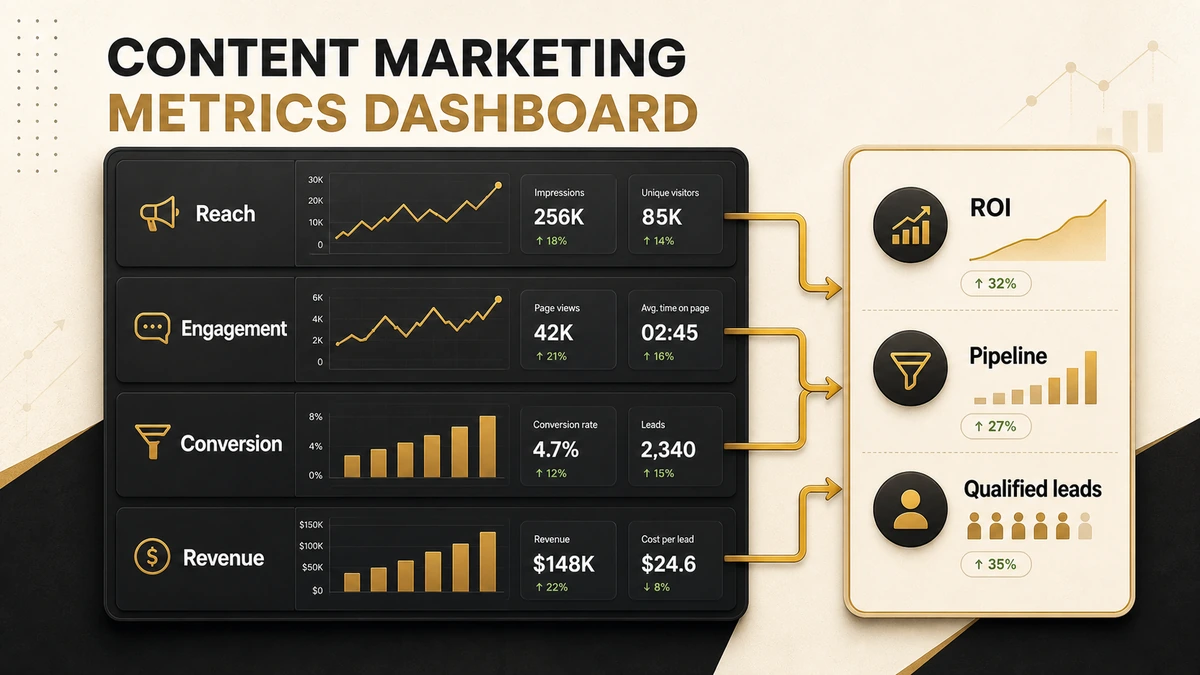
A content marketing metrics dashboard is a single view that tracks how your content performs across four funnel layers – reach, engagement, conversion, and revenue – by pulling data from analytics, search, email, and your CRM into one place. You build it by picking 8 to 12 decision-driving metrics tied to one question, mapping each to its source, and grouping them by funnel stage or audience. The key distinction: it isolates content-attributed results, not all-channel marketing performance.
Key Takeaways
- A content dashboard tracks four layers in order: reach, engagement, conversion, and revenue. Stop at the click and you only prove activity.
- Track 8 to 12 decision-driving metrics, not every number a tool exposes. More metrics lower the odds anyone reads the dashboard.
- Every metric needs a formula, a source, and a target. A number with no “good vs bad” line is decoration.
- Content marketing ROI = (revenue attributed to content − content cost) ÷ content cost × 100. Most dashboards skip the cost side.
- Build three views, not one: an ROI view for leadership, a performance view for managers, and a diagnostic view for analysts.
Before the metric-by-metric detail, it helps to know which kind of dashboard you are actually building. The three archetypes below answer different questions, and most teams need more than one.
| Dashboard type | What it shows | Use it when | Don’t rely on it when |
|---|---|---|---|
| Performance / SEO | Traffic, rankings, CTR, engagement, scroll depth | You need to see visibility and on-page behavior | You need to prove revenue; it stops at the click |
| Conversion / lead | Conversions, leads, MQLs, cost per content lead, form fills | Content’s job is pipeline, not just brand | Your sales cycle is long; conversions lag the content |
| ROI / attribution | Influenced pipeline, content-sourced revenue, content ROI | You report to finance or leadership | Your attribution data is incomplete or untrusted |
What Is a Content Marketing Metrics Dashboard?
A content marketing metrics dashboard is a centralized report that tracks how your content performs across the full funnel, from organic reach to closed revenue, by combining data from analytics, search, email, and CRM tools into one view. It exists to answer one question fast: is content producing the outcome you hired it to produce?
The word that matters in that definition is “content.” A general marketing dashboard reports on every channel at once, paid included, and rolls results into blended numbers like total leads or overall CAC. A content dashboard isolates the slice that content earned, which is harder and far more useful. If your view shows all-channel pipeline, you have built a marketing dashboard; the content question is still unanswered. For the wider scorecard that sits above this one, our breakdown of which 15 B2B marketing KPIs leaders actually decide on shows where content metrics fit into the full picture.
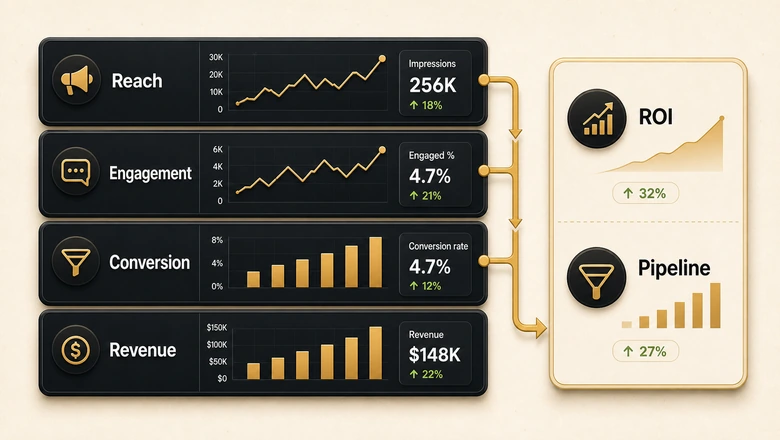
Think of the dashboard in four stacked layers, each feeding the next. Reach measures whether content gets found. Engagement measures whether it holds the right readers. Conversion measures whether those readers act. Revenue measures whether that action becomes money. A report that only covers the first two layers is the most common failure mode on the market, and it is exactly why content teams lose budget arguments.
The Metrics That Belong on a Content Marketing Dashboard
The metrics below are organized by the four funnel layers, so each one earns its place by answering a question the layer above cannot. Every row lists what it measures, how it is calculated, a sourced benchmark where a credible one exists, and the primary source you pull it from. Where no defensible industry benchmark exists, the honest target is your own trend, not a borrowed number. That fallback carries one condition worth stating, because your own trend only holds if the definition behind it never quietly changed midway through the periods you are comparing.
| Metric | What it measures | Layer | How it’s calculated | B2B benchmark (2026) | Primary source |
|---|---|---|---|---|---|
| Organic sessions | Search-driven visits to content | Reach | Sessions from the organic channel | Trend vs your baseline | GA4 / Search Console |
| Impressions & avg. position | How often and how high you show in search | Reach | Total impressions; mean rank | Trend vs your baseline | Search Console |
| Organic CTR | Share of searchers who click | Reach | Clicks ÷ impressions × 100 | Pos. 1–3 ≈ 11–28% | Search Console |
| Keyword footprint | Topics you rank for | Reach | Count of keywords in positions 1–10 | Trend vs your baseline | Semrush / Ahrefs |
| Referring domains | Earned links to content | Reach | Count of unique linking domains | Trend vs your baseline | Ahrefs / Semrush |
| Engagement rate | Share of sessions that engage | Engagement | Engaged sessions ÷ total sessions | All-industry median ≈ 56% | GA4 |
| Avg. engagement time | Attention per session | Engagement | Total engagement time ÷ sessions | B2B avg. session ≈ 78 sec | GA4 |
| Scroll depth | How far readers get | Engagement | % reaching 25 / 50 / 75 / 100% | Trend vs your baseline | GA4 (event) |
| Email engagement | Pull of content distribution | Engagement | Clicks ÷ delivered (lean on CTR) | B2B ≈ 40% open / 3.25% CTR | ESP / HubSpot |
| Content conversion rate | Visitor-to-lead from content | Conversion | Conversions ÷ sessions × 100 | Organic ≈ 4.9% | GA4 + CRM |
| Leads / MQLs from content | Qualified volume content created | Conversion | Count of form fills / MQLs attributed | Trend vs your baseline | CRM |
| Cost per content lead | Acquisition efficiency | Conversion | Content cost ÷ content leads | Trend vs your baseline | CRM + finance |
| Content-influenced pipeline | Open deal value content touched | Revenue | Σ open deal value with a content touch | Trend vs your baseline | CRM / attribution |
| Content-sourced revenue | Closed-won attributed to content | Revenue | Σ won deal value, content first touch | Trend vs your baseline | CRM / attribution |
| Content marketing ROI | Return on content spend | Revenue | (Revenue − cost) ÷ cost × 100 | Trend vs your baseline | CRM + finance |
Benchmarks sourced from Backlinko’s analysis of 4M search results (CTR), Databox GA4 benchmarks (engagement rate and session duration), GetResponse email benchmarks, and Ruler Analytics’ 2026 conversion benchmarks (110M+ sessions). Open rate is inflated by Apple Mail Privacy Protection, so weight clicks over opens.
Reach: Did the Content Get Found?
Reach metrics tell you whether content is visible, and they are where most dashboards spend too much real estate. Organic sessions, impressions, and rankings matter, but the metric that actually moves is organic CTR, because rankings without clicks are vanity. Position one earns roughly 28% of clicks while position three earns about 11%, per Backlinko, so a page that climbs from five to three can double its traffic with no new content. CTR is also where AI Overviews now eat into results, which is its own discipline; our guide to earning citations inside AI Overviews covers how to keep clicks when the answer box appears above you.
Add branded search volume and share of voice when you want reach to reflect brand pull, not just page-level ranking. Both connect the dashboard back to the strategy it measures, because reach is the output of topic and cluster decisions made upstream; the planning that drives it sits in our framework for building a content strategy that ranks for B2B. Treat any reach metric as a leading indicator, never as the proof of value, and keep it on one or two tiles at most.
Engagement: Did It Hold the Right Readers?
Engagement separates a page people land on from a page people read. GA4’s engagement rate is the cleanest signal here because it has a defensible definition: an engaged session lasts longer than 10 seconds, fires a key event, or includes two or more pageviews, per Google’s official documentation. Pair it with scroll depth and average engagement time, and you can tell whether a 2,000-word guide actually gets read or just gets opened. Raw bounce rate, by contrast, lies constantly on blog pages, where a high figure often means the reader got their answer.
Engagement metrics also double as a refresh trigger. When engagement time or scroll depth on a once-strong page slides for two reporting periods in a row, that page is decaying and belongs on a refresh list, not in the archive. Wiring that signal into the dashboard turns it from a scorecard into a work queue, which is the difference between a report people glance at and one they act on.
Conversion: Did Readers Act?
Conversion is where content stops being a cost center on paper. Track content conversion rate, the leads or MQLs each piece produces, and the cost per content lead. B2B organic content converts at about 4.9% on average across Ruler Analytics’ 2026 dataset, though your number depends heavily on offer and intent. The deeper architecture behind that rate, gated versus ungated, lead magnets, and the path from post to pipeline, is the subject of our system for turning content into a repeatable lead engine.
Segment conversion by content format, because a blended rate hides the decisions worth making. A comparison post, a calculator, and a thought-leadership essay convert at wildly different rates and serve different funnel jobs, yet most dashboards average them into one meaningless figure. Break conversion out by format and the dashboard starts telling you what to produce more of, which is the question a content manager actually has.
Revenue: Did It Make Money?
Revenue is the layer competitors name and skip. Content-influenced pipeline and content-sourced revenue both require an attribution model, and the model you pick decides what counts; choosing one well is a project of its own, which is why teams reach for dedicated B2B attribution software once spreadsheets stop coping. The single most important revenue metric, though, is content marketing ROI, because it forces the cost side into the conversation.
Content Marketing ROI = (Revenue Attributed to Content − Content Cost) ÷ Content Cost × 100Work a real example. Say a pillar guide costs $2,400 to produce and promote, counting the writer, an editor, design, and three months of distribution. Over the next year it is the first touch on six deals that close for $48,000 in won revenue. Apply a conservative 20% content-attribution weighting and content gets credit for $9,600. ROI is (9,600 − 2,400) ÷ 2,400 × 100, which lands at 300%. The number is only honest because the cost side is real, and that is precisely what a pageviews chart can never tell you.
IMPORTANT
Content-attributed is not the same as all-channel. If a metric on your dashboard counts leads paid search also touched, you are crediting content with revenue it shared. Define attribution rules before you build, not after leadership asks.
Vanity Metrics vs Decision-Driving Metrics
The fastest way to ruin a dashboard is to fill it with numbers that go up without telling you what to do. A vanity metric feels good and changes no decision. A decision-driving metric is one where a move up or down should trigger a specific action. The table below pairs the common offenders with the replacement that earns the same row.
| Vanity metric | Why it misleads | Decision-driving replacement | Decision it informs |
|---|---|---|---|
| Total pageviews | Counts bots, bounces, and wrong-fit readers | Qualified organic sessions by ICP | Which topics attract real buyers |
| Social shares | Applause rarely maps to pipeline | Content-influenced pipeline | Whether social content earns revenue |
| Email list size | A big list can be a dead list | Email-to-opportunity rate | Whether the list is actually qualified |
| Raw bounce rate | High is normal when content answers fast | Engagement rate + scroll depth | Whether the page holds the right reader |
| Total content published | Output is not outcome | Content conversion rate by format | Which formats to make more of |
| Average position alone | Rank without clicks is invisible | Organic CTR + conversions | Whether rankings turn into demand |
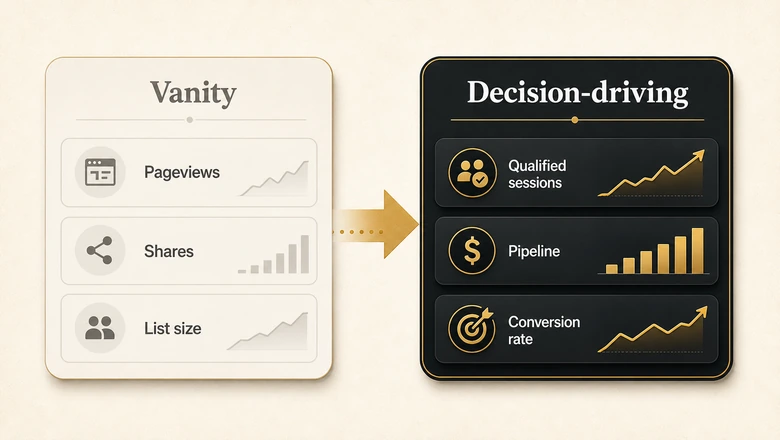
None of the left-column metrics are banned. Keep one or two as context if your leadership expects them, but never let them headline the dashboard. The test is simple: if a number moves and nobody changes what they do next, it does not belong on the main view.
How to Build a Content Marketing Dashboard
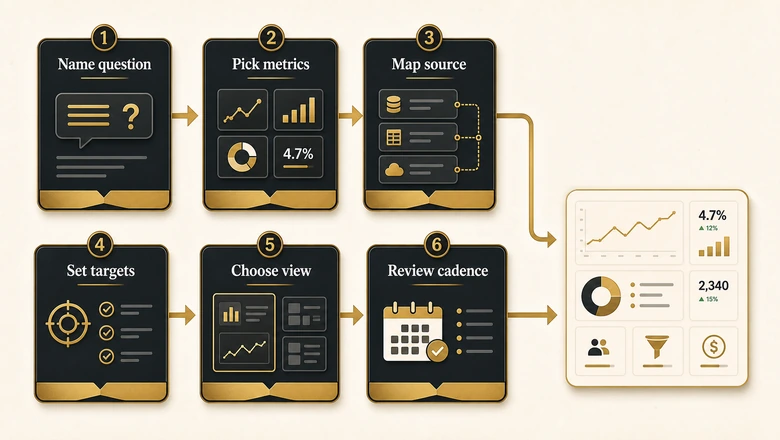
Building the dashboard is less about the tool and more about discipline in what you include. The sequence below works whether you assemble it in a spreadsheet, a free BI tool, or a paid reporting platform. Resist the urge to start by connecting data; start by naming the decision.
Workflow · about 2 hours
How to build a content marketing metrics dashboard
Turn scattered analytics into one decision-ready view by choosing metrics before tools and grouping them by funnel stage.
Name the one question and its owner
Write the single decision this dashboard exists to support and who makes it. “Is content returning money?” and “which posts to refresh next?” need different views.
Pick 8 to 12 decision-driving metrics
Choose across all four layers, reach through revenue. If a metric would not change the owner’s next action, leave it off.
Map each metric to its source system
Assign every metric one source of truth: GA4 and Search Console for reach and engagement, the CRM for leads and revenue, the ESP for email.
Choose a build approach to fit team maturity
Use a spreadsheet to start, a free BI tool like Looker Studio to automate, or a paid reporting platform once manual pulls eat real hours.
Lay it out by funnel stage or audience
Group tiles top to bottom in funnel order, or split into separate views per audience. Put the most actionable number first.
Set a target, a threshold, and a cadence
Give every metric a goal line and an alert level, then fix a review rhythm. A dashboard nobody reviews on a schedule quietly dies.
On tooling, stay neutral and match the stack to the job. The free layer covers most teams: GA4 and Search Console for behavior and search, Looker Studio to visualize them together. Add a CRM for revenue data and an SEO platform for rankings and links. The point is the metric model, not the logo.
Whatever you connect, get the source data clean first, because a dashboard inherits every flaw in its inputs. A miscounted key event or a broken UTM convention in GA4 will quietly poison every tile downstream, so the setup work behind the numbers matters as much as the layout; our walkthrough on configuring GA4 for B2B traffic and pipeline covers the tracking that has to be right before a dashboard is worth trusting. Note the data freshness of each source too, since CRM revenue lags live traffic by days, and a view that mixes real-time and delayed data invites the wrong conclusion.
PRO TIP
Before you connect a single data source, write the dashboard’s one-line purpose at the top of the file. Every metric you are tempted to add gets one test: does it help answer that line? If not, it goes in a backup tab, not the main view.
Dashboard Views by Audience: Executive, Manager, Analyst
A single dashboard rarely serves three audiences who ask three different questions. Leadership wants to know if content pays. Managers want to know what to fix this week. Analysts want to know why a number moved. Build one view per question rather than one crowded screen that satisfies none of them.
| View | Audience | Question it answers | Metrics shown | Refresh cadence |
|---|---|---|---|---|
| ROI view | CMO, leadership, finance | Is content returning money? | Content-sourced revenue, influenced pipeline, content ROI, cost per content lead | Monthly / quarterly |
| Performance view | Content & demand-gen managers | What’s working and what to fix? | Organic sessions, conversions, conversion rate by format, leads / MQLs | Weekly |
| Diagnostic view | SEO, analysts, ops | Why did the number move? | CTR by query, rankings, engagement rate, scroll depth, data-quality checks | Daily / on demand |
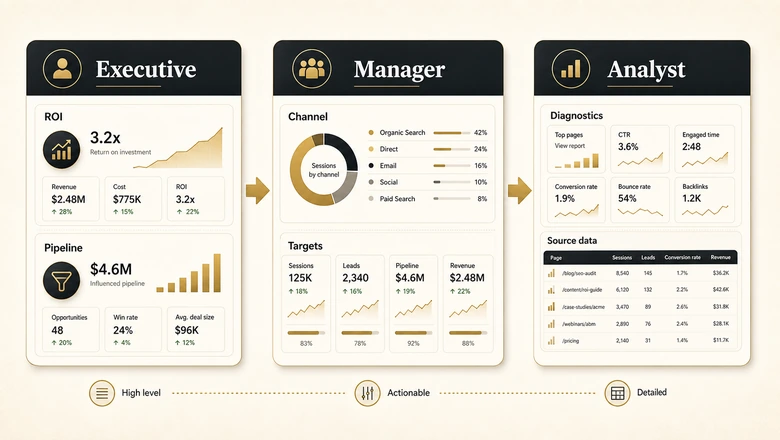
Use the ROI view when you present to leadership or defend budget; it stays high and ties to revenue. Use the performance view for the weekly content stand-up, where the job is to spot wins to scale and pages to refresh. Use the diagnostic view when a headline number moves and someone has to find out why before the next report. Pick the view by who is asking, not by which one looks fullest.
Mistakes That Make a Content Dashboard Useless
Dashboards fail in predictable ways, and almost all of them trace back to skipping the discipline above. The first is blending content results with all-channel numbers, which quietly credits content with revenue other channels earned. Isolate the content slice or the report answers a different question than the one you asked.
The second is trusting one number when two systems disagree. GA4 and your CRM will report different lead counts because they define a lead differently and tag sessions differently. The fix is not to pick the friendlier figure; it is to define the metric once, choose a single source of truth for it, and segment consistently so the gap is explainable rather than embarrassing.
The third is shipping a dashboard with no targets. A metric without a goal line and a threshold is a fact, not a signal, and facts do not drive action. The fourth is overload: a 40-tile screen no one reads beats a 10-tile screen no one needs, every time. Trim ruthlessly, assign an owner, and protect the review cadence, or the dashboard becomes another tab nobody opens.
Frequently Asked Questions
Content marketing metrics are the data points that measure how content performs across the funnel. They fall into four layers: reach (organic sessions, impressions, CTR), engagement (engagement rate, scroll depth, time on page), conversion (leads, content conversion rate), and revenue (influenced pipeline, content-sourced revenue, ROI). The strongest sets favor decision-driving metrics over vanity counts.
Include 8 to 12 metrics spread across all four funnel layers, never just reach and engagement. A practical core: organic sessions, organic CTR, engagement rate, content conversion rate, leads or MQLs from content, content-influenced pipeline, content-sourced revenue, and content marketing ROI. Add one or two context metrics only if leadership expects them.
The five most cited marketing metrics are customer acquisition cost (CAC), customer lifetime value (CLV), return on investment (ROI), conversion rate, and churn rate. Together they cover acquisition efficiency, customer value, profitability, demand, and retention. On a content dashboard, conversion rate and ROI carry the most weight because they tie content directly to outcomes.
Content marketing ROI = (revenue attributed to content − content cost) ÷ content cost × 100. Revenue comes from your attribution model, and cost must include production, tools, and promotion, not just writing. If a $2,400 asset is credited with $9,600 in attributed revenue, ROI is 300%. The cost side is what most reports leave out.
A marketing dashboard reports on every channel, paid included, and blends results into totals like overall leads or CAC. A content marketing dashboard isolates the results content earned, from organic reach to content-sourced revenue. The content view answers whether content specifically pays, which the blended marketing view hides. Many teams run both, with clear roles.