
Almost every first-party data guide published in the last two years opens with the same premise: third-party cookies are going away, so you need to own your data. That premise is now wrong. In April 2025 Google decided to keep the existing third-party cookie choice in Chrome and drop the planned standalone prompt. In October 2025 it went further and retired ten Privacy Sandbox technologies, including the Attribution Reporting API, Protected Audience and Topics.
The countdown ended. The problem did not. Browser and privacy fragmentation is still real, and B2B teams still cannot answer basic questions about their own data: which system is authoritative for a job title, who approved sending that audience to LinkedIn, whether the person who filled in the form last March is still contactable for that purpose.
Those are not cookie questions. They are operating questions, and a B2B first-party data strategy that does not answer them is a slide, not a strategy.
Direct answer — What is a B2B first-party data strategy?
A B2B first-party data strategy defines why data is collected, how it is validated, how sessions, devices, people, accounts and opportunities are linked, who owns each field and system, which uses are permitted, how data is activated, and how quality and revenue outcomes return to the model. It is an operating model, not a CRM purchase, a CDP purchase or a cookie replacement. First-party describes where data came from, not whether it is consented, accurate or usable.
Key Takeaways
- First-party is a provenance label. It says data came from your own direct interactions. It does not certify consent, accuracy, completeness or lawful use for any specific purpose.
- Track provenance at field level, not database level. A CRM holds direct, appended, purchased, partner and inferred data side by side.
- B2B needs five identities, not one customer ID: session, device, person, account and opportunity, joined by reversible links with confidence and validity dates.
- A CDP is one implementation pattern, not a requirement. CRM-centric, warehouse-composable and hybrid architectures deliver the same capabilities with different trade-offs.
- Activation without a return path is not activation. Delivery, match, suppression and revenue outcomes have to flow back to the model that produced the audience.
- Publish quality formulas with entity, denominator, rule set and period attached, or the numbers are not comparable to anything.
What counts as B2B first-party data
B2B first-party data is data your organisation collects or creates through its own direct interactions and operations with prospects, customers, users, partners and accounts. The definition describes provenance and nothing else. It is a statement about origin, not a quality badge.
Most guides stop at “data you collect yourself” and move on. That is where the operating problems start, because eight different kinds of data behave differently once you try to govern them.
| Type | What it is | What it is good for | Where it breaks |
|---|---|---|---|
| Observed | Recorded behaviour and system events: content views, form successes, product actions, stage changes | Timing, interest, propensity | Meaningless without event definitions and versions |
| Declared | What a person or authorised representative intentionally tells you: role, needs, budget range, preferences | Fit, routing, personalisation | Self-reported, decays fast, often marketed as “zero-party” |
| Transactional | Orders, invoices, subscriptions, contracts, renewals, opportunity stages and amounts | Revenue truth, segmentation | Lives in finance and CRM systems with different owners |
| Engagement | Email clicks, meeting attendance, chat, campaign responses | Relationship strength | Reliability varies by channel; treat email opens as weak |
| Identity | Identifiers and contact points that distinguish sessions, devices, people, accounts and opportunities | Joining everything else | Useless without a namespace and a source |
| Permission | Purpose, channel, jurisdiction, status, timestamp, notice version, withdrawal history | Deciding what you may do | Modelled as a single checkbox in most CRMs |
| Account | Organisation-level attributes and relationships | Targeting, tiering, territory | Only first-party where you collected it directly |
| Derived | Scores, segments, predictions, classifications | Prioritisation | Gets confused with observed fact once written back |
Table 1. Data-type taxonomy for B2B first-party data. Source: IVRIS synthesis of public regulatory guidance, open standards and official platform documentation. Classification is IVRIS-owned; no source is represented as endorsing the synthesis.
Provenance belongs to the field, not the database
The account row is where most B2B teams quietly lose the plot. Industry codes, employee counts and installed technologies bought from a vendor stay third-party in origin no matter how long they sit in your CRM, which is why the practical distinctions in how firmographic and technographic fields are actually sourced matter more than the label on the database they live in. The same logic applies to appended contact and company attributes: enrichment changes what you know, not where the data came from, and the provenance flag has to survive the write.
Derived data deserves the same discipline. A propensity score built partly on purchased signals is not an observed fact about the account, and third-party intent signals stay third-party once they feed a model. Keep the model version and input lineage attached, or in six months nobody will be able to say what the number meant.
Three things first-party data is not
Three claims appear on nearly every page ranking for this topic. All three are wrong, and correcting them is the fastest way to improve how your team actually handles data.
It is not automatically consented
“You collected it, so you have consent” conflates two separate objects. Provenance describes collection. Permission describes what a specific purpose, channel, audience type and jurisdiction allow. The GDPR text makes the separation explicit: Article 5(1)(b) requires that personal data be “collected for specified, explicit and legitimate purposes”, while Article 6 sets out the lawful bases for processing. Those are different tests, applied separately.
Consent is one possible basis among several, and B2B adds its own complications: rules can differ by communication channel and by whether the subscriber is a corporate entity or an individual, sole trader or partnership. The practical instruction is to stop writing “consent required” as a global rule. Write “identify the applicable lawful basis or permission rule” and attach the jurisdiction, channel and purpose that make the answer specific.
It is not automatically accurate
Direct collection removes some intermediaries. It does not make data current, complete, correctly keyed or free of duplicates. The UK Government’s Data Quality Framework defines quality as fitness for purpose and warns directly against the confusion that causes most of the damage: a complete data set may still hold incorrect values, which makes it complete and inaccurate at the same time. It names six dimensions, and completeness and accuracy are two of them, not synonyms.
It is not everything in your CRM
A CRM is a container, not a provenance category. Open any mature B2B instance and you will find directly submitted form data, purchased contact records, partner-supplied lists, vendor-appended firmographics, imported event lists and machine-generated scores in adjacent columns of the same object. Labelling the whole system “first-party” destroys the distinction you need when legal asks where a field came from.
IMPORTANT
Provenance, permission and quality are three separate fields, not one. A record can be directly collected, impermissible for the channel you want, and stale, all at once. Store them separately or you will not be able to answer a rights request or an audit question without a manual investigation.
Start with purpose, not collection
The first artefact in a first-party data strategy is not a source inventory. It is a purpose register, because purpose determines the minimum data and the retention rule, not the other way round. Article 5(1)(c) of the GDPR requires that data be “adequate, relevant and limited to what is necessary in relation to the purposes for which they are processed”, which is impossible to satisfy if the purpose is written after the collection.
A purpose register row commits ten things: purpose ID, use case and business outcome, target entity, the decision or action it drives, minimum fields and events, permission rule, retention, approved destinations, accountable owner and success metric. “Collect more data” is not a use case and should be rejected at the register.
Two or three purposes is the right starting scope. Teams that register twenty purposes in the first workshop produce a document nobody maintains.
The IVRIS operating architecture
An operating architecture describes capabilities and controls, not products. Six layers do the work, with a control plane running alongside them and a feedback loop running back through them.
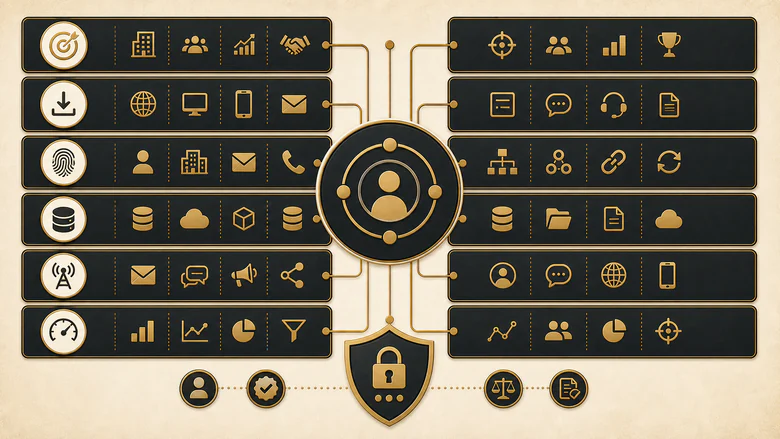
- Purpose. Approved use cases, minimum data, retention, permission rules.
- Collection and contracts. Owned touchpoints, event definitions, validation, versions.
- Identity. Session, device, person, account and opportunity, with explicit relationships.
- Systems of record. The authoritative source for each field, named at field level.
- Activation. Controlled use in a destination, with a permission filter in front of it.
- Measurement. Quality, coverage and commercial outcome, returned to the model.
The control plane cuts across all six: ownership, lineage, access, retention, change control and incident handling. The feedback loop is what separates an architecture from a diagram, and it is the piece almost every competing guide omits.
Figure 1. Capability-based operating architecture. Source: IVRIS synthesis of public regulatory guidance, open standards and official platform documentation. Architecture is an IVRIS conclusion and does not imply that a CDP is required.
Design the collection and event taxonomy
Collection becomes governable at the moment events stop being ad-hoc tags and start being defined objects. An event definition needs a business definition, a trigger, an entity, required properties, identity keys, an event ID for deduplication, event time and ingest time as separate fields, a purpose reference, a retention rule, a schema version and a deprecation path.
The minimum viable set for B2B covers six domains.
| Domain | Minimum events |
|---|---|
| Acquisition and content | content_view, cta_click, form_start, form_submit, form_success, asset_download, webinar_register, webinar_attend |
| Communication and meetings | email_delivered, email_clicked, email_unsubscribed, meeting_booked, meeting_completed, call_completed, chat_started |
| CRM and identity | lead_or_contact_created, contact_account_associated, identity_linked, identity_unlinked, consent_updated |
| Commercial | opportunity_created, opportunity_stage_changed, opportunity_closed, contract_started, renewal_due |
| Product and service | account_created, trial_started, trial_activated, product_key_action, support_case_opened, support_case_resolved |
| Activation and measurement | audience_qualified, activation_sent, activation_delivered_or_matched, activation_suppressed, activation_outcome |
Table 2. Minimum viable event set for B2B collection and measurement. Source: IVRIS synthesis informed by open telemetry and event-specification standards and official platform documentation.
Note what is deliberately split: form_submit and form_success are different events, because a submitted form that failed validation is a different business fact from a captured lead. That distinction is also where campaign attribution quietly dies, since the hidden fields carrying source and campaign values are exactly what arrive empty when the form context breaks. You can check whether your own forms render the hidden-field coverage you expect with the IVRIS Web Form Audit.
Upstream of the form, the campaign values themselves need the same contract discipline. Inconsistent source and medium strings produce channel groupings that nobody trusts by quarter three, which is why a pre-launch gate on every campaign URL belongs in the collection layer rather than the reporting layer.
PRO TIP
Record event time and ingest time as separate fields from day one. Retrofitting the distinction after a year of data means you can never say whether a freshness problem was a collection delay or a pipeline delay. That pair is also what makes an expiry rule enforceable rather than advisory, because every signal class carries its own validity window and none of them can be applied to a signal whose true age you cannot reconstruct.
Resolve B2B identity without collapsing entities
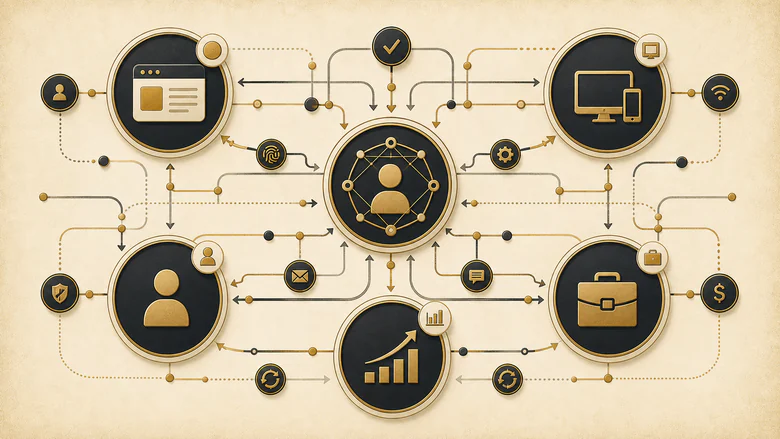
Business-to-business identity does not reduce to one customer profile. Five identities answer five different questions, and merging them destroys information you cannot recover. The same collapse happens one layer up in the metrics, where collapsing company and person resolution into a single percentage produces the largest number on the page and measures nothing, because the two sets overlap.
| Identity | Answers | Cardinality trap |
|---|---|---|
| Session | What happened in one bounded visit? | Not a person; may need user plus session ID to be unique |
| Device | Which browser or app installation? | Pseudonymous; does not reliably equal one human |
| Person | Which human contact? | One person, several devices and email addresses |
| Account | Which organisation? | One person can relate to several accounts |
| Opportunity | Which specific deal? | Many contacts per deal, many deals per account |
Table 3. Five B2B identities and their relationships. Source: IVRIS synthesis using official Google Analytics, Salesforce, HubSpot and Adobe identity documentation.
The platform documentation supports every one of these distinctions. Google Analytics 4 treats User-ID as separate from Device ID and warns that assigning the same ID to multiple users skews the data, which is the same failure as a bad merge in a CRM. HubSpot models contacts, companies and deals as many-to-many associations with typed labels rather than a single flattened record. Salesforce provides OpportunityContactRole as an explicit junction between contacts and opportunities, carrying a role and a primary flag. Adobe’s XDM IdentityMap keys identities by namespace with a primary indicator and an authenticated state.
Four rules for the identity graph
Preserve source IDs rather than overwriting them with a golden record. Namespace every identifier so an email address from a form and one from a purchased list are distinguishable. Attach confidence and valid-from and valid-to dates to every link. Make merges reversible, because a wrong merge that cannot be unmerged is permanent data loss.
The person-to-account relationship is the one that most often gets modelled as a single foreign key. In practice a buying committee spans six to thirteen people across functions and sometimes across legal entities, and a contact who moves employer does not stop existing. Analytics identity rules deserve the same scrutiny, and the session and user distinctions in a properly configured GA4 property are the cheapest place to see the model working or failing.
Govern fields, contracts and systems of record
Governance stops being a policy document when producers and consumers share versioned contracts. The Open Data Contract Standard is a useful reference shape here: it organises a contract into schema, data quality, service levels, team, roles, support, references and custom properties, all machine-readable.
Three artefacts carry the load.
Field ownership and systems of record
Name the authoritative source per field, not per application. Job title may be authoritative in the CRM while employee count is authoritative in the enrichment feed and contract value is authoritative in billing. One universal master system is a fiction in most B2B stacks, and pretending otherwise produces silent overwrite wars.
Data contracts
A contract carries meaning, schema, allowed values, owner, quality expectation, service level, security class, version and deprecation window. A contract that cannot fail is not a contract, so each one names what happens when validation breaks and who is paged.
Lineage
OpenLineage models lineage as datasets, jobs and runs with extensible facets, which is a good mental model even if you never adopt the standard. You need to be able to say where a value originated, which job last touched it and which destinations consumed it.
Accountability
Then assign accountability. One accountable owner per activity, no exceptions and no committees in the A column.
| Activity | A | R | C |
|---|---|---|---|
| Approve use case and outcome | Executive or data council | Business data owner | Privacy, RevOps, activation owner |
| Define purpose, minimum data, retention | Business data owner | Data steward, privacy | Engineering, security |
| Name system of record and field owner | Business data owner | Data steward, engineering | Privacy, RevOps |
| Approve event or field contract | Business data owner | Data steward, engineering, RevOps | Privacy, security |
| Define identity rules and conflict handling | Business data owner | Data steward, engineering, RevOps | Privacy, analytics |
| Map permission and suppression rules | Privacy or legal | RevOps, activation owner | Data steward, security |
| Approve destination activation | Business data owner | Privacy, RevOps, activation owner | Security, analytics |
| Monitor quality SLA and resolve defects | Business data owner | Data steward, engineering, RevOps | Privacy, analytics |
| Operate change and deprecation control | Business data owner | Data steward, engineering, RevOps | Privacy, security |
| Approve AI retrieval, training or inference use | Business data owner | Engineering, privacy, security, analytics | RevOps |
Table 4. Condensed governance responsibility matrix. A = accountable (one owner), R = responsible, C = consulted. Full fourteen-activity version with informed roles and escalation SLAs is in the downloadable workbook. Source: IVRIS synthesis.
This is the layer where RevOps ownership of data governance stops being a job-description line and becomes a named person per field. If you cannot fill the A column for every row above, that gap is your real maturity score.
Choose a storage and platform pattern
Four patterns deliver these capabilities. None of them is universally correct, and a customer data platform is one option rather than the answer.
| Pattern | Fits when | Main trade-off |
|---|---|---|
| CRM-centric | Sales-led motion, modest event volume, small data team | Weak event history and limited identity control |
| Warehouse or composable | Existing data team, high event volume, strong governance need | Slower activation, needs engineering to stay usable |
| Packaged CDP | Many destinations, marketing-owned activation, limited engineering | Cost, and identity logic hidden inside a vendor abstraction |
| Hybrid | Warehouse as source of truth, CDP or reverse ETL for activation | Two systems to govern, and drift between them |
Table 5. Four implementation patterns against one capability checklist. Source: IVRIS synthesis. No pattern is recommended universally.
Judge any of them against the same list: can it hold field-level provenance, can it express five identities with reversible links, can it version an event schema, can it filter activation by permission, can it return delivery and outcome feedback, and can it show lineage. A product that fails four of those is not made adequate by the category name on the invoice.
The boundary question that comes up first in most stacks is which of CRM and marketing automation owns which object, and answering that honestly usually removes the perceived need for a third system.
Activate with policy and feedback
Activation is a controlled use of data in a destination, and every activation needs a contract of its own: use-case ID, audience definition and version, input payload, permission filter, destination and owner, delivery metric, outcome feedback and an expiry rule.
Destination constraints are real and specific, which is why they belong in the contract rather than in someone’s memory. Google Ads Customer Match lists carry a maximum membership duration of 540 days, and a list must keep at least 100 members added or updated within that window to stay eligible. LinkedIn Matched Audiences splits into website retargeting, contact targeting and company targeting, and the company path is the one that matches how B2B actually buys.
A connector is not an activation. The test is whether five things exist: the audience is policy-filtered before it leaves, the destination owner is named, delivery or match results come back, commercial outcomes come back, and suppression reasons are recorded. Most stacks pass the first and fail the rest.
The return path is where first-party data earns its keep. Closing the loop from a delivered audience to a created opportunity is the same problem as crediting an account where twenty-two people touched the deal, and it depends on the opportunity identity being modelled properly upstream. That is also why the same deal can produce six defensible answers depending on which model reads it, and why the feedback event needs to carry the identity link rather than a channel label.
Measure quality and coverage with published formulas
These are IVRIS operating metrics, not market benchmarks. Each one requires you to publish entity, eligible population, required field or event set, rule set, authoritative timestamp, exclusions and measurement period. Two organisations reporting “92% complete” are not comparable unless all seven match.
Validly populated required fields ÷ (Records in scope × Required fields)Validly populated excludes null, blank, placeholder and values failing a format rule. Report field-level rates next to any roll-up, because a weighted average hides the one field that blocks activation.
Entity-field pairs within SLA ÷ Total authoritative entity-field pairsMeasure against source-system time, not warehouse load time, and publish median and 95th-percentile age alongside the coverage rate. A single percentage hides the tail, which is where the damage lives. dbt’s source freshness checks are a practical implementation reference, including the sensible rule that freshness jobs should run at roughly double the frequency of the tightest SLA.
Σ (cluster size − 1) ÷ Records in scopeReport person and account duplication separately and review false merges alongside false splits. A unique-email rule is not sufficient for B2B, where shared inboxes and role addresses are common.
Combinations with current traceable permission ÷ Eligible purpose × channel × person combinationsCall it consent coverage only when consent is genuinely the required state. Otherwise permission coverage is the honest name, and the jurisdiction and notice version stay attached.
Use cases live, filtered, tested and returning feedback ÷ Approved use-case × destination combinationsAll five conditions must hold for a combination to count. A live connector with no outcome feedback scores zero, which is the point. Identity resolution coverage follows the same shape, reported separately for session-to-person, person-to-account and opportunity linkage rather than as one blended number, and the measurement discipline it takes to keep those honest is the same one that makes multi-touch journey analysis worth running at all.
Assess maturity with observable gates
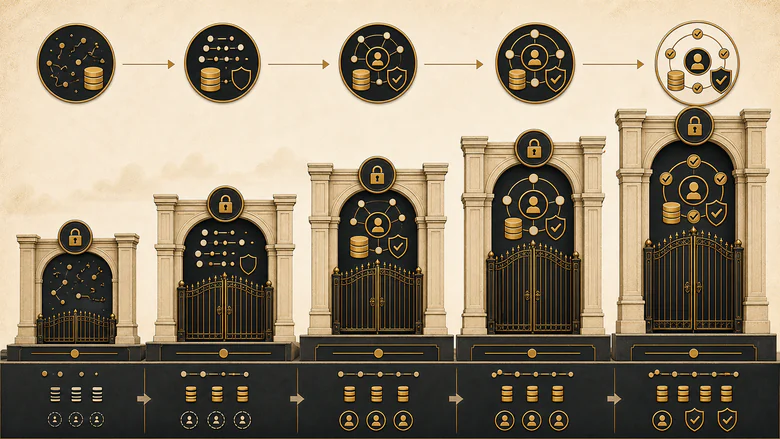
Maturity levels are gated, not averaged. You sit at the highest level whose mandatory controls all pass. A missing privacy, identity or change-control gate is not offset by strength elsewhere, and no level can be bought.
| Level | Passes when |
|---|---|
| 0. Uncontrolled | No approved purpose register, incomplete inventory, unknown permission propagation. Do not scale activation. |
| 1. Instrumented | Priority use cases named, minimum event and field dictionary exists, pilot data traceable from source to report. |
| 2. Governed | Named owners, versioned contracts, retention and access rules, automated validation, live change and incident process. Controls operate, not just documents exist. |
| 3. Resolved and activated | Measured identity links, policy-aware activation across two or more destinations, suppression and commercial feedback, reviewed quality SLAs. |
| 4. Assured and adaptive | End-to-end lineage, automated policy enforcement, reversible identity unmerge, AI data and use registration with evaluation. |
Figure 2. Observable maturity gates. Source: IVRIS synthesis. Level is determined by observable controls, not technology ownership.
Run the implementation sequence
Ten phases take a team from ambition to a governed loop. The first pass through phases one to seven fits in a quarter for most mid-market B2B teams if the scope stays at two or three use cases.
Workflow · 90 min workshop
How to build a B2B first-party data operating model: the 90-minute governance workshop
Take one use case from ambition to committed backlog, with named owners and defined contracts, in a single working session.
Select one use case and outcome
Name the business outcome, target entity, the decision it drives, approved destinations and the accountable owner. Reject “collect more data” as a use case.
Map purpose and minimum data
Write the purpose ID, required fields and events, permission rule, retention period and success metric. Cut any field nobody can tie to the outcome.
Map identities and systems of record
List session, device, person, account and opportunity IDs with their namespaces and source systems. Name the authoritative source for each field in scope.
Define contracts and quality rules
Agree event and field definitions, validation rules, freshness thresholds, deduplication rules, owners and service levels. Record what happens when each one fails.
Assign RACI and change control
Put one accountable name against every activity in the governance matrix. Define the escalation path and the deprecation process for retiring a field or event.
Design activation and feedback
Specify payload, destination, permission filter, suppression rules, delivery or match metric and the commercial outcome event that returns to the model.
Commit the backlog
Record every decision, unresolved risk, owner and due date. Anything without a name and a date did not get decided.
After the workshop, phases eight to ten run continuously: operate the quality and governance loop, expand only by approved use case rather than because a connector exists, and add AI last as a governed destination with registered purpose, source lineage and evaluation ownership.
PRO TIP
Run the whole workshop once with fictional records before you use it on real data. Ambiguities in your own field definitions surface in about twenty minutes, and finding them on invented data costs nothing.
Seven failure modes worth naming
Each of these is common, cheap to prevent and expensive to unwind. The fifth is the one this article opened with, and it is worth seeing on a timeline: the deadline that justified a generation of first-party data strategy decks was cancelled in April 2025 and then partly dismantled in October 2025.
| Failure mode | What it looks like | Control |
|---|---|---|
| Collecting before purpose | Tracking plan written by whoever built the tag | Purpose register gates the field list |
| CRM provenance blindness | “It’s in the CRM so it’s first-party” | Provenance flag at field level |
| One-ID thinking | Golden record overwrites source IDs | Namespaced graph with reversible links |
| Blanket consent | Single opt-in checkbox drives every channel | Permission modelled by purpose, channel and jurisdiction |
| Stale cookie narrative | Strategy justified by a phase-out that did not happen | Rationale built on relationship value and governance |
| Connector without feedback | Audience syncs, nobody knows what happened | Delivery and outcome events required before go-live |
| AI data dumping | Everything piped into a retrieval index | AI registered as a destination with purpose and lineage |
Table 6. Failure modes and their controls. Source: IVRIS synthesis.
The last one is getting more expensive quickly. An AI system does not neutralise a permission problem, it multiplies it, because inference creates new data about people from inputs that were collected for something else. Treat retrieval indexes, feature stores, training sets and model outputs as registered activation assets with source and permission lineage attached.
Where to start this quarter
Pick one use case with a named owner and a revenue outcome. Write its purpose register row. Name the system of record for every field it needs. Publish one event contract and instrument one path end to end, proving that permission state survives the journey. Activate it to one destination that supports suppression and returns delivery data. Then review what broke.
That sequence produces something no maturity slide does: evidence about your own stack. If you want a second pair of eyes on the tracking, identity and activation design before committing engineering time, an IVRIS first-party data operating audit covers exactly that ground, and it works with the CRM, warehouse or marketing automation platform you already run. Tell us what you are trying to activate and we will tell you what is missing.
Frequently Asked Questions
No. A CRM stores data of mixed provenance: directly submitted form data, purchased contact lists, partner-supplied records, vendor-appended firmographics and machine-generated scores. First-party describes how data was obtained, not where it is stored. Track provenance as a field-level attribute so legal and quality reviews can trace any value to its origin.
Not automatically. Consent is one lawful basis among several, and the requirement depends on jurisdiction, purpose, channel and the type of subscriber or contact involved. Rules for business contacts can differ from consumer rules. Identify the applicable lawful basis or permission rule per purpose and channel rather than applying one global setting.
No. A CDP is one implementation pattern. CRM-centric, warehouse or composable, and hybrid architectures can deliver the same capabilities with different trade-offs in cost, speed and engineering dependency. Judge any option against the capability checklist: field-level provenance, five identities, schema versioning, permission-filtered activation, feedback and lineage.
Operationally, no. Zero-party is a marketing term for declared data, meaning information someone intentionally gives you such as role, needs or preferences. It is still collected through your direct relationship, so it is first-party in provenance. Treat it as the declared subtype, and remember declared data is self-reported and decays quickly.
Measure completeness, validity, freshness, duplication, permission coverage, identity resolution coverage and activation coverage as separate metrics. Publish the entity, eligible population, required fields, rule set and period with every figure. Quality is fitness for a declared purpose, so a field can be adequate for reporting and inadequate for activation.
Not on a fixed schedule. In April 2025 Google chose to keep its existing user-choice approach in Chrome and cancelled the planned standalone prompt. In October 2025 it retired ten Privacy Sandbox technologies. Other browsers and privacy controls still restrict tracking, so fragmentation continues without a single deadline.
Methodology and revision note
This page is built from public third-party evidence: regulatory texts, public quality and data-contract frameworks, and official platform documentation. IVRIS did not conduct the underlying research and does not present any source as endorsing its synthesis. The architecture, identity model, governance matrix, formulas, maturity gates and failure-mode taxonomy are IVRIS-designed classifications built on that evidence, and they are labelled as such wherever they appear.
No universal B2B benchmark is offered here, because accessible public research with disclosed methodology and compatible B2B definitions is thin. Where a widely quoted figure exists but rests on consumer-weighted or self-reported data, it has been left out rather than restated with a caveat.
Evidence cut-off: 24 July 2026. Version 1.0. Next scheduled review: quarterly, or immediately on a browser or platform policy change, a new commencement date in a named jurisdiction, or a material change to a cited platform’s identity or activation documentation.
Suggested citation: IVRIS, B2B First-Party Data Strategy: Decisions, Owners and Controls, version 1.0, July 2026.