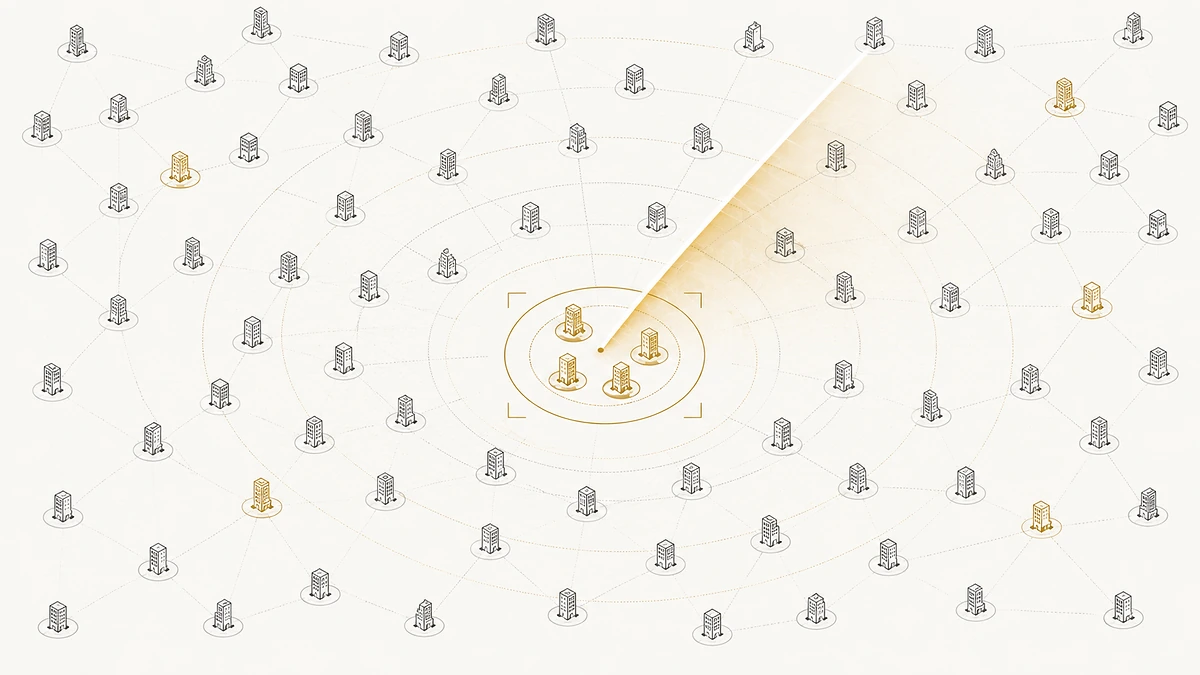
At any given moment, only about 5% of the companies in your market are actively looking to buy. The other 95% are not, no matter how sharp your outreach is. That figure comes from the LinkedIn B2B Institute’s research with the Ehrenberg-Bass Institute, and it is the whole reason B2B intent data exists: to find the small share of accounts researching your category right now, before they fill out a form or take a cold call.
The catch is that “intent data” has become a catch-all label vendors attach to very different things, from a known visitor clicking your pricing page to an anonymized research surge inside a company you cannot quite identify. Some of it is precise. A lot of it is noise. This guide separates the signal types, shows where each one comes from, and walks through how to put intent to work in lead scoring, account-based marketing, and routing without burying your sales team in false positives.
Direct answer – What is B2B intent data?
B2B intent data is behavioral information showing which companies are researching a product or category, and how actively. It comes in three forms: first-party (your own website and product), second-party (review sites like G2), and third-party (publisher co-ops like Bombora). It measures buying timing, not fit, which is what separates it from firmographic or technographic data that describe who a company is. One event is an intent signal; many signals aggregated and scored become intent data.
Key Takeaways
- B2B intent data reveals buying timing (which accounts are in-market now), while firmographic and technographic data reveal fit (which accounts should buy). You need both.
- Intent comes in three types: first-party (highest precision, lowest reach), second-party (review-site behavior), and third-party (widest reach, most noise). Weight them in that order.
- An intent signal is a single event; intent data is those signals aggregated, scored, and decayed over time. Acting on raw signals without scoring is how pipelines fill with false positives.
- Only about 5% of your market is in-market in a given quarter, so intent data’s real job is prioritization, not prospecting the whole database.
- Third-party intent is account-level and probabilistic. Pair it with fit data before routing anything to sales, or reps lose trust in the signal fast.
What is B2B intent data?
B2B intent data is information about the research behavior of companies that signals they may be in-market for a product or service. It is collected from a mix of your own digital properties and external sources, then aggregated to the account level so revenue teams can see which businesses are showing interest and how strong that interest is.
The key word is behavior. Intent data is built from actions: pages viewed, content downloaded, searches run, review-site comparisons, competitor terms researched. A firmographic record tells you a company has 500 employees and sells insurance. An intent record tells you that same company read four articles about fraud-detection software last week. The first describes what the account is. The second hints at what it might do next.
That distinction matters because timing drives most of the value in B2B. According to Gartner’s research on the B2B buying journey, buyers spend just 17% of their total purchase time meeting with potential suppliers, and a typical purchase now involves six to ten decision-makers. If you only reach an account after it has built a shortlist, you are competing for 17% of a process you entered late. Intent data is an attempt to enter earlier.
Intent signals vs. intent data: the difference that matters
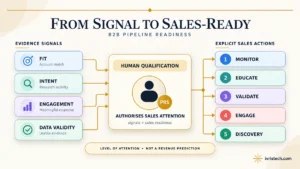
An intent signal is a single observed action; intent data is the aggregated, scored picture those signals build over time. The terms get used interchangeably, but treating them as the same thing is where a lot of programs go wrong.
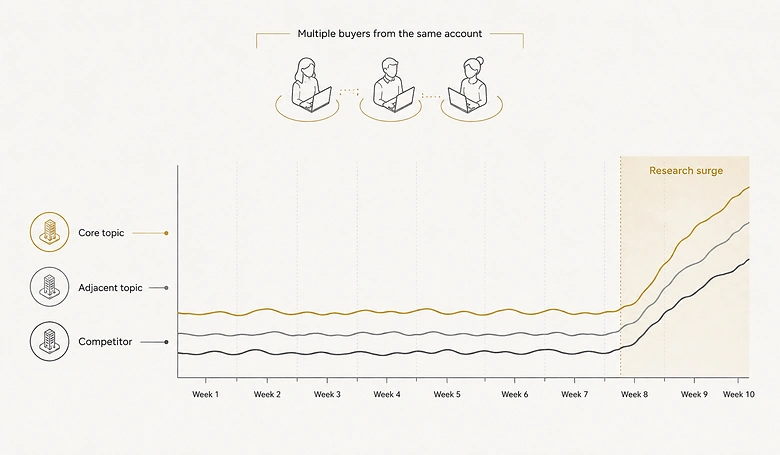
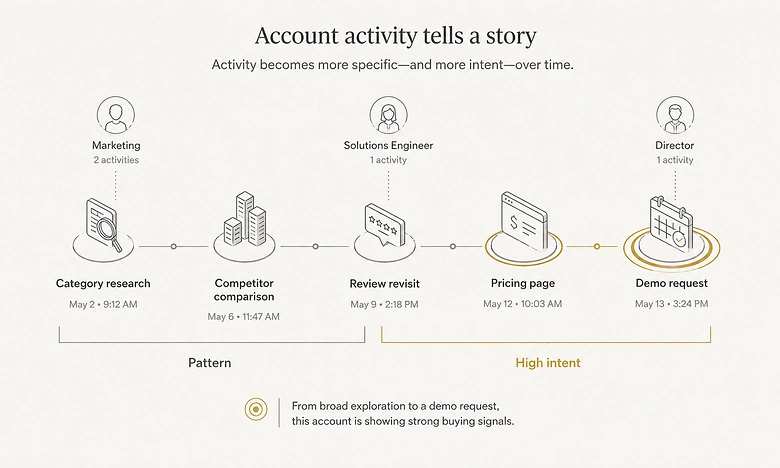
One person downloading one whitepaper is a signal. It could mean a live deal, a student, or a competitor doing research. On its own it proves nothing. Intent data is what you get when you collect many signals from many people at the same account, weight them by how meaningful each action is, and watch whether the pattern is building or fading. A single spike is noise. A rising trend across several buyers in one company, on topics close to what you sell, is a lead worth acting on.
Account-level aggregation is not optional at B2B scale. Forrester’s State of Business Buying 2024 found the average purchase involves about 13 people, with 89% of purchases spanning two or more departments. No single click from one of those 13 means much; the pattern across all of them does.
This is also where intent connects to the rest of your pipeline. A cluster of high-value signals is often the trigger that moves an account from awareness into active consideration, the same shift the stages of a B2B sales funnel are built to track. Read signals as isolated facts and you drown; read them as a trend and they become useful.
First-party, second-party, and third-party intent data
Intent data comes in three types, defined by who collected it and how close it sits to a real buyer. First-party is yours, second-party is shared, and third-party is aggregated from across the web. Each trades precision for reach. Apply that lens to vendor metrics rather than vendor data and it cuts just as hard, because the same provenance question decides whether a published match rate means anything once you trace who measured it and against what.
| Attribute | First-party intent | Second-party intent | Third-party intent |
|---|---|---|---|
| What it is | Behavior on your own properties | Another company’s first-party data, shared with you | Aggregated research behavior across the wider web |
| Where it comes from | Your website, product, email, CRM | Review sites and publishers (G2, TrustRadius) | Publisher co-ops and bidstream (Bombora, 6sense) |
| Example signals | Pricing-page visits, demo requests, repeat product logins | Category comparisons and competitor-page views on G2 | Off-site research surges on topics you sell |
| Best for | Scoring known leads and expansion | Catching active evaluators mid-comparison | Finding net-new accounts before they engage |
| Main blind spot | Only sees buyers who already found you | Limited to that platform’s audience | Anonymized, account-level, and noisy |
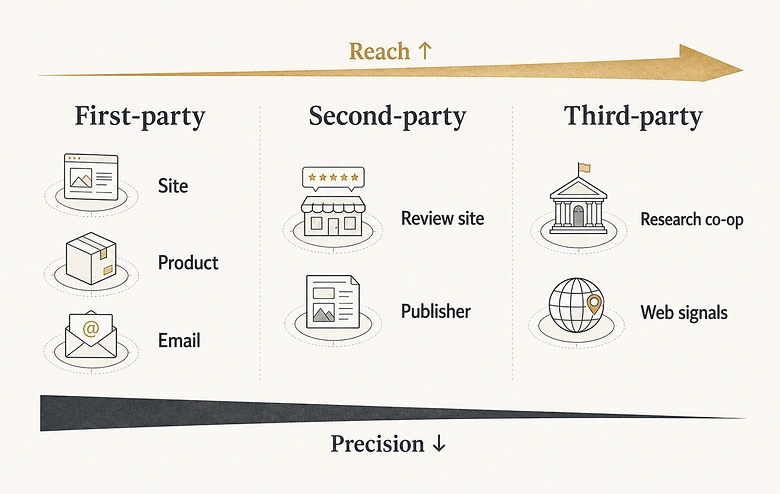
The practical read on that table: first-party intent is the most reliable because you can tie it to a known person and a known account, but it only covers buyers who already found you. Third-party intent has the opposite profile, huge reach across companies that have never visited your site, but anonymized to the account level and mixed with noise. Second-party sits in between. Most mature programs use all three and trust them in that order. That same account-level signal isn’t only an acquisition tool; feeding one shared read of the account to marketing, sales, and success is the shared signal an account-based experience runs on long after the first deal closes.
Where intent signals come from
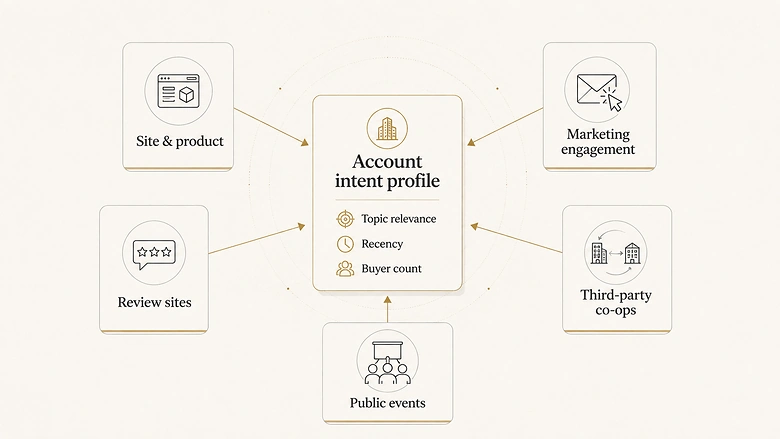
Intent signals come from five main places: your website and product, your marketing engagement, review platforms, third-party research networks, and public company events. Knowing the source tells you how much to trust the signal.
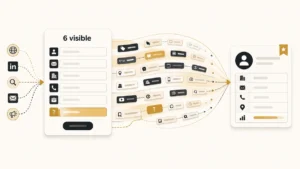
Your own properties produce the strongest signals. Repeat visits to pricing or product pages, demo requests, form fills, and in-product activity are first-party and directly attributable. Marketing engagement sits close behind, though email opens have gotten noisier under Apple Mail Privacy Protection, so a click or a reply is worth far more than an open. Calling those signals first-party describes where they came from and nothing else, so the permission and quality state each signal carries still has to be modelled separately before a rep acts on one.
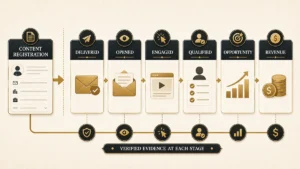
Review sites such as G2 and TrustRadius capture buyers at the comparison stage, often the highest-commercial-intent moment in the whole journey. Third-party co-ops like Bombora aggregate content consumption across thousands of publisher sites and report surges at the account level. And public events, such as a funding round, a leadership hire, or a tech-stack change, act as timing triggers even though they are not research behavior in the strict sense. Content signals also need their own clock, because a registration and an actual read are two days apart on average while a demo gets opened inside the hour.
The window all of this is trying to open keeps shrinking. The 6sense 2025 B2B Buyer Experience Report found that buyers now reach the point of first contact with a seller at 61% of the way through their journey, down from 69% a year earlier, roughly six to seven weeks sooner. By the time an account raises its hand, most of its research is already done, much of it on exactly these third-party and review channels.
PRO TIP
Before you buy any third-party feed, instrument your first-party signals properly: pricing-page visits, repeat sessions, and demo requests. They are free, higher-precision, and most teams under-use them while paying for noisier co-op data.
How to use B2B intent data
To use intent data, feed it into three systems: lead and account scoring, account-based marketing, and routing. Intent that does not change a decision somewhere is just a dashboard. Account-based marketing is where that feed does the most work, because an AI-run ABM motion turns a live intent surge into an automatic selection and outreach decision instead of a report someone reads on Monday.
Feed it into lead and account scoring
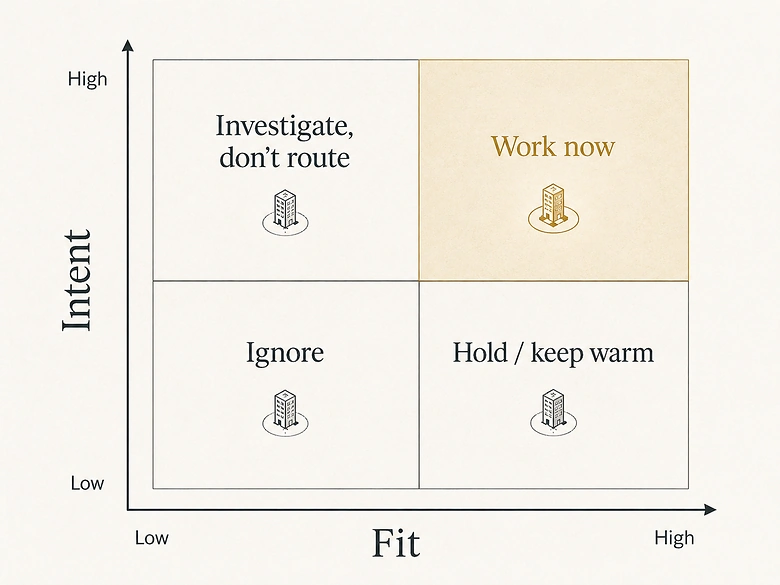
The most common use is adding an intent dimension to your scoring model. Fit tells you whether an account should buy; intent tells you whether it is looking now. A clean model keeps the two separate and then combines them, so a perfect-fit account with no activity can wait while a good-fit account with a research surge gets worked. The specific behaviors and point values belong in your lead scoring criteria, where intent shows up as the behavioral half of the score. Intent explains why an account started looking, but it never tells you which of your touches earned the deal; that second question is how attribution assigns credit across a buying group, and it needs a different instrument entirely.
At the account level, the same logic drives an ICP scoring rubric: a surge pushes an in-profile account up the priority list without changing whether it fits in the first place. A simple way to combine signals is to weight each by strength and let it fade with time:
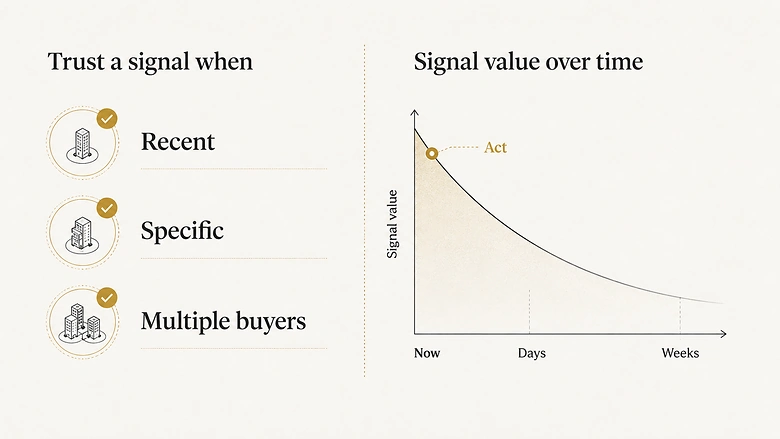
Account intent score = Σ (signal strength × topic relevance) × recency decayRecency is the part teams skip, and it is why so many pipelines fill with three-month-old surges sitting at the top of the list. A signal from last week should outweigh the same signal from last quarter. How much it should outweigh it depends on the signal class, because a funding round and a pricing-page visit decay on completely different timetables, and one recency curve applied across every feed will be wrong for most of them.
Prioritize account-based marketing
In ABM, intent data decides which accounts get the expensive, personalized treatment and when. Instead of running the same plays against a static target list all year, you watch for accounts in your named tiers that light up with research activity, then concentrate ads, content, and outreach on them while the interest is live. The tiering and play design sit in your broader ABM strategy; intent is the timing layer that tells you which tier-one account to work this week.
Trigger routing and outreach
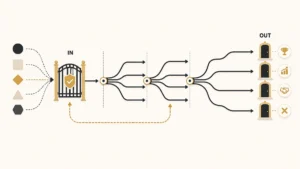
Intent is most useful when it fires an action on its own. A qualified surge on a high-fit account can notify the owner, enroll the account in a sequence, or move it into a priority queue, all without a person watching a report. This is where intent data plugs into B2B marketing automation: the signal is the trigger, and the workflow does the rest. The discipline is to route only signals that clear a fit-and-strength threshold, so reps get a short list they trust instead of a firehose.
IMPORTANT
Never route raw third-party intent straight to sales. It is account-level and probabilistic: it says a company is researching, not who or how seriously. Pair it with fit and a strength threshold first, or reps stop trusting the alerts within a month. The same limit applies downstream, where a surge can suggest an account is worth verifying but can never establish which named person performs which decision function, so treat it as a task generator rather than evidence.
When to trust an intent signal (and when to ignore it)
Trust an intent signal when it is recent, specific to what you sell, and backed by more than one person at the account. Ignore it when it is stale, generic, or a single anonymous hit. That test filters most of the noise. The multi-person condition matters more than it looks: the evidence on buying group size shows the people you can name are a floor rather than a count, so two identified contacts often stand in for a much wider group.
The skepticism is earned. Search any sales forum and you will find teams reporting that third-party intent has become diluted as more vendors buy the same co-op data and chase the same surges. The signal is real, but it is not exclusive, and it decays fast. Three rules keep it honest:
Use first-party over third-party when precision matters. A known buyer on your pricing page beats an anonymized surge every time; third-party is for discovery, first-party is for decisions. Use a strength threshold, not a switch. One topic view is not intent; a sustained cluster across several buyers is. Never act on intent alone. Intent without fit sends reps after companies that will never buy, which is the fastest way to kill their faith in the data.
Intent data doesn’t create demand. It finds the small share of the market that already has it, a little earlier than your competitors do.
Acting early is the point. The same 6sense research found that 95% of the time, the eventual winner is already on the buyer’s shortlist by the day they first contact a seller. If you wait for the hand-raise, you are fighting to crack a shortlist that is effectively closed. Intent data is how you get on it while the account is still deciding, not after.
Intent data vs. fit data: where it stops
Intent data tells you when an account is in-market; it does not tell you whether the account is a good fit, and it does not fill in the details you need to act. Those are different jobs handled by different data, and blurring them is a common mistake.
Fit is the domain of firmographic and technographic data: industry, size, revenue, and the tools a company already runs. That data sets the boundary of who could and should buy. Intent then works inside that boundary to tell you who is looking right now. Run intent without fit and you chase in-market companies that will never be customers; run fit without intent and you have a good list with no sense of timing.
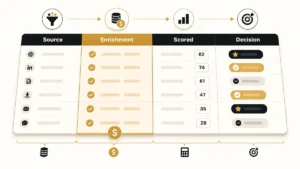
There is also a plumbing problem intent alone does not solve. A third-party surge usually arrives as an anonymized company name and a topic, nothing you can email. Turning that into a workable record, with contacts, titles, and current firmographics, is the job of B2B data enrichment. In practice the sequence runs in order: third-party intent flags the account, enrichment fills in the people and the fit, and scoring decides whether it is worth a rep’s time. Intent is the first step, not the whole chain.
Frequently Asked Questions
B2B intent data is behavioral information showing which companies are actively researching a product or category. It is gathered from your own site, review platforms, and third-party publisher networks, then aggregated to the account level so sales and marketing teams can prioritize the accounts most likely to be in-market now.
First-party intent is behavior on your own properties, like a pricing-page visit, tied to a known person. Third-party intent is anonymized research activity collected across the wider web by co-ops such as Bombora. First-party is more precise but limited to buyers who found you; third-party has far more reach but more noise.
Common buyer intent signals include repeat visits to pricing or product pages, demo requests, content downloads, competitor comparisons on review sites like G2, spikes in off-site research on topics you sell, and company events such as funding rounds, leadership hires, or tech-stack changes that create new buying needs.
Intent data is worth it when you already have clear fit criteria and a way to act on signals quickly; it is wasted otherwise. It will not create demand, and only about 5% of your market is in-market at once. Used for prioritization rather than prospecting the whole list, it earns its cost.
Most B2B intent data is sold on custom, quote-based pricing rather than public rates (as of Q3 2026). Cost depends on the provider, how many intent topics you track, data coverage, and whether you buy raw third-party signals or a full platform that adds contact data and activation. Expect annual contracts, not month-to-month.
Where to start with intent data
If you are adding intent data for the first time, start with what you already own. Instrument your first-party signals, agree on the handful of behaviors that actually predict a deal, and wire them into your existing score before you buy a single third-party feed. Get that working, and the account-level surges you add later have somewhere reliable to land.
From there, layer in second- and third-party sources deliberately, one at a time, and hold each to the same test: does this signal, combined with fit, change what a rep or a workflow does today? If it does, it is intent data. If it just fills a dashboard, it is noise with a subscription.