Most account-based programs are built to win a logo and then quietly hand it off. Marketing runs the target account list, sales closes the deal, and the moment the contract is signed the coordinated attention stops. The account that was courted with tailored ads and one-to-one outreach becomes a ticket number in a support queue.
Account-based experience (ABX) is the correction to that drop-off. It takes the precision ABM already brought to acquisition and applies the same account focus to the entire relationship, from the first anonymous research session through onboarding and expansion. The account list doesn’t change at the contract line; the experience just keeps going.
This guide covers what ABX actually is, how it differs from ABM, how it maps to the full customer lifecycle, how marketing, sales, and customer success share one account plan, and the metrics that tell you it’s working.
Direct answer — What is account-based experience (ABX), and how is it different from ABM?
Account-based experience (ABX) is a go-to-market strategy that coordinates marketing, sales, and customer success around a set of target accounts to deliver one connected journey across the full lifecycle: acquisition, onboarding, and expansion. Account-based marketing (ABM) concentrates on winning those accounts before the sale; ABX keeps the same account focus running after the deal closes and measures success by account engagement and revenue retention rather than lead volume.
Key Takeaways
- ABX extends account-based marketing from a pre-sale acquisition motion into a full-lifecycle strategy that runs through onboarding, renewal, and expansion.
- The defining shift is ownership: ABM is marketing-led and hands off at the deal; ABX keeps marketing, sales, and customer success accountable to the same account plan.
- ABX depends on a shared account data foundation, so every team acts on the same intent signals and account history instead of its own fragment.
- Success metrics move from lead and pipeline counts to account engagement, win rate, net revenue retention, and customer lifetime value.
- ABX doesn’t replace ABM. It absorbs it, adding customer-experience discipline to the targeting ABM already does well.
What account-based experience (ABX) means
Account-based experience (ABX) is a go-to-market strategy that uses shared account data to coordinate marketing, sales, and customer success across the entire B2B lifecycle, so a target account gets one relevant, consistent experience from first research to renewal. It treats the account, not the lead or the campaign, as the unit everyone works on.
The term is recent. Jon Miller, who co-founded Marketo and Engagio before Engagio was acquired by Demandbase, defined ABX in a March 2021 announcement as the next generation of ABM. His argument was that classic ABM had the targeting right but the manners wrong: it pushed messages at accounts whether or not they were ready to hear them, which he compared to fishing with spears.
The word “experience” is the whole point. ABM asks how to reach and win an account. ABX asks what the account actually feels at each step, and whether every touch is timed, relevant, and welcome. That reframing borrows directly from the customer-experience discipline, and it pulls account-based work out of the marketing silo into the shared responsibility of every team that touches the account. That’s the same reason it sits alongside a broader go-to-market strategy rather than under a single channel.
ABM wins the account. ABX makes sure the account is glad you did.
ABM vs ABX: what actually changes
The difference between ABM and ABX is scope and ownership, not a swap of tactics. ABM is a pre-sale, marketing-led motion measured in pipeline; ABX carries the same account targeting through the sale and past it, and makes the whole revenue team accountable for the result. Everything ABM does well still happens inside ABX.
| Dimension | Account-based marketing (ABM) | Account-based experience (ABX) |
|---|---|---|
| Primary goal | Win the target account | Serve the account across its whole lifecycle |
| Lifecycle span | Awareness to closed-won | First research through onboarding, renewal, and expansion |
| Team ownership | Marketing-led, sales-aligned | Marketing, sales, and customer success on one plan |
| Unit of work | Campaign against an account list | Coordinated experience per account |
| Core metric | Pipeline and marketing-sourced revenue | Account engagement, retention, and expansion |
| Failure mode | Wins the logo, drops the relationship | Harder to run without shared data and clean handoffs |
Focus: winning the account vs. serving it
ABM’s job ends at the deal. Its success looks like a signed contract from a named account, and its playbook, the target account list, the tailored ads, the one-to-one outreach, is built to get there. There’s a full catalogue of that motion in these account-based marketing examples, and ABX keeps every one of them. It just refuses to stop once the signature lands.
Alignment: two teams vs. three
ABM needs marketing and sales to agree on the account list and the handoff. ABX adds customer success as a full owner, because the post-sale experience is where retention and expansion are won or lost. When the CSM sees the same account history the SDR and the campaign manager saw, the renewal conversation starts from context instead of a cold restart.
Scope: campaign vs. lifecycle
ABM thinks in campaigns with start and end dates. ABX thinks in a continuous relationship where the account moves through stages and the experience adapts to each one. That is the shift the rest of this guide unpacks, stage by stage.
How ABX extends ABM across the lifecycle
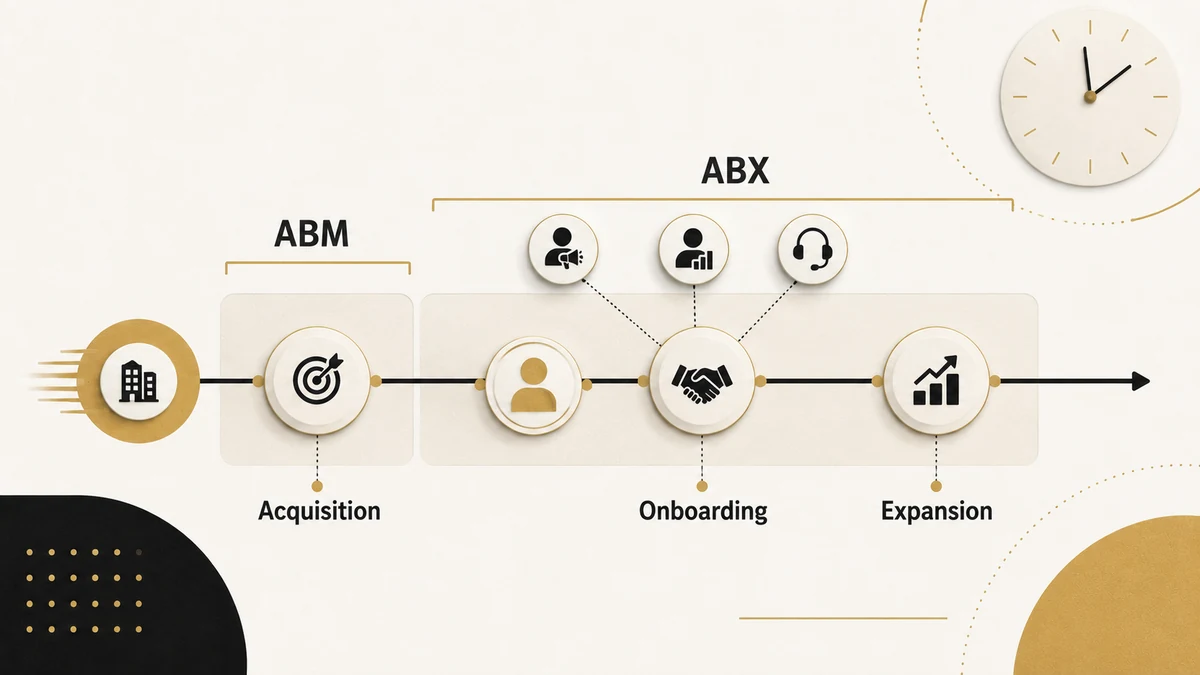
ABX maps the account-based approach onto three lifecycle stages that ABM usually leaves to other teams: acquisition, onboarding, and expansion. The account list stays constant across all three; what changes is the goal of each touch and which team is in the lead.
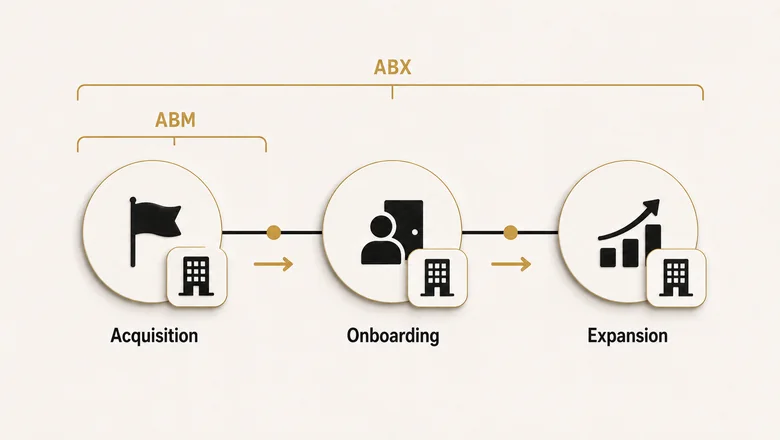
Acquisition: the ABM motion, timed to intent
The acquisition stage is where ABX looks most like classic ABM: a defined target account list, tailored messaging, and coordinated marketing and sales plays. The ABX difference is restraint. Instead of hitting every account on the list at the same cadence, the team acts on intent signals and engages when an account is actually researching, which is the discipline behind well-run account-based marketing campaigns.
Onboarding: protecting the experience at handoff
Onboarding is the stage ABM ignores and ABX treats as make-or-break. The handoff from sales to customer success is where most account experiences fracture, because the context built during the sale rarely travels with the account. ABX makes the onboarding plan part of the same account record, so the promises made in the deal become the priorities of the first ninety days instead of a story the customer has to repeat.
Expansion: where account economics compound
Expansion is the stage that pays for the whole model. Renewals, cross-sell, and upsell to an existing account cost far less than net-new acquisition, and they’re where account-based attention produces its highest return. Tracking that return properly means connecting expansion revenue back to the original account plan, the same thread that good account-based attribution is built to follow.
Put the three stages together and the model is easy to see. A target account gets researched and won during acquisition, inherits its full deal context at onboarding, and becomes a named expansion target the following year, all against the same account record. ABM owns the first stage. ABX is the decision to own all three.
Orchestrating ABX across marketing, sales, and customer success
Orchestration is what makes account-based experience work in practice: every team acts on the same account data, at the right moment, without stepping on each other. Without it, ABX is just three departments running separate account programs and calling the result one strategy.
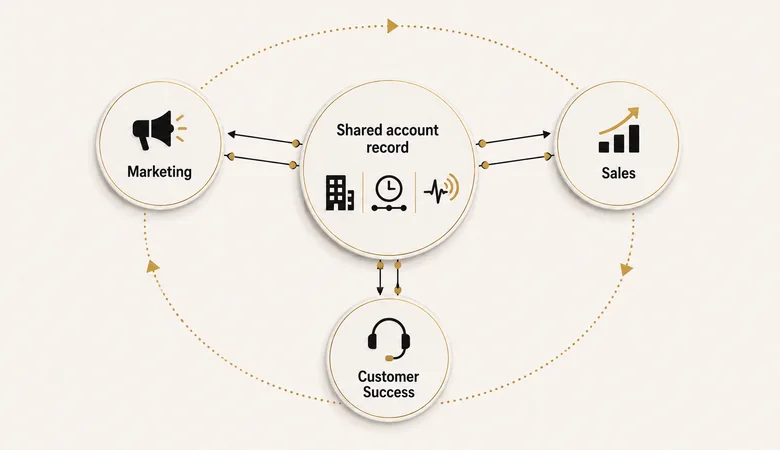
One account data foundation
ABX depends on a single source of account truth that combines firmographics, engagement history, and buying signals. When marketing, sales, and success each work from their own fragment, the account gets contradictory touches and the experience breaks. Feeding every team the same B2B intent data is what lets them coordinate instead of collide.
In practice, that shared record is a short list of fields every team can see: who sits on the buying committee, what the account engaged with before the deal, what was promised during the sale, and how the account uses the product now. With those in one place, the success team starts from the commitments the deal made, not a blank page. Deciding who belongs on that list is harder than it sounds, because the published studies count buying group members by at least six different rules. Keep the relationship fields separated by lifecycle stage as well, because day-to-day access is not renewal authority and an account can look healthy on usage right up to the moment nobody can reach the person who signs. The first of those fields is the one teams most often define loosely, and a vendor-neutral schema setting out what each of those committee fields should actually contain saves the argument about whether a job title counts as a role. That pre-deal column is the one teams underweight, given that most buyers already knew the product they ended up buying before any research began, rising to 89% among enterprise buyers.
Coordinated touchpoints, not louder ones
The point of orchestration isn’t more outreach; it’s fewer, better-timed touches that build on each other. This is also where automation earns its place, sequencing plays across channels so the account sees a coherent story, which is exactly the problem AI-driven ABM tooling now handles at scale.
IMPORTANT
Coordination isn’t optional at enterprise scale. Gartner finds a typical buying group for a complex B2B purchase involves six to ten decision-makers, each arriving with their own research. One account and ten experiences that don’t line up is exactly what ABX exists to prevent.
The metrics that measure account-based experience
Account-based experience is measured at the account level, not the lead level: the questions are whether a target account is engaging, converting, retaining, and growing, not how many forms got filled. That change in measurement is the clearest sign a team has actually moved from ABM to ABX.
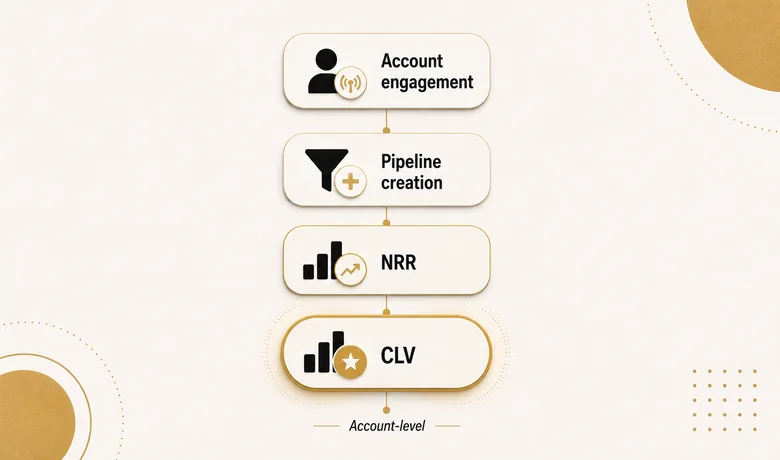
Four metrics carry most of the weight. Account engagement tracks how actively the buying group interacts with your content and outreach. Opportunity and pipeline creation shows whether that engagement converts. Net revenue retention and customer lifetime value capture the post-sale expansion ABM never measured. Practitioner guides from vendors like 6sense converge on roughly this set, and the mechanics of scoring and benchmarking each one live in a dedicated guide to account-based marketing metrics.
Net revenue retention is the number ABX lives or dies on, because it captures whether the post-sale experience actually kept and grew the account:
NRR = (Starting ARR + Expansion − Contraction − Churn) ÷ Starting ARRAn NRR above 100% means your existing accounts grow even before you win a single new logo. That is the financial case for extending account attention past the sale, stated in one number a CFO will accept.
When to adopt ABX (and when ABM is enough)
ABX is worth its operational cost when your revenue depends on keeping and growing a defined set of accounts, not just winning new ones. It is not a mandatory upgrade for every team, and forcing it before the data and handoffs are ready produces worse coordination than a clean ABM program.
Use this as a quick decision test:
- Adopt ABX when expansion and retention drive most of your revenue, you sell to large buying committees, and marketing, sales, and success already share account data.
- Stay ABM-first when your priority is still breaking into net-new accounts and your post-sale motion is genuinely handled well elsewhere.
- Hold off if your teams can’t yet see the same account record, because ABX without shared data just adds coordination overhead to the silos you already have.
For most mid-market B2B teams the honest answer is a staged one: keep running the account-based campaigns that already work, then extend them one lifecycle stage at a time. The wider set of B2B campaign strategies a team already runs is usually the right place to graft on the first post-sale plays.
PRO TIP
Start ABX at the handoff, not the whole lifecycle. Pick your ten most valuable existing accounts, give marketing, sales, and success one shared plan for each, and measure net revenue retention against a matched set you left on the old model. The gap between them is your business case.
Frequently Asked Questions
ABM (account-based marketing) targets and wins a defined list of accounts before the sale, led by marketing and measured in pipeline. ABX (account-based experience) keeps that same account focus running after the deal, adds customer success as an owner, and measures engagement, retention, and expansion across the full lifecycle.
Account-based experience means treating each target account as the unit of work and coordinating marketing, sales, and customer success to give that account one relevant, well-timed experience from first research through renewal, rather than a set of disconnected campaigns and handoffs that reset at every stage.
A software vendor picks 50 target accounts, runs intent-timed ads and sales outreach to win them, then hands each new customer to success with the full deal context. Onboarding, quarterly reviews, and expansion offers all reference the same account plan, so the experience never resets.
ABX is measured at the account level: account engagement score, opportunity and pipeline creation, win rate, net revenue retention, and customer lifetime value. These replace lead-volume metrics because ABX cares whether an account engages, converts, stays, and grows, not how many contacts filled a form.
No. ABX absorbs ABM rather than replacing it. ABM’s targeting and personalization stay intact, but ABX extends them past the sale, adds customer success as an owner, and shifts the scorecard from pipeline to full-lifecycle account outcomes. It’s a wider scope, not a new name for the same motion.