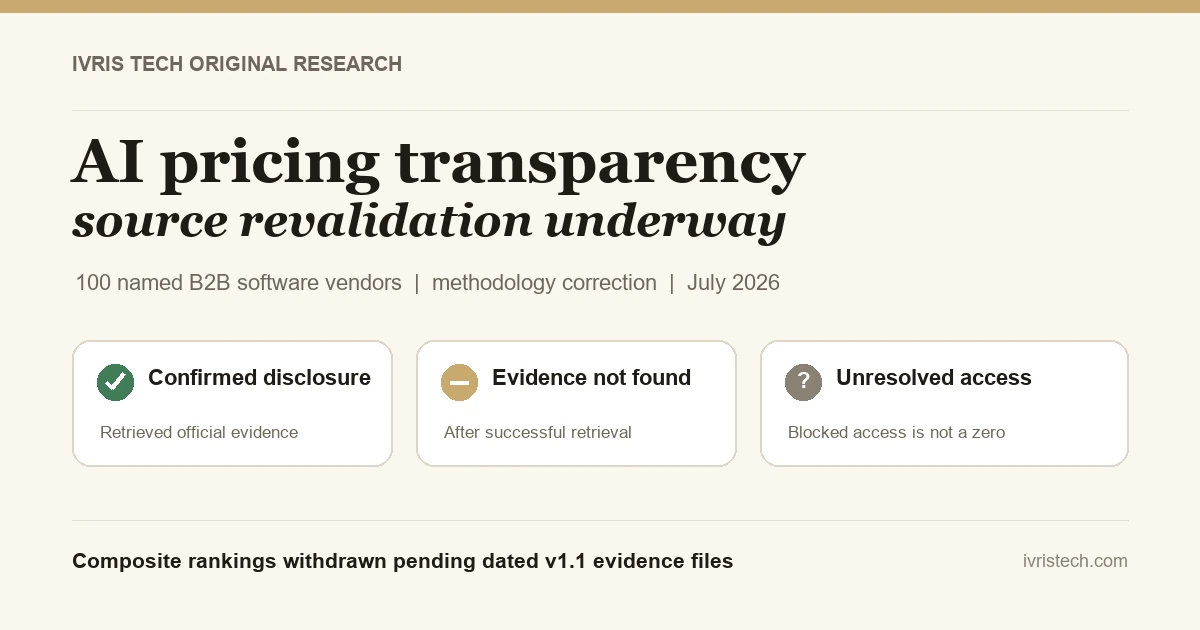
AI Pricing Transparency: Can Buyers Price AI?

Home Research AI Pricing Transparency: Can Buyers Price AI?
AI & Automation

We scored 100 B2B software vendors on whether buyers can calculate AI access and usage costs. See the scorecard, findings and methodology.

MS
July 15, 2026 14 min

AI pricing transparency is now a procurement problem, not a cosmetic pricing-page preference. In IVRIS Tech’s 100-vendor benchmark, 82 vendors made their AI packaging explicit, but only 11 published enough information for a buyer to calculate the marginal cost of additional AI usage. That gap is where budget surprises begin.

AI features can be included in a plan, sold as credits, charged per outcome, or attached to a custom contract. None of those models is automatically bad. The practical question is simpler: can a prospective buyer calculate what it costs to start and what it costs when adoption grows?

Direct answer – What is AI pricing transparency?

AI pricing transparency is the extent to which a prospective buyer can calculate the minimum cost to access a vendor’s AI capability and the cost of using it beyond any included allowance. In IVRIS Tech’s July 2026 benchmark of 100 B2B vendors, only 11 disclosed enough to calculate marginal AI usage cost. A public starting price alone is not transparent when the AI tier, billing unit, or overage rate is unclear.

Key Takeaways

  • The 100-vendor sample scored 4.29 out of 10 on public AI pricing calculability; the median score was 5.
  • Only 27 vendors were substantially or fully calculable, while 45 offered limited or no publicly calculable AI cost information.
  • AI packaging was visible for 82 vendors, but only 13 disclosed an incremental or overage price and only 11 made marginal usage cost calculable.
  • Customer engagement and service scored highest at 5.75 out of 10; ABM and GTM intelligence scored lowest at 2.40 out of 10.
Buyer questionPublic detail requiredBenchmark criterion
What do I need to buy to access the AI?Minimum eligible plan and its commitmentC2 and C3
What is the minimum AI access cost?Public base price plus AI packagingC1, C4 and C9
What counts as AI usage?A named, defined billing unit or an explicit no-meter basisC5 and C6
What will additional usage cost?Allowance and a stated incremental or overage priceC7, C8 and C10

What the AI pricing transparency benchmark measures

The AI pricing transparency benchmark measures whether a buyer can calculate the minimum cost and usage economics of one named vendor’s principal AI capability from official public, unauthenticated sources. It does not rate product quality, price fairness, model accuracy, or a vendor’s willingness to negotiate in a private sales process.

Each vendor received one point for each of ten binary criteria. The study used official pricing, product, help, documentation, legal, catalog, FAQ, and announcement pages available without a login. Quote-only information, review sites, resellers, private sales quotes, and assumptions about what a plan might include did not count.

Scoring method
Transparency score = C1 + C2 + C3 + C4 + C5 + C6 + C7 + C8 + C9 + C10

A score of 9-10 means the capability was fully calculable from the reviewed public evidence. A score of 7-8 means it was substantially calculable; 4-6 means partially calculable; 1-3 means limited disclosure; and 0 means the reviewed sources did not make the cost publicly calculable. The score is a statement about public information, not a verdict on the vendor.

The study is adjacent to, but narrower than, a general guide to six SaaS pricing models. A hybrid, outcome-based, or credit-based model can be perfectly sensible. This benchmark asks whether a buyer can follow the numbers within that model before committing.

The central gap: buyers can see AI, but rarely price usage

The headline result is a disclosure cliff. Eighty-two of 100 vendors explicitly described how their AI was packaged, and 75 identified a minimum AI-eligible plan. Only 11 let a buyer calculate marginal AI usage cost from the reviewed public information.

What the buyer can seeVendorsWhat still may be missing
AI packaging is explicit82The billing unit, allowance, or overage rate
Minimum AI-eligible plan is identifiable75The required commitment or total minimum access cost
Minimum AI access cost is calculable52The cost after included usage is exhausted
Incremental or overage price is disclosed13Whether usage can be forecast without a sales conversation
Marginal AI usage cost is calculable11Nothing material for the measured AI action

This is why a public monthly price is not enough. A plan can advertise AI access while leaving the operational economics unresolved: what action consumes a credit, how many credits are included, whether the allowance resets, what happens at the cap, and what each additional unit costs.

The buyer-side standard is not novel: Stripe advises vendors to use metrics customers can estimate from information they already have. Its usage-based pricing guidance is relevant here because it treats predictability as part of the product, not a sales-call afterthought.

That distinction matters more as vendors move from seats to credits, actions, and outcomes. Our earlier report on the AI subscription reset explains why procurement teams need usage history and contract protections before a pricing change turns a fixed budget into a variable one.

IMPORTANT

“Not publicly calculable” does not mean a vendor has no price, a poor product, or unfair terms. It means the reviewed official public sources did not satisfy the frozen criteria for calculating that cost without a login, private quote, or unsupported assumption.

Where public AI pricing breaks down

Public AI pricing breaks down most often after plan access. The platform price and plan gate are common enough to find. The unit economics that matter once usage scales are much less often defined.

CriterionVendors passingWhy it matters to a buyer
C1: Numeric platform starting price61Sets a public entry anchor
C2: Minimum AI-eligible plan75Shows where access actually begins
C3: Minimum commitment calculable52Shows annual, seat, or minimum-spend exposure
C4: AI packaging explicit82Distinguishes inclusion, add-on, credit, and outcome models
C5: AI billing unit or no-meter basis identified36Shows what creates consumption
C6: Billing unit defined26Makes the unit interpretable, not just named
C7: Recurring allowance quantified21Shows how much use is included
C8: Incremental or overage price disclosed13Lets buyers forecast the next unit of cost
C9: Minimum AI access cost calculable52Turns plan details into a real entry price
C10: Marginal AI usage cost calculable11Lets a team estimate growth-stage spend

For a useful live example of the level of detail buyers need, Salesforce publishes distinct buying models, a named Flex Credit unit, unit multipliers, published rate-card pricing, and worked cost examples for Agentforce. That does not make every buyer scenario simple, but the Agentforce pricing page gives a buyer inputs to model.

The same standard applies to simpler models. Intercom’s public small-business page states both its platform starting price and Fin’s per-outcome price, so a buyer can see the base and the variable component together. That is the kind of public clarity that makes a per-outcome AI price operationally usable.

Which B2B software categories were easier to price

Category results are descriptive averages for 20 named vendors in each group, not estimates for an entire market. Customer engagement and service led the sample, while ABM and GTM intelligence trailed it by more than three points.

CategoryVendorsMean scoreWhat the result suggests
Customer engagement and service205.75Outcome and interaction models more often expose a usable unit
Sales intelligence and engagement205.50More public entry tiers, but variable-use detail remains uneven
Marketing analytics and attribution204.00Public capability descriptions outpaced usage-cost disclosure
Marketing automation203.80Plan packaging was common; credit and overage detail was not
ABM and GTM intelligence202.40Quote-led enterprise buying left the least public calculability

The high score for customer engagement is not a claim that service AI is cheaper. It reflects that a resolved conversation, session, or interaction is easier to expose as a public commercial unit. HubSpot’s result-based Breeze pricing shift is one concrete example of that pattern.

The low ABM and GTM intelligence average should also be read carefully. These products often sell into large, customized deployments, so a public page may be enough to establish that AI exists but not enough to calculate a minimum commitment or an incremental cost. Buyers comparing these platforms should treat the public price page as an evidence check, not a substitute for an implementation model.

The 100-vendor AI pricing transparency scorecard

The scorecard below lists every vendor in the frozen sample. Scores describe only the public calculability of the named principal AI capability from official pages checked on July 12-13, 2026. The downloadable dataset includes the underlying URLs, evidence summaries, criteria, notes, and calculation fields.

VendorCategoryPrincipal AI capability scoredScorePublic calculability
HubSpotMarketing automationBreeze Customer Agent10/10Fully calculable
KlaviyoMarketing automationKlaviyo Composer8/10Substantially calculable
GetResponseMarketing automationAI Email Generator7/10Substantially calculable
Customer.ioMarketing automationCustomer.io AI Agent6/10Partially calculable
ActiveCampaignMarketing automationActive Intelligence5/10Partially calculable
BrevoMarketing automationAI Content Generator5/10Partially calculable
Constant ContactMarketing automationAI Copy Generator5/10Partially calculable
MailchimpMarketing automationGenerative AI Features / Intuit Assist5/10Partially calculable
OmnisendMarketing automationForms AI Assistant5/10Partially calculable
OrttoMarketing automationAI Subject Line Generator5/10Partially calculable
Salesforce Marketing CloudMarketing automationAgentforce Campaign Creation5/10Partially calculable
CleverTapMarketing automationCleverAI Predictions Agent3/10Limited disclosure
Adobe Marketo EngageMarketing automationAI personalization2/10Limited disclosure
Bloomreach EngagementMarketing automationLoomi AI2/10Limited disclosure
BrazeMarketing automationBrazeAI Agent Console2/10Limited disclosure
MoEngageMarketing automationMerlin AI1/10Limited disclosure
DotdigitalMarketing automationWinstonAI0/10Not publicly calculable
IterableMarketing automationNova Agents0/10Not publicly calculable
Oracle EloquaMarketing automationOracle AI for marketing automation0/10Not publicly calculable
SAP EmarsysMarketing automationEmarsys AI0/10Not publicly calculable
UserGemsABM and GTM intelligenceUserGems AI Agents8/10Substantially calculable
Common RoomABM and GTM intelligenceRoomieAI7/10Substantially calculable
WarmlyABM and GTM intelligenceAI Inbound Autopilot7/10Substantially calculable
AdRoll ABMABM and GTM intelligenceAdRoll AI Assistant5/10Partially calculable
AlbacrossABM and GTM intelligenceAI email and LinkedIn sequences5/10Partially calculable
LeadfeederABM and GTM intelligenceLeadfeeder AI and buyer insights5/10Partially calculable
Factors.aiABM and GTM intelligenceScout and Scout Agents3/10Limited disclosure
CognismABM and GTM intelligenceCognism AI Search and Research2/10Limited disclosure
QualifiedABM and GTM intelligencePiper AI SDR Agent2/10Limited disclosure
ZoomInfoABM and GTM intelligenceZoomInfo Copilot2/10Limited disclosure
Apollo.ioABM and GTM intelligenceApollo AI Assistant1/10Limited disclosure
RB2BABM and GTM intelligenceRB2B AI1/10Limited disclosure
6senseABM and GTM intelligence6sense Revenue AI0/10Not publicly calculable
BomboraABM and GTM intelligenceBombora AI and Company Surge0/10Not publicly calculable
DemandbaseABM and GTM intelligenceDemandbase AI0/10Not publicly calculable
IntentsifyABM and GTM intelligenceIntentsify AI-powered intent intelligence0/10Not publicly calculable
LeadspaceABM and GTM intelligenceLeadspace AI-powered B2B data platform0/10Not publicly calculable
MadKudu (HG Insights)ABM and GTM intelligenceMadKudu AI seller intelligence0/10Not publicly calculable
Metadata.ioABM and GTM intelligenceMetadata AI campaign automation0/10Not publicly calculable
TerminusABM and GTM intelligenceTerminus AI0/10Not publicly calculable
AvomaSales intelligence and engagementAI Meeting Assistant10/10Fully calculable
FathomSales intelligence and engagementInstant AI call summaries10/10Fully calculable
InstantlySales intelligence and engagementAI Sales Agent9/10Fully calculable
Copy.aiSales intelligence and engagementGTM AI Workflows8/10Substantially calculable
Fireflies.aiSales intelligence and engagementAI summaries and AskFred8/10Substantially calculable
Otter.aiSales intelligence and engagementOtter AI Chat and meeting workflows8/10Substantially calculable
Regie.aiSales intelligence and engagementRegieOne AI agents8/10Substantially calculable
Reply.ioSales intelligence and engagementJason AI SDR8/10Substantially calculable
tl;dvSales intelligence and engagementAI meeting notes and reports7/10Substantially calculable
AmplemarketSales intelligence and engagementDuo Copilot5/10Partially calculable
ClaySales intelligence and engagementClaygent5/10Partially calculable
LavenderSales intelligence and engagementLavender AI Email Coach5/10Partially calculable
LemlistSales intelligence and engagementAI sequence and email generation5/10Partially calculable
SmartleadSales intelligence and engagementSmartlead AI-assisted outreach5/10Partially calculable
OutreachSales intelligence and engagementKaia and Outreach AI4/10Partially calculable
ClariSales intelligence and engagementClari Copilot and Revenue AI2/10Limited disclosure
SalesloftSales intelligence and engagementRhythm and Salesloft AI2/10Limited disclosure
ModjoSales intelligence and engagementModjo AI conversation intelligence1/10Limited disclosure
GongSales intelligence and engagementGong Revenue AI0/10Not publicly calculable
People.aiSales intelligence and engagementPeople.ai Revenue Intelligence AI0/10Not publicly calculable
AmplitudeMarketing analytics and attributionAmplitude AI Agents10/10Fully calculable
ThoughtSpotMarketing analytics and attributionSpotter AI Agent10/10Fully calculable
SupermetricsMarketing analytics and attributionSupermetrics AI7/10Substantially calculable
DreamdataMarketing analytics and attributionDreamdata AI Chat5/10Partially calculable
FunnelMarketing analytics and attributionFunnel AI5/10Partially calculable
MixpanelMarketing analytics and attributionMixpanel Agent5/10Partially calculable
NorthbeamMarketing analytics and attributionNorthbeam AI5/10Partially calculable
TableauMarketing analytics and attributionTableau Agent5/10Partially calculable
Triple WhaleMarketing analytics and attributionMoby AI5/10Partially calculable
DomoMarketing analytics and attributionDomo.AI4/10Partially calculable
HeapMarketing analytics and attributionHeap AI / Illuminate3/10Limited disclosure
Adobe Customer Journey AnalyticsMarketing analytics and attributionAI Assistant for CJA2/10Limited disclosure
ContentsquareMarketing analytics and attributionSense AI2/10Limited disclosure
FullstoryMarketing analytics and attributionStoryAI2/10Limited disclosure
HockeyStackMarketing analytics and attributionOdin / GTM Intelligence2/10Limited disclosure
ImprovadoMarketing analytics and attributionAI Agent2/10Limited disclosure
QlikMarketing analytics and attributionQlik Answers2/10Limited disclosure
Twilio SegmentMarketing analytics and attributionCustomerAI Predictions2/10Limited disclosure
AppsFlyerMarketing analytics and attributionAppsFlyer AI Assistant1/10Limited disclosure
Piwik PROMarketing analytics and attributionPiwik PRO AI Assistant1/10Limited disclosure
GorgiasCustomer engagement and serviceGorgias AI Agent10/10Fully calculable
Freshworks FreshdeskCustomer engagement and serviceFreddy AI Agent9/10Fully calculable
FrontCustomer engagement and serviceFront AI9/10Fully calculable
Help ScoutCustomer engagement and serviceAI Answers9/10Fully calculable
IntercomCustomer engagement and serviceFin AI Agent9/10Fully calculable
NICE CXoneCustomer engagement and serviceCXone Mpower AI9/10Fully calculable
Five9Customer engagement and serviceFive9 Genius AI8/10Substantially calculable
Genesys Cloud CXCustomer engagement and serviceGenesys Cloud AI8/10Substantially calculable
TidioCustomer engagement and serviceLyro AI Agent8/10Substantially calculable
ZendeskCustomer engagement and serviceZendesk AI Agents6/10Partially calculable
TalkdeskCustomer engagement and serviceTalkdesk AI Agents5/10Partially calculable
Zoho DeskCustomer engagement and serviceZia5/10Partially calculable
DixaCustomer engagement and serviceMim AI4/10Partially calculable
DecagonCustomer engagement and serviceDecagon AI Agents3/10Limited disclosure
LivePersonCustomer engagement and serviceConversational AI3/10Limited disclosure
SierraCustomer engagement and serviceSierra AI Agent3/10Limited disclosure
AdaCustomer engagement and serviceAda AI Agent2/10Limited disclosure
ForethoughtCustomer engagement and serviceAutoflow / SupportGPT2/10Limited disclosure
KustomerCustomer engagement and serviceKustomer AI Agents2/10Limited disclosure
GladlyCustomer engagement and serviceGladly Sidekick1/10Limited disclosure

What buyers should ask before signing an AI contract

Buyers should treat AI pricing as an operational model, not a feature checkbox. The right questions turn a vague “included AI” promise into an exposure estimate that finance, procurement, and the operator can all use.

  1. What is the minimum configuration that provides this AI capability? Ask for the plan, seat floor, billing cadence, mandatory onboarding, and first-year cash commitment.
  2. What action creates consumption? Require a plain-language definition of a credit, action, resolution, token, session, or outcome.
  3. What usage is included, and when does it reset? Confirm whether allowances are per user, per account, pooled, monthly, annual, or non-rollover.
  4. What happens after the allowance is exhausted? Get the public or contractual overage rate, cap behavior, alerting, and approval path in writing.
  5. Can we model three usage scenarios? Price a pilot, expected adoption, and high-adoption case before accepting a multi-year commitment.
  6. What can change during the term? Ask about model retirement, credit multipliers, rate-card changes, notice periods, and exit or re-pricing rights.

These questions extend the normal B2B pricing model framework. The difference with AI is that a stable platform fee can sit beneath an unstable usage layer, so the model must work at both the renewal meeting and the day-to-day operator level.

PRO TIP

Run the vendor’s calculation on your own historical activity before signing. A pricing page can tell you the unit rate; only your workflow data can tell you how many units an agent, campaign, or team will actually consume.

For marketing leaders, this belongs beside the normal feature and adoption test. A useful AI marketing tool buying guide can narrow the shortlist, but no feature comparison can replace a three-scenario cost model when credits or outcomes enter the contract.

Methodology, review, and limitations

IVRIS Tech froze a purposive sample of 100 named B2B software vendors: 20 each in marketing automation, ABM and GTM intelligence, sales intelligence and engagement, marketing analytics and attribution, and customer engagement and service. One principal AI capability was selected for each vendor, then scored against ten unweighted binary criteria using official public, unauthenticated sources checked July 12-13, 2026.

The work is reproducible, but it is not a probability sample and it should not be generalized to every software vendor. Forty-nine of 173 supplied official URL attempts failed because of dynamic rendering, internal retrieval errors, or retrieval controls. Missing, ambiguous, inaccessible, or capability-mismatched evidence scored zero under the frozen codebook.

The candidate dataset then went through an isolated AI-assisted blind rescore. Agreement was 98.4% across 1,000 binary decisions, with Cohen’s kappa of 0.967. All 16 disagreements were AI-adjudicated, changing six candidate cells. This was not a second-human review, and the benchmark should not be described that way.

Pricing, packaging, regional availability, taxes, discounts, and vendor documentation can change after the snapshot date. A lower score does not mean a vendor is deceptive, expensive, unsuitable, or unable to explain pricing in a sales process. It means the reviewed official public evidence did not make the measured cost calculable.

Download the research files

Download the 100-vendor CSV for every criterion, source URL, evidence note, score, classification, and calculation field.

Download the formula-driven workbook for score logic, category summaries, charts, methodology, limitations, and review records.

Correction policy

Vendors and readers can submit corrections with an official public unauthenticated URL, the disputed criterion, exact supporting language or value, region, currency, billing cadence, and effective date. Private quotes, logged-in screenshots, review sites, resellers, and undocumented sales claims are not eligible.

Accepted material corrections will be released as a new dated benchmark version with an updated workbook, CSV, findings, charts, and change log. Prior versions will remain available for audit. IVRIS Tech will refresh the benchmark at least quarterly.

Frequently Asked Questions

AI pricing transparency is the ability to calculate what AI access costs and what additional AI use costs from public vendor information. It requires more than a starting subscription price. Buyers need the eligible plan, commitment, billing unit, included allowance, and any overage or marginal-use rate for the relevant AI capability.

IVRIS Tech scored 100 named vendors against ten unweighted binary criteria using official public, unauthenticated evidence checked July 12-13, 2026. The criteria cover platform price, eligible plan, minimum commitment, AI packaging, billing unit, allowance, overage price, minimum access cost, and marginal usage cost.

No. A low score means the reviewed public sources did not let a buyer calculate the measured AI cost under the benchmark’s rules. It does not judge product quality, price fairness, private enterprise terms, discounting, or information available after a sales conversation.

IVRIS Tech plans to refresh the benchmark at least quarterly and to issue a new dated version for accepted material corrections. Pricing and packaging are point-in-time observations, so readers should use the snapshot date, source links, and correction policy before relying on a result for a live purchase decision.

Share
MS
Written by
Mahesh Sirvi
Founder, Ivris Tech
Started in sales, moved into B2B demand generation — ABM, lead scoring, BANT, and pipeline operations. Now focused on technical SEO, AI workflows, and n8n automation. Writes about B2B strategy, AI & automation, and MarTech at Ivris Tech from hands-on experience. MBA in Business Analytics. Still learning, still building.

Get B2B marketing insights weekly

Strategies, frameworks, and tools — no fluff. Join operators who read Ivris Tech.

No spam. Unsubscribe anytime.
Link copied!