Direct answer – how much video ad creative uses GenAI in 2026?
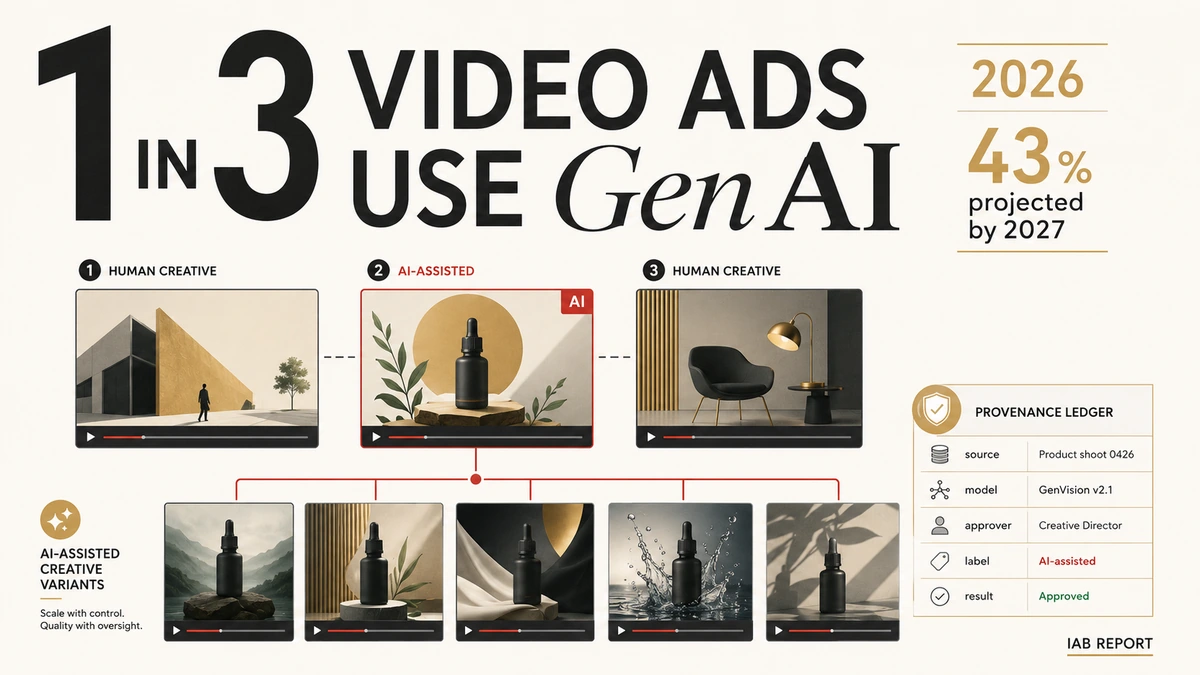
IAB says one-third of digital video ad assets will use generative AI in 2026, up from one-quarter in 2025, with the share projected to reach 43% in 2027. Nearly two-thirds of video buyers now use GenAI for creative production. The operating issue is no longer access to generation tools. It is whether teams can prove asset origin, approval, performance, and compliance across a growing volume of variants.
IAB released its 2026 Digital Video Ad Spend & Strategy Full Report on July 14, finding that one-third of digital video ad assets will use generative AI this year.
That share rose from one-quarter in IAB’s 2025 study and is projected to reach 43% in 2027. Nearly two-thirds of buyers now use GenAI for digital video creative. The report was developed with Advertiser Perceptions and Guideline.
For marketing teams, the adoption number is only the first signal. The same report shows strong demand for proof, human review, audit trails, and guardrails across AI-enabled media operations. As creative volume rises, asset provenance becomes a campaign control, not a production note.
Key Takeaways
- One-third of digital video ad assets will use GenAI in 2026, according to IAB.
- The share is projected to reach 43% in 2027.
- Nearly two-thirds of video buyers now use GenAI for creative production.
- Among smaller buyers, 96% are dissatisfied with their current level of GenAI use.
- More creative volume increases the need for provenance, approval, and outcome evidence.
What the 2026 IAB Video Report Found
The IAB report covers a digital video market that has doubled in volume over five years. It projects 2026 growth of 13% for social video, 11% for connected TV, and 10% for online video. Buyers are spending more, but they are also asking harder questions about inventory quality, targeting, and how outcomes were produced.
GenAI is already part of the production system. Nearly two in three buyers use it for digital video creative, and one in three assets will include it this year. That can include generated or modified copy, imagery, backgrounds, animation, voices, video segments, or full creative variants. XR’s broader 2026 creative-production adoption data shows the same pattern extending into VFX, testing, image creation, motion, copywriting, and adaptation across U.S. brand and agency workflows.
The 33% figure is an average, not a maturity score. IAB says 96% of smaller buyers are not satisfied with their current level of GenAI use, while more than four in ten want stronger performance proof and easier platform or DSP integration.
That gap connects directly to Zappi Amplify AI’s predictive creative testing. Generating more variants solves a supply problem. Deciding which variants deserve spend, and whether a predictive score maps to business results, remains a measurement problem.
More Output Does Not Mean More Confidence
AI can reduce the time and cost of creating localized, audience-specific, and format-specific video. It can also multiply weak ideas. If one unsupported claim enters a prompt or template, the workflow can repeat it across languages, aspect ratios, audiences, and placements before a reviewer sees the pattern.
That makes variant count a poor success metric. A team that creates 200 versions but learns nothing about hook, offer, audience, or message has only increased review load. The useful metric is decision speed: how quickly the team can identify a winning change without weakening brand or legal controls.
TikTok Symphony Agent shows the channel-level version of this problem. TikTok can create short-form variations quickly, but B2B advertisers still need approved source claims, creator-fit review, and pipeline evidence. The IAB data suggests that this is becoming a standard video-operations requirement rather than an isolated platform concern.
TVNewsCheck’s report recap highlights broader mistrust in the media supply chain. Forty-three percent of buyers reported somewhat to no confidence in trusted CTV inventory, rising to 55% for private marketplaces and 67% for open exchange or RTB.
Provenance Is Becoming a Production Requirement
A video team needs to know what AI changed, which approved source supported the claim, who accepted the final asset, where the asset ran, and which performance result belongs to that version. Without those records, it is hard to investigate an inaccurate claim, a disclosure failure, or a sudden performance change. Meta’s decision to sign the EU transparency code reinforces the same split between embedded provenance and the visible disclosure a deployer may still have to make. accessiBe’s ecommerce accessibility research extends that record to generated text, images, and interfaces by asking whether accessibility was checked before release.
IAB’s agentic-AI findings reinforce that expectation on the media side. Ninety-six percent of buyers see a role for agentic AI in programmatic, but 40% want humans in the loop. The figure reaches 50% among small and medium spenders. Thirty-six percent want an audit trail for explainability, and 31% want guardrails that limit agent actions.
Those programmatic statistics still carry into creative. The asset record should preserve its source brief, model or tool, approver, edit history, label decision, placement, and test cell. The Article 50 enforcement launch makes those fields useful for responding to a complaint or information request, not only internal governance.
New York’s AI advertising disclosure law makes that traceability practical. It does not require a label for every AI-assisted edit, but it does require covered synthetic performers to be disclosed. A team cannot make the right disclosure decision if it does not know how the person in the asset was created.
What Video Teams Should Test Now
Start with a controlled creative family, not an open-ended generation target. Choose one offer, one audience, and one base video. Use GenAI to change one variable at a time, such as the hook, proof point, visual treatment, or call to action.
- Assign an asset ID: Give every generated or modified variant a stable identifier that follows it into the media platform.
- Record source claims: Link product, legal, customer, or research evidence behind every factual statement.
- Track AI contribution: Note the tool, model, prompt or brief, generated elements, and material human edits.
- Set approval tiers: Require stricter review for synthetic people, voice, regulated claims, customer likeness, or price statements.
- Measure by test cell: Compare creative performance with qualified conversions, incremental lift, and sales quality, not only view or click volume.
The IAB report shows that GenAI video production has crossed from experimentation into routine use. The next advantage will not come from producing the most assets. It will come from knowing which AI-assisted change improved the campaign, which source made the claim defensible, and which controls prevented a fast mistake from becoming a scaled one.
Frequently Asked Questions
IAB says one-third of digital video ad assets will use GenAI in 2026, up from one-quarter in 2025. The share is projected to reach 43% in 2027.
The 2026 IAB report says nearly two-thirds of digital video buyers now use GenAI for creative production, up from half in 2025.
Teams should record source claims, AI-generated elements, tool and model details, human edits, approvers, disclosure decisions, placement, and performance by asset. Synthetic people, voices, regulated claims, and pricing need stricter review.
No single rule requires every AI-assisted ad to carry the same label. Requirements depend on the platform, location, asset type, and how AI was used. Teams should obtain legal advice and preserve production records so they can make the correct decision.