What Is a B2B Pricing Strategy?
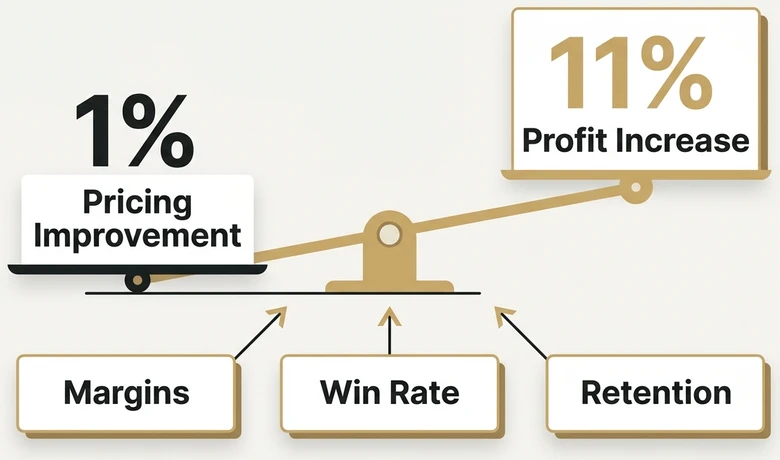
A B2B pricing strategy is a method businesses use to set prices for products or services sold to other businesses. It accounts for factors like production costs, customer value, competitive positioning, and the complexity of multi-stakeholder buying decisions that define B2B sales. The right pricing strategy directly affects profit margins, win rates, and long-term customer retention.
Pricing is one of the most overlooked growth levers in B2B. A 1% improvement in pricing yields an average 11% increase in profit, according to research from McKinsey. Yet most B2B companies spend far more time optimizing their marketing funnel than their pricing model.
This guide covers eight B2B pricing models, the 5 C’s framework for making pricing decisions, real company examples, and a step-by-step template for building your own strategy. Whether you’re pricing a SaaS product, a professional service, or a physical product for wholesale distribution, you’ll find actionable guidance here.
Industry-specific buyers — like those evaluating CRM solutions for construction — often respond best to tiered or usage-based models.
Key Takeaways
- Value-based pricing consistently outperforms cost-plus, but requires understanding how customers measure the ROI of your product.
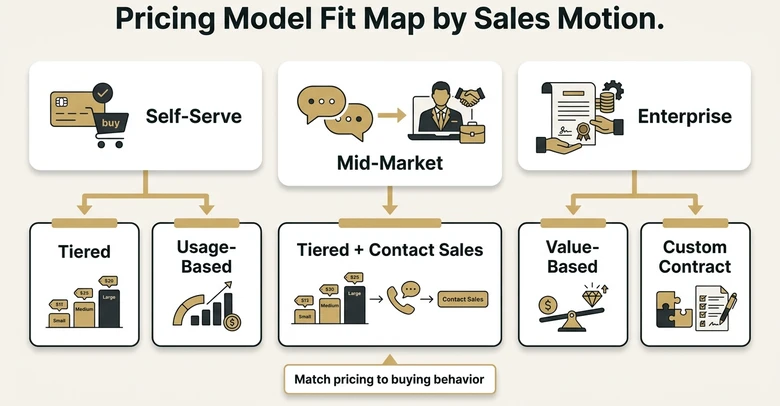
- Your pricing model should match your sales motion: self-serve products need transparent pricing; enterprise sales benefit from custom quotes.
- Most B2B companies underprice. If you haven’t raised prices in 12+ months, you’re almost certainly leaving margin on the table.
- The 5 C’s of pricing (Cost, Customers, Competition, Channel, Compatibility) give you a structured framework for every pricing decision.
- Pricing isn’t set-and-forget. Review quarterly and adjust based on win/loss data, competitive shifts, and customer feedback.
- AI-driven dynamic pricing is gaining traction in B2B, but works best for high-volume segments with clean data. Most mid-market companies should start with value-based models and add dynamic elements gradually.
8 B2B Pricing Models (With Pros and Cons)
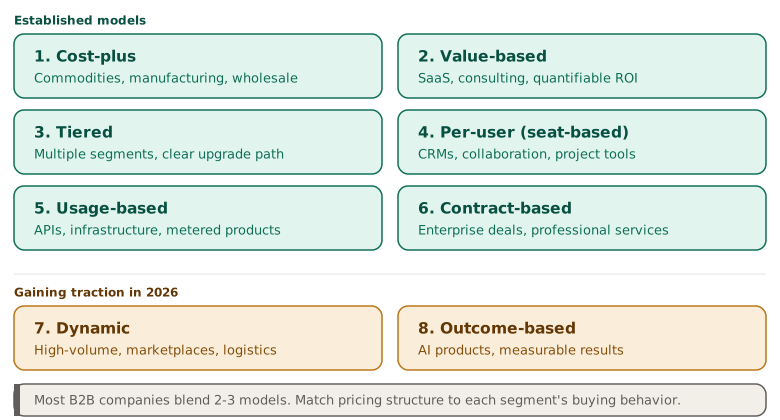
A pricing model is the structure you use to calculate and present your prices. It’s the “how” of your pricing. The first six models below are established B2B standards. The last two, dynamic and outcome-based, are gaining traction in 2026 as AI changes how companies price and deliver value.
1. Cost-Plus Pricing
Calculate your production cost and add a fixed margin. If your product costs $10 to produce and you apply a 50% markup, you sell for $15. It’s the simplest model to implement and easy for customers to understand.
Best for: Commodity products, manufacturing, and wholesale distribution where costs are predictable and differentiation is low.
Drawback: It ignores customer willingness to pay. You might be charging $15 for something customers would happily pay $25 for, leaving 40% of potential revenue on the table.
2. Value-Based Pricing
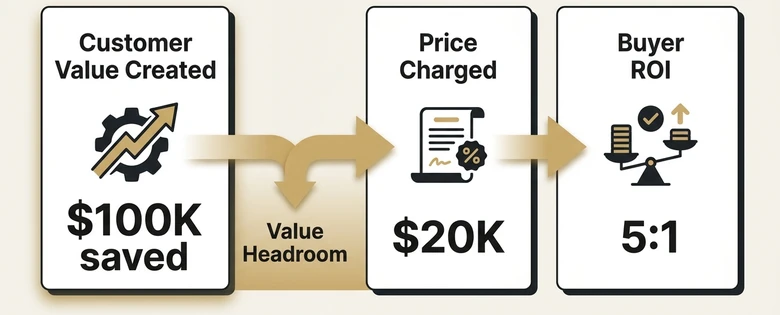
Set prices based on the value your product delivers to customers rather than what it costs you to produce. If your software saves a company $100,000 per year and you charge $20,000, that’s a 5:1 ROI. The customer is happy, and your margins are healthy regardless of your actual production cost. Executing per-customer or contract pricing online is its own requirement, which is why buyers shortlist B2B ecommerce platforms with native contract-pricing engines rather than bolting rules onto a consumer cart.
Best for: SaaS products, consulting services, and any offering where you can quantify the outcome for the buyer. This is the pricing approach most often used by top-performing B2B companies. A Vendavo study of pricing professionals found that 28% favor value-based models over all other approaches.
Drawback: Requires deep understanding of customer outcomes. If you can’t articulate and prove the value, this model falls apart in negotiations.
PRO TIP
Build an ROI calculator for your sales team. When reps can show prospects a personalized value estimate during the sales process, price objections drop significantly. Tools like Ceros or even a well-built spreadsheet work for this.
3. Tiered Pricing
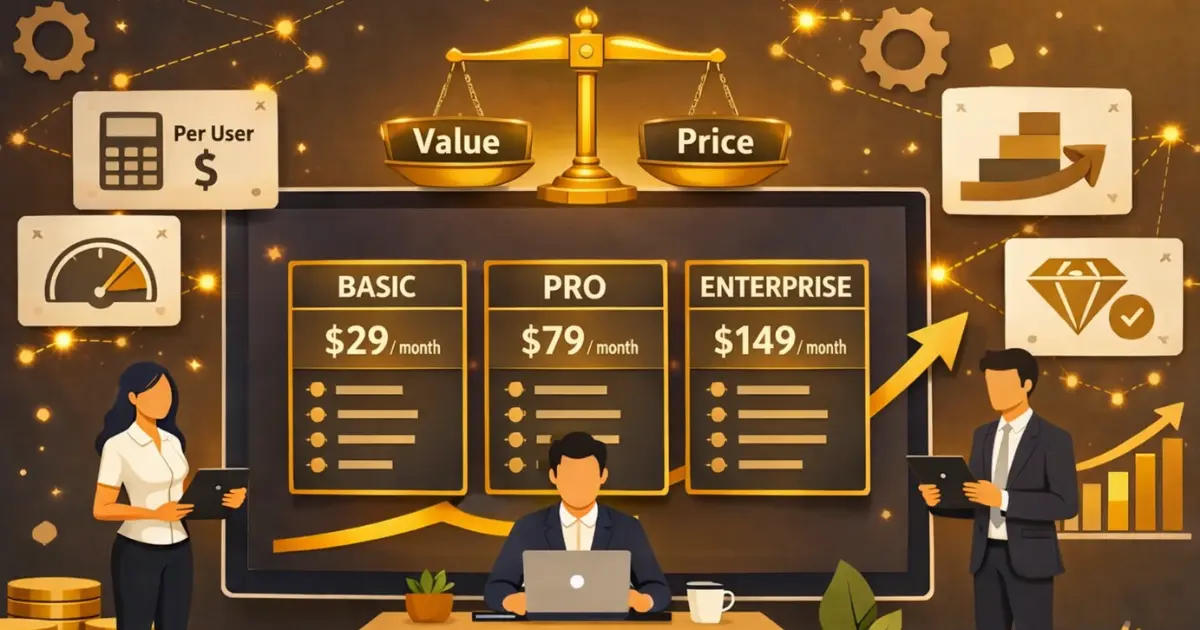
Offer multiple packages at different price points, each with a different set of features or usage limits. Most SaaS companies use this model: a Starter plan, a Professional plan, and an Enterprise plan.
Best for: Products serving multiple customer segments with different needs and budgets. Tiered pricing lets you capture value from price-sensitive small businesses and high-value enterprise accounts with the same product.
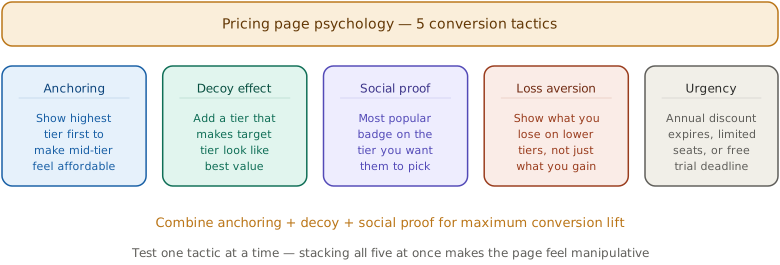
Drawback: If tiers are poorly designed, customers cluster in the cheapest option. The fix: make the middle tier the most attractive by including the features most buyers need. This is the “decoy effect” in action. See how Grainger, Steelcase, and Amazon Business implement account-specific pricing in our B2B ecommerce examples guide.
4. Per-User (Seat-Based) Pricing
Charge a fixed amount per user per month. Salesforce popularized this model with its $25/user/month starting price. It’s predictable for both the seller and the buyer, and revenue grows naturally as the customer’s team grows.
Best for: Collaboration tools, CRMs, project management software, and any product where value scales with team adoption.
Drawback: Customers may limit seat purchases to control costs, reducing adoption within the organization. Some companies (like Slack) have addressed this by only charging for active users.
5. Usage-Based Pricing
Charge based on how much of the product the customer actually uses. Think API calls, data storage, transactions processed, or emails sent. Stripe, Twilio, and AWS all use usage-based models.
Best for: Infrastructure products, APIs, and platforms where customer value directly correlates with consumption volume. Usage-based pricing aligns cost with value and removes adoption barriers for smaller customers.
Drawback: Revenue becomes harder to predict. Customers may also hesitate to increase usage if they’re watching costs closely. Many companies address this with minimum commitments or hybrid models that combine a base fee with usage-based overages.
6. Contract-Based (Custom) Pricing
Negotiate bespoke pricing for each deal based on the customer’s specific requirements, volume, and contract length. This is the default model for enterprise B2B sales.
Best for: Complex enterprise deals, professional services, and situations where customer needs vary significantly from one account to the next.
Drawback: Slow to close and resource-intensive. Without clear discount guardrails, sales teams may over-discount to close deals, eroding margins. Set maximum discount thresholds by deal type and require approval workflows for anything beyond them.
7. Dynamic Pricing
Adjust prices in real time based on demand, supply conditions, competitor moves, or customer segment. Airlines and ecommerce retailers have used dynamic pricing for decades. In B2B, it’s gaining adoption in wholesale distribution, logistics, and commodity-adjacent categories where price volatility is high.
Best for: High-volume B2B transactions, marketplaces, API-based products, and industries where demand fluctuates significantly. A 2026 McKinsey analysis found that AI-driven pricing can increase revenue by 2-5% and improve margins by 5-10%.
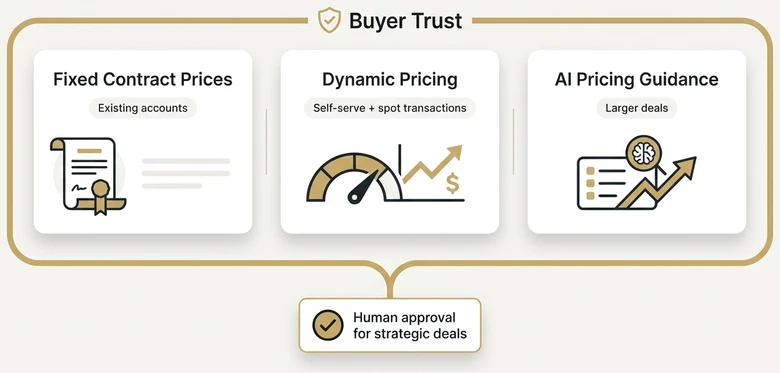
Drawback: B2B buyers value price stability. Frequent fluctuations can erode trust, especially in relationship-driven sales. If you adopt dynamic pricing, apply it to spot transactions and walk-in customers while keeping contract prices fixed for established accounts.
8. Outcome-Based Pricing
Charge based on the results your product delivers rather than access or usage. Intercom charges $0.99 per AI resolution. Salesforce’s Agentforce costs $2 per conversation. The customer pays only when the product delivers measurable value.
Best for: AI-powered products, consulting engagements, and any offering where outcomes are clearly measurable and attributable. Outcome-based pricing removes buyer risk entirely, which shortens sales cycles and reduces churn.
Drawback: Revenue depends on product performance, not contracts. If your product underdelivers, revenue drops. You also need reliable measurement infrastructure. Both sides must agree on what counts as a “result” before signing.
The 5 C’s of B2B Pricing
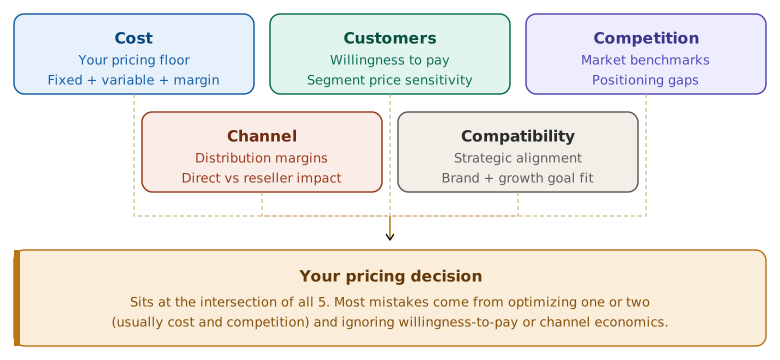
Before picking a pricing model, you need a framework for the decision itself. The 5 C’s of pricing give you that structure. Originally developed in marketing academia and adopted by pricing consultants globally, this framework forces you to evaluate five factors before setting or changing any price.
1. Cost
Start with what it actually costs you to produce, deliver, and support your product. This includes direct costs (hosting, materials, labor) and indirect costs (marketing, overhead, support). Cost is your pricing floor. You can’t sustainably price below it, but you shouldn’t let it be your ceiling either. Two products with identical production costs can justify wildly different prices if one delivers more value.
2. Customers
What are your buyers willing to pay? Willingness to pay is shaped by perceived value, reference prices (what they’ve paid before or what competitors charge), and budget constraints. In B2B, this varies dramatically by segment. An enterprise buyer might pay $50,000/year for the same product an SMB values at $5,000. Understanding these differences is what makes tiered and segment-specific pricing work.
3. Competition
Your price doesn’t exist in isolation. Buyers compare you against alternatives, including doing nothing. Map your competitors’ pricing publicly available on their websites. Identify where you’re priced higher (and whether you can justify it with better features or service) and where you’re priced lower (and whether you’re leaving margin on the table). For more on analyzing competitive positioning, see our guide to B2B marketing frameworks.
4. Channel
How does your product reach the buyer? Direct sales, partner resellers, marketplaces, and self-serve all affect pricing. Each intermediary takes a margin, which impacts the final price. If you sell through channel partners, your pricing must leave enough room for their margins while keeping the end-user price competitive. A self-serve SaaS product sold directly can price lower than the same product sold through a VAR that needs a 30% cut. When that channel is a marketplace you operate yourself, the commission you set is the pricing lever, and the marketplace software that splits payments across sellers is what enforces it on every transaction.
5. Compatibility
Does your pricing align with your broader business strategy and brand positioning? A premium brand that aggressively discounts undermines its own value perception. A company pursuing rapid market penetration might intentionally price below competitors to gain share, even at lower short-term margins. Pricing decisions that conflict with your strategic goals create friction across sales, marketing, and finance. Every price change should pass a simple test: does this support where we’re trying to go as a business?
PRO TIP
Before your next pricing review, score each of the 5 C’s on a 1-5 scale for how well your current pricing addresses it. Any score below 3 is a gap worth investigating. This takes 20 minutes and surfaces blind spots that data alone won’t reveal.
How to Choose the Right B2B Pricing Strategy
The right model depends on three factors: your product type, your sales motion, and your customer’s buying behavior. Here’s a decision framework that eliminates the guesswork.
If your product is self-serve with a fast time-to-value, use tiered or usage-based pricing. Publish prices on your website. Buyers in this segment expect transparency and will disqualify you if they have to “request a quote” for a $99/month tool.
If your average deal size is $10K-$50K/year, use tiered pricing with an option to “contact sales” for custom plans. Your mid-market buyers want to see pricing context (what they get at each tier) but expect some flexibility for annual commitments or bundled features.
If your average deal size exceeds $50K/year, use value-based or contract-based pricing. Enterprise buyers expect custom proposals tailored to their specific requirements. Your pricing page should communicate value and direct them to a sales conversation rather than listing fixed prices.
If you sell physical products or wholesale, start with cost-plus pricing as your floor, then layer in value-based adjustments for premium products, volume discounts for large orders, and dynamic pricing for market-sensitive commodities. For more on optimizing B2B ecommerce operations, see our guide to B2B ecommerce best practices.
One important nuance: many B2B companies blend models. A SaaS platform might offer tiered subscriptions for self-serve customers, usage-based overages for heavy users, and custom contract pricing for enterprise accounts. The goal isn’t to pick one model for all customers. It’s to match the pricing structure to the buying behavior of each segment.
Whatever model you choose, test it before committing. Run A/B pricing tests on new customers, interview churned customers about price sensitivity, and review competitive pricing quarterly. Your first pricing model is a hypothesis. Treat it like one.
Real B2B Pricing Strategy Examples
Here’s how three well-known companies approach B2B pricing differently based on their product and market.
HubSpot: Tiered With a Freemium Floor
HubSpot offers a free CRM with paid Marketing Hub, Sales Hub, and Service Hub tiers starting at $20/month and scaling to $3,600+/month for enterprise. The free tier drives massive adoption. More than 228,000 customers use HubSpot across 135+ countries, and the tiered model captures value as companies grow and need more advanced features. Each tier is clearly differentiated by features and usage limits, making it easy for buyers to self-select the plan that fits their needs. How a free or trial tier actually converts to paid is the deciding metric in this model — our SaaS sales funnel playbook breaks down the trial-to-paid benchmarks and BOFU levers in detail.
Stripe: Usage-Based With Transparent Pricing
Stripe charges 2.9% + $0.30 per transaction with no monthly fees or setup costs. Revenue scales directly with customer volume. This removes friction for startups and SMBs while generating significant revenue from high-volume enterprises. The model works because Stripe’s value is directly tied to transaction volume. For larger customers processing millions in payments, Stripe offers custom pricing with volume discounts and dedicated support.
Salesforce: Per-User With Enterprise Customization
Salesforce starts at $25/user/month for Starter and scales to $500/user/month for Unlimited+. The per-user model creates predictable revenue, and enterprise customers negotiate custom contracts with volume discounts, add-on modules, and multi-year terms. This hybrid approach serves both mid-market and enterprise segments effectively. For a more detailed comparison of how Salesforce stacks up against its biggest competitor, check our HubSpot vs Salesforce comparison.
Dynamic Pricing for B2B: What Actually Works in 2026
Dynamic pricing has been standard in B2C for years. Amazon adjusts prices on millions of products every day. Airlines change fares by the minute. But B2B has been slower to adopt, and for good reason: B2B buyers value predictability, and the relationship dynamics are different from consumer transactions.
That said, AI is accelerating adoption in specific B2B segments. A McKinsey article published in April 2026 described how a $15 billion B2B distributor used AI-driven pricing tools to transform its pricing process over 18 months. The company moved from static annual price lists to AI-generated pricing guidance that adjusted based on demand signals, competitor data, and customer-specific willingness to pay.
Here’s where dynamic pricing works in B2B and where it doesn’t.
Where It Works
High-volume, low-touch transactions. If you sell thousands of SKUs through an ecommerce portal (think industrial supplies, office products, or components), dynamic pricing can optimize margins across the catalog without requiring sales rep involvement. AI adjusts prices within guardrails you set. Whether your platform actually supports those guardrails is its own evaluation — our framework on how to choose a B2B ecommerce platform covers which architectures handle complex contract pricing without breaking.
Spot pricing and commodities. B2B companies selling raw materials, chemicals, or logistics services already deal with price volatility. AI-driven forecasting helps set spot prices that reflect real-time supply and demand conditions.
API and usage-based products. If your product charges per API call, per transaction, or per compute hour, pricing can flex based on volume thresholds, time of day, or capacity constraints.
Where It Doesn’t
Relationship-driven enterprise sales. If your customers negotiate annual contracts with dedicated account managers, dynamic pricing will damage trust. Enterprise buyers need price stability to build internal budgets and get procurement approval. Use contract-based pricing for these accounts and reserve dynamic elements for add-ons or overages.
Early-stage companies with limited data. Dynamic pricing requires clean historical data on transactions, win rates, and customer behavior. If you don’t have at least 12-24 months of pricing data, start with value-based pricing and collect the data you’ll need to go dynamic later.
The Hybrid Approach
The most practical path for mid-market B2B companies: keep contract prices fixed for existing accounts, apply dynamic pricing to new inbound deals and self-serve transactions, and use AI for pricing guidance (not autonomous execution) on larger deals. This gives you the efficiency benefits without the trust risks. As your data matures and your team builds confidence in the models, you can gradually expand the scope of automation.
Common B2B Pricing Mistakes to Avoid
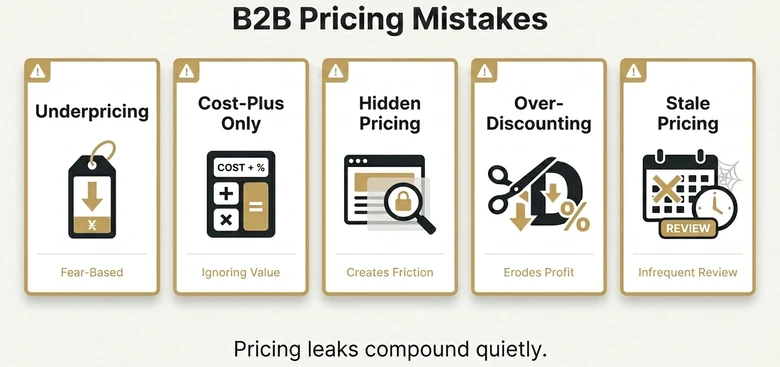
After analyzing how companies price, here are the five mistakes that cost B2B teams the most revenue.
Underpricing out of fear. Many B2B companies set prices too low because they’re afraid of losing deals. But competing on price in B2B is a losing strategy unless you have a genuine cost advantage. If your product delivers clear value, charge accordingly.
Using only cost-plus. Cost-plus ignores the buyer’s perspective entirely. A product that costs you $10 to produce but saves the customer $10,000/year should never be priced at $15. Start with value, then check that your margins work.
Hiding your pricing entirely. For self-serve and mid-market products, hiding pricing creates friction and drives prospects to competitors who are more transparent. Show pricing unless your deals genuinely require custom scoping.
Offering too many discounts. Without discount governance, sales teams create their own norms. Over time, your effective price drifts far below list price. Set clear discount thresholds by deal size and require manager approval for anything beyond 15-20%.
Never revisiting pricing. Markets shift. Costs change. Your product adds new features. If you haven’t reviewed pricing in over a year, you’re almost certainly undercharging.
Build a quarterly pricing review into your revenue operations process. Tracking the right metrics helps here. For guidance on what to measure, explore our SaaS marketing metrics guide.
PRO TIP
Before raising prices, run a win/loss analysis on your last 50 deals. If your win rate exceeds 40% and price objections are rare, you’re likely undercharging by 15-25%. Test higher pricing on new prospects before rolling it out across the board.
B2B Pricing Strategy Template: Build Yours in 5 Steps
If you’re starting from scratch or rethinking your current approach, this framework gives you a repeatable process. It works for SaaS products, professional services, and physical goods sold B2B.
Step 1: Audit Your Costs and Margins
Map every cost associated with delivering your product: COGS, hosting, support, sales, and onboarding. Calculate your fully loaded cost per customer at each tier or segment. This is your pricing floor. Any price below this line loses money, no matter how many customers you sign.
Step 2: Research Customer Willingness to Pay
Interview 10-15 current customers and 5-10 churned customers. Ask: “If this product didn’t exist, what would you use instead and how much would that cost?” The gap between your price and the cost of the alternative is your pricing headroom. Van Westendorp surveys (asking “at what price is this too cheap / a bargain / getting expensive / too expensive”) give you a quantitative range.
Step 3: Map the Competitive Field
Document every competitor’s publicly available pricing. Note their model (tiered, per-user, usage), their price points, and their packaging. Identify where you offer more value and where they undercut you. Your price should reflect your relative positioning: premium products price above the median, challenger products price below it, and commodity products match it.
Step 4: Choose Your Model and Set Initial Prices
Using the 5 C’s framework and the decision tree from the “How to Choose” section above, select a pricing model. Set your initial prices based on the data from steps 1-3. Anchor your recommended tier at the price point most customers are willing to pay, then build a lower tier for price-sensitive buyers and a higher tier for power users or enterprise accounts.
Step 5: Test, Measure, and Iterate
Launch your pricing with a 90-day review window. Track win rate, average deal size, discount frequency, and customer acquisition cost at each tier. After 90 days, adjust. If win rates are above 50%, you likely have room to raise prices. If below 20%, either the price is too high or the value communication needs work. The first pricing model is always a hypothesis. The goal is to get to version 2 faster, not to get version 1 perfect. Tier-by-tier CAC tracking only earns its keep when the CAC denominator is fully-loaded — what fully-loaded CAC math actually requires is salary burden, tooling, and overhead allocation that most monthly snapshots leave out.
If you’re tracking these metrics alongside your broader marketing KPIs, our guide to B2B go-to-market strategy covers how pricing fits into the larger launch process.
When to Change Your B2B Pricing Strategy
Pricing isn’t permanent. Pricing consultants recommend reviewing at least annually, with more frequent adjustments in inflationary or fast-changing markets. Here are the signals that it’s time to revisit your model or price points.
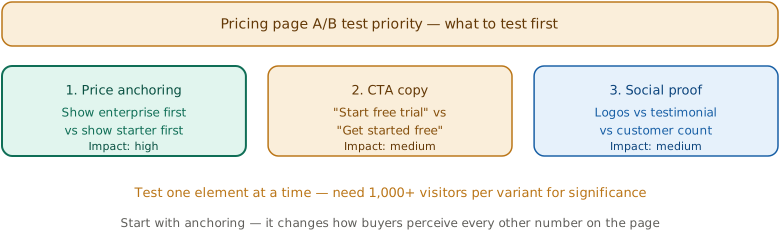
Your win rate is unusually high. If you’re closing 50%+ of proposals, you may be underpriced. Test a 10-15% increase on new deals and monitor whether win rates hold.
Customers never push back on price. Some price sensitivity is normal and healthy. If nobody ever questions your pricing, you’re leaving money on the table.
You’ve added significant product value. New features, integrations, or capabilities that solve additional problems for customers justify a price increase. Frame price changes around the new value delivered, not around your cost increases.
Your costs have changed materially. Input cost increases (raw materials, hosting, labor) should be passed through to customers, ideally with advance notice and clear communication about why.
You’re expanding into a new segment. Enterprise customers and SMB customers have different willingness to pay, different buying processes, and different feature requirements. A single pricing model rarely serves both well.
B2B Pricing Negotiation: Protecting Margins on Custom Deals
Even with a strong pricing strategy, enterprise deals often come down to negotiation. The biggest margin leak in B2B isn’t bad pricing. It’s undisciplined discounting during the sales process.
Set discount guardrails before the conversation starts. Define maximum discount levels by deal size and contract length. A 10% discount on a 3-year commitment might be reasonable. A 30% discount on a month-to-month deal is margin destruction.
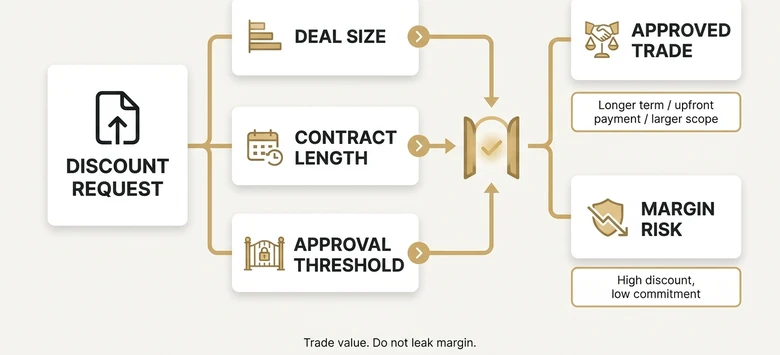
Trade, don’t just discount. Every discount should come with a concession from the buyer: longer contract commitment, upfront annual payment, case study participation, or a larger scope. Reps who discount without trading train buyers to always ask for more.
Use payment terms as a lever. Net-30 is standard, but you can offer Net-15 with a 2% discount or Net-60 at a 5% premium. Payment terms affect your cash flow, and pricing them explicitly turns a hidden cost into a negotiation tool.
Track your effective price. Compare what you quote (list price) against what you actually collect (effective price after discounts, credits, and concessions). If the gap exceeds 15%, your pricing isn’t the problem. Your revenue operations process needs tighter controls.
Frequently Asked Questions
The four most common B2B pricing strategies are cost-plus pricing (production cost plus a fixed margin), value-based pricing (priced according to customer-perceived value), competition-based pricing (benchmarked against competitors), and dynamic pricing (adjusted in real time based on demand, inventory, or market conditions). Most B2B companies use a combination of two or more of these approaches.
Value-based pricing combined with a tiered model works best for most B2B SaaS companies. Set your tiers based on the value each customer segment receives, not just the features they access. Anchor with a “recommended” middle tier that captures the majority of customers, and offer a premium enterprise tier with custom pricing for high-value accounts.
For self-serve products under $500/month, yes. Transparency reduces friction and builds trust. For mid-market products ($500-$5,000/month), show tier ranges with a “contact us” option for custom plans. For enterprise products above $5,000/month, focus your pricing page on value and ROI rather than specific numbers, and direct visitors to sales.
Review pricing quarterly and make adjustments at least annually. Track win/loss ratios, discount rates, and competitive pricing shifts as inputs to your review. In inflationary or rapidly changing markets, monthly monitoring with quarterly adjustments is appropriate.
The 5 C’s are Cost, Customers, Competition, Channel, and Compatibility. Cost sets your pricing floor. Customers determine willingness to pay. Competition provides benchmarks. Channel accounts for distribution margins. Compatibility ensures pricing aligns with your brand strategy and business goals. Evaluate all five before setting or changing any price.
The rule of 7 is a marketing principle stating that prospects need at least seven interactions with your brand before making a purchase decision. In B2B, where buying cycles are longer and multiple stakeholders are involved, this means sustained multi-channel engagement through content, email, ads, and sales touchpoints. The number isn’t literal, but the principle holds: repeated exposure builds the trust required for high-value B2B purchases.
Set Your Pricing, Then Iterate
The biggest pricing mistake isn’t choosing the wrong model. It’s choosing a model and never revisiting it. Start with the framework that fits your product, sales motion, and customer base. Price based on value where possible, use cost-plus as a floor, and monitor competitive positioning as a reference point.
Then commit to a regular review cycle. Pull win/loss data, survey lost deals about price sensitivity, and track your effective price (actual revenue per customer) versus your list price. The gap between those two numbers tells you whether your pricing strategy is working or whether your sales team is quietly rewriting it through discounts.
Here’s your first step: pull your last 20 closed-lost deals and ask one question during your loss review. Was price the primary reason they didn’t buy? If fewer than 30% cite price, you probably have room to raise it. If more than 50% cite price, you need to either adjust pricing or improve how you communicate value during the sales process.
Pricing is a muscle. The more you exercise it with data, testing, and intentional adjustments, the stronger your margins become.