
Most SaaS funnel articles spend 80% of their words on the top of the funnel and 20% on everything that actually drives revenue. The math is backwards. ChartMogul’s 2026 analysis of self-serve SaaS products found a 10x conversion gap between the top 20% and bottom 20% of products at the trial-to-paid step alone. The median sits at 8% across all self-serve SaaS, and 18% specifically for B2B opt-in trials per First Page Sage.
Top quartile B2B teams hit 35-45%. The teams clustered in single digits aren’t lacking awareness traffic. They’re losing the sale at the moment of truth, between trial signup and credit card.
The shape of the SERP reflects this. Plenty of “stages of a SaaS funnel” guides exist. Almost none focus on where the conversion delta actually lives. This guide does.
You’ll get the full 6-stage SaaS sales funnel framework, then a deep look at the trial-to-paid step where the revenue is hiding: real benchmarks by trial model, why shorter trials often outperform longer ones, the opt-in vs. opt-out conversion gap, and the four levers that consistently move the needle.
If activation is the bottleneck, pair the funnel map with a trial and PQL lead scoring model so product signals decide when sales should step in.
Key Takeaways
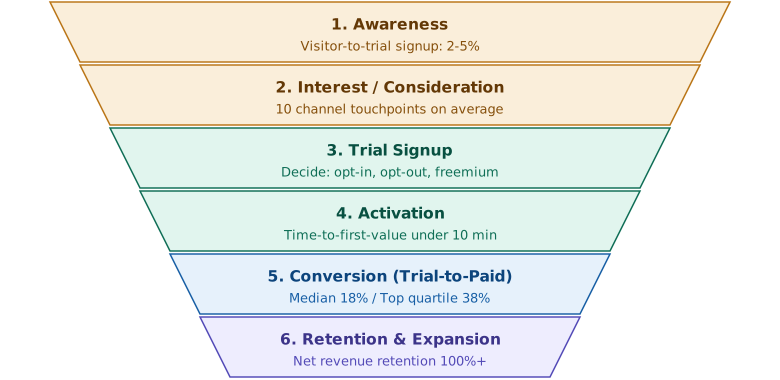
- The SaaS sales funnel has six stages, not four. Awareness, interest, trial signup, activation, conversion, and retention/expansion. Most articles compress activation and conversion into one box, which is exactly where teams lose deals.
- Median B2B trial-to-paid conversion is 18%. Top quartile hits 38%. Closing that gap is usually worth more than doubling top-of-funnel traffic.
- Opt-out trials (credit card required) convert at ~49% vs. opt-in at ~18%. But fewer prospects start. The right model depends on price point, brand trust, and product complexity.
- Trials shorter than 14 days often outperform longer ones. Time-to-first-value matters more than total trial length.
- Track stage-specific metrics, not vanity totals. Visitor-to-trial conversion, activation rate, and trial-to-paid each tell you something different about where the funnel is leaking.
What Is a SaaS Sales Funnel?
A SaaS sales funnel is the structured journey a prospect takes from first awareness of your product through trial, conversion to a paying subscriber, and expansion into a long-term customer. Unlike traditional B2C funnels that end at the purchase, SaaS funnels are circular. The sale isn’t the finish line because subscription revenue compounds through retention, expansion, and renewal cycles.
This structural difference reshapes every stage. Bain’s research on customer retention shows that increasing retention by just 5% can lift profits by 25-95% depending on industry. For SaaS specifically, ProfitWell estimates 70% of revenue comes from existing customers. The funnel has to be engineered for that reality, not just first conversions.
Three structural differences matter for funnel design:
The sale is the start, not the end. A traditional retail funnel optimizes for first purchase. A SaaS funnel optimizes for retained, expanding revenue across years. Customer success, onboarding, and expansion sit inside the funnel, not after it.
Trial is the conversion event, not the sales call. Per Apollo’s 2026 B2B SaaS funnel research, 69% of buyers complete most of their evaluation before talking to sales, and 61% prefer rep-free experiences. The trial period replaces a lot of what discovery and demo calls used to do. Supademo’s AI Demo Agent launch pushes that same buyer preference into the demo request itself, letting prospects qualify and see product proof before a rep joins.
For non-SaaS motions, compare this trial-led path with the broader B2B sales funnel before copying the same stages.
Buying committees, not buyers. The average B2B SaaS buying group now includes 11 stakeholders. The funnel has to enable a champion to build internal consensus, not just get one person sold. That consensus-building is why the SaaS journey behaves less like a funnel and more like a committee working through the journey together, each member entering at a different point. Before you design for that champion, it helps to know the buying committee behind a SaaS purchase in full, since the trial user is rarely the person who signs the contract.
The 6 Stages of a SaaS Sales Funnel
Most guides use four stages (awareness, interest, decision, action) borrowed from the AIDA model. That model dates to 1898 and was built for retail print ads. It doesn’t account for trial signup, activation, or the difference between paying once and paying every month forever. Six stages is the cleaner cut for SaaS. Whichever model you adopt, define whether a stage counts booked meetings or held ones before you benchmark it, because the two produce different numbers from identical activity.
Stage 1: Awareness
The prospect doesn’t know your product exists. They might not even know they have a problem worth solving. Job here is to get into their consideration set without burning trust. Tactics: SEO content targeting problem-aware queries, paid social with educational angles, podcast sponsorships, partner marketing, organic LinkedIn. Key metric: visitor-to-trial conversion rate (typical range 2-5% per ChartMogul’s 2026 data; top 10% hit 11%+).
Stage 2: Interest / Consideration
Prospect knows you exist and is comparing you to alternatives. They’re reading comparison pages, watching demos, downloading buyer guides. The mistake here is pushing for a sales call too early. McKinsey research cited by Apollo shows B2B buyers now use ten interaction channels in their journey, double the 2016 number. Be present across them; don’t try to compress the journey into one call. Key metric: content engagement (time on page, return visits, multi-page sessions) and email signup rate.
Stage 3: Trial Signup
The conversion event most teams underweight. The prospect is willing to enter the product. This is where you find out whether your trial flow is actually frictionless or just feels frictionless to the team that built it. Key metric: visitor-to-trial signup rate. Target: above 4-6% for free trials, 9%+ for freemium.
Stage 4: Activation
The prospect signs up, then has to actually experience value before the trial ends. Activation is the leading indicator nobody can fake. If users hit the “aha moment” (sent the first message, connected the first integration, generated the first report), they convert. If they don’t, they churn. The 1Capture 2025 benchmarks suggest top-quartile activation rates run 60%+ vs. median of 30-35%. Key metric: activation rate, time-to-first-value.
Stage 5: Conversion (Trial-to-Paid)
The credit card moment. This is the stage with the widest spread between average and top performers, and the section below covers the playbook. Key metric: trial-to-paid conversion rate. Median for B2B opt-in: 18%. Top quartile: 35-45%.
Stage 6: Retention & Expansion
The new customer onboards, integrates the product into their workflow, and (in good cases) expands into more seats, more features, or adjacent products. This is where SaaS economics actually work. Per ProfitWell, expansion revenue often exceeds new business revenue at scale. Key metric: net revenue retention (NRR), gross revenue retention (GRR), churn rate, expansion MRR.
Free Trial to Paid: The Stage Most Articles Skip
Almost every “stages of the SaaS funnel” guide treats the trial-to-paid moment as a single sentence: “the prospect converts.” That sentence is hiding 90% of the work. Here’s what actually happens at the BOFU step that nobody else lays out cleanly.
The Real Conversion Benchmarks
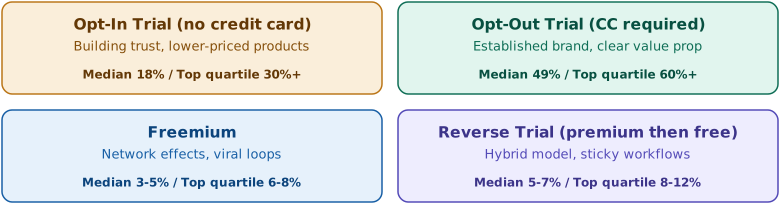
The single most-cited “industry average” of 25% trial-to-paid is misleading because it doesn’t separate trial models. The actual data segmented by model:
| Trial Model | Median | Top Quartile | Best For |
|---|---|---|---|
| Opt-in trial (no credit card) | 18% | 30%+ | Lower-priced products, early-stage trust |
| Opt-out trial (credit card required) | 49% | 60%+ | Established brands, clear value prop |
| Freemium | 3-5% | 6-8% | Network-effect products, viral loops |
| Reverse trial (premium then free) | 5-7% | 8-12% | Hybrid models, sticky workflows |
The opt-out number looks dramatically better, but fewer prospects enter the trial in the first place because asking for a credit card upfront is real friction. The right model is the one that produces the highest paying customers from your specific traffic, not the one with the highest conversion rate in isolation. Some traffic shouldn’t run a trial at all: large, multi-stakeholder accounts convert through a sales-led enterprise sales funnel, where a buying committee and procurement, not a credit card, decide the outcome.
The trial model should match the SaaS pricing model underneath it; freemium, reverse trials, and usage-based pricing create different conversion behavior.
Why 7-Day Trials Often Beat 30-Day Trials
Counterintuitive but consistently confirmed by SaaS benchmark data: trials of 7 days or fewer often outperform 14 or 30-day trials. The mechanism is urgency. A 30-day trial gives users 29 days to keep deferring the decision. A 7-day trial creates a decision deadline that aligns with how people actually behave under deadlines.
The catch is your product has to deliver value within that window. If your time-to-first-value is two weeks (because of integration, configuration, or learning curve), a 7-day trial will tank conversion. The fix is reducing time-to-first-value, not extending the trial.
Opt-In vs. Opt-Out: The 30-Point Conversion Gap
The single biggest structural lever in your trial design is whether you require a credit card upfront. The conversion-rate gap (~18% opt-in vs. ~49% opt-out) is enormous, but it’s not the right metric to compare. The right comparison is paying customers per 1,000 visitors:
Opt-in path: 1,000 visitors → 90 trial signups (9% trial signup rate) → 16 paying customers (18% trial-to-paid).
Opt-out path: 1,000 visitors → 35 trial signups (3.5% rate, lower because of credit card friction) → 17 paying customers (49% trial-to-paid).
The math is closer than the headline conversion rate suggests. Opt-out wins when your brand is established and your value prop is unmistakable. Opt-in wins when you’re building trust or competing on accessibility. Most early-stage B2B SaaS should default to opt-in. Most established B2B SaaS with mature product should at least test opt-out.
4 Levers That Move Trial-to-Paid
From the trial-conversion benchmark literature and the patterns we see across SaaS clients, four levers consistently outperform everything else:
1. Time-to-first-value under 10 minutes. Every 10-minute delay in users hitting their “aha moment” costs an estimated 8% in conversion per 1Capture’s 2025 analysis. Onboarding is not a “nice-to-have.” It’s the single biggest growth investment most SaaS teams underweight.
2. Behavioral triggers, not calendar emails. An email sent on day 3 to every trial user converts worse than an email sent the moment a user completes (or fails to complete) a key action. Tools like Customer.io, Intercom, and Userflow handle this. Calendar-based sequences underperform behavioral by 67% according to 1Capture data.
3. Activation milestone tracking. If your activation rate is 30%, the rest of your trial-to-paid funnel doesn’t matter. You’re optimizing the wrong stage. Define your activation milestone (the action that 90%+ of paid users take), measure it, and obsess over it. ChartMogul’s research shows top-quartile companies have 2x the activation rate of the median. Figuring out which stage actually deserves the fix before you invest in it is what a structured journey optimization pass is for, ranking each stage by the revenue its drop-off costs.
4. Stakeholder-specific assets. B2B SaaS trials usually need internal consensus. The trial-using champion is rarely the budget holder. Make it easy for the champion to share. Build ROI calculators, executive summary one-pagers, security documentation, and procurement-ready compliance pages. Pricing strategy decisions directly affect this stage; if your pricing page can’t be sent to a CFO without questions, you’re losing trial-to-paid conversions before the trial even ends.
PRO TIP
Run a cohort analysis at 90 days, not 30. Trials that don’t convert in the trial window often convert in the following 60-90 days through retargeting, support follow-up, or product-led engagement. Measuring trial-to-paid only at trial expiry undercounts your real conversion rate by 15-25%.
SaaS Sales Funnel Metrics That Actually Matter
Most SaaS funnel dashboards track 30-40 metrics. Three or four actually drive decisions. Here are the metrics that matter at each stage, what to target, and what most teams get wrong about each one.
For a wider SaaS dashboard beyond funnel conversion, use SaaS marketing metrics to connect acquisition, retention, and unit economics.
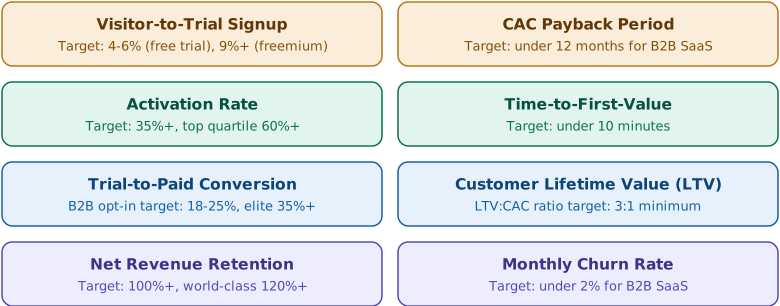
Customer Acquisition Cost (CAC). Total sales and marketing spend divided by new customers acquired. Useful, but not on its own. The metric that matters is CAC payback period (months until a new customer’s gross profit equals their CAC). Sub-12 months is excellent for B2B SaaS, 12-18 months is acceptable, 24+ months means the business model is breaking. Both CAC and CAC payback depend on the CAC numerator being fully-loaded; salary burden, tooling, and overhead allocation are the inputs most teams quietly leave out, which means a payback that looks like 11 months on paper often runs 14 once the math is honest.
Visitor-to-trial signup rate. The single best signal of whether your messaging matches your audience. Below 2% means the website isn’t pulling its weight. Above 6% means something is working — figure out what and double down.
Activation rate. The leading indicator that nobody outside the SaaS world tracks. Define your activation event clearly (sent first message, completed first import, created first project — whatever your product’s “aha moment” is) and track the percentage of trial users who hit it. Below 35% means the onboarding is broken.
Trial-to-paid conversion rate. Already covered above. Target 18% for B2B opt-in, 35%+ for top-quartile performance.
Net revenue retention (NRR). The single best metric for SaaS economics overall. NRR above 100% means your existing customers are growing in value faster than churn shrinks them. World-class SaaS companies hit 120%+ NRR. Below 90% NRR, the leaky bucket is faster than the inflow.
Customer lifetime value to CAC ratio (LTV:CAC). Aim for 3:1 minimum. Below 1:1, you’re losing money on every customer. Above 5:1, you’re probably underspending on growth. The 3:1 target is the consensus across SaaS investor benchmarks.
5 Costly SaaS Sales Funnel Mistakes
The mistakes below come from post-mortems on SaaS funnels that underperformed despite solid traffic and reasonable trial design. Each one is preventable.
1. Optimizing for vanity totals instead of stage-specific bottlenecks. “Conversion rate” as a single number is meaningless. Visitor-to-trial, trial-to-activation, activation-to-paid, and paid-to-retained are four different problems with four different solutions. Teams that look only at the overall conversion rate end up over-investing in the stage that’s already working and under-investing in the stage that’s broken. Sales-led motions fracture the same way: the demo funnel splits the same way, into six measurement events, and only two of them have public benchmark evidence solid enough to compare yourself against.
2. Trying to fix top-of-funnel when the leak is mid-funnel. Anthony Blatner’s recent observation hits the nail on the head: most SaaS funnels aren’t broken at the top, they’re misfiring in the middle. Doubling traffic on a 1.5% trial-to-paid funnel just doubles the wasted spend. Fix the trial-to-paid step before you scale acquisition.
3. Treating activation as an onboarding email problem. Activation isn’t an email. It’s the structural design of the first user experience inside the product. If a user can’t reach the aha moment in their first 10-minute session, no email sequence will save the conversion. Activation problems are product problems disguised as marketing problems.
4. Killing trials too early. Some products genuinely need 14 or 30 days for users to evaluate. A complex compliance tool with multi-system integration won’t activate in 7 days no matter how clean the onboarding is. Pick the trial length that matches your time-to-first-value, not the length that maximizes urgency in isolation.
5. Ignoring expansion revenue in funnel design. The funnel doesn’t end at conversion. If your retention and expansion stages aren’t engineered with the same care as acquisition, you’ll always be running on the acquisition treadmill. NRR above 110% changes the unit economics of the entire business; that’s where the funnel work actually pays off.
How to Audit Your SaaS Sales Funnel: A 6-Step Process
Most SaaS teams think they need a “funnel optimization sprint.” What they usually need is an honest audit that reveals which stage is actually broken. Here’s how to run one in two weeks.
Step 1: Map the Current Funnel End-to-End
Document every stage from first website visit to renewal, including the conversion rates between stages. Most teams have never written this down completely. The act of writing it surfaces gaps. Use last 90 days of cohort data; older cohorts can mislead because behavior changes.
Step 2: Identify the Lowest-Conversion Stage Relative to Benchmarks
Compare your stage rates to the benchmarks in this guide. The biggest gap is your priority. If your visitor-to-trial is 1.2% (vs. 4% benchmark), that’s where the focus goes. If trial-to-paid is 7% (vs. 18% benchmark), focus there. Don’t try to fix multiple stages at once. Before you act on a gap, check that the benchmark shares your denominator, because two funnels reporting the same stage name routinely count completely different populations.
Step 3: Diagnose the Root Cause
Run user interviews, session recordings, and exit surveys for the priority stage. The fix for “low trial signup” might be messaging, pricing visibility, social proof, or page speed. Don’t guess. The data tells you which.
Step 4: Design One Targeted Experiment
Pick a single change with a clear hypothesis and a measurable outcome. Don’t ship five changes at once because you’ll never know which moved the metric. The constraint is what produces learning.
Step 5: Run for Statistical Significance
Most SaaS funnel experiments need 2-4 weeks for statistical significance unless you have massive volume. Stopping early is the most common mistake. If the experiment doesn’t move the metric in two weeks, you have your answer; if it moves it, you need to confirm it’s real.
Step 6: Lock In Wins, Move to the Next Stage
Document what worked, integrate it into the standard funnel, then repeat the audit on the next-lowest-conversion stage. The compound effect over 3-4 cycles often outperforms any single big-bang funnel rebuild.
IMPORTANT
Funnel audits work best when one person owns the metrics across all stages. If marketing owns TOFU, product owns activation, and sales owns conversion, the handoffs between stages become invisible. Either appoint a funnel owner (often called a head of growth or RevOps) or run the audit as a cross-functional weekly review with shared metrics.
Frequently Asked Questions
The classic 5-stage SaaS funnel uses awareness, interest, consideration, decision, and retention. The 6-stage model adds activation as a separate stage between trial signup and conversion, which matters in SaaS because activation predicts conversion better than any other behavioral signal. The 5-stage model is simpler; the 6-stage model surfaces the bottleneck most teams have.
For B2B opt-in trials (no credit card), 15% is acceptable, 25% is the target, and 30%+ is excellent per Lincoln Murphy’s benchmarks. For opt-out trials (credit card required), 50% is the median and 60%+ is top quartile. Freemium products typically convert at 3-5% to paid. Vertical SaaS (healthcare, legal, construction) often outperforms general-purpose tools at 25-40% trial-to-paid when qualification is strong.
The traditional 7-stage funnel is awareness, interest, consideration, conversion, retention, expansion, and advocacy. The 7-stage version separates retention, expansion, and advocacy where the 6-stage version groups them. Both are valid; pick the one that matches how your team thinks about the customer lifecycle. The number of stages matters less than measuring transitions between them.
Match the trial length to your time-to-first-value, not industry convention. If users hit the aha moment within their first session, 7-day trials often outperform 14 or 30 days because of urgency. If your product requires multi-system integration or learning curve, 14-30 days is necessary. The most common trial length is 14 days (62% of products per ChartMogul), followed by 7 days and 30 days at 14% each. The wrong length is the one that doesn’t match your activation timeline.
Freemium suits products with network effects, viral loops, or low marginal serving cost (Slack, Notion, Figma). Free trials suit products where users need to experience full functionality to make a buying decision (Salesforce, HubSpot, Intercom). Per ChartMogul’s 2026 data, free trial products convert at higher rates (4-15% great) but freemium captures more total signups. The right answer depends on whether your value prop is felt immediately or builds with sustained use.
The SaaS sales funnel is structured enough to model and messy enough to break in different places for different companies. The framework above gives you the stages and benchmarks. The audit process gives you a way to find your specific bottleneck without guessing. Start with the stage that has the biggest gap to benchmark, fix it, then move on. Over 3-4 cycles, the compound effect usually outperforms any single funnel rebuild.
If your funnel work is part of a broader market push, layer it into your B2B go-to-market strategy rather than running it separately. The funnel is the execution arm of the GTM, and the same logic from B2B ecommerce best practices on stakeholder-specific content applies inside SaaS sales motions too.