Updated Q2 2026. Most “best B2B marketplace software” lists make the same mistake: they mix up two completely different products. Half the entries are tools for running your own single-brand store, and the other half are platforms for operating a multi-seller marketplace. Those are different businesses with different software. This guide covers only the second kind.
B2B marketplace software is the platform a company uses to operate a marketplace where third-party sellers list and sell to business buyers, with the operator taking a commission on each transaction. If you are a manufacturer building a distributor portal, a distributor opening your catalog to other suppliers, or an industry group launching a vertical trading hub, this is the category you are shopping. According to Gartner, 80% of B2B sales interactions now happen in digital channels, and operated marketplaces are how a growing share of manufacturers and distributors capture that demand without holding every SKU themselves.
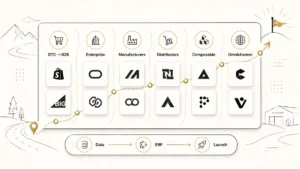
The ten platforms below were each verified against their official Q2 2026 pricing and positioning. They span four tiers, from enterprise systems that run billion-dollar marketplaces down to a module that turns an existing store into a marketplace for a few hundred dollars. The reason for the wide range is simple: manufacturers and distributors are not one buyer. A Fortune 500 industrial group and a single-region wholesaler need very different software, and pretending one tool fits both is how these lists mislead people. After the reviews you get a comparison table, a plain explanation of how a marketplace actually works, pricing benchmarks, a selection framework, and the five mistakes that send operators to the wrong platform.
Key Takeaways
- B2B marketplace software runs a multi-seller platform (you take a commission on other sellers’ transactions). It is not the same as a B2B ecommerce platform, which runs your own single-brand store. Buy the wrong one and you rebuild in a year.
- The category splits into four tiers as of Q2 2026: enterprise (Mirakl, VTEX, Spryker), mid-market and aggregator (Marketplacer, Nautical Commerce), turnkey and SMB (Sharetribe, Yo!Kart, Arcadier), and open-source or add-on (CS-Cart, Webkul). Match the tier to your scale, not to a feature list.
- Enterprise platforms quote custom pricing and run from roughly $50,000 to $250,000+ per year all-in. Self-hosted and turnkey options start at a $999 one-time Yo!Kart license or a $39/month Sharetribe plan (both as of Q2 2026).
- The real cost of a marketplace is implementation and integration (ERP, payments, seller onboarding), not the license fee. Budget for it before you sign.
- For B2B specifically, the load-bearing features are corporate accounts, contract or negotiated pricing per buyer, approval workflows, and split payouts to sellers. A consumer marketplace tool that lacks these will not survive contact with procurement.
What B2B Marketplace Software Is (and What It Isn’t)
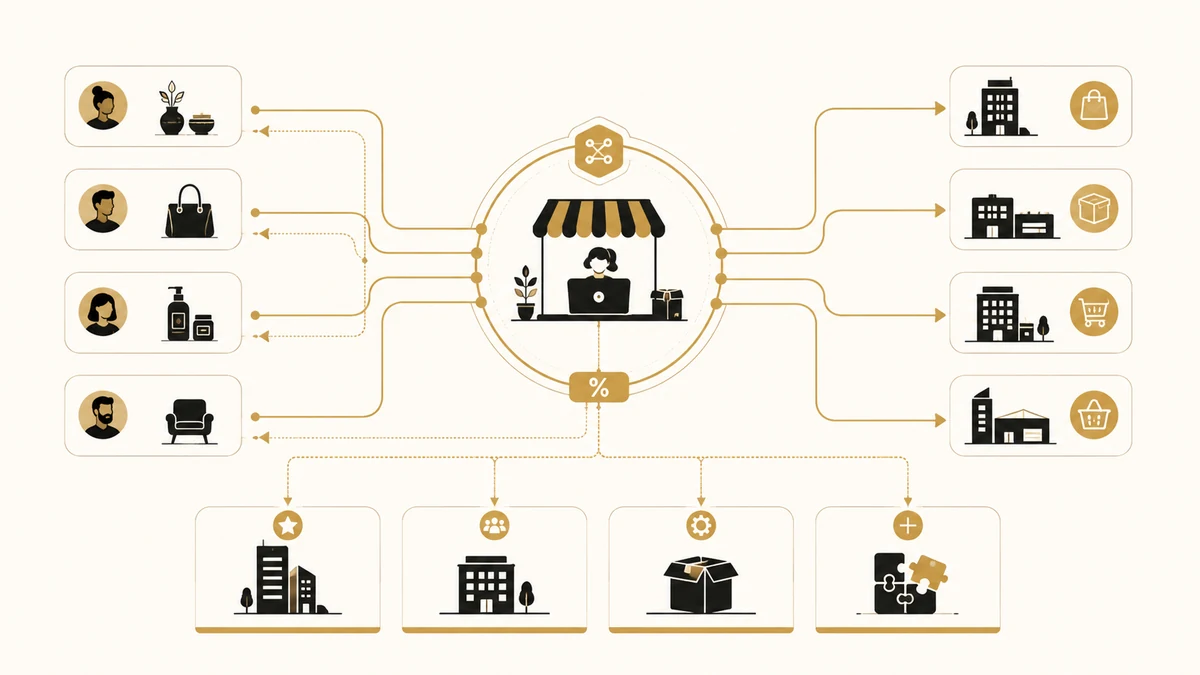
B2B marketplace software is a platform that lets one company (the operator) run an online marketplace where multiple third-party sellers list products or services and sell to business buyers, while the operator manages onboarding, catalogs, orders, commissions, and payouts. The defining trait is the three-sided model: an operator in the middle, sellers on one side, buyers on the other. The operator rarely owns the inventory. They own the audience, the rules, and the transaction layer, and they monetize through commission, subscription, or listing fees. That inversion is the whole point. A traditional distributor grows by buying more inventory and warehousing it; a marketplace operator grows by adding more sellers, which costs far less capital per dollar of new catalog. It is also why marketplaces expand into adjacent categories quickly, since the operator does not have to fund or store the new products, only recruit the sellers who already do.
That is a different job from a B2B ecommerce platform, which is built for one company to sell its own catalog through a branded storefront. Both involve carts and checkouts, so they look similar in a demo. Underneath, the data models are different. A marketplace platform has to model many sellers, split a single order across them, calculate a commission per line item, and pay each seller separately. A single-store platform does none of that because there is only one seller: you.
For B2B, the software also has to handle the things procurement teams demand. Corporate accounts with multiple buyers under one company. Contract pricing that differs by customer. Quote requests and approval chains before a purchase order is issued. Integration with the buyer’s ERP through formats like PunchOut. A platform that treats every buyer as an anonymous credit-card shopper will work in a consumer marketplace and fail the first enterprise procurement review. The best B2B marketplace software treats these as first-class features, not bolt-ons.
Marketplace Software vs. Ecommerce Platform: Which One Do You Actually Need?
This is the decision that determines everything else, and it is where most buyers go wrong. Pick the wrong model and no amount of feature richness saves you, because you will be forcing a tool to do a job it was not built for.
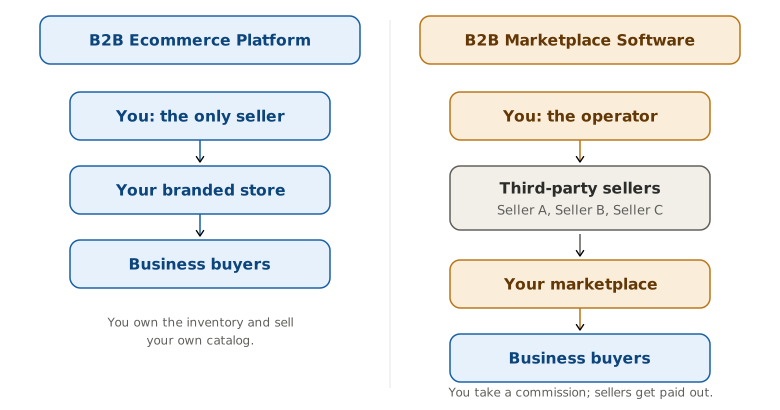
Choose a B2B ecommerce platform when you sell your own products. If your company manufactures or stocks the goods, owns the inventory, and wants a branded storefront with B2B features like bulk ordering and account-based pricing, you want a single-store platform. That is a separate buying decision with its own shortlist, and we cover how to make it in our guide to choosing a B2B ecommerce platform. Tools like Shopify Plus, BigCommerce B2B, OroCommerce, and Adobe Commerce live in that world. They are excellent at running your store. They are not marketplace software.
Choose B2B marketplace software when other companies will sell through your platform. The moment you want third-party sellers listing their own products, getting paid out individually, and being charged a commission, you have crossed into marketplace territory. A manufacturer that wants its certified distributors to sell through one branded portal needs marketplace software. A distributor that wants to broaden its catalog by inviting complementary suppliers needs marketplace software. An industry association launching a neutral trading hub needs marketplace software.
Some platforms blur the line on purpose. VTEX, Spryker, and Adobe Commerce can run a single store and bolt on marketplace capability, which is useful if you expect to start as a store and add sellers later. But “can add a marketplace module” is not the same as “built as marketplace software,” and the difference shows up in seller onboarding, payout logic, and commission management. If the marketplace is the point, start with a platform that was designed for it. For a sense of how operators actually structure these models in the wild, our roundup of B2B ecommerce examples shows the patterns that work, and the broader playbook in our B2B ecommerce best practices guide covers the fundamentals both models share.
How We Chose These 10 Platforms
The shortlist was built against four criteria. Each platform had to be genuine multi-vendor marketplace software (not a single-store tool), had to be actively sold and supported as of Q2 2026, had to publish or confirm its positioning and pricing model on request, and had to have a credible track record with business sellers and buyers.
The bigger editorial choice was tier coverage. Manufacturers and distributors do not sit at one scale. They range from Fortune 500 industrial groups running global seller networks down to single-region wholesalers launching a first portal on a fixed budget. A list that only profiled enterprise platforms would be useless to the wholesaler, and a list that only profiled $999 turnkey kits would be useless to the enterprise. So this guide deliberately spans four tiers: enterprise B2B, mid-market and aggregator, turnkey and SMB, and open-source or add-on. We also required that pricing be either published or confirmable, which is why some platforms show custom rates here rather than a number we invented. Where a vendor does not disclose pricing, this guide says so plainly instead of guessing, because a made-up figure is worse than an honest “contact sales.”
That means the platforms here are not ranked against each other on a single scale. A turnkey kit is not “worse” than an enterprise platform any more than a van is worse than a freight train. Each platform is placed honestly inside its own tier, with a clear statement of who it fits and who it does not. The order below moves from the heaviest enterprise systems down to the lightest add-ons, so you can stop reading at the tier that matches your scale. Picking the right tier is itself part of a sound go-to-market strategy, because the platform you can actually staff and afford beats the one with the longest feature list. It also sits alongside your B2B SEO strategy, since a marketplace buyers cannot find in search starts at a disadvantage that no feature list overcomes.
The 10 Best B2B Marketplace Software Platforms in 2026
Each platform below gets the same structure: who they are, who they are best for, the standout that separates them, the starting price as of Q2 2026, and whether a free trial exists. Pricing marked “custom” means the vendor quotes per deal and does not publish rates, which is normal at the enterprise tier.
1. Mirakl: Best for Enterprise Manufacturers and Distributors Operating at Scale
Mirakl is the most established name in enterprise marketplace software, used by large retailers, manufacturers, and distributors to run operated marketplaces and dropship programs globally. The platform is built around the three-sided model at scale, with dedicated solutions for distributors and manufacturers, a catalog platform for managing supplier data, and infrastructure that handles enormous SKU counts and daily inventory updates. It is explicitly B2B-capable, with the corporate-account and catalog logic that procurement teams expect. Mirakl reports working with hundreds of marketplaces worldwide, and its seller and catalog tooling is deep enough that large operators run mixed first-party and third-party assortments on one platform. The trade-off is cost and operational overhead. This is not a platform you adopt to test an idea, and a smaller operator will pay for capability it cannot yet use.
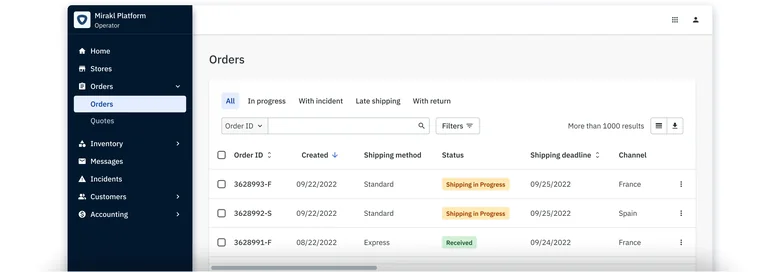
Best for: Large manufacturers and distributors that want to launch a marketplace as a strategic channel and have the budget and team to run it. Strong fit when you are managing a wide seller network or moving from a fixed catalog to an expandable one.
Standout: The breadth of the ecosystem and tooling, plus Mirakl Nexus, a newer layer aimed at connecting marketplaces to AI-driven agentic commerce. Few platforms match its enterprise marketplace operations depth.
Starting price (as of Q2 2026): Custom, contact sales. Enterprise engagements typically run into six figures annually once implementation is included. Demo available; no public free trial.
2. VTEX: Best for Global Enterprises Unifying Store, B2B, and Marketplace
VTEX is an enterprise commerce platform that runs direct-to-consumer, B2B, and marketplace models on one system, which is its core pitch: instead of stitching together separate tools, a global brand can operate its store and its marketplace from a single platform. It explicitly supports B2B with self-service buyer portals, and it lets operators expand assortment by adding their own marketplace. The platform leans heavily into AI-native features for merchandising and customer service. Because one platform runs your direct sales and your marketplace, a manufacturer can sell its own catalog and host third-party sellers without integrating two separate systems, which is the whole consolidation pitch. The cost is that VTEX is an enterprise commitment, sized and priced for organizations with real scale rather than a single first portal.
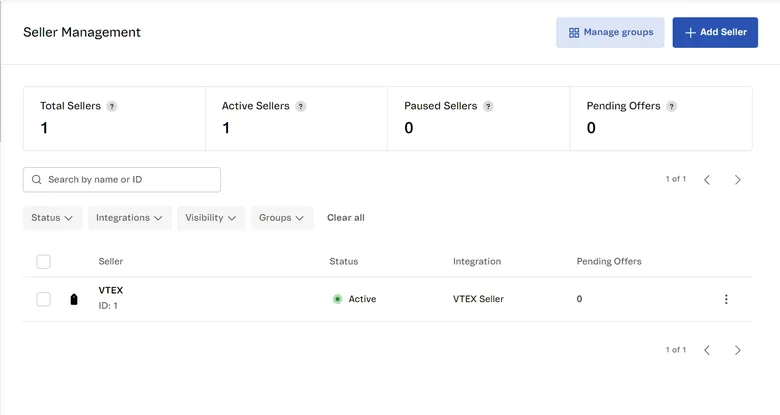
Best for: Global enterprises that already run multiple commerce models and want to consolidate, especially manufacturers or distributors that sell direct and also want a marketplace channel under one roof.
Standout: A single AI-native suite spanning D2C, B2B, and marketplace, which removes the integration tax of running separate platforms for each model.
Starting price (as of Q2 2026): Custom, contact sales, with consumption-based components. Demo available on request; no public free trial.
3. Spryker: Best for Complex Industrial and Wholesale B2B With Developer Resources
Spryker is a composable, API-first commerce platform aimed at mid-to-large B2B enterprises with requirements that off-the-shelf software cannot meet. It supports contract pricing, self-service portals, and marketplace capability through its app composition platform, and it is built to be assembled and extended by a development team rather than configured by a marketer. Gartner named it a Visionary in its 2025 Magic Quadrant for Digital Commerce. Spryker suits teams that have outgrown configurable platforms and need to model rules no template anticipates, from unusual approval chains to industry-specific catalog structures. That power assumes engineering capacity. Without developers to build on it, the composable approach becomes a cost rather than an advantage.
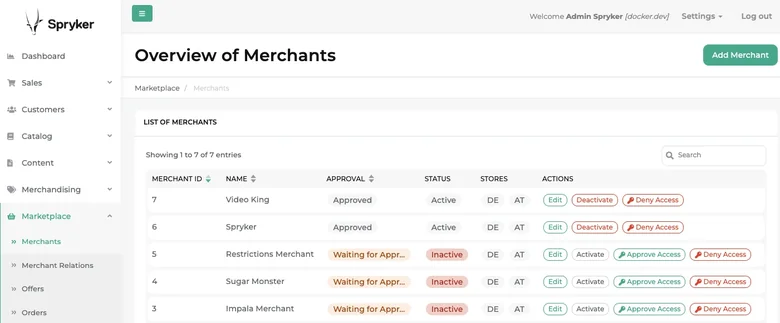
Best for: Industrial, automotive, life-sciences, and wholesale B2B operators with bespoke processes and the engineering capacity to build on a headless platform. Strong fit when your business logic is genuinely unusual.
Standout: Composable architecture that lets teams build exactly the marketplace and B2B logic they need, without fighting a rigid template.
Starting price (as of Q2 2026): Custom, contact sales. Built for teams that can support a developer-led implementation. Demo available; no public free trial.
4. Marketplacer: Best for Retailers and Distributors Adding Third-Party Range Fast
Marketplacer is marketplace software built to bolt a curated multi-seller marketplace onto an existing business without a full platform rebuild. It connects to platforms like BigCommerce, Shopify, Salesforce Commerce Cloud, commercetools, and Adobe Commerce, which means an operator can extend their range with third-party sellers while keeping the storefront they already run. It serves B2B alongside retail, with seller controls and ERP integration for business buyers. Because it connects to the storefront you already run, Marketplacer is the lowest-disruption way for an established retailer or distributor to add third-party sellers, and it serves both retail and B2B from one platform. It is built for operators with an existing business to extend, not for a standalone marketplace started from nothing.
Best for: Established retailers, distributors, and brands that want to expand their catalog through third-party sellers quickly, especially when they already have a storefront and do not want to replace it.
Standout: The Fast Start approach, which promises a marketplace launch in roughly 90 days by connecting to your existing platform rather than rebuilding from scratch.
Starting price (as of Q2 2026): Custom, contact sales. Demo available on request; no public free trial.
5. Nautical Commerce: Best for Mid-Market B2B Marketplaces That Need a Fast Launch
Nautical Commerce is a modern, B2B-focused marketplace platform built to help retailers, brands, and B2B companies launch a company-operated marketplace quickly, often in around 90 days. It manages sellers, commissions, inventory, listings, orders, and payments through a cloud platform with a no-code storefront builder and a GraphQL API for customization. One important update as of Q2 2026: Traide (TraideX, LLC) has acquired the assets of Nautical Commerce and now operates the platform, so confirm the current roadmap and support terms directly before committing.
Best for: Mid-market manufacturers, distributors, and brands that want a purpose-built B2B marketplace without an enterprise budget or timeline. Strong fit when speed to launch matters more than deep customization.
Standout: Built specifically for the B2B sales process and complexity, with a fast implementation that undercuts the typical enterprise timeline. For a distributor or mid-market manufacturer that wants real B2B workflows without an enterprise budget, it hits a useful middle point the turnkey kits cannot match and the enterprise platforms price out of reach. The open question is continuity: an asset acquisition can mean steady investment or a slow wind-down, so make roadmap and support commitments part of your evaluation rather than an afterthought.
Starting price (as of Q2 2026): Custom, contact sales, with month-to-month plans referenced. Demo available; no public free trial. Verify continuity under Traide ownership.
6. Sharetribe: Best for Launching a Niche B2B Marketplace MVP
Sharetribe is a no-code marketplace builder designed to get a marketplace live fast, often in a day, with an optional open-source template for teams that want to extend it with code later. It handles listings, transactions, and payments out of the box and scales from your first user upward. It is the easiest entry point on this list for testing whether a marketplace idea has legs before you spend serious money.
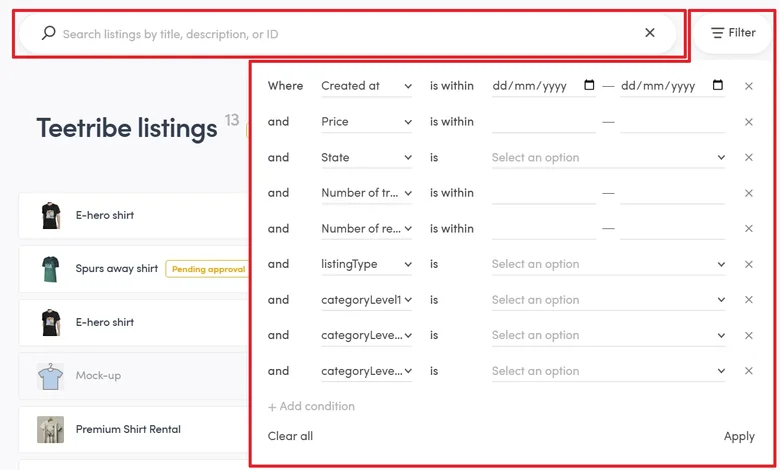
Best for: Founders and operators launching a focused, single-industry or niche B2B marketplace and validating demand quickly. Best for getting a working marketplace in front of real buyers cheaply; not the pick if you are a manufacturer that needs contract pricing, ERP integration, and multi-buyer corporate accounts on day one, because those enterprise B2B workflows are not its focus.
Standout: A genuine launch-in-a-day experience plus an unlimited test environment, so you can build and trial the full product before going live.
Starting price (as of Q2 2026): Build plan $39/month, Lite $99/month, Pro $199/month, Extend $299/month (billed yearly). 14-day free trial, no credit card required.
7. CS-Cart Multi-Vendor: Best for Owning and Self-Hosting Your Marketplace
CS-Cart Multi-Vendor is established marketplace software that gives you full source-code access and a one-time license option, so you can own the software and host it yourself instead of renting it forever. It ships with the core marketplace features (vendor panels, commissions, catalog and order management) and supports B2B use. For operators who want control and predictable long-term cost, the buy-it-once model is the draw.
Best for: Budget-aware operators and distributors who want to own and self-host their marketplace software, keep data in-house, and avoid open-ended subscription costs.
Standout: Full source-code access plus a lifetime-license option, which is rare among the SaaS-first platforms on this list.
Starting price (as of Q2 2026): Subscription from $61/month (Standard), $121/month (Plus), $300/month (Ultimate); or a lifetime license from $3,590 once. Free demo and trial available.
8. Yo!Kart: Best for a Fixed-Budget B2B Launch With No Recurring Fees
Yo!Kart is a turnkey multi-vendor marketplace solution sold as a one-time license with source-code ownership and no transaction fees, which makes its total cost easy to predict. It is positioned for B2B and B2C marketplace launches and ships with standard marketplace features, mobile apps on higher tiers, and free technical support for a set period. For an operator who wants to own the software outright on a fixed budget, it is one of the clearest value propositions here.
Best for: SMB manufacturers, distributors, and startups launching a marketplace on a defined budget who want to own the software and avoid recurring or per-transaction fees. Best for a predictable one-time spend; not the pick if you need a vendor-managed SaaS that handles hosting, security patching, and scaling for you, because you take on hosting and maintenance yourself.
Standout: Lifetime license with source-code ownership and no transaction fees, so the platform cost does not grow with your GMV.
Starting price (as of Q2 2026): GoQuick $999 one-time, GoQuick Boost around $2,499, GoCustom $7,499, GoCustom Prime by quote. Free demo available.
9. Arcadier: Best for a Hosted, API-Extensible Marketplace That Scales
Arcadier is a hosted marketplace platform with a tiered subscription model and full API access on higher plans, which positions it between the no-code builders and the enterprise platforms. You get a managed marketplace without running your own servers, plus the ability to extend through APIs and custom scripts as you grow. It supports both self-serve plans and an enterprise offering, so it can scale with transaction volume.
Best for: Operators who want a hosted, API-extensible marketplace and expect to grow from a simple launch into something more customized, without committing to a developer-heavy enterprise build. Best for a managed middle path; not the pick if you need full source-code ownership or deeply bespoke B2B procurement logic, which sit at the open-source and enterprise ends of this list.
Standout: API-first extensibility on a hosted platform, giving you a managed launch now with room to customize later.
Starting price (as of Q2 2026): Self-serve plans scale by transaction volume; a simple marketplace starts around $1,500/month billed yearly, with API-enabled plans higher and a custom enterprise tier. Trial historically available; confirm current terms.
10. Webkul Marketplace: Best for Adding Multi-Vendor to an Existing Store
Webkul builds multi-vendor marketplace modules that turn an existing store on Shopify, Adobe Commerce (Magento), BigCommerce, WooCommerce, OpenCart, Odoo, or PrestaShop into a marketplace. Rather than adopting a new platform, you install an extension that adds seller accounts, commissions, and vendor panels to the store you already run. Webkul also offers B2B marketplace development services for operators who need more than the module provides.
Best for: Merchants already running a supported store who want to add multi-vendor capability at the lowest cost and complexity, without migrating platforms.
Standout: Converts an existing storefront into a marketplace through a module, which is the cheapest and fastest path if you are already on a supported platform.
Starting price (as of Q2 2026): Module-based, priced per platform as a one-time purchase plus annual support; exact figures vary by the platform you run. Demos available.
B2B Marketplace Software Comparison Table
The table below summarizes the ten platforms on the dimensions operators ask about first: who each fits, starting price as of Q2 2026, whether a free trial exists, the standout strength, and a one-line verdict. Scroll horizontally on mobile to see every column.
| Platform | Best For | Starting Price (Q2 2026) | Free Trial | Standout | Verdict |
|---|---|---|---|---|---|
| Mirakl | Enterprise manufacturers & distributors at scale | Custom | Demo only | Largest enterprise marketplace ecosystem | The category leader if you have the budget |
| VTEX | Global enterprises unifying store + B2B + marketplace | Demo only | Demo only | One AI-native suite for every model | Best when marketplace is one of several channels |
| Spryker | Complex industrial/wholesale B2B with developers | Custom | Demo only | Composable, API-first B2B logic | Most flexible for genuinely unusual requirements |
| Marketplacer | Retailers/distributors adding 3rd-party range | Custom | Demo only | Fast Start: ~90-day launch via connectors | Best bolt-on marketplace for an existing store |
| Nautical Commerce | Mid-market B2B operated marketplaces | Custom | Demo only | Purpose-built B2B, ~90-day launch | Strong mid-market pick; confirm Traide roadmap |
| Sharetribe | Launching a niche B2B marketplace MVP | $39/mo | 14 days, no card | No-code, launch in a day | Best for validating an idea cheaply |
| CS-Cart Multi-Vendor | Owning & self-hosting your marketplace | $61/mo or $3,590 once | Yes | Source-code access + lifetime license | Best buy-it-once, self-hosted control |
| Yo!Kart | Fixed-budget B2B launch, no recurring fees | $999 one-time | Demo only | Lifetime license, no transaction fees | Best fixed-budget turnkey with ownership |
| Arcadier | Hosted, API-extensible marketplace SMB to mid | ~$1,500/mo (yearly) | Confirm | API-first on a managed platform | Middle path between no-code and enterprise |
| Webkul Marketplace | Adding multi-vendor to an existing store | Per-platform module | Demo only | Turns your store into a marketplace | Cheapest route if you are already on a platform |
PRO TIP
Mirakl, VTEX, Spryker, Marketplacer, and Nautical Commerce are the enterprise and mid-market B2B-native picks. Sharetribe, Yo!Kart, Arcadier, CS-Cart, and Webkul fit smaller B2B operations, niche industries, or budget-constrained launches. Match the tier to your scale, not to the feature list. The longest feature list is worthless if you cannot staff or afford the platform that carries it.
Best B2B Marketplace Software by Use Case
Tier coverage is only useful if you can map it to your situation. Here are the four operator profiles that buy this software most often, and the honest pick for each. Whichever profile fits, the marketplace still needs buyers, so plan for how your lead generation tools and demand channels will feed it from the start.
BEST FOR MANUFACTURERS BUILDING A DISTRIBUTOR PORTAL
Mirakl, or VTEX if you also sell direct. A manufacturer opening a branded portal for certified distributors needs enterprise-grade catalog management, corporate accounts, and contract pricing. Mirakl runs this model at scale; VTEX fits when the portal sits alongside an existing direct-sales storefront.
BEST FOR DISTRIBUTORS EXPANDING THEIR CATALOG
Nautical Commerce or Spryker. A distributor inviting complementary suppliers to broaden the catalog wants fast onboarding and B2B workflows without an enterprise timeline. Nautical Commerce targets exactly this mid-market case; Spryker fits when the procurement logic is genuinely complex and you have developers.
BEST FOR A B2B RETAIL AGGREGATOR
Marketplacer. If you already run a storefront and want to add third-party sellers to widen your range, Marketplacer connects to your existing platform and launches a curated marketplace in roughly 90 days, instead of forcing a rebuild.
BEST FOR A NICHE INDUSTRY MARKETPLACE
Sharetribe to validate, CS-Cart or Yo!Kart to own it. For a focused vertical marketplace, start on Sharetribe to prove demand cheaply, then move to CS-Cart or Yo!Kart if you want source-code ownership and predictable long-term cost once the model is working.
BEST FOR A FAST OR BUDGET LAUNCH
Yo!Kart or CS-Cart Multi-Vendor. To launch on a fixed budget and own the software rather than rent it, a one-time Yo!Kart license from $999 or a CS-Cart lifetime license from $3,590 (both as of Q2 2026) gets a marketplace running without recurring platform fees. Webkul is the cheaper option still if you only need to add multi-vendor features to a store you already operate.
How a B2B Marketplace Works: Operator, Sellers, and Buyers
A B2B marketplace works by inserting an operator between many sellers and many buyers, and routing every transaction, commission, and payout through the operator’s platform. Understanding this flow makes the feature checklist obvious, because every box on it maps to a step in the cycle below.
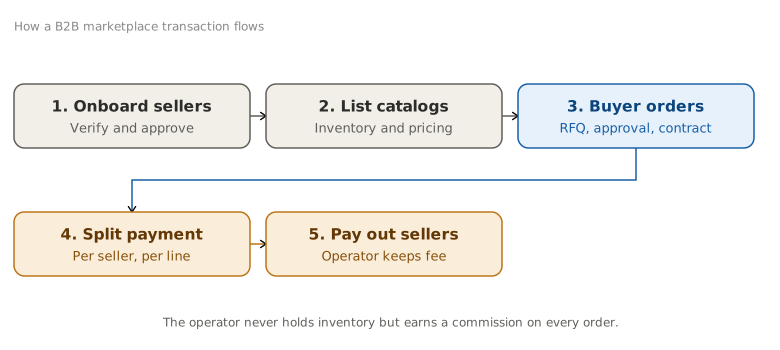
It starts with seller onboarding. The operator recruits and verifies sellers, often with identity and business checks, then gives each a vendor panel to upload their catalog, set inventory, and manage orders. Good software automates this, because manual onboarding is the first thing that breaks as a marketplace grows. The operator also sets the rules of the marketplace at this stage: which sellers qualify, what commission they pay, what service standards they accept, and what happens when they miss them. Those rules are the operator’s main lever, because the operator controls the platform and the audience rather than the inventory.
Then comes the catalog and the buyer experience. Buyers browse a unified catalog that spans many sellers, but B2B adds layers a consumer marketplace skips. Corporate accounts group multiple buyers under one company. Negotiated or contract pricing shows different rates to different customers. Larger orders trigger a request for quote and an approval chain before a purchase order is issued. For operators who want pricing logic done right, our guide to B2B pricing strategy covers how contract and volume pricing should be structured before you configure it in software.
Finally, the money moves. When a buyer pays, the platform splits the order across the relevant sellers, deducts the operator’s commission, and pays each seller their share, often through an integrated payment system that handles the split automatically. The operator never touches inventory but earns on every transaction, which is what makes the model attractive: revenue scales with the catalog without the operator funding the stock. Behind the scenes, the marketplace has to sync orders and payouts with back-office systems, which is where integration with ERP and revenue operations software determines whether the marketplace scales cleanly or drowns in reconciliation work.
Must-Have Features in B2B Marketplace Software
The features that matter in B2B marketplace software are the ones that handle many sellers and demanding business buyers at the same time. A consumer-grade builder covers listings and checkout; the capabilities below are what separate software that passes a procurement review from software that stalls after launch. Use them as your evaluation checklist, and weight the ones your buyers will actually exercise.
Seller Onboarding and Management
Seller onboarding is how a marketplace recruits, verifies, and activates the third-party sellers who list on it. The software should automate identity and business verification, give every seller a self-service panel to upload catalogs and manage orders, and let the operator set approval rules and performance standards per seller. This is the feature operators underrate most. A marketplace with slow or manual onboarding starves the catalog that buyers come for, and the work never stops because you are always adding sellers. Look for bulk onboarding, document collection, and automated checks rather than a shared inbox and a spreadsheet. The platforms built for scale, like Mirakl and Nautical Commerce, treat onboarding as a product in its own right, with dashboards that show where each seller sits in the pipeline and what is blocking activation.
Catalog and Product Data
Catalog management in a marketplace is the job of turning many sellers’ product data into one clean, searchable storefront. Each seller submits data in its own format, and the platform has to map it to a shared structure, remove duplicates, and keep inventory and pricing current. For B2B, that often means handling technical specifications, part numbers, and large SKU counts, which is why several platforms include or integrate product information management. Weak catalog tooling shows up as inconsistent listings, broken search, and buyers who cannot find the part they need. Ask any vendor how they handle catalog ingestion from a seller with fifty thousand SKUs and a messy spreadsheet, because that is the real test, not the tidy demo catalog.
Corporate Accounts and Contract Pricing
Corporate accounts and contract pricing are the features that make a marketplace usable by procurement teams rather than only by individual card-paying buyers. A single customer company may have many buyers under one account, each with roles, spending limits, and approval chains. Pricing has to vary by customer, with negotiated rates, volume tiers, and customer-specific catalogs rendering correctly the moment a buyer logs in. Larger orders should trigger a request for quote and route for approval before a purchase order is issued. This is the layer consumer marketplace tools skip, and its absence is the most common reason a B2B marketplace fails its first enterprise review. If your buyers expect their contract price to appear automatically, confirm the platform supports per-account pricing before you evaluate anything else.
Commission, Split Payments, and Payouts
Commission and payout handling is the engine that lets an operator earn on transactions it does not fulfill. The software should let you configure a take rate by category, seller, or line item, split a single buyer order across multiple sellers, deduct your commission automatically, and pay each seller their share on a schedule. For B2B, that also means handling purchase orders, net terms, and tax across many sellers, which is harder than a consumer marketplace’s card-in, card-out flow. Most platforms partner with a payments provider that supports marketplace split payments rather than building it themselves. Get this wrong and you spend the month reconciling who is owed what by hand, which is exactly the work the platform was supposed to remove.
Integrations and Analytics
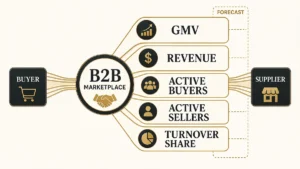
Integration and reporting are what connect the marketplace to the rest of your business and tell you whether it is working. At minimum the platform should sync orders and payouts with your ERP and accounting, connect to a payments provider, and, for enterprise B2B, support PunchOut so buyers can purchase from inside their own procurement system. On the reporting side, you want gross merchandise value, take rate, active sellers, and repeat-buyer rate visible without exporting to a spreadsheet. These are the marketplace equivalents of the metrics you already track elsewhere, and a platform that cannot report them leaves you blind on the only numbers that prove the channel is paying off.
Build vs. Buy: Should You Develop Your Own Marketplace?
Build vs buy is the choice between developing custom marketplace software in-house and licensing one of the platforms in this guide. For most manufacturers and distributors, buying wins, and it is worth understanding why before an engineering team talks you into a custom build that takes two years and never quite ships.
The hard part of marketplace software is not the storefront. It is the multi-seller logic underneath: onboarding and verifying sellers, splitting orders, calculating commission per line item, paying each seller correctly, and keeping all of it in sync with payments and tax. Vendors like Mirakl, Sharetribe, and CS-Cart have spent years building and hardening that logic across thousands of marketplaces. Recreating it in-house means rebuilding problems that are already solved, on your budget and your timeline.
Buying makes sense when speed and predictability matter, which is almost always. A turnkey platform gets a marketplace live in weeks, a mid-market platform in around 90 days, and even an enterprise implementation is faster than building from zero. You also inherit the vendor’s ongoing work on security, payments, and compliance instead of owning all of it yourself. For a first marketplace especially, buying lets you test whether the model works before you commit serious capital to it.
Building from scratch makes sense in a narrow set of cases: your requirements are genuinely unique, no platform can model your business logic even with customization, and you have a product and engineering team that can own the software for years. Even then, many teams reach for a composable platform like Spryker that gives developers control without starting from a blank file. Pure custom builds are the right answer far less often than the people proposing them believe.
The honest middle path is buy, then extend. Start on a platform whose core fits your model, use its APIs to build the few things that are truly specific to your business, and keep the multi-seller engine as the vendor’s problem. That is how most successful B2B marketplaces are actually built, and it is why the build-versus-buy debate usually ends with buy.
B2B Marketplace Software Pricing Benchmarks for 2026
B2B marketplace software pricing in 2026 splits into three bands, and the band you land in is set by your scale and how much you want to own versus rent. The headline license number is rarely the real cost, a point we return to below.
| Tier | Price Range (Q2 2026) | Deployment | Example Platforms | Best For |
|---|---|---|---|---|
| Turnkey / SMB | $39-$300/mo, or $999-$7,499 one-time | SaaS or self-hosted license | Sharetribe, Yo!Kart, CS-Cart, Webkul | First launch, niche markets, fixed budgets |
| Mid-Market | ~$1,500-$5,000+/mo, or mid license | Hosted SaaS / API | Arcadier, Nautical Commerce | Growing operators needing room to scale |
| Enterprise | Custom; ~$50K-$250K+/yr all-in | SaaS / composable | Mirakl, VTEX, Spryker, Marketplacer | Scale, complex B2B, global seller networks |
The turnkey and SMB band is where most first marketplaces start. A Sharetribe plan from $39/month or a Yo!Kart license at $999 one-time (both as of Q2 2026) gets a working marketplace live without a capital project. The trade-off is that you do more of the setup and, with self-hosted options, the maintenance. For a first marketplace, that trade-off is usually worth it: you learn what your sellers and buyers actually need on cheap software, then move up a tier with real requirements instead of guesses. Replatforming later is work, but it costs far less than overbuying an enterprise platform you grow into slowly, if ever.
The mid-market band buys room to grow. Hosted platforms like Arcadier (around $1,500/month billed yearly as of Q2 2026) and purpose-built B2B systems like Nautical Commerce sit here. You pay more for managed infrastructure and deeper B2B features, and you avoid the enterprise price jump until you actually need it.
The enterprise band is custom-quoted, and the real number is dominated by implementation, not license. Platforms like Mirakl, VTEX, and Spryker rarely cost less than $50,000 a year once you add setup, integration, and support, and large programs run well past $250,000. The pricing models themselves vary the same way software does generally, and our breakdown of SaaS pricing models explains the commission, subscription, and consumption structures you will see quoted.
IMPORTANT
The license fee is the small number. The real cost of a B2B marketplace is implementation: ERP and payment integration, seller onboarding, catalog migration, and the team to run it. Budget two to five times the annual license for a serious enterprise launch, and confirm what is included before you sign. A cheap license attached to a six-figure integration is not a cheap marketplace.
How to Choose B2B Marketplace Software
Choosing B2B marketplace software is a four-question exercise, and answering them in order keeps you from being sold a platform that is bigger or smaller than your actual need.
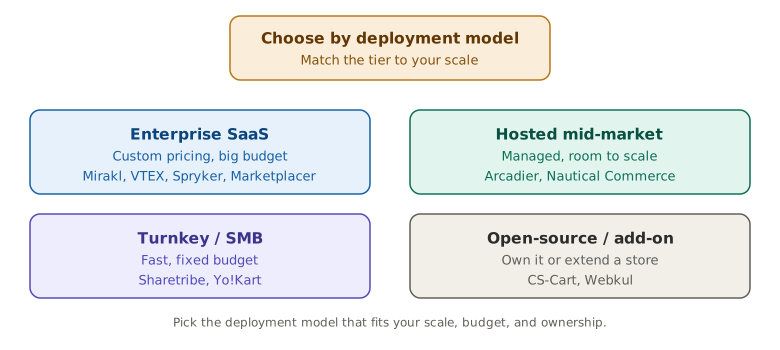
1. What Is Your Scale and Timeline?
Be honest about size. If you are launching a first marketplace in a niche, an enterprise platform will overwhelm you with cost and complexity you cannot use yet. If you are an established manufacturer building a strategic channel, a turnkey kit will hit its ceiling within a year. Scale and timeline pick your tier before any feature comparison begins. A simple way to locate yourself: estimate the gross merchandise value the marketplace will handle in year one and the number of sellers you will onboard. A handful of sellers and modest volume points to turnkey or open-source; hundreds of sellers and serious volume points to mid-market or enterprise. The estimate does not have to be precise, only honest.
2. Do You Want to Own the Software or Rent It?
Self-hosted options like CS-Cart and Yo!Kart give you source-code ownership and predictable cost, but you carry hosting, security, and maintenance. SaaS platforms like Mirakl, VTEX, and Nautical Commerce handle all of that for you in exchange for recurring fees. Neither is better in the abstract; it depends on whether your constraint is cash or engineering capacity.
3. How Deep Are Your B2B Requirements?
List your must-haves: corporate accounts, contract pricing, approval workflows, RFQ, PunchOut, ERP integration. A consumer-grade builder will not have these, and discovering that after launch is expensive. The further down the procurement-complexity scale you sit, the more you should weight platforms built for B2B from the start, and the more you should connect the marketplace to the rest of your stack, from the demand channels that fill it to the systems that measure it.
4. How Will You Measure Whether It Works?
Decide your success metrics before you buy, because the platform should be able to report them. Gross merchandise value, take rate, active sellers, and repeat-buyer rate are the marketplace equivalents of the B2B marketing metrics you already track, and a marketplace launched without a plan to measure these is a project without a scoreboard. Tie the platform choice to how buyers will actually find the marketplace too, because one that does not show up in search will struggle no matter how well it is built.
5 Mistakes Manufacturers and Distributors Make Choosing Marketplace Software
1. Buying a Single-Store Platform and Expecting It to Run a Marketplace
This is the most expensive mistake on the list. A team buys Shopify Plus or a similar single-store platform, then discovers it cannot pay multiple sellers, split orders, or manage commissions without heavy custom work. The fix is to decide the model first. If third parties will sell through your platform, you need marketplace software, not a storefront with a plugin holding it together.
2. Buying for the Tier Above Your Scale
Enterprise platforms are impressive in a demo, and that is the trap. A mid-market distributor signs a six-figure enterprise deal, then spends a year and most of the budget on an implementation that a mid-market platform would have handled in 90 days. Buy for the scale you are at plus realistic 18-month growth, not for the logo you want on your vendor list. The same caution applies in reverse: a fast-growing operator that buys the cheapest turnkey kit can outgrow it within a year and face a migration mid-stride. The goal is not the cheapest platform or the most impressive one, but the one that fits the next 18 months of real, evidenced growth.
3. Ignoring the Integration Cost
The license is quoted; the integration is not. Connecting the marketplace to your ERP, payment processor, and seller systems is where the time and money actually go, and teams that skip this estimate are the ones whose projects run double the budget. Ask every vendor for an implementation estimate, not just a license price, and treat the integration as the main line item. The cleanest way to surface this early is a short integration questionnaire before the demo: which systems do you connect to out of the box, what needs custom work, and can you name a reference customer running our exact ERP. The answers reshape the shortlist faster than any feature comparison.
4. Underestimating Seller Onboarding
A marketplace with no sellers is an empty store. Operators obsess over the buyer experience and forget that recruiting, verifying, and onboarding sellers is the harder problem, and that it never stops. Weight your platform choice toward the onboarding automation and seller tooling, because that is what determines whether your catalog grows or stalls after launch. A useful test during evaluation is to ask how a non-technical seller adds their first hundred products, and how long it takes from invitation to live listings. If the answer involves manual data entry or a long back-and-forth, your catalog will grow slowly no matter how polished the buyer-facing storefront looks.
5. Skipping Contract and Account-Based Pricing
B2B buyers do not pay sticker price. They expect negotiated rates, volume discounts, and account-specific catalogs, and a platform that cannot model contract pricing will lose them at the first quote. Confirm that your shortlist supports per-account pricing and approval workflows before you buy, not after a key customer asks why they cannot see their contract rate.
Frequently Asked Questions
B2B marketplace software is a platform that lets one company (the operator) run an online marketplace where multiple third-party sellers list and sell products or services to business buyers, while the operator manages onboarding, catalogs, orders, commissions, and payouts. It differs from a B2B ecommerce platform, which runs a single company’s own store. Marketplace software adds multi-seller logic: splitting orders across sellers, charging commission, and paying each seller separately, plus B2B features like corporate accounts and contract pricing.
As of Q2 2026, pricing splits into three bands. Turnkey and SMB software starts at $39/month (Sharetribe) or a $999 one-time license (Yo!Kart). Mid-market hosted platforms run roughly $1,500-$5,000+/month (Arcadier). Enterprise platforms like Mirakl, VTEX, and Spryker quote custom pricing that typically runs $50,000 to $250,000+ per year once implementation is included. The license is rarely the largest cost; ERP integration, payments, and seller onboarding usually dominate the budget.
Most operators buy marketplace software rather than build from scratch, because building the multi-seller, commission, and payout logic in-house is slow and expensive. The practical path is: confirm you need a marketplace (not a single store), pick a tier that matches your scale, validate demand on a fast platform like Sharetribe or Nautical Commerce, then scale to an enterprise platform like Mirakl or VTEX if volume and complexity justify it. Custom builds make sense only when your requirements are genuinely unique and you have the engineering team to support them.
A B2B ecommerce platform runs your own store: you own the inventory and sell your own catalog through a branded storefront. A B2B marketplace runs a multi-seller platform: third parties list and sell their products, and you (the operator) take a commission and pay sellers out. If you are the only seller, you want an ecommerce platform. If other companies will sell through your site, you want marketplace software. Choosing the wrong one is the most common and most expensive mistake operators make.
Your Next Move
Start by settling the model, not the vendor. Write down one sentence: “Other companies will sell through my platform” or “I sell my own products.” If it is the first, you are shopping marketplace software and this list is your shortlist. If it is the second, you want a B2B ecommerce platform instead, and that is a different decision.
Once the model is settled, pick your tier honestly. Match the platform to your scale and timeline, then choose two candidates from that tier and book demos with a written list of your B2B must-haves and an implementation-cost question ready. An operator who walks into a demo knowing their model, their tier, and their non-negotiables learns more in 30 minutes than one collecting vendor pitches for a month. Bring three things to each demo: a short description of your business and buyers, the specific outcome you want in twelve months, and the integration questionnaire from earlier. Ask the vendor to run the demo on something close to your real data rather than their tidy sample, and watch how they handle the messy parts. The platform that survives your actual catalog and your actual pricing rules is the one worth shortlisting, and if all of them feel like a stretch, that is a signal too: you may be earlier than you think, and the right first move is a turnkey launch to learn on, not an enterprise contract to grow into.
The platforms here range from a $39/month plan to a quarter-million-dollar enterprise program, and the right one is the one that fits the marketplace you are actually building this year, not the one you imagine running in five. Get the tier right, budget for the integration, and the software stops being the hard part.