Global B2B ecommerce is projected to hit $36 trillion in 2026 at a 14.5% CAGR per the International Trade Administration, and 80% of B2B sales interactions are now digital. The interesting question isn’t whether to sell B2B online. It’s what good actually looks like when your customers buy by purchase order, approve through three layers, and expect their negotiated price to appear automatically.
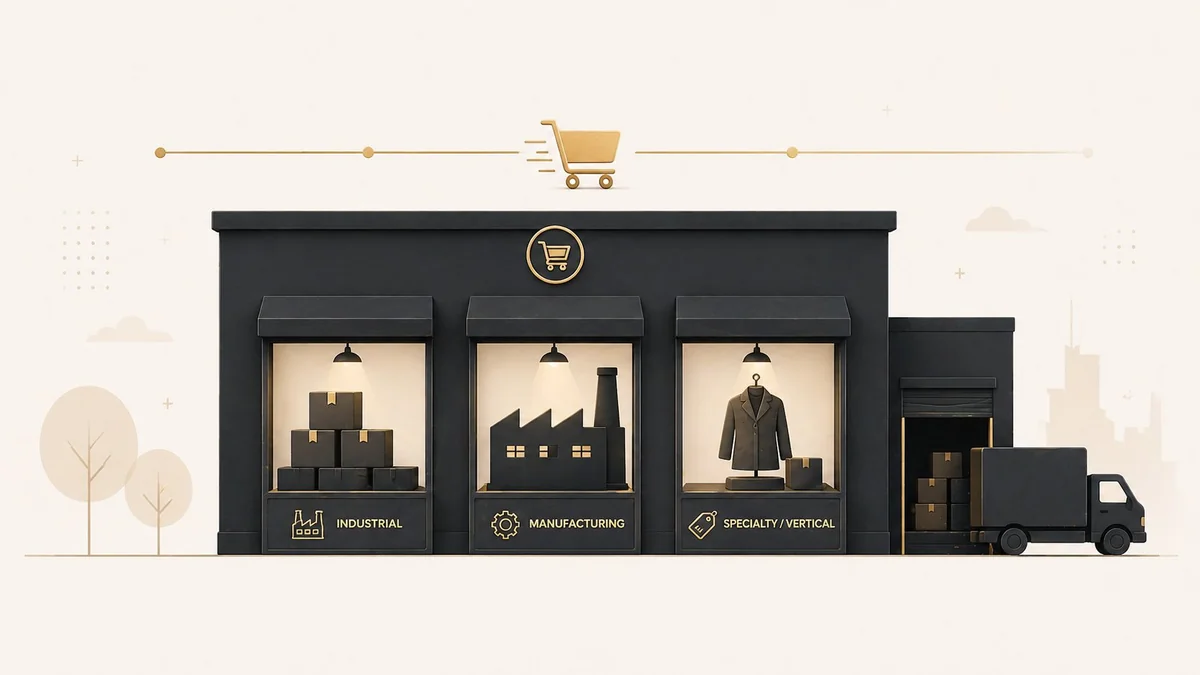
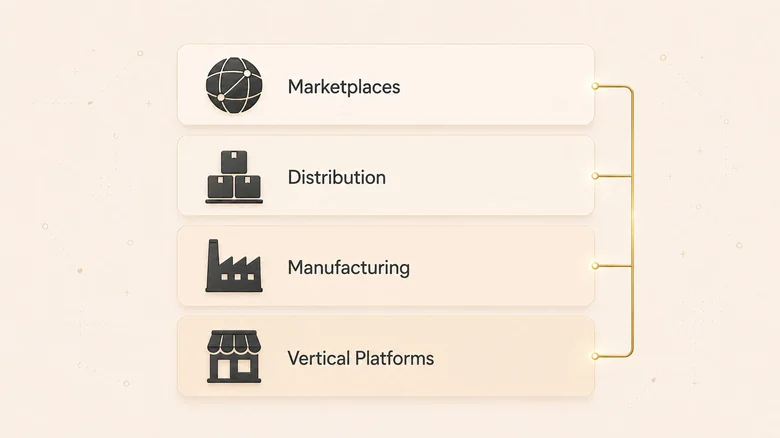
This guide collects 12 B2B ecommerce examples organized into the four categories that map how the space actually segments: Large-Scale Marketplaces, Industrial and MRO Distribution, Manufacturing Direct-to-Business, and Specialized Vertical Platforms. Each example includes the model, the standout capability, and what mid-market B2B teams can take from it without rebuilding their entire stack.
Key Takeaways
- B2B ecommerce splits into 4 functional categories: Large-Scale Marketplaces (Alibaba, Amazon Business, Faire), Industrial & MRO Distribution (Grainger, Uline, McMaster-Carr), Manufacturing Direct-to-Business (CeramicSpeed, Massey Ferguson, Stanley Black & Decker), and Specialized Vertical Platforms (JOOR, Steelcase, Hummert International).
- Amazon Business has reached 6 million customers and $35 billion in annual sales as of 2025, up from $1 billion in 2016 and $25 billion in 2020. 36% of B2B buyers now use it as a default channel.
- The 6 capabilities that separate working B2B ecommerce from broken: personalized pricing per account, multi-buyer approval workflows, punch-out catalog integration with procurement systems, quick reorder, ERP integration, and self-service account management.
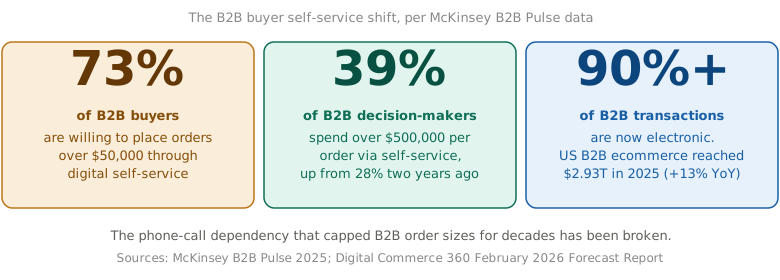
- 73% of B2B buyers are willing to place orders over $50,000 through digital self-service, and 39% spend over $500,000 per order, per McKinsey’s B2B Pulse data (up from 28%).
- The 5 mistakes that sink B2B ecommerce projects: building it like B2C, one-size-fits-all pricing, no ERP integration, weak mobile experience, and no human escalation paths.
- Mid-market B2B brands don’t need Alibaba’s scale or Steelcase’s punch-out catalogs to win. They need 3 of the 6 core capabilities executed cleanly, on a platform that fits their procurement reality.
How to Read B2B Ecommerce Examples
B2B ecommerce examples are companies that sell products or services to other businesses primarily through digital channels, with capabilities that match how B2B procurement actually works: account-specific pricing, multi-stakeholder approval, bulk ordering, and integrations with the buyer’s existing procurement systems.
The space organizes cleanly into 4 categories based on selling model, not platform choice. A single Adobe Commerce site can host any of the 4 categories below; the categorization is about who sells to whom, not the underlying tech. The platform still matters once search enters the picture, though, because the underlying tech decides how cleanly a catalog can be crawled and indexed, which is the whole question behind picking the best ecommerce platform for SEO.
Why B2B Ecommerce Differs From B2C
B2C buying is one person, one decision, one cart, one card. B2B buying involves 6 to 10 stakeholders per Gartner’s B2B buying research, and the average buyer now uses 10.2 channels in a single journey (up from 5 in 2016). The buying surface has to handle scenarios B2C platforms aren’t built for: a procurement agent who hands the spec to a buyer who routes it for approval to a manager who needs the invoice flagged with the right cost code.
The strategic ground rules these examples sit on top of are the same capability framework every successful B2B ecommerce operation builds toward — covered in depth in our B2B ecommerce best practices piece, which is the operational companion to this listicle.
Large-Scale B2B Marketplaces
Marketplaces are platforms where many sellers list to many buyers under shared rules. They win on selection breadth and discovery efficiency, and they’ve become a default first-stop for B2B buyers researching new categories. Forrester forecasts US B2B ecommerce will exceed $3 trillion by 2027, with marketplaces growing at 17.8% CAGR (the fastest segment within B2B ecommerce overall).
1. Alibaba
The world’s largest B2B marketplace, connecting global manufacturers (mostly Asian) with buyers worldwide. Alibaba’s defining capability is the trade-assurance escrow that protects buyers from fraud across cross-border transactions. The platform handles RFQ-style negotiation natively, which is how most international B2B buying actually happens. For mid-market US brands, the takeaway isn’t to copy Alibaba’s scale. It’s that buyers researching wholesale options now expect the search-and-compare flow that Alibaba normalized.
2. Amazon Business
Amazon’s B2B side launched in 2015 and reached 6 million customers and $35 billion in annual sales by 2025. The defining capabilities are familiar B2C-style search, multi-user accounts with role-based purchasing limits, business-only pricing, and quantity discounts. 36% of B2B buyers now use Amazon Business as a research or purchase channel. The takeaway for any B2B seller is that “the Amazon experience” is now the implicit benchmark every buyer mentally compares your portal to.
3. Faire
Faire is a wholesale marketplace founded in 2017 that connects independent retailers with brands across home goods, food, beauty, and apparel. It pioneered net-60 payment terms for retailers (Faire takes the credit risk) and free returns on first orders. Faire’s defining capability is removing the cash-flow friction that historically locked indie retailers out of wholesale, which expanded the buyer base for thousands of brands. The lesson: vertical marketplaces win when they remove a category-specific friction the horizontal marketplaces don’t address.
Industrial and MRO Distribution
Industrial and MRO (maintenance, repair, operations) distribution is the oldest segment of B2B ecommerce and still one of the largest. These companies sell to facility managers, plant operators, and procurement teams that buy the same SKUs repeatedly across years. The defining capabilities are catalog depth (millions of SKUs), reorder workflows, and integration with the buyer’s ERP for automated purchasing. Distributors building this kind of operation usually shortlist from the platforms that power examples like these, where the ERP-integrated options are reviewed by use case.
4. Grainger
Grainger has been a category-defining B2B distributor for industrial supplies since 1927 and was one of the first traditional distributors to make ecommerce a core channel. Grainger.com handles 1.5 million-plus SKUs, account-specific pricing for over 4 million customers, and EDI integration for enterprise buyers. The defining capability is contract pricing automation: customers see their negotiated rates, and the procurement system applies them at checkout without human intervention. At that scale buyers and Google only reach those SKUs through category and subcategory pages, so how a distributor structures and optimizes its category pages decides how much of the catalog ever ranks.
5. Uline
Uline sells packaging, shipping, and industrial supplies and runs one of the most aggressive same-day shipping operations in B2B (12 distribution centers, 99.9% in-stock). The catalog runs 41,000 SKUs, with quick reorder and quantity-break pricing tooled into every product page. The takeaway for smaller distributors: Uline’s competitive moat is logistics speed, not platform features. Same-day shipping changes which orders the buyer routes through your portal vs. a marketplace.
6. McMaster-Carr
McMaster-Carr sells industrial supplies and is widely considered the gold standard for B2B website usability. The site uses essentially no marketing copy, no carousels, and no animations. It’s pure catalog: every part has the spec, the dimensions, the CAD file, and the in-stock status visible without a click. Engineers and maintenance leads spend less time on the site than on any other distributor’s because the information density is so high. The takeaway: in B2B, conversion-optimized landing-page tactics often hurt instead of help. Buyers want the spec, not the story.
PRO TIP
If you’re rebuilding a B2B catalog, audit McMaster-Carr’s product pages before you brief a designer. Time how fast you can find a part’s specs vs. on your own site. The gap is almost always 3-10x slower on the typical mid-market distributor’s site, and the fix is more about removing decoration than adding features. Run the same scrutiny on the search side and audit your catalog’s SEO before you rebuild, so the new build fixes rankings instead of quietly resetting the ones the old pages earned.
Manufacturing Direct-to-Business
Manufacturers selling direct to business buyers used to mean a sales rep, a printed catalog, and a faxed order. The category has digitized rapidly since 2020, with manufacturers building branded portals that let dealers, distributors, and direct customers configure orders, check stock, and submit purchase orders without phone calls.
7. CeramicSpeed
CeramicSpeed manufactures ceramic bearings and drivetrain components for cycling and industrial applications. Their B2B portal lets authorized dealers place orders, check warranty status, and access marketing assets, with a mobile app for service techs in the field. The defining capability is role-based access: a dealer principal sees pricing and ordering, a service tech sees only warranty and parts lookup, all under one account hierarchy.
8. Massey Ferguson
The agricultural machinery brand (now part of AGCO) runs an authorized-dealer portal that handles parts ordering, equipment configuration, and warranty management. Dealers can quote a customer in real time using current stock and dealer-specific pricing. The takeaway for any manufacturer with a dealer channel: the portal isn’t there to replace the dealer relationship. It’s there to make every dealer 30% more productive on transactional work, so they can spend more time selling.
9. Stanley Black & Decker (DEWALT B2B)
Stanley Black & Decker runs DEWALT B2B for contractors, fleet managers, and tool-program buyers. The portal handles fleet pricing, asset tagging, lost-tool replacement workflows, and warranty service requests. The defining capability is the asset-tracking integration: large contractors can see every DEWALT tool deployed across job sites, with maintenance schedules and replacement tracking. This is the “ecommerce becomes operations software” pattern that mature B2B platforms graduate into.
Specialized Vertical Platforms
Specialized platforms serve a single industry vertical with capabilities other generalists can’t match. They typically charge a premium for the vertical-specific workflow, and they win the buyers who’d rather pay more than wrestle a horizontal platform into doing something it wasn’t built for.
10. JOOR
JOOR is a digital wholesale marketplace for fashion brands and retailers that has processed over $40 billion in transactions. The defining capability is virtual showrooms: brands display seasonal collections in 3D environments, retailers browse by category and trend, and orders flow through with line-item editing across SKUs, sizes, and colors. The takeaway is that fashion-specific workflows (linesheets, season planning, mix-and-match orders) require purpose-built tools, which is why a generalist marketplace never displaced JOOR despite multiple attempts.
11. Steelcase
The office furniture giant runs an ecommerce platform that integrates directly with corporate procurement systems through punch-out catalog integration (cXML and OCI standards). Steelcase customers can browse the full catalog inside their own SAP Ariba, Coupa, or Oracle Procurement instance, with pre-negotiated pricing and approved-product lists already filtered. The defining capability is procurement-system-native selling: the buyer never leaves their procurement platform. This pattern is essential for any B2B brand selling into Fortune 500 corporate procurement.
Once you know which category your company fits, use those patterns to choose a B2B ecommerce platform with the right catalog, pricing, and integration depth.
12. Hummert International
Hummert is a 90-year-old horticultural distributor that digitized its 30,000-product catalog for commercial growers, garden centers, and greenhouse operators. The platform handles bulk-quantity pricing, seasonal availability, and grower-specific account hierarchies. The takeaway is that even a 90-year-old distributor in a niche vertical can rebuild its commerce experience around modern capabilities (account-based pricing, mobile reorder, ERP integration) without becoming a generalist marketplace.
6 Patterns That Make B2B Ecommerce Work
Across all 12 examples, the same 6 capabilities show up. None of them is technologically exotic in 2026. The differentiation is execution depth, not feature presence.
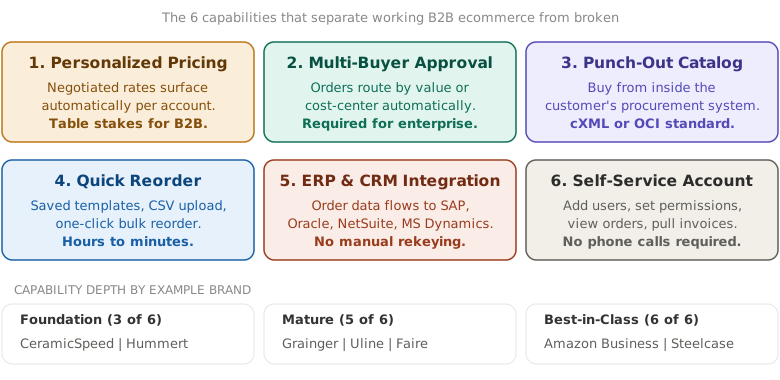
1. Personalized pricing per account. Different customers see different prices based on their negotiated agreements. This is table-stakes for industrial and manufacturing B2B and increasingly expected in marketplace and vertical platforms. The implementation is a price-management engine that joins customer ID, product SKU, contract terms, and quantity to produce a single number on the page.
2. Multi-buyer approval workflows. Orders above a threshold route to a manager for approval before processing. The buyer doesn’t email procurement; the platform handles routing automatically based on order value, cost center, or product category. Steelcase and Amazon Business both invest heavily here because enterprise buyers won’t use platforms that bypass their internal controls.
3. Punch-out catalog integration. The buyer accesses your catalog from inside their own procurement system (SAP Ariba, Coupa, Oracle Procurement, JAGGAER). They never leave their procurement workflow, but they see your full product set with their pricing applied. This is the single biggest revenue lever for B2B brands selling into the Fortune 500. The technical standard is cXML or OCI; both are well-documented.
4. Quick reorder and bulk ordering. Buyers who order the same 50 SKUs every quarter shouldn’t browse the catalog every time. Saved order templates, CSV upload, and one-click reorder reduce procurement time from hours to minutes. Grainger, Uline, and Amazon Business all treat this as core, not a feature.
5. ERP and CRM integration. Order data flows automatically into the seller’s ERP (SAP, Oracle, NetSuite, Microsoft Dynamics) and the buyer’s procurement system. Manual rekeying is the friction that historically kept B2B online sales below 50% of total volume; integration eliminates it. Our HubSpot vs Salesforce comparison covers the CRM-side integration choices that shape these workflows.
6. Self-service account management. Buyers add users, set permission levels, view order history, manage payment methods, and pull invoices without a phone call. The 73% of buyers willing to place $50,000+ orders via self-service per McKinsey’s data only do it on platforms that handle account self-service competently. Phone-call dependency caps the order size buyers will route through any platform.
5 B2B Ecommerce Mistakes That Sink Projects
The same five mistakes show up in nearly every failed B2B ecommerce launch. Each is fixable, but each gets harder to fix the longer it sits in production.
1. Building it like B2C. One product, one price, one buyer, one cart. The team builds a beautiful Shopify-style storefront with no account hierarchy, no approval routing, and a single price per product. Three months in, enterprise customers ask why they can’t see their negotiated rates and the project rebuilds from scratch. It is also a hiring failure a buyer can catch early, because a skilled Shopify developer will ask about account hierarchy, approval routing, and pricing before touching the theme.
2. One-size-fits-all pricing. Treating list price as the price. B2B buyers expect their negotiated rates to appear automatically on every product page, not a footnote that says “contact sales for volume pricing.” Personalized pricing is the single highest-impact capability because every contract pricing exception that requires a phone call is a reason for the customer to use your portal less. For pricing model design itself, see our B2B pricing strategy guide.
3. No ERP integration. Order data lives in the ecommerce platform, customer data lives in the CRM, inventory lives in the ERP, and three people manually reconcile them weekly. This works at $5M revenue. It collapses at $50M. Build integration in from day one or accept that scaling means hiring three people whose entire job is data reconciliation.
4. Weak mobile experience. 60% of B2B buyer research now happens on mobile. The plant manager checking part availability does it from the floor. The procurement agent reorders during their commute. A desktop-first portal that’s “responsive” but unusable on mobile loses to a marketplace that nailed mobile.
5. No human escalation paths. Self-service handles 90% of transactions. The remaining 10% are high-stakes (a wrong order shipped, a custom configuration question, a contract dispute) and need a person fast. Platforms that route to a generic support queue lose the high-value customers; platforms that surface a named account rep within two clicks keep them.
IMPORTANT
2026’s emerging shift is agentic commerce: AI agents that procure on behalf of human buyers. Mondelez’s agentic commerce strategy is one of the early enterprise-scale signals. Forrester predicts five major US or European brands will unify agentic commerce experiences this year. The B2B ecommerce platforms that win the next 36 months will be the ones whose APIs and product data are clean enough for AI agents to read, not just human shoppers.
B2B Ecommerce Platforms (Brief)
The 12 examples above run on different platforms, and platform choice is a separate question from selling model. Adobe Commerce (formerly Magento) powers Steelcase and many enterprise manufacturers. BigCommerce B2B powers Faire-adjacent and mid-market direct-to-business sellers. Shopify Plus has rapidly added B2B capabilities and now powers many manufacturers under $100M revenue. SAP Commerce Cloud and Oracle Commerce serve the largest enterprise tier. Sana Commerce, commercetools, and Salesforce Commerce Cloud round out the competitive set. Those are all single-store platforms, where you sell your own catalog; if your model is instead operating a multi-seller marketplace, the shortlist is different, which we break down in our guide to the best B2B marketplace software.
Platform selection should follow the capability requirements, not the other way around. If you need punch-out catalog integration on day one, the platform shortlist narrows to four vendors. If you need account-specific pricing for 10,000-plus customers, the shortlist looks different. The capability audit always precedes the vendor demo; teams that reverse that order rebuild within two years.
B2B Ecommerce Tools and Platforms
The five tool pills below cover the ecommerce-platform tier that powers most B2B ecommerce examples in this article. They span enterprise (Adobe Commerce, SAP) through mid-market (BigCommerce, Sana, Shopify Plus B2B).
The strategy, measurement, and acquisition layers around the ecommerce platform are where mid-market operators spend most of year two — once the platform itself is running, the differentiation moves upstream into go-to-market design and downstream into measurement discipline. The platform is the table stakes; the GTM motion is the moat.
Frequently Asked Questions
Amazon Business is a clear example of B2B ecommerce: a digital marketplace where businesses purchase products from other businesses, with B2B-specific capabilities like multi-user accounts, business-only pricing, and quantity discounts. It reached 6 million customers and $35 billion in annual sales by 2025. Other examples span industrial distribution (Grainger, Uline), wholesale marketplaces (Alibaba, Faire), and manufacturer portals (CeramicSpeed, Massey Ferguson).
McMaster-Carr (mcmaster.com) is widely cited as the gold standard for B2B ecommerce websites. The site sells industrial supplies and is built around catalog density rather than marketing decoration: every product page surfaces the full spec, dimensions, CAD files, and in-stock status without a click. Engineers and maintenance leads complete tasks faster on McMaster-Carr than on any other distributor site, which is the operational definition of good B2B ecommerce.
B2B ecommerce involves multiple stakeholders (6-10 per buying journey per Gartner), longer cycles, contract-specific pricing, multi-tier approval workflows, bulk ordering, and integration with the buyer’s procurement system. B2C is one buyer, one decision, one cart. Functionally, the largest difference is account-specific pricing: B2B buyers expect their negotiated rates to appear automatically, while B2C buyers see the same listed price as everyone else.
Through account-specific pricing engines that join the customer ID, the product SKU, the contract terms, and the quantity to produce a single price displayed on the product page. Larger sellers (Grainger, Steelcase, Amazon Business) automate this completely so the buyer never sees a public list price they have to negotiate against. Mid-market sellers often start with tier-based pricing (Bronze, Silver, Gold customer segments) before evolving to per-account pricing.
Platform fit depends on company size and capability needs. Adobe Commerce and SAP Commerce Cloud serve the enterprise tier (Steelcase, large manufacturers). BigCommerce B2B and Shopify Plus B2B serve mid-market direct-to-business sellers. Sana Commerce specializes in tight ERP integration (SAP and Microsoft Dynamics). commercetools is the leader in headless and composable commerce. Choose by capability requirements (punch-out, account hierarchies, ERP integration) before evaluating individual platforms.
Your First Move
Pick one of the 12 examples above whose model maps closest to your business and audit your portal against their 6 core capabilities. Personalized pricing, multi-buyer approval, punch-out, quick reorder, ERP integration, self-service account management. You don’t need all 6 from day one. You need to know which 3 are non-negotiable for your buyer base and which 3 can wait until ARR doubles.
The pattern across all 12 examples is the same: capability requirements drive platform selection, pricing flexibility drives buyer adoption, and the GTM motion drives sustained volume. The companies that win are the ones who treat ecommerce as the front end of a coordinated commercial system, not as a standalone digital storefront bolted onto a legacy sales process.