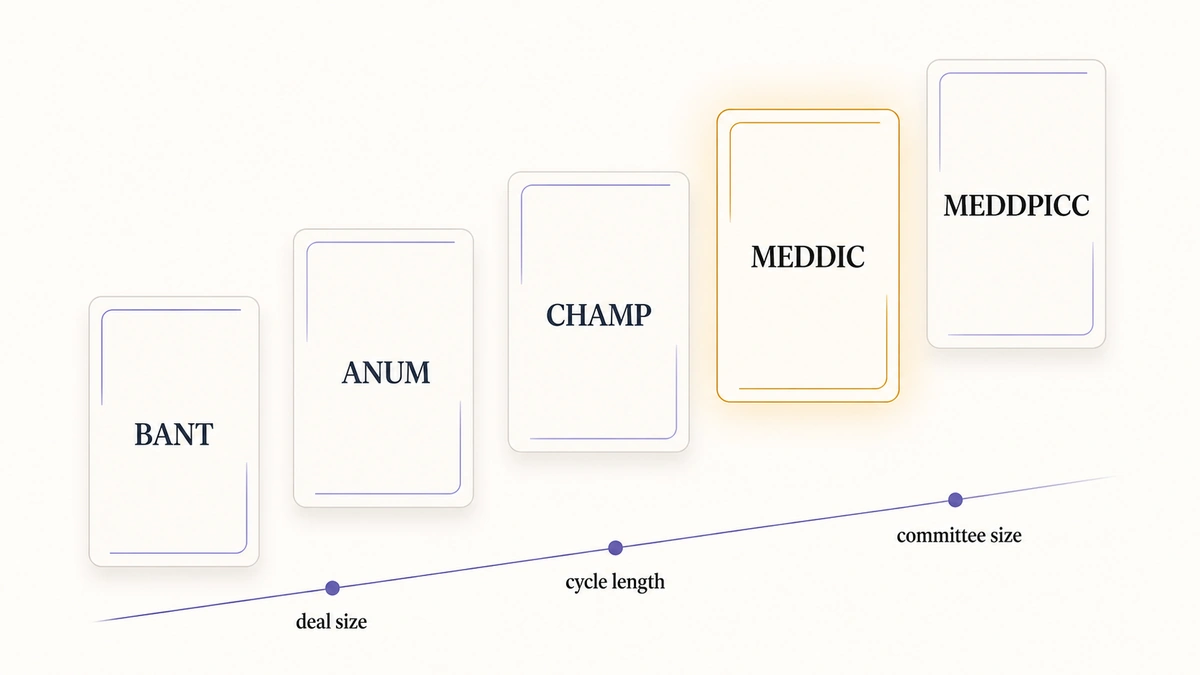
Most teams choose a lead qualification framework the way they choose a CRM report layout: somebody senior used it at their last company, so it wins. That is how a business with four-week deals and a single signer ends up running MEDDIC, and how a business selling six-figure platforms to procurement committees ends up running BANT.
Both mistakes cost the same thing, which is deals you should have won. The choice is not a matter of taste. It is a bet about how your buyers decide, and there are only three numbers in that bet: how big your deals are, how long they take, and how many people have to agree.
A fourth number matters more than which framework you pick. Ebsta’s 2025 Sales Qualification Report, built on more than 655,000 B2B opportunities worth $48 billion, found that only 36% of deals passing Discovery carried both a qualification score and supporting notes. Most teams are not running a framework badly. They are not recording one at all.
Direct answer — What is a lead qualification framework?
A lead qualification framework is a fixed set of questions a rep answers about one opportunity to decide whether it is real. BANT, MEDDIC, MEDDPICC, CHAMP and ANUM each assume a different deal shape: how much budget already exists, how many people must agree, and how long the decision takes. Pick the one whose assumptions match your deals. A framework that assumes a single decision-maker will disqualify committee buyers who were going to buy.
Key Takeaways
- Select a framework from three measured numbers: median deal size, median days open, and the count of people on the winning side of your last 40 closed-won deals.
- BANT and ANUM are triage tools for cheap, fast deals. MEDDIC and MEDDPICC are state-tracking tools for expensive, slow ones. CHAMP sits between them when pain is real and budget is not yet allocated.
- Score candidate frameworks against must-have gates first, then weighted criteria. A framework that fails a gate is excluded, not penalised.
- Every element of the framework needs a CRM field, an owner, and a validation rule before rollout. Ebsta found only 36% of post-Discovery deals carry both a qualification score and notes.
- Well-qualified deals in Ebsta’s dataset won at 50% against 8% for poorly qualified ones, and closed 21.6% faster.
What Is a Lead Qualification Framework?
A lead qualification framework is a repeatable set of questions a seller answers about a single opportunity to decide whether it is worth pursuing. It runs in conversation, produces a defensible yes or no, and leaves a record other people can audit.
That last clause is what separates a framework from a habit. Any rep can ask about budget. A framework requires the answer to land somewhere a manager can read it three weeks later, which is why the CRM mapping later in this article is not an implementation detail.
A framework is also not a scoring model. Scoring runs automatically on every record in your database and ranks who to call. A framework runs once a human is on the phone. The two sit on either side of the handoff, and the point values, signal weights and threshold math belong to our guide to B2B lead scoring criteria, which also covers GPCTBA/C&I and FAINT in the same depth this page gives to the five below.
Two adjacent methods sit outside this comparison deliberately. SPICED (Situation, Pain, Impact, Critical Event, Decision) is a discovery-conversation structure rather than a pass or fail gate, and a product qualified lead (PQL) arrives through in-product behaviour rather than a rep conversation. Neither changes which of the five frameworks below you should adopt.
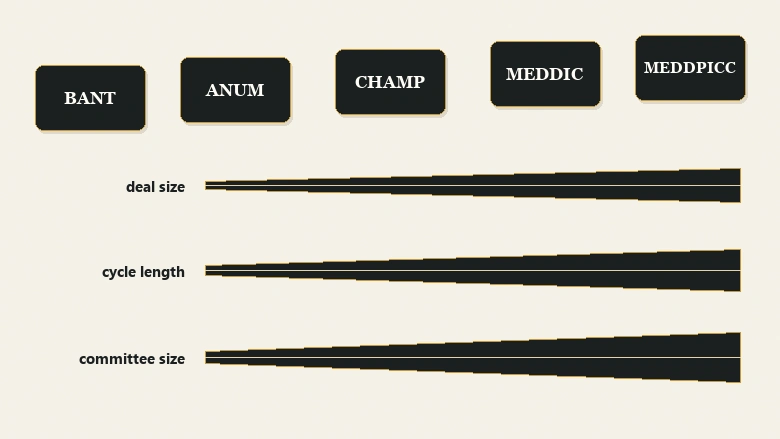
The five frameworks at a glance
| Framework | First question it asks | Pick it when | Do not pick it when |
|---|---|---|---|
| BANT (Budget, Authority, Need, Timeline) | Is there money? | You triage high inbound volume in under five minutes, the budget line already exists, and one person signs. | The buyer has real pain and no allocated budget, or more than one person has to agree. |
| ANUM (Authority, Need, Urgency, Money) | Can this person say yes? | You run outbound into cold accounts where no budget exists yet and reaching the right person is the bottleneck. | Nobody in the account can say yes alone, which makes the first question unanswerable. |
| CHAMP (Challenges, Authority, Money, Prioritization) | What is broken? | Mid-market inbound where the problem is real, the budget is not yet allocated, and you would rather map authority than test it. | Your cycle runs long enough that stated priorities change before you reach a decision. |
| MEDDIC (Metrics, Economic Buyer, Decision Criteria, Decision Process, Identify Pain, Champion) | What does this fix, in numbers? | Deals run into six figures and get re-reviewed at every stage gate by someone other than the rep. | The deal closes in three weeks, or nobody re-scores the opportunity after discovery. |
| MEDDPICC (MEDDIC plus Paper Process and Competition) | Who else is in this deal, and what has to be signed? | Procurement and legal are on the deal and a named competitor is active. | You have no realistic way to keep eight fields current on every open opportunity. |
Notice that none of these columns is about elegance. Every one of them is a claim about your deals, which means you can settle the argument with data you already hold.
Select by Deal Size, Cycle Length and Committee Size
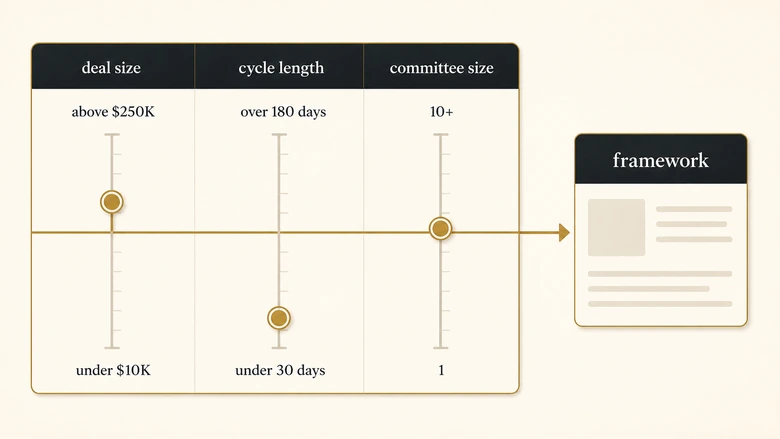
To pick a qualification framework, measure three properties of your own closed-won deals and match them against what each framework assumes. Preference, familiarity and vendor marketing are not inputs.
Deal size sets your qualification time budget
Qualification is not free. BANT takes a rep two to four minutes. A full MEDDPICC pass takes half an hour on the first run and needs upkeep at every stage review. That difference is trivial on a $200,000 opportunity and ruinous on a $4,000 one.
Work out the ceiling before you shortlist anything. If your median deal is $8,000 and your gross margin is 70%, an hour of AE time spread across qualification, upkeep and stage reviews is a real percentage of the deal. Frameworks that cost more to run than the deal returns get abandoned quietly within a quarter, which is worse than never adopting them, because now the CRM has half-filled fields nobody trusts.
Cycle length decides whether qualification is an event or a state
Short cycles let qualification be an event. A rep answers four questions on the first call, the answer holds until close, and nobody revisits it. Long cycles do not work that way. Over five months the champion changes role, the compelling event slips, a competitor appears, and an answer captured in month one is fiction by month four.
That is the real dividing line between BANT-class and MEDDIC-class frameworks, and most teams miss it. MEDDIC’s value is not that it asks more questions. It is that it defines a state you can re-score at every stage gate. If nobody in your process ever re-scores anything, adopting MEDDIC gets you MEDDIC’s cost and BANT’s benefit.
Committee size decides how many people the framework must hold
Published measurements of B2B buying group size disagree, and the disagreement is the point. TrustRadius surveyed 2,058 technology buyers in January 2025 and reported an average buying group of 4.8 people, with 79% naming five or fewer. Forrester’s January 2026 release puts the typical decision at 13 internal stakeholders plus nine external influencers.
You cannot average those figures into a number that describes your business, and you do not need to. Count the distinct contacts on the winning side of your last 40 closed-won opportunities. That number is the one your framework has to hold. If it is one or two, a single Authority field is honest. If it is six, a single Authority field is a rounding error, and the anatomy of who those people are is covered in our breakdown of the B2B buying committee.
IMPORTANT
Measure these three numbers from closed-won deals, not from your pipeline. Pipeline reflects what your current qualification lets through, so using it to choose a framework bakes in the bias you are trying to remove.
The Vendor-Neutral Framework Scorecard
To compare frameworks without defaulting to preference, apply must-have gates first and score only what survives. This is the same method our review of lead routing software uses on vendors, and it works here for the same reason: it separates a hard requirement from a nice-to-have before any weighting math starts.
Set your must-have gates first
A gate is binary and non-negotiable. Anything that fails one is excluded outright rather than penalised, because a weighted score lets a strong average hide a fatal miss. Typical gates for a qualification framework:
- It must hold more than one named stakeholder if your committee count is three or higher.
- It must be completable inside the time your median deal value justifies.
- It must ask about money at a point your buyer can actually answer.
- It must survive re-scoring at a stage gate without a rep rewriting the whole record.
Weight the criteria that survive
Score the survivors on identical evidence, using the weights below. Change them: a team selling $6,000 subscriptions should not carry the same weighting as one selling $600,000 platforms, and a scorecard you cannot re-weight is somebody else’s opinion in a spreadsheet.
| Criterion | Weight | What a “Yes” looks like |
|---|---|---|
| Committee coverage | 22% | The framework records more than one named person and distinguishes their roles. |
| Time-to-answer fit | 20% | A rep completes a first pass inside the time budget your deal value allows. |
| Budget-timing fit | 16% | The money question arrives at a point in the conversation your buyer can answer honestly. |
| Re-scoring durability | 16% | The record stays meaningful across a full cycle and is designed to be updated, not rewritten. |
| CRM representability | 14% | Every element maps to a field type a rep will realistically fill and a manager can report on. |
| Disqualification honesty | 12% | The framework produces a defensible no, not a soft maybe that keeps dead deals in forecast. |
Fit score = Σ (criterion weight × evidence factor), where Yes = 1.0, Partial = 0.5, No = 0The weights sum to 100, so the total reads directly as a percentage. Report gate results and fit score separately. A framework that clears every gate at 71% is a better choice than one that scores 88% and fails a gate, and collapsing both into one number is how teams talk themselves into the wrong answer.
Framework Selector: Which One Fits Your Deals
Match your three measured numbers to a row below, then read across. The final column is the specific failure you should expect if you ignore the row and pick something else.
| Median deal size | Median cycle | People who must agree | Start with | Failure mode if you pick wrong |
|---|---|---|---|---|
| Under $10K ACV | Under 30 days | 1 to 2 | BANT | MEDDIC upkeep costs more per deal than the deal returns, so reps stop filling the fields. |
| $10K to $50K ACV | 30 to 90 days | 2 to 5 | CHAMP | BANT disqualifies pain-rich, budget-poor buyers who would have funded it next quarter. |
| $50K to $250K ACV | 3 to 6 months | 5 to 10 | MEDDIC | CHAMP gives no re-scoring discipline, so stage reviews run on last quarter’s answers. |
| Above $250K ACV | 6 months or more | 10+, plus procurement and legal | MEDDPICC | MEDDIC has no Paper Process field, so signed-in-principle deals die in legal review. |
| Cold outbound, any size | Not yet a cycle | Unknown | ANUM | BANT asks for budget before you know whether you are talking to a buyer at all. |
Cite this table as: IVRIS Tech, “Lead Qualification Framework Selector,” ivristech.com/lead-qualification-framework/, 2026.
Workflow · 2 hours
How to select a lead qualification framework: the two-hour version
Turn your own closed-won history into a framework decision you can defend to a sales leader who prefers a different one.
Pull your last 40 closed-won deals
Export amount, created date, close date and every contact role from the CRM. Record the median deal size, the median days open, and the median count of distinct contacts on the winning side.
Write your must-have gates
Convert those three medians into binary requirements. A committee median of five becomes “must hold more than one named stakeholder”; a median of 26 days becomes “must be completable in under five minutes”.
Exclude anything that fails a gate
Remove failing frameworks from the shortlist entirely. Do not score them and hope a strong weighted average compensates, because it will hide the miss that ends the rollout.
Score the survivors on identical evidence
Apply the six weighted criteria to every remaining framework using the same source material. Report gate results and fit score as two separate figures, never as one blended number.
Pilot the winner on one segment for 30 days
Build the CRM fields, brief one team, and run it on a single segment. Check field completion rates at day 30 before rolling it out to everyone.
Map the Framework to CRM Fields Before Rollout
To operationalise a qualification framework, give every element a CRM field, a named owner, and a validation rule. A framework nobody can query is a training exercise, and the 36% completion figure at the top of this article is what that looks like at scale.
This is where most rollouts quietly fail, and it is the part almost no framework comparison covers. The table below maps each element to a concrete field in the two CRMs most B2B teams run.
| Framework element | Salesforce | HubSpot | Who fills it, and when | Validation rule that keeps it honest |
|---|---|---|---|---|
| Budget / Money / Funds | Opportunity currency field, e.g. Qualified Budget | Deal property, number type | AE, before Discovery closes | Required before the stage can advance past Discovery. |
| Authority / Economic Buyer | Opportunity Contact Role set to Economic Buyer | Deal association label “Decision maker” | AE, on the call where it is confirmed | Stage validation requires at least one contact role of that type. |
| Need / Challenges / Identify Pain | Opportunity long text area | Deal property, multi-line text | AE, in the buyer’s own words | Minimum character count, and flagged if it only repeats your product name. |
| Timeline / Urgency / Critical Event | Opportunity date field | Deal property, date picker | AE, refreshed at every stage review | Report flags any open deal whose event date is in the past. |
| Metrics | Opportunity number field plus a text field for the source | Deal number property plus a text property | AE, sourced from the buyer not the rep | Required from stage 3 upward; blank blocks the forecast category. |
| Decision Process / Paper Process | Opportunity picklist plus a free-text detail field | Deal dropdown plus text property | AE, updated the moment procurement joins | Warns when empty above your chosen ACV threshold. |
| Champion | Contact Role set to Champion, plus a strength rating | Association label plus a score property | AE, re-confirmed monthly | Deal marked single-threaded when only one contact role exists. |
| Competition | Opportunity multi-select picklist | Deal multiple-checkbox property | AE, whenever a competitor is named | “None known” must be an explicit choice, never a blank value. |
Field types that survive contact with reps
Picklists and contact roles get filled. Long free-text fields get filled once and never updated. Wherever an element can be a picklist, a date or a contact role, make it one, and keep free text for the pain statement where the buyer’s own language genuinely matters.
Two rules protect the data over time. Never make every field required on day one, because reps will enter placeholder values to clear the validation and your dataset is poisoned from week one. And decide up front which fields feed the handoff, because the qualification record is what a rep reads before accepting a lead, and the criteria for that acceptance belong to your sales accepted lead definition.
PRO TIP
Run a field-completion report at day 30 of the pilot. Any field under 60% completion is either badly designed or genuinely unanswerable at that stage, and both problems are cheaper to fix before the full rollout.
ANUM and MEDDPICC: The Two Most Shortlists Miss
Most framework roundups stop at BANT, MEDDIC and CHAMP. The two that get skipped are the two that solve the specific problems teams complain about most: cold outbound where nobody will discuss budget, and enterprise deals that die in procurement.
ANUM reorders BANT rather than replacing it
ANUM stands for Authority, Need, Urgency, Money. It keeps BANT’s four concerns and moves Authority to the front and Money to the end, on the logic that budget is an unanswerable question until you know whether the person can buy at all. InsideSales, which published the framework, puts it plainly: the principles of BANT are correct, but the order is now different.
The attribution to Ken Krogue in 2012 is repeated widely across sales blogs, but it does not appear on InsideSales’ own page, so treat the personal attribution as unverified. The framework itself is well documented; the origin story is not.
ANUM earns its place in outbound and demand creation, where you are creating the need rather than responding to one. It inherits BANT’s single-authority assumption unchanged, which is exactly why it belongs on cold accounts and not on committee deals.
MEDDPICC adds the two fields enterprise deals die without
MEDDPICC extends MEDDIC with Paper Process and Competition. MEDDICC’s own account traces the original MEDDIC to PTC in 1996 and Dick Dunkel, with the two additional letters arriving later to handle complex paper processes and increased competition in modern selling.
Those two additions are not decoration. Paper Process is the field that catches the deal everyone agrees on and nobody can sign, because security review, legal redlines and vendor onboarding were never scoped. Competition is the field that stops a forecast built entirely on your own champion’s optimism.
The cost is upkeep. Eight elements across every open opportunity is a real operational burden, and it only repays itself when stage reviews genuinely interrogate the fields. Ebsta’s dataset found well-qualified deals won at 50% against 8% for poorly qualified ones and closed 21.6% faster, but that gap belongs to teams who maintain the record, not to teams who create it once.
Where Framework Rollouts Actually Fail
Framework rollouts fail for operational reasons, not intellectual ones. The framework is almost never the problem; the way it was chosen and wired in usually is.
- Choosing by pedigree. A new VP brings the framework from their last company, where deals were four times larger and cycles three times longer. The framework was right there and wrong here, and nobody re-ran the numbers.
- Running two at once. Marketing scores on one model while sales qualifies on another with different definitions. Reps fill in whichever fields are easiest and the stage review stops meaning anything.
- Adopting a state framework without a re-scoring cadence. MEDDIC and MEDDPICC only pay off when someone re-reads them at every stage gate. Without that, you have paid full price for a one-time checklist.
- Making everything required immediately. Reps enter placeholder values to clear validation, and the qualification data is unusable within a month.
- Never disqualifying. A framework that has never produced a no is not being used. It is being filled in.
The fit half of the question deserves the same discipline. If the framework decides whether a live conversation is real, the account-level fit criteria behind it belong in a written rubric, and our guide to building an ICP scoring rubric covers the weighting math that keeps the two consistent. The point values that run underneath either of them, on records nobody has called yet, are covered in our lead scoring best practices.
Methodology, Limitations and Revision History
Framework definitions here come from each framework’s own published source where one exists. MEDDIC and MEDDPICC composition and origin come from MEDDICC’s methodology page. ANUM comes from InsideSales’ own page, and the widely repeated personal attribution is marked unverified because that page does not carry it. BANT’s IBM origin is repeated everywhere and traceable to no public primary document, so this article makes no origin claim for it.
Qualification outcome figures come from Ebsta’s 2025 Sales Qualification Report, covering more than 655,000 B2B opportunities worth $48 billion. Buying group figures come from TrustRadius, January 2025, n=2,058, and Forrester, January 2026. Those two count different objects and should not be averaged.
Limitations: the ACV and cycle bands in the selector are operating thresholds for mid-market B2B SaaS and technology sales, not measured population boundaries. They will shift for services, hardware and regulated industries where procurement adds fixed time regardless of deal size. The weights in the scorecard are a starting point and are meant to be changed. All sources were checked on 10 August 2026.
Frequently Asked Questions
Every framework tests four things in some order: whether money exists, whether the person can decide, whether the problem is real, and whether anything forces a timeline. Frameworks differ in which they ask first and how many people they let you record. Choose by your deal size, cycle length and committee size.
An MQL is a record that crossed a marketing scoring threshold based on fit and behaviour, with no human conversation involved. An SQL is a lead a salesperson has spoken to and judged worth pursuing. A qualification framework is the structure used to make that second judgement defensible.
There is no single agreed definition and no traceable primary source. It circulates as three prospects across three channels with three attempts, and also as three seconds of attention, three minutes of research and three days of follow-up. Either way it is an outreach cadence, not a qualification framework.
Yes, for the deals it was built for: fast, cheap, single-signer purchases where the budget line already exists. BANT fails when authority is shared or budget has not been allocated yet, which describes most mid-market and enterprise buying. Its problem is misapplication rather than obsolescence.
There is no single best framework for SaaS, because SaaS spans $40 monthly subscriptions and $500,000 platform deals. Use BANT or ANUM below $10,000 ACV, CHAMP through mid-market, MEDDIC above $50,000, and MEDDPICC once procurement and legal join the deal.