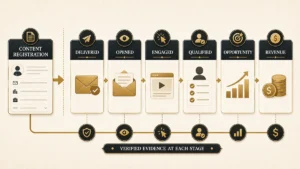
Every vendor in this category now sells you a buying group object. Demandbase models buying groups as a first-class record built from Personas. LeanData ships a Journey Object inside Salesforce. Adobe Journey Optimizer B2B Edition binds a buying group to an account and a solution interest, then scores it daily. The pitch is that your CRM cannot represent a committee, so you need their object to do it.
Here is the part nobody selling you that object mentions. In February 2020, Forrester analyst Vicki Brown wrote that Salesforce’s Opportunity Contact Role “is considered the ‘buying group’ object,” that the Winter ’20 release had made it a first-class object with custom fields, formulas and triggers, and that you could therefore run the Demand Unit Waterfall “without creating custom objects or custom code.”
So the object has existed for six years. Which means buying group marketing was never blocked on data modelling. It was blocked on three decisions most teams still have not made: when the group starts existing, what you score once it does, and who owns it when it qualifies. This article is about those three decisions.
Direct answer — What is buying group marketing?
Buying group marketing is a B2B go-to-market model that treats everyone involved in a purchase decision as one unit of demand, instead of scoring and routing each person as a separate lead. Operationally it requires three changes: a CRM record that represents the group, a score measuring the group’s role coverage and engagement rather than one person’s activity, and routing that sends every member to a single owner. It replaces the MQL, not the account.
Key Takeaways
- The blocker is rarely the object. Forrester documented Salesforce’s Opportunity Contact Role as a scorable buying group object in 2020; the unsolved problem is representing a group that forms before an opportunity exists.
- Two scores do different jobs. Coverage asks whether the roles you need are present at all; engagement asks whether the people in those roles are actually doing anything. Adobe recalculates both daily and keeps them separate for good reason.
- Group routing is an ownership decision, not a distribution one. The rule you need is not “who gets this lead” but “which existing group does this person join, and who already owns it.”
- Buying role belongs to the membership record, not the person. HubSpot’s buying role has historically been a contact property, which means a role set on one deal follows that contact into every other deal they touch.
- The results are real where the motion is real. Forrester reported that Palo Alto Networks doubled win rates in pilot and saw an 800% increase in opportunity progression to forecast at full scale.
What is buying group marketing?
Buying group marketing is the practice of targeting, measuring and qualifying an entire purchase committee as a single demand unit. Influ2, one of the category’s vendors, defines it as a discipline that “focuses on finding and engaging the buying groups and key decision-makers inside your target accounts.” That definition is accurate and tells you almost nothing about how to run it.
The useful definition is structural. Lead-based marketing has one unit of demand: a person. Account-based marketing has one unit of demand: a company. Buying group marketing puts a third unit between them, because neither of the other two matches how a purchase actually gets decided. A company is too coarse to act on and a person is too narrow to qualify.
The lineage matters here, because the model is older than the software. SiriusDecisions introduced the Demand Unit Waterfall in 2017 specifically to redefine the buyer as a demand unit rather than a lead, and Forrester later rebranded that framework as the B2B Revenue Waterfall. Buying group marketing is the execution layer for that model. The vendors did not invent the idea; they packaged the plumbing.
Why the lead is the wrong unit of demand
Kerry Cunningham put the problem plainly for Forrester in 2021: “the buyer is neither a lead nor an account, but a group”. He also identified the specific failure that follows, which is that organisations track leads and accounts as separate things and therefore miss the moment when several leads from one company are in fact one buying group, arriving together.
Watch what a lead-based system does with that moment. Four people from the same company download three assets over two weeks. The scoring model evaluates each of them independently. Two clear the MQL threshold and get routed, possibly to different reps under a round-robin rule. One sits below threshold forever because they are a security reviewer who reads one document and never returns. The fourth is the CFO, who never fills in a form at all.
Nothing in that system is broken. Every rule fired correctly. The system simply had no way to represent the only fact that mattered, which is that those four people were one deal. Buying group marketing is the correction, and the correction is structural rather than motivational. You do not fix this by telling reps to think in committees.
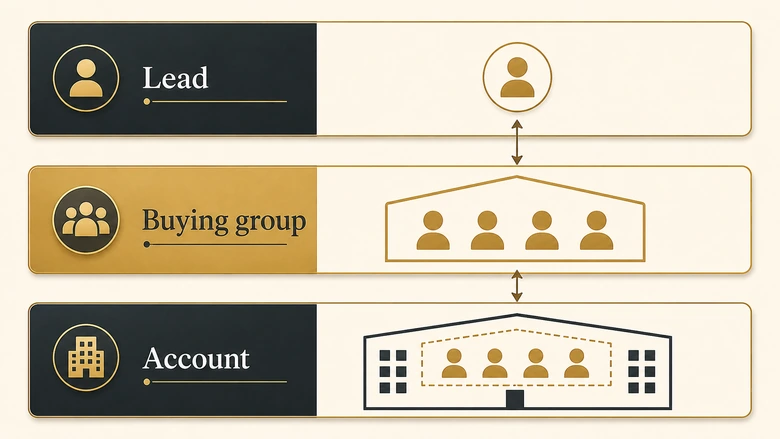
Group size is where most articles on this topic stop, and it is worth being careful with the numbers. Forrester’s Buyers’ Journey Survey, 2024 put an average of 13 people in a purchase decision, but published committee-size figures vary widely depending on what each study counted. We audited that evidence separately, so if you are about to quote a number in a board deck, check which population each study actually measured before you do.
The other kind of buying group
One disambiguation, because the search results for this term are genuinely split. In retail and reselling, a “buying group” means a purchasing co-operative: a set of independent dealers who pool orders to negotiate better pricing, sometimes coordinated through Discord servers and deal-alert communities. That is a different industry and a different meaning. Everything below concerns the B2B enterprise sense, where the group is a committee inside one buying organisation.
How the platforms actually model a buying group
Before designing anything, it helps to see what your existing stack already does. The platforms differ less on whether they have a group construct and more on what the group attaches to, which turns out to be the decision that governs everything downstream.
| Platform | Native group construct | What it attaches to | Key constraint |
|---|---|---|---|
| Salesforce (Sales Cloud) | Opportunity Contact Role | An Opportunity | Cannot exist before the opportunity does; holds Contacts, not unconverted Leads |
| Demandbase | Buying Group, built from Personas | An account, via up to 10 active Personas per group | Product-level tagging and multi-journey tracking were still roadmap items as of the April 2026 update |
| LeanData | Buying Group Journey (custom Salesforce object) | A journey that can pre-date the opportunity; roles map to Opportunity Contact Roles | Members are Leads or Contacts marked potential or confirmed, so hygiene work moves upstream |
| Adobe Journey Optimizer B2B Edition | Buying group | An account and a solution interest | Assignment precedence is fixed: manual beats journey action beats system job |
| 6sense | Persona Map | An account | A coverage and engagement view rather than a routable record |
| HubSpot | Buying groups with blueprints | A company record | Sales or Service Hub Enterprise, and still in beta as of the 28 May 2026 documentation update |
Read the third column again. Salesforce attaches the group to an opportunity. Demandbase, 6sense and HubSpot attach it to an account. Adobe attaches it to an account plus a solution interest. LeanData attaches it to a journey that can start before either. Those are four genuinely different answers to one question, and the question is when a buying group starts existing.
Model the buying group in your CRM
To model a buying group you need three things: a record that represents the group, a membership record linking each person to it, and a role stored on the membership rather than on the person. Most teams get the first one right and the third one wrong.
Decide when the group forms
This is the decision that determines whether you can use standard objects. If a buying group only becomes real once sales has created an opportunity, Opportunity Contact Role is genuinely sufficient, and Forrester’s 2020 guidance holds without modification. Add custom fields to OCR for score and role source, add a trigger for campaign membership, and you are done.
If a buying group becomes real when marketing detects three people from one account engaging the same solution, OCR cannot hold it, because there is no opportunity yet. That is the actual gap the vendors fill, and it is worth being precise that this is what you are buying. You are not buying the ability to represent a committee. You are buying the ability to represent one before sales has agreed there is a deal.
IMPORTANT
Salesforce also ships an unrelated object called Buyer Group (CommerceEntitlementBuyerGroup, API v49.0+). It belongs to B2B Commerce and controls which products and prices a buyer account can see. It has nothing to do with buying committees, and the name collision has sent more than one admin down the wrong documentation path.
The membership record is the real object
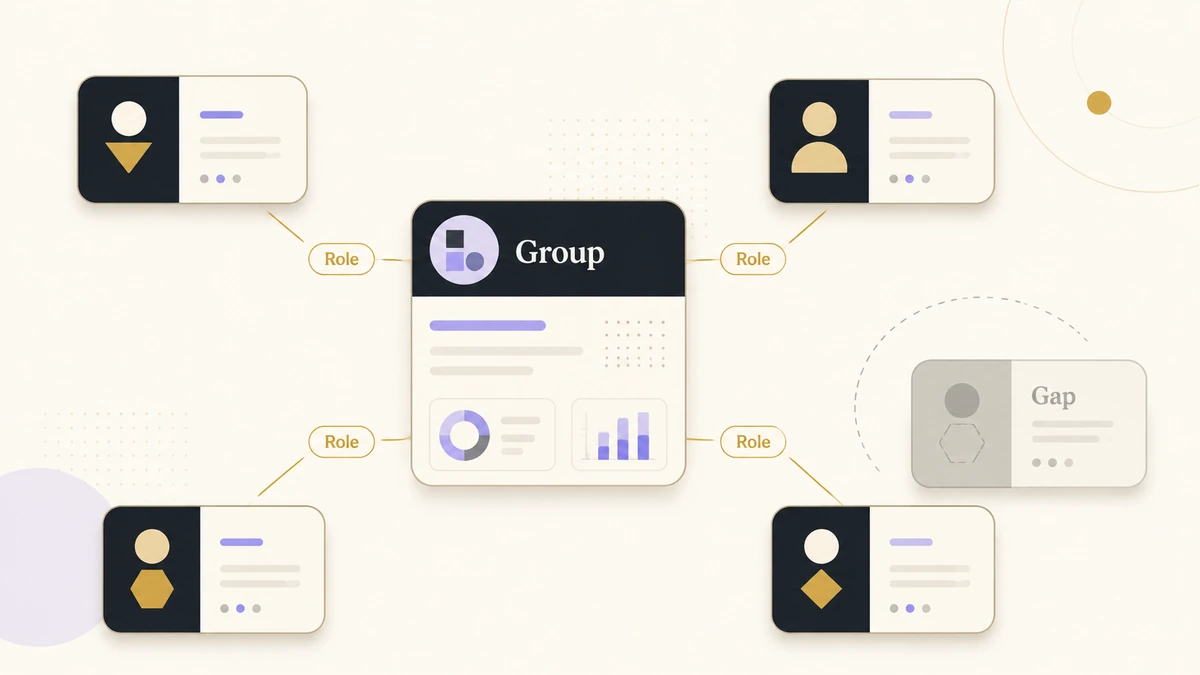
The group record itself is thin. It needs an identifier, the account it belongs to, the solution or product interest it formed around, a status, and an owner. Everything interesting lives on the membership record that joins a person to that group, because that is where role, evidence and engagement belong.
LeanData’s model is instructive here even if you never buy it. A Buying Group Member is a Lead or Contact carrying relevant signals, flagged as either potential (identified by the system against configured criteria) or confirmed (verified by a human). That single flag solves a problem most home-built models trip over, which is distinguishing “we think this person is on the committee” from “someone checked.”
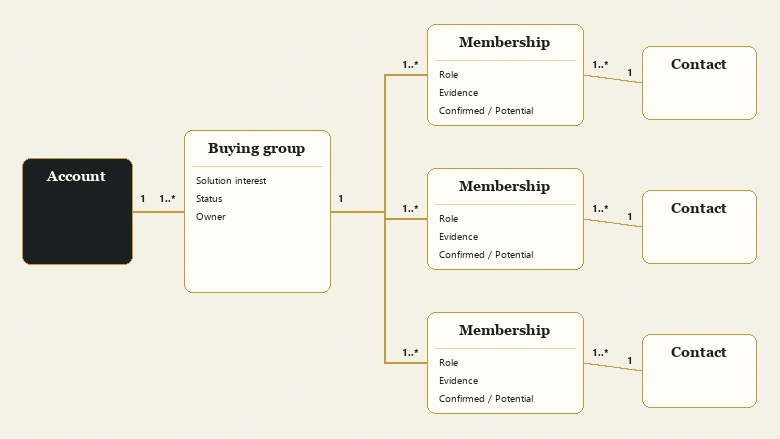
Populating those membership records is its own discipline, and guessing at roles from job titles produces a map that looks complete and predicts nothing. If you need a structure for recording who performs which decision function and what evidence supports each classification, our buying committee mapping template and coverage score covers that step in full.
Role belongs to the membership, not the person
A person is not permanently a champion. They are a champion on this deal, for this product, this quarter. Store buying role as an attribute of the person and you have asserted something that is not true.
This is not theoretical. HubSpot’s buying role has historically been a contact-level property, and practitioners in HubSpot’s own community have pushed for years to have it scoped per deal instead, precisely because a role set during one purchase then follows that contact into every other deal they appear on. Salesforce avoids this by putting Role on the OCR junction, where it belongs. If you are building your own model, copy the junction pattern rather than the property pattern.
Role is also not the same as influence. A person can hold the title of economic buyer and have no real sway, while a staff engineer nobody listed carries the veto. Recording that difference is a separate exercise from recording the role, and we treat relationship strength and real influence as its own layer rather than folding it into the role field.
Score the group, not the person
Group scoring is where most implementations quietly revert to lead scoring, because summing individual lead scores is easy and feels like progress. It is not group scoring. A group of one very engaged person scores identically to a group of four moderately engaged people across every required role, and those two situations mean opposite things.
Coverage and engagement are two different scores
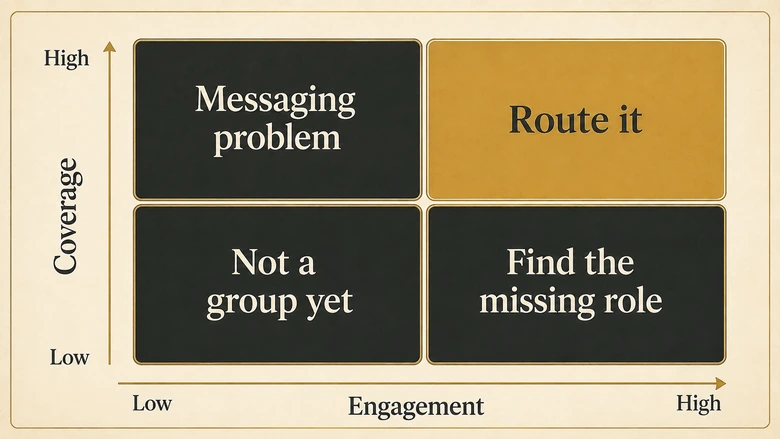
Adobe Journey Optimizer B2B Edition gets this structurally right and is worth copying regardless of your stack. It maintains a completeness score and an engagement score as separate values, both recalculated daily. Completeness asks whether the roles the template requires have enough members. Engagement is built from member activities, weighted by action and by role.
Keeping them apart is the whole point, because they trigger different work. Low coverage with high engagement means the people you have are interested and you are missing a role, which is a research and prospecting problem. High coverage with low engagement means you have found everyone and nobody cares, which is a messaging problem. Collapse the two into one number and both diagnoses disappear.
Coverage = Required Roles Filled ÷ Required Roles DefinedWeight engagement by role rather than by volume. A single pricing-page visit from the economic buyer is worth more than nine content downloads from an intern, and a model that counts actions without weighting who performed them will rank your noisiest accounts highest. Demandbase’s console splits this the same way, reporting buying role distribution and engagement by persona as separate readings rather than one blended score.
What replaces the MQL
The group-level equivalent of an MQL is a threshold on both scores at once, not on either alone. Clever Touch calls the resulting unit a Marketing Qualified Buying Group, which is a reasonable name for a thing that needs one.
Set the threshold as a conjunction: coverage at or above your minimum required roles, and engagement above your floor, and at least one member in a decision-making role. A group that clears all three is qualified. A group that clears two is a development target with a named gap, which is far more actionable than an unqualified lead, because you know exactly which role to go find.
PRO TIP
Keep your existing lead scoring running for the first two quarters and score both ways in parallel. You need the comparison to defend the change, and the groups that qualify while none of their members would have qualified individually are the single most persuasive artefact you will produce.
Route the whole group
Group routing looks like lead routing and is a different problem. Lead routing asks who should get this record. Group routing asks which existing group this person belongs to, and who already owns it. Get the second question wrong and you have rebuilt lead routing with extra steps.
The mechanics of assignment rules, precedence and round-robin distribution do not change, and we have covered how routing works end to end, including what wins when two rules match, separately. What changes here is the unit and the order of operations.
Workflow · 30 min
How to route a qualified buying group to one owner
Builds the assignment rule that sends an entire qualified buying group to a single owner and keeps later members attached to that same owner.
Match the person to an account first
Resolve the inbound record to an account before any group logic runs. If lead-to-account matching is unreliable, group routing inherits every one of its errors.
Look for an open group on that account
Query for an existing open buying group on the matched account with the same solution interest. Join the person to it as a membership record rather than creating a second group.
Create the group only when none exists
If no open group matches, create one, set its solution interest, and attach the person as its first member. Leave it unqualified and unowned at this stage.
Evaluate coverage and engagement together
Recalculate both scores on the group, not the person. Route nothing until the group clears the coverage floor, the engagement floor and the decision-maker requirement.
Assign one owner to the group record
Apply your territory or round-robin rule once, at group level, and write the owner to the group record. Do not run the rule per member.
Inherit ownership for every later member
Configure new members joining an owned group to inherit that owner and notify them, instead of re-entering the assignment queue as fresh leads.
What happens when a second member converts
Step six is the one teams skip, and skipping it reintroduces the exact problem buying group marketing exists to solve. A prospect fills in a demo form. The account already has an owned, qualified group. If that form submission enters the standard queue, it gets scored as a fresh lead and can be routed to a different rep than the one running the deal.
LeanData’s Journey FlowBuilder handles this by letting you build routing logic for the entire group or for individual members based on role, so a qualified group can route to an account executive while technical evaluators route to a solutions engineer. If you are building it yourself, the rule is simpler than it sounds: membership in an owned group is itself a routing condition, and it should be evaluated before any scoring rule.
Once the group is owned, the work becomes a selling problem rather than a systems one, and it is a genuinely different motion from working a single lead. Multithreading, arming a champion and getting to consensus across the committee are covered in our guide to selling to a committee of six to ten buyers.
Where buying group marketing breaks
Four failure modes account for most stalled implementations, and three of them are upstream of anything this article has described.
Matching quality. Group formation depends entirely on correctly resolving people to accounts. Free-email signups, subsidiaries with different legal names and shared corporate networks all break the match, and a broken match produces two half-groups rather than one whole one. Fix matching before you build groups, not after.
Attribution that still counts leads. If marketing is measured on MQL volume, a model that produces fewer, better-qualified units reads as a decline for at least two quarters. Agree the new measure before the change, not after the first bad month.
Role data with no evidence trail. Roles inferred from job titles decay silently. A membership record should carry both the role and how it was determined, which is the difference between a map you can act on and one you merely believe.
Solution interest left undefined. Adobe binds a group to an account and a solution interest for a reason. Without the second element, a company evaluating two products of yours produces one merged group that qualifies for neither, and Demandbase listed product-level tagging as roadmap rather than shipped as of April 2026, so this is not a solved problem across the category.
None of this is a reason to stay lead-based. Forrester reported that Palo Alto Networks, after moving to a buying group motion, doubled win rates during the pilot and saw an 800% increase in opportunity progression to forecast at full scale. It is one company and one vendor-adjacent case study, so treat it as directional rather than as a benchmark. The direction is nonetheless consistent with the structural argument, which is that you cannot qualify a group by measuring one member of it.
The roles themselves, and who tends to sit in the room at each deal size, are covered in our breakdown of the buying committee and its six core roles. This page assumes you already know who is in the group and deals only with representing, scoring and routing them.
Frequently Asked Questions
They differ on the unit of demand. ABM targets and measures a whole company, which is often too coarse to act on because most accounts contain several unrelated evaluations. Buying group marketing targets the specific set of people evaluating one solution, so it sits between account-level and lead-level targeting rather than replacing either.
Yes, that is the point of it. The qualified unit becomes the group rather than the individual, sometimes called a marketing qualified buying group. Qualification tests role coverage and weighted engagement together, so a group qualifies when the right roles are present and active, not when one person crosses a points threshold.
Partly. Forrester documented in 2020 that Opportunity Contact Role works as a scorable buying group object using custom fields, formulas and triggers. The limit is timing: OCR requires an existing opportunity, so it cannot represent a group that marketing detects before sales has created one.
Count roles rather than people. A group with four contacts in one function is weaker than a group with two contacts spanning the economic and technical roles. Set a required-role template per solution, then route when the filled roles clear your coverage floor and at least one decision-maker is present.
Methodology and sources
Platform behaviour in the comparison table was taken from each vendor’s own product documentation, current as of Q3 2026. Demandbase, LeanData and 6sense documentation domains return HTTP 403 to all automated clients, so those rows were verified through domain-scoped search of the vendors’ published documentation rather than direct retrieval; Adobe, HubSpot and Forrester pages were retrieved directly. Roadmap items are labelled as roadmap because the vendors label them that way.
No committee-size statistic is reconciled on this page by design. Where a figure appears it is attributed to its named study and linked to our separate evidence audit. The Palo Alto Networks results are a single reported case and are presented as directional, not as a benchmark.