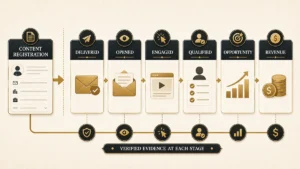
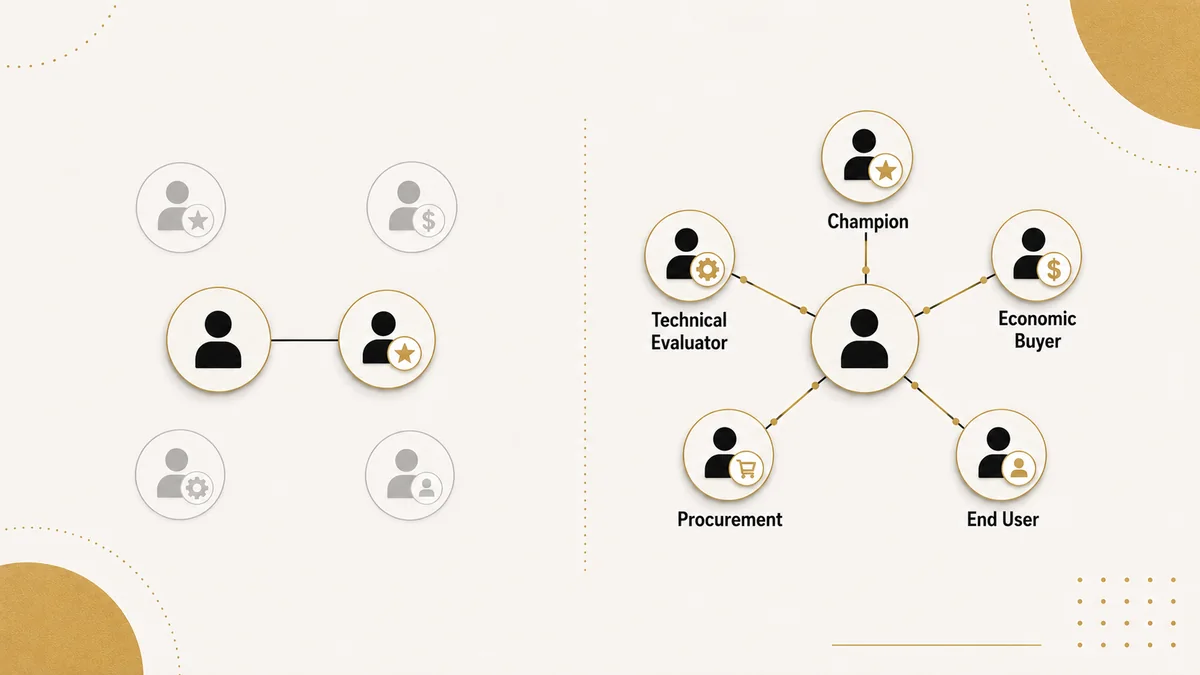
A B2B purchase used to have a buyer. Now it has a committee. On a complex deal, six to ten people have to agree before anything gets signed, and each one arrives with a different priority, a different metric, and a different reason to stall.
Most sellers still run the deal through one friendly contact and hope that person carries the rest of the room. That is how deals go quiet. The real competitor in a committee sale is rarely another vendor. It is the group quietly deciding that changing nothing feels safer than choosing you. The published evidence on how many people are actually in the room puts the internal count at 13 in Forrester’s 2026 research, which is a lot of quiet to work against.
This guide is about the selling motion, not the theory. If you want the ground-level view of what a B2B buying committee is and how it forms, start there; here we assume it and get tactical: how to map the roles, thread every one of them, tailor what each person hears, arm an internal champion, and build the consensus that beats a “no decision.”
Direct answer — How do you sell to a B2B buying committee?
Sell to a B2B buying committee by working the whole group, not one contact. Map every stakeholder and label their role: champion, economic buyer, technical evaluator, end user, and procurement. Multi-thread so each role has a live conversation with you, tailor your message to what that role actually cares about, and arm your champion to make the case in the meetings you never attend. Then drive the group toward a shared, dated decision so the deal does not die in indecision.
Key Takeaways
- A complex B2B deal is decided by six to ten people, each with a different priority. Selling to one of them and hoping is the fastest way to lose the room.
- Multi-threading is the core skill. UserGems, analyzing more than 5,000 B2B opportunities, found multi-threaded deals win at roughly five times the rate of single-threaded ones.
- Every role hears a different value proposition: ROI for the economic buyer, security and fit for the technical evaluator, time saved for the end user, low risk for procurement.
- Your champion sells for you in the rooms you never enter. Give them the one-pager, the battlecard, and the ROI math to do it well.
- The deal’s real competitor is “no decision.” Visible consensus across the group, not enthusiasm from a single fan, is what gets a committee to sign.
Why selling to one person loses the committee deal
A committee sale is lost the moment you let it rest on one relationship. When a single contact is your only line into the account, you inherit every gap in their internal standing, and you never hear the objections raised in rooms you are not in. You are betting the whole deal on that person’s calendar, their politics, and their willingness to keep fighting for you after you hang up.
The cost shows up in the forecast as a soft, deniable loss. Research by Matthew Dixon and Ted McKenna, drawn from 2.5 million recorded sales calls, found that 40% to 60% of deals are lost not to a rival vendor but to customer indecision: buyers who intended to purchase and then failed to act. Indecision is a group condition. It lives in the stakeholders your one champion never gets in front of, and no amount of enthusiasm from a single fan clears it.
Map the buying committee: the roles that decide
Before you can sell to a committee, you have to see it. Mapping means naming every person who can influence or veto the purchase and pinning down what each one is actually evaluating. Most committees resolve to five recurring roles, and the same person can hold more than one on a smaller deal.
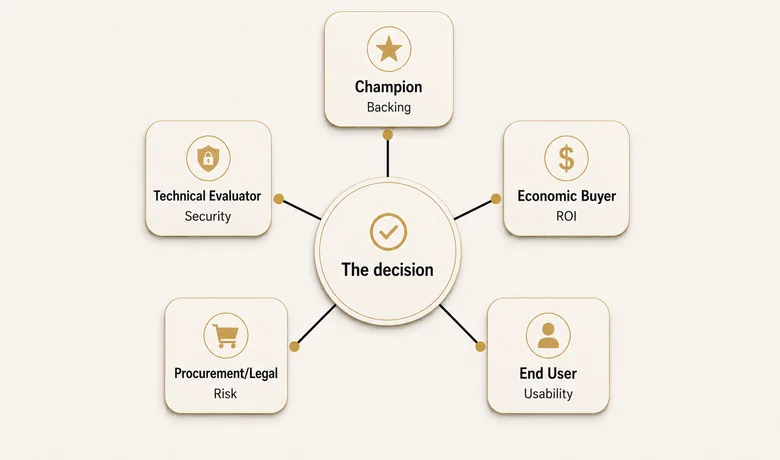
| Role | What they care about | What kills the deal for them | How to win them |
|---|---|---|---|
| Champion | Solving their own problem and looking good for backing you | Being handed a pitch they cannot repeat internally | A clear story and assets they can forward without you attached |
| Economic buyer | ROI, budget, and business impact | Vague numbers and unclear payback | A defensible ROI model tied to their own metrics |
| Technical evaluator | Security, integration, and fit | Missing documentation or a failed review | Clean specs, security docs, and a working proof of concept |
| End user | Daily usability and time saved | A tool that adds work instead of removing it | A hands-on look at how their day gets easier |
| Procurement / legal | Price, risk, and contract terms | Surprise terms and a rushed timeline | Transparent pricing and paperwork started early |
One role deserves special attention: the blocker. A blocker is not a villain; it is usually a technical evaluator or a procurement lead whose job is to find reasons to say no. You do not win a blocker with enthusiasm. You win them by removing the specific risk they are paid to catch, in writing, before they have to ask for it.
You do not sell to a committee. You arm the people inside it to sell for you.
Multi-thread across the committee
Multi-threading means building a real, active conversation with more than one member of the committee at the same time. Not a CC line on an email. A genuine thread where that person knows you, has seen something useful from you, and would take your call.
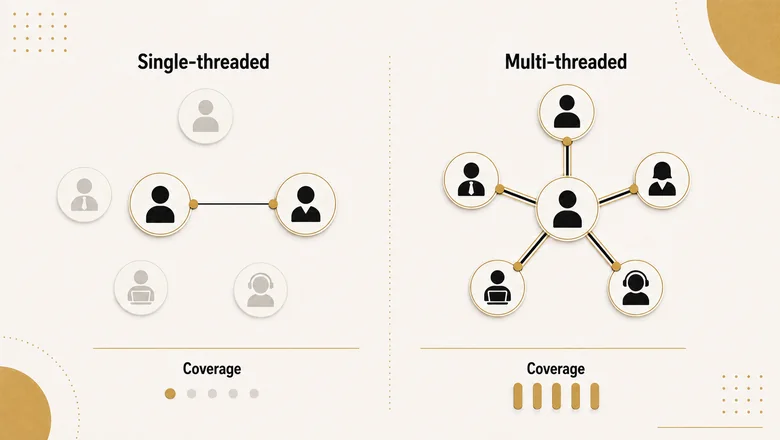
The math favors it heavily. UserGems, analyzing more than 5,000 B2B opportunities, found that multi-threaded deals win at roughly five times the rate of single-threaded ones, and yet 70% of opportunities still carry only one contact on record. The distance between what works and what sellers actually do is enormous, which means multi-threading is still an edge rather than table stakes.
Threads also sit at different depths. Your champion might be deep in evaluation while the economic buyer has barely engaged, so each contact occupies a different point in your enterprise sales funnel and needs its own next step. Track them separately, and never assume a warm champion means a warm committee.
Committee coverage = stakeholders with a live thread ÷ total committee membersCoverage is the single most useful number in a committee deal. If you have mapped nine stakeholders and hold live threads with three, your coverage is 33% and your forecast is fiction. Push coverage toward the whole group before you trust the deal to close. Count the threads carefully, though, because several of them often turn out to be one route wearing different names: weight each contact by access, influence and evidence quality and four mapped contacts can behave like 2.3 relationships. A thread count is the crude version of that number, though: a fuller measure weights each decision function by how much it matters at this stage, then asks whether you can actually reach them, and whether they have engaged, which is how a deal with nine mapped names can still be missing the only signature that counts. Coverage is also urgent rather than merely important, because 94% of groups arrive with a shortlist they have already ranked and the vendor sitting at the top of it wins about four times in five.
Tailor the message to each persona
Once every role has a thread, the mistake is sending them all the same thing. A committee does not evaluate one pitch; it evaluates five at once, one per role, and a message built for the economic buyer will bore the end user and worry procurement.
Say the same product in five languages. The economic buyer hears payback and business case. The technical evaluator hears security, integration, and proof. The end user hears less manual work and fewer clicks. Procurement hears predictable pricing and low switching risk. The champion hears all of it, because they are the one who has to repeat it when you leave the room.
This is the same discipline behind good B2B copywriting: write for one reader at a time, lead with what that reader already cares about, and cut every line that serves you instead of them.
PRO TIP
Write a one-line value proposition for each role before your next committee meeting and put all five on a single page. If you cannot state in one sentence why each person should care, you have not finished mapping that role.
Arm your champion to sell when you are not in the room
You will not be in most of the meetings where this deal is decided. Your champion will. Arming that champion, giving them the material and the confidence to make your case internally, is the highest-impact move in committee selling, because it buys you influence in rooms you can never enter yourself.
First, make sure your champion is real. A champion who is well liked but powerless cannot move an economic buyer. The same executive outreach qualification criteria you would use to vet a cold executive apply here: confirm their access, their budget influence, and their willingness to spend political capital before you bet the deal on them.
Then equip them. The three assets that travel best inside an account are a one-page business case the economic buyer can skim, a competitive battlecard that answers “why not the alternative,” and an ROI model your champion can defend to finance without you on the call. Each one is built to be forwarded, not presented.
IMPORTANT
A champion with no ammunition loses to the status quo by default. If your champion cannot answer “what does this cost, what does it return, and why now” from a single page you handed them, the committee hears silence exactly where your argument should be.
Workflow · 30 min
How to build a committee-selling plan for one deal
Turn a named account into a mapped, multi-threaded plan you can actually run this week.
List every stakeholder and label their role
Write down each person who can influence or veto the deal, then tag them champion, economic buyer, technical evaluator, end user, or procurement.
Assign each role’s priority and deal-killer
For every name, note the one thing they care about most and the one objection that would make them say no.
Open a live thread with each role
Secure a real conversation and a clear next step with every stakeholder, not just your champion, so no part of the committee goes dark.
Tailor one asset per persona
Match each role to a single piece of proof: an ROI model for the economic buyer, a security document for the evaluator, a hands-on demo for the end user.
Arm the champion and set a mutual action plan
Hand your champion the business case and battlecard, then agree on a written, dated path to a decision that every stakeholder has seen.
Build consensus and beat “no decision”
Even a well-threaded, well-armed deal can die at the finish line if the committee never reaches a shared yes. Consensus is not the same as enthusiasm. One excited champion and four silent stakeholders is not agreement; it is a deal waiting to stall into the “no decision” bucket.
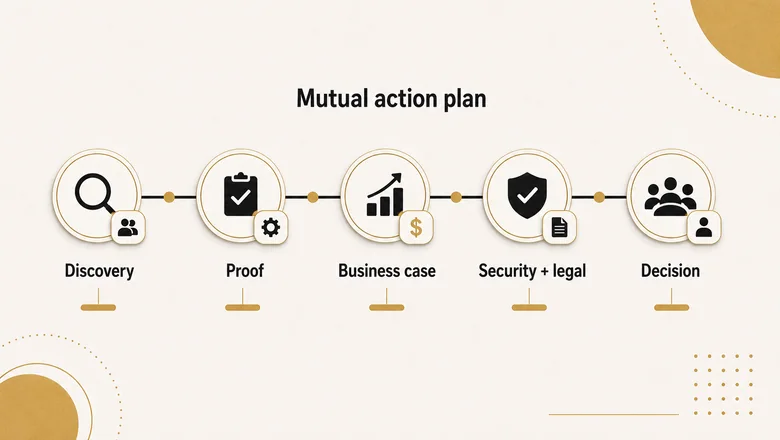
Give the committee one place to decide. Scattering documents across a dozen email threads guarantees that different people are looking at different versions and no one sees the whole picture. A single shared space, a digital sales room or even one maintained deal page, keeps every stakeholder on the same proposal, the same pricing, and the same timeline.
Then make the path to a decision explicit. A mutual action plan, a dated list of steps both sides agree to, turns a vague “we will get back to you” into a schedule the committee has signed up for. It also surfaces the silent blocker early, because someone always hesitates when asked to commit to a real date.
Use this to decide how hard to thread a given deal:
- Multi-thread aggressively when the deal is large, crosses departments, or triggers security and legal review. Deals like these never resolve through one person.
- A single champion is enough only when the purchase is small, the champion holds the budget, and no other function has to approve. That is rare above a few thousand dollars.
- Pause or walk away when you cannot earn a second thread after real effort. A committee that will only give you one contact has usually already chosen someone else.
Frequently Asked Questions
A typical complex B2B purchase involves six to ten decision-makers, and larger enterprise deals often reach eleven to thirteen. The exact count matters less than the range: assume several stakeholders, not one buyer, and map every one of them before you trust the forecast.
Multi-threading means holding an active, individual conversation with several members of the buying committee at once, rather than routing the whole deal through one contact. Each thread is a real relationship with its own next step. UserGems, analyzing more than 5,000 B2B opportunities, found multi-threaded deals win at roughly five times the rate of single-threaded ones.
Most committees include a champion who backs you internally, an economic buyer who owns the budget, a technical evaluator who checks security and fit, one or more end users, and a procurement or legal reviewer. On a smaller deal, one person can hold several of these roles at once.
A blocker is usually someone paid to find risk, often in security or procurement. You handle them by removing the specific objection they are responsible for, in writing, before they raise it. Winning a blocker is about eliminating their risk, not overpowering it with enthusiasm.
Because committees stall. Research across 2.5 million sales calls found 40% to 60% of deals are lost to customer indecision, not to competitors. Multiple stakeholders, unclear consensus, and fear of a wrong choice make doing nothing feel safer than buying. A mutual action plan is the counter.