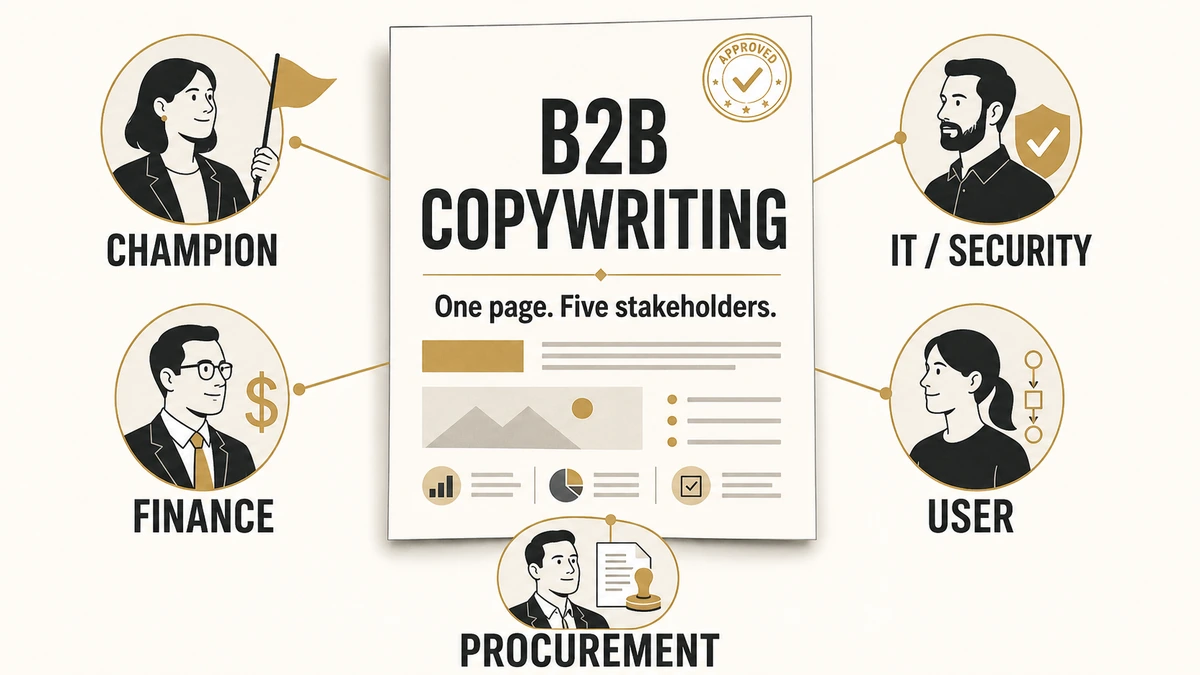
Most B2B copywriting fails for one reason: it’s written for a single reader who doesn’t exist. The person who lands on your page rarely signs the contract alone. Behind them sits a buying group of six to ten people, and your words have to win over every one of them before a deal moves an inch.
That’s the part generic advice skips. B2B copy isn’t B2C with longer words and a tie. It’s persuasion engineered for a group decision, a sales cycle measured in months, and a technical buyer who has already read three competitors’ pages and is waiting to catch you bluffing. Get it right and copy becomes your cheapest, most scalable salesperson. Get it wrong and even a great product stalls in “let’s circle back next quarter” purgatory.
This guide gives you a named system for writing copy that survives the committee, six frameworks you can apply today, and before-and-after rewrites you can lift straight into your own pages. Let’s start with what the job actually is.
Key Takeaways
- The buyer is a committee, not a person. Gartner puts the typical B2B buying group at six to ten people, so every page has to answer several different objections at once.
- Clarity and proof beat clever. Technical buyers reward specific, evidence-backed claims and punish vague hype, which is the opposite of how much B2C copy works.
- Pick a framework, don’t face a blank page. PAS, AIDA, BAB, FAB, PASTOR, and the 4 Ps each fit a specific B2B asset. The matrix below shows which to reach for.
- Write for the 95%, sell to the 5%. The 95-5 rule means most readers aren’t ready to buy today, so copy has to build memory now and convert later.
- The single biggest fix is feature-to-outcome. The six before-and-after rewrites here turn product specs into business results a committee can approve.
What Is B2B Copywriting?
B2B copywriting is the practice of writing marketing and sales content that persuades one business to buy from another. It covers landing pages, emails, white papers, case studies, ads, and sales decks, and its goal is to turn a complex, multi-person purchase into a confident yes by proving business value, reducing risk, and answering every stakeholder’s question before a rep ever joins the call.
Set that against B2C copywriting, which usually nudges one person toward a fast, emotional, low-risk purchase. A consumer ad can sell running shoes on desire alone. A B2B page has to justify a $60,000 contract to a finance lead, survive a security review, and reassure the team that will actually use the tool. Same craft, very different physics.
Here’s how the two disciplines diverge in practice:
| Dimension | B2C copywriting | B2B copywriting |
|---|---|---|
| Audience | One individual buyer | A six-to-ten-person buying committee |
| Primary driver | Emotion, identity, desire | ROI, risk reduction, evidence |
| Sales cycle | Minutes to days | Weeks to many months |
| Proof that persuades | Reviews and social proof | Data, case studies, security and compliance |
| Tone | Casual, playful | Clear, credible, jargon-aware |
| Success metric | Immediate conversion | Pipeline, qualified demand, closed revenue |
Why B2B Copywriting Is Harder Than B2C
B2B copywriting is harder because you’re never writing to one person, and the people you are writing to are paid to be skeptical. Three forces turn it into a different job: the buying committee, the length of the sales cycle, and the fact that most of your audience isn’t ready to buy at all.
The buying committee reads everything
According to Gartner, a typical buying group for a complex B2B solution involves six to ten decision makers, each armed with four or five pieces of information they gathered on their own. Those people rarely agree, and your copy is what they quote at each other in the meetings you’ll never attend.
Buyers now spend just 17% of the total purchase journey meeting with any potential supplier, and that sliver of time is split across every vendor on the shortlist. Your copy does the selling when nobody from your team is in the room.
Long sales cycles reward memory, not hype
Because the cycle runs for months, a single page rarely closes anyone. It nudges the buyer one stage further along a path that loops back on itself, which is the logic behind mapping copy to each stage of the B2B sales funnel instead of writing every page to “convert” on the spot. The 95-5 rule, popularized by the LinkedIn B2B Institute and the Ehrenberg-Bass Institute, holds that only about 5% of business buyers are in-market in a given quarter. The other 95% will buy eventually, just not this week, so copy that chases only the ready-to-buy few leaves most of the market untouched.
Skeptical, technical readers want proof, not adjectives
Decision makers trust evidence over enthusiasm. The 2024 Edelman-LinkedIn B2B Thought Leadership Impact Report found that 73% of decision makers consider an organization’s thought-leadership content a more trustworthy basis for judging its strengths than its marketing and product materials. In B2B, the proof is the persuasion. An unsupported “best-in-class” reads as noise; “SOC 2 Type II, with a 30-day rollout” reads as competence.
The Committee-Proof Copy Framework
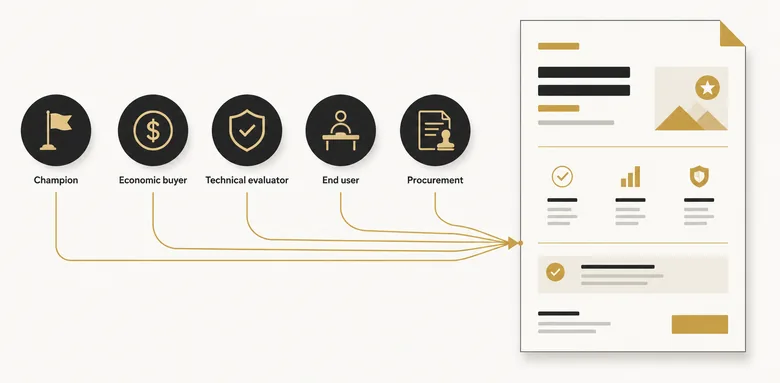
The Committee-Proof Copy Framework is a method for writing B2B copy that earns a yes, or at least a “no objection,” from every role on the buying committee. Instead of writing to a single persona, you write to the five jobs a committee performs and make sure each one finds the proof it needs on the page.
We read the seven pages ranking for this topic before writing this one. Every single one tells you to be clear and benefit-led. Not one shows you how to pressure-test a page against the committee that actually approves the deal. That gap is the reason this framework exists.
Most pages speak to the champion and ignore everyone else. But the champion can’t sign. They have to carry your argument into a room full of people you’ll never meet: the economic buyer who controls budget, the technical evaluator who can veto on security, the end user who has to live with the tool, and procurement, whose entire job is to slow the deal down and negotiate it. Copy that hands the champion ammunition for each of those conversations is copy that closes.
| Committee role | What they need to hear | The copy’s job | Before → After |
|---|---|---|---|
| Champion | A reason to spend political capital on you | Hand them a one-line internal pitch | “A powerful, flexible platform” → “Cut campaign launch from 6 weeks to 9 days” |
| Economic buyer | The business case in money and time | Lead with ROI and payback period | “Enterprise-grade capabilities” → “$240K saved in year one, payback in four months” |
| Technical evaluator | Proof it works and won’t break | Get specific about specs and security | “Bank-level security” → “SOC 2 Type II, SSO, and SCIM on every plan” |
| End user | That their day gets easier, not harder | Show the workflow and the time saved | “Boost team productivity” → “Reps stop logging activity by hand and save 6 hours a week” |
| Procurement / blocker | De-risked terms and proof others succeeded | Surface guarantees, references, exit terms | “Trusted by industry leaders” → “Used by 40 mid-market CFOs; 30-day exit clause, no lock-in” |
PRO TIP
Before you publish any high-stakes B2B page, read it five times, once as each committee role. If a role can’t find the single line written for it in under ten seconds, that line isn’t on the page yet.
FREE WORKBOOK
Audit your copy before the committee does. Score every important section against five buying roles, proof gaps, clarity, objections, and rewrite priority. Download the Committee-Proof Copy Audit workbook.
6 Proven B2B Copywriting Frameworks (and When to Use Each)
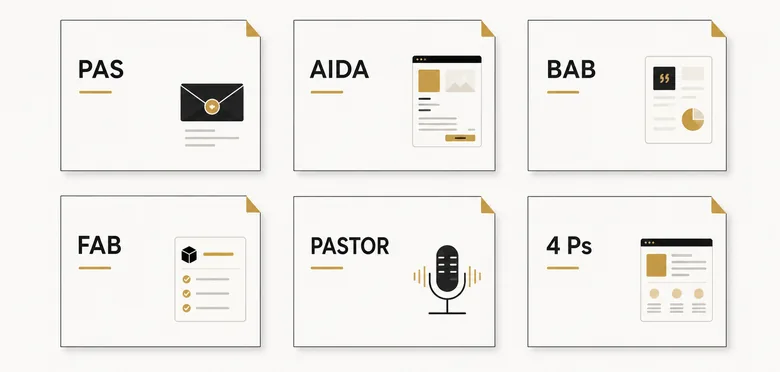
A copywriting framework is a reusable structure for ordering an argument so it persuades. You don’t have to invent persuasion from scratch on every page; you pick the proven structure that fits the asset. These six B2B copywriting frameworks cover almost every job you’ll face.
| Framework | Structure | Best B2B use | Example opener |
|---|---|---|---|
| PAS | Problem, Agitate, Solution | Cold email, paid ads, landing pages | “Your reps lose 6 hours a week to manual data entry.” |
| AIDA | Attention, Interest, Desire, Action | Long landing pages, email sequences | “The average B2B deal now needs 10 people to agree.” |
| BAB | Before, After, Bridge | Case studies, value-prop sections | “Before: 6-week launches. After: 9 days. The bridge was…” |
| FAB | Features, Advantages, Benefits | Product pages, spec sheets, sales enablement | “SOC 2 (feature) means no security-review delay (benefit).” |
| PASTOR | Problem, Amplify, Story, Transformation, Offer, Response | Webinars, long-form, founder letters | “Here’s what changed when one RevOps team stopped guessing.” |
| 4 Ps | Promise, Picture, Proof, Push | Homepages, white-paper intros | “Promise: a forecast you can trust. Picture: every Monday…” |
How to choose the right one
The framework follows the asset, not the other way around. PAS is the workhorse of cold outreach, where the subject line has to earn the open before the problem even lands, which is why cold email subject lines deserve as much testing as the body copy underneath them. For everything else, this quick rule holds:
- Short, single-objective asset like an ad or cold email: PAS.
- Product or pricing page: FAB, so each feature ladders up to a business benefit.
- Proof-driven asset like a case study: BAB.
- Long, narrative asset like a webinar or founder letter: PASTOR.
B2B Copywriting Examples: 6 Before-and-After Rewrites
The fastest way to improve B2B copy is to convert features into outcomes and back every outcome with proof. Below are six B2B copywriting examples, each rewriting weak, feature-led copy into committee-ready copy, with a note on why the new version wins.
| Asset | Before (feature-led) | After (outcome + proof) | Why it works in B2B |
|---|---|---|---|
| Headline | “AI-powered analytics for modern teams” | “Know which 20 accounts to call Monday morning” | Maps to a job the buyer is measured on, not a feature category |
| Landing-page hero | “The all-in-one revenue platform” | “Forecast within 5% accuracy, without the spreadsheet” | A specific number signals competence and sets a testable promise |
| Cold email opener | “I’d love to tell you about our solution” | “You posted 3 SDR roles this quarter. Here’s how to hit pipeline without all 3.” | Proof the sender did the homework; leads with the buyer’s problem |
| LinkedIn ad | “Request a demo of our software” | “See the 3-minute teardown of a $1.2M pipeline build” | Lowers the ask; trades a high-commitment demo for a low-risk watch |
| CTA button | “Submit” | “Get my free pipeline audit” | States the value the reader receives, in the reader’s words |
| Case-study lead | “Acme is a leading provider of…” | “Acme cut onboarding from 6 weeks to 9 days. Here’s the playbook.” | Opens on the transformation, the only thing the committee remembers |
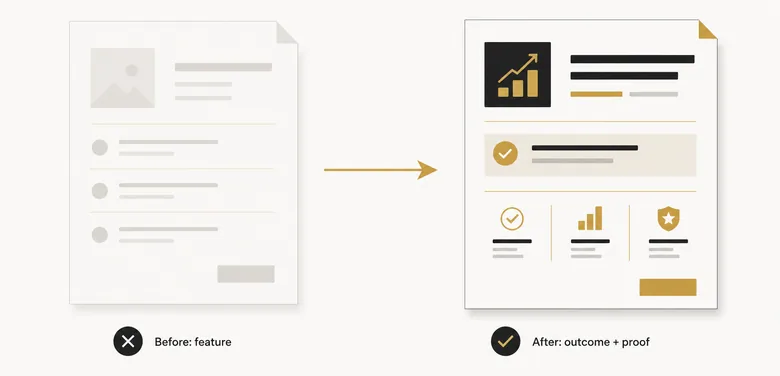
The LinkedIn rewrite swaps a demand for a demo with a low-friction watch, the same pattern that separates scroll-stopping LinkedIn ad examples from the ones that quietly drain budget. Notice that none of the “after” lines are clever. They’re specific. In B2B, specificity is the personality.
IMPORTANT
Every number in your copy is a promise a technical evaluator will test. Use real figures you can defend in a sales call. One inflated stat that falls apart in the demo costs you the entire committee’s trust, not just that line.
B2B Copywriting by Channel and Asset Type
B2B copywriting changes shape by channel: the same value proposition needs a different structure in a cold email, a white paper, and a landing page. Here’s how to handle each of the core B2B assets.
Landing pages and website copy
Landing pages carry the heaviest load, so they earn the most proof. Open with the outcome, follow with one specific number, then stack the risk-reducers a technical buyer and procurement will look for. Website and SEO copy is where most B2B demand starts, and it converts only when it’s built to capture intent, the core idea behind treating content marketing as lead generation rather than traffic for its own sake.
White papers and ebooks
These are trust assets, not sales sheets. A white paper earns the download by promising a specific answer (“how 40 RevOps teams cut CAC in 2025”) and earns the follow-up by delivering data the reader can’t find elsewhere. Write the title as a claim, not a topic.
Case studies
The case study is the single most persuasive B2B asset because it lets a peer make your argument for you. Use BAB, lead with the transformation in the first line, and quantify the result. A case study that opens with company history has already lost the skim.
Cold email and outreach
Cold copy lives or dies on relevance. PAS keeps it tight: name the problem you have evidence the prospect feels, agitate the cost of leaving it, then offer one small next step. The body should never be longer than the buyer’s patience.
Sales enablement copy
One-pagers, battlecards, and decks have one reader who matters: your champion, mid-meeting, under pressure. Write it so they can read a line aloud and have it land. FAB works well here because it translates features into the benefits a champion needs to defend the purchase. Strong battlecards still need a delivery system, and putting your champion’s lines in front of the whole committee is the multi-threading motion that gets every stakeholder to hear them.
SEO and blog copy
Blog copy plays the long game of the 95-5 rule, building familiarity with the 95% who aren’t ready yet. It works best when each post is part of a planned cluster instead of a one-off, which is what a real content strategy for SEO delivers that scattered publishing never will.
How to Write B2B Copy That Converts
To write B2B copy that converts, start with the committee and the proof, not the product. This six-step workflow turns a blank page into a draft every stakeholder can approve.
Workflow · 30 min
How to write B2B copy that survives the committee
Turn a blank page into a B2B draft every stakeholder on the buying committee can approve.
Map the buying committee
List the four or five roles who must approve this purchase, and write the one objection each of them will raise.
Pick the asset and the framework
Match the asset to a structure from the matrix above, such as PAS for an ad or FAB for a product page.
Lead with the outcome
Write the headline as the business result the buyer is measured on, then name the feature that delivers it.
Stack the proof
Add a specific number, a named customer, and a risk-reducer like security or a guarantee for the skeptics.
Cut the jargon and the clever
Read it aloud and delete anything a time-poor, non-native reader would stumble over or have to reread.
Pressure-test against the committee
Reread the draft once as each role. If a role has no line written for it, add that line before you ship.
Strong B2B copy is downstream of strong positioning. If the value proposition itself is fuzzy, no framework will rescue the page. This positioning masterclass from April Dunford is a useful companion to the workflow above, because it fixes the input that most weak copy gets wrong.
9 B2B Copywriting Tips That Sharpen Every Draft
These B2B copywriting tips apply whether you’re writing a cold email or a twelve-page white paper. Each one pushes a draft toward clarity, proof, and the committee.
- Write to one reader, sell to the group. Use “you,” but make sure every committee role can find its line.
- Lead with the outcome. Open on the result the buyer is measured on, then explain the feature behind it.
- Quantify everything you can. “6 hours a week” beats “save time” every single time.
- Name the proof. A real customer, a real number, a real integration. Vague proof reads as no proof.
- Cut jargon you didn’t define. Write for a smart non-expert; specialists won’t mind, and generalists will stay.
- Kill the clever. If a pun hides the point, the point loses. Clarity outsells wit in B2B.
- Make the next step small. Trade “book a demo” for a teardown, a calculator, or a one-pager when the reader is still cold.
- Match copy to the funnel stage. Top of funnel educates; bottom of funnel de-risks. Don’t pitch the 95% like the 5%.
- Edit out loud. Read every draft aloud. The sentences you trip on are the ones the buyer will trip on too.
Two free tools make the clarity pass faster, though neither replaces the research that makes copy credible:
B2B Copywriting Services: In-House, Freelance, or Agency?
B2B copywriting services come in three models: hiring an in-house writer, contracting a freelance B2B copywriter, or retaining an agency. The right choice depends on volume, technical depth, and how much subject-matter context you can hand over.
An in-house writer is best when copy volume is steady and the product is complex enough that context takes months to build. A freelance B2B copywriter fits specialized, project-based work like a white paper or a launch page, and usually costs less than an agency for the same asset. An agency makes sense when you need a full team, multiple channels, and managed throughput at once, and when you’d rather buy a process than build one.
What a good B2B copywriter actually does
A strong B2B copywriter is a researcher first and a writer second. They interview your sales team, read the win/loss notes, and learn enough about the product to draft a credible spec sheet. The actual writing is the last 20% of the work. When you evaluate a freelancer or agency, ask for B2B samples in your category and a short paid test on your real product, not a polished but generic portfolio. The tell of an expert is how good their questions are before they write a word.
How AI Search Is Changing B2B Copywriting
AI search adds a second reader to every page: the model that summarizes your copy for the buyer before they ever click. B2B copywriting in 2026 has to persuade a human committee and stay quotable to a machine at the same time, because more of the buying journey now begins inside an answer engine instead of a list of blue links.
The shift is already measurable. Gartner predicts that traditional search engine volume will drop 25% by 2026 as buyers move questions to AI chatbots and assistants. When a generative engine answers the question outright, your copy only earns the click if the model cited it, and models cite the clearest, best-structured, most specific source on the page.
The good news is that the habits which win a buying committee also win the machine. Clean definitions, direct answers, specific numbers with attribution, and structured assets like tables and FAQ blocks are exactly what both a skeptical finance lead and a language model can lift and trust. Vague, clever, unstructured copy loses both readers at once.
To make B2B copy citable by AI engines, prioritize three things:
- Answer in the first sentence. Open each section with a self-contained definition or instruction a model can quote without the surrounding context.
- Structure the proof. Put comparable data in real tables and pair every claim with a named source.
- Write plainly. Models, like buyers, struggle to summarize hedged, jargon-heavy copy, so the simplest accurate phrasing wins.
Treat the answer engine as the newest member of the buying committee, the one that reads your page first and decides whether the others ever see it. Write for it the way you write for the technical evaluator: with proof, structure, and no bluffing.
Frequently Asked Questions
B2B copywriting is the craft of writing marketing and sales content that persuades one business to buy from another. It spans landing pages, emails, white papers, case studies, and ads, and it succeeds by proving business value, reducing risk, and answering the questions of a multi-person buying committee rather than a single shopper.
The 95-5 rule, from the LinkedIn B2B Institute and the Ehrenberg-Bass Institute, says only about 5% of business buyers are in-market in a given quarter while 95% are not. For copywriting, it means most readers aren’t ready to buy yet, so copy should build trust and recognition now and convert the small in-market share later.
Yes. As B2B buyers do more of their research alone, often through search and AI tools, copy is doing more of the selling than ever. Demand has shifted toward writers who can prove business value and handle technical subjects, while generic, feature-led copy that any model can draft is losing value fast.
Rates vary widely by experience and asset. Freelance B2B copywriters commonly bill around $75 to $200 or more per hour, or $0.50 to $2 a word, and specialized pieces like white papers and case studies often run into the low thousands. Pay tracks technical depth and proven business results far more than word count.
B2B copywriting persuades a group of business buyers to make a considered, high-value purchase, so it leads with ROI, proof, and risk reduction. B2C copywriting usually moves one consumer toward a fast, emotional purchase. B2B cycles run longer, the audience is a committee, and evidence matters far more than personality or wit.