Type “PPC vs display advertising” into Google and most guides hand you the same tidy split: PPC catches people who are searching, display shows banners to people who are not. That is true, and for a B2B marketer deciding where next quarter’s budget goes, it is also not enough. The useful question is not which channel is better. It is which job each one does, and which job you need done right now.
PPC (pay-per-click search advertising) and display advertising sit at opposite ends of the buying journey and price themselves in opposite ways. One charges you per click and rewards intent that already exists; the other charges you per thousand impressions and manufactures attention before intent shows up. Run the wrong one for your goal and you either overpay to reach people who will never buy, or you miss the buyers already raising their hands. Both live inside the same B2B Google Ads account, so the real skill is fitting each to its moment.
This guide compares PPC and display advertising for B2B specifically: the intent gap, the funnel stage each owns, the CPC-versus-CPM economics, how you actually measure each one, and a decision block you can act on. The short answer is below; the benchmarks and the “run both” playbook follow.
Direct answer – what is the difference between PPC and display advertising?
PPC (pay-per-click) usually means paid search: text ads that appear when someone searches a keyword, billed each time the ad is clicked (CPC). Display advertising places visual banner, image, and video ads on third-party websites, apps, and YouTube, usually billed per thousand impressions (CPM). PPC captures demand that already exists; display creates demand among buyers who are not searching yet. For B2B, PPC harvests the small in-market share while display warms the larger out-of-market majority, and most programs run both.
Key Takeaways
- PPC is intent capture on search, priced per click; display advertising is demand creation on visual placements, priced per thousand impressions. They are complementary jobs, not rivals.
- The engagement gap is stark in B2B: paid search click-through rates cluster around 6%, while B2B display banners sit near 0.2 to 0.3%. Display earns its place on cheap reach, not clicks.
- Only about 5% of B2B buyers are in-market in any quarter (the 95-5 rule). PPC monetizes that 5%; display builds familiarity with the 95% who will buy later.
- The economics invert: paid search costs a few dollars per click, display costs a few dollars per thousand impressions. You buy decisions with PPC and attention with display.
- Measurement is where B2B teams go wrong. Judge PPC on last-click leads, but judge display on assisted and view-through impact, and feed both offline conversions so bidding chases pipeline, not form fills.
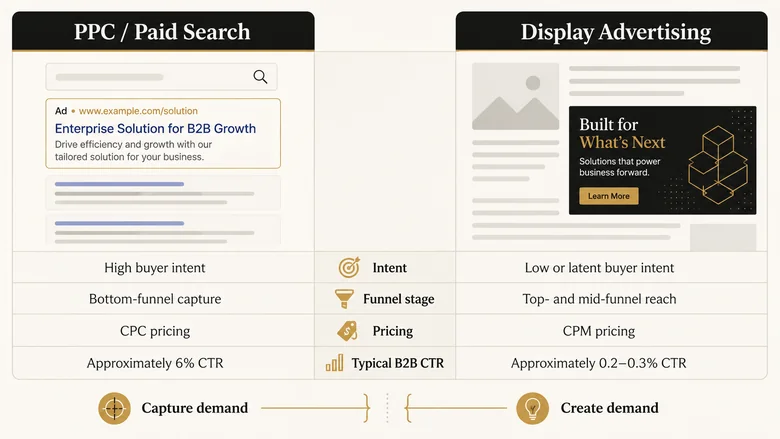
Here is the whole comparison in one view. Skim it, then drop into the sections that decide your next campaign.
| Dimension | PPC (paid search) | Display advertising |
|---|---|---|
| Buyer intent | High: the person is actively searching | Low: the person is browsing, not searching |
| Funnel stage | Bottom: capture and conversion | Top and middle: awareness and consideration |
| Ad format | Text ads on the results page | Visual banners, rich media, and video on third-party sites, apps, and YouTube |
| Pricing model | Cost per click (CPC) | Cost per thousand impressions (CPM) |
| Typical B2B click-through rate | ~6% (Business Services) | ~0.2 to 0.3% (B2B banners) |
| Targeting basis | Keywords and search intent | Audiences, firmographics, interests, and site retargeting |
| Measurement | Click and last-click conversion friendly | Assisted, view-through, and brand lift |
| Best B2B use | Capture in-market demand and high-intent queries | Create demand, build brand, and retarget long sales cycles |
What Is PPC (Pay-Per-Click) Advertising?
PPC is a paid advertising model where you bid on keywords and pay only when someone clicks your ad, most commonly on a search engine results page. In everyday B2B use, “PPC” and “paid search” are the same thing: text ads on Google and Microsoft that appear the moment a prospect types a query like “b2b crm software” or “managed it services provider.”
The defining trait is intent. Nobody sees a PPC ad by accident; they see it because they searched for something related to what you sell. That makes paid search the most direct way to reach a buyer at the exact moment of need, which is why it carries the highest intent and the highest cost per click of any channel. You are bidding against competitors for the same raised hand.
For B2B, the strength and the limit are the same fact: PPC only works when demand already exists. It cannot reach a buyer who has not started searching, and search volume for a niche category is finite. Once you have captured the in-market queries, scaling PPC means paying more for the same clicks or widening into looser keywords that convert worse.
What Is Display Advertising?
Display advertising is the practice of placing visual ads (static banners, rich media, and video) on third-party websites, mobile apps, and platforms like YouTube and Gmail, rather than on a search results page. It runs across networks such as the Google Display Network, which reaches the large majority of internet users, and through programmatic exchanges that buy inventory in real time.
Where PPC waits for a search, display interrupts. Your ad appears next to content the person chose to read, not because they asked for you. That is why display is measured in impressions and priced per thousand of them: the unit you are buying is attention and reach, not a click. Programmatic buying now accounts for the large majority of US display spend, so most display is bought through automated exchanges rather than one publisher at a time.
Targeting is what makes display useful for B2B rather than a spray of banners. Instead of keywords, you point ads at audiences: firmographic segments, job titles, in-market and affinity groups, lookalikes of your customers, and account lists that match your target market. Most valuable of all is retargeting people who already visited your site, which is where display converts hardest and where it bridges back to PPC.
PPC vs Display Advertising: The Key Differences for B2B
PPC and display differ on five axes that decide which one fits a given B2B goal: intent, funnel stage, cost model, measurement, and creative. Take them one at a time.
Intent versus interruption
This is the difference everything else follows from. PPC is a pull channel: the buyer initiates by searching, and you answer. Display is a push channel: you initiate, and the buyer was doing something else. Neither is superior, but they reach people in completely different states of mind, and B2B intent is rarer than most budgets assume. Capturing that rare intent while manufacturing more of it is the balancing act the performance agencies built to run both at once are hired to manage.
Research from the Ehrenberg-Bass Institute found that only about 5% of business buyers are in-market for a given category in any quarter; the other 95% are not shopping at all. PPC can only ever reach that 5%. Display is how you reach the 95%, which is also why pointing high-intent B2B intent data at your display audiences beats blasting generic banners at everyone.
Funnel stage
Because it depends on active search, PPC concentrates at the bottom of the funnel, where people are comparing and ready to act. Display spreads across the top and middle, where people are learning a category exists and forming opinions about who to trust. In the create-and-capture model that good demand programs use, display is a demand-creation channel and PPC is a demand-capture channel.
That mapping turns the channel choice into a strategy check. If too few people search for you at all, more PPC will not fix it; you need the demand-creation work that a demand generation framework describes, and display is one of its paid arms.
If instead your problem is capturing existing intent efficiently, that is a campaign-type decision, closer to the Demand Gen versus Performance Max question inside Google Ads. Zoom out and the same create-versus-capture logic is what separates demand generation from lead generation as whole programs.
CPC versus CPM economics
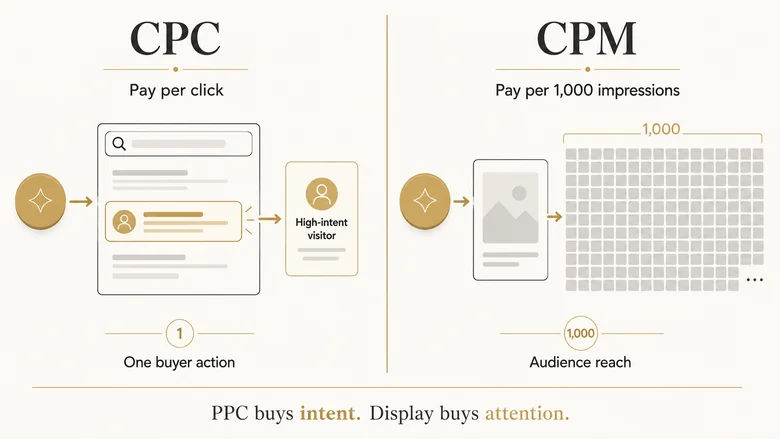
The pricing models are not just different units; they change what you are buying. PPC bills per click, so you pay for a discrete action, and in B2B that action is expensive. WordStream’s 2026 benchmarks put the median Business Services cost per click at $5.87 against a 6.10% click-through rate, drawn from more than 13,000 US search campaigns. Every dollar buys a click from someone who was already looking.
Display bills per thousand impressions, so you pay for exposure and clicks are almost incidental. Cross-industry display click-through rates average about 0.46%, and B2B Services sit near 0.22%, the lowest of any sector. On paper that looks like failure. In practice it is the point: a B2B display CPM commonly runs about $4 to $10 depending on inventory, so a few dollars buys thousands of impressions instead of one click. You are renting familiarity, not paying for a decision.
Put the two side by side and the trade is clear. Paid search converts attention you did not have to create, at a high price per action. Display manufactures attention at a low price per view, then waits for it to pay off later or through another channel. Judging display by PPC’s cost-per-click math is the single most common way B2B teams talk themselves out of the channel that feeds their pipeline.
Measurement and attribution
PPC is friendly to simple measurement because the click and the conversion often sit in the same session: someone searches, clicks, and fills a form, and last-click attribution gives search the credit. That tidiness is real but flattering, and it is why paid search always looks efficient in a last-click report while display looks wasteful.
Display rarely gets last-click credit even when it did the work, because its impact shows up as assisted conversions, view-through conversions, and lifts in branded search weeks later. To see it you need attribution beyond last click and clean conversion data flowing back to the platforms. Third-party PPC reporting and bid management tools help surface the assisted paths native dashboards bury, and importing offline outcomes through enhanced conversions for B2B lead gen is what lets either channel optimize toward revenue instead of raw form fills.
Creative and format
PPC creative is mostly words: headlines, descriptions, and extensions that have to win a click on a crowded results page. Display creative is visual, which is a heavier lift and a bigger opportunity. Weak banners get ignored, but strong visual and video creative is exactly what builds the memory structures display exists to create.
The same creative discipline carries across paid social, where B2B display-style advertising often performs best. Studying strong LinkedIn ad examples is a fast way to see what visual B2B creative should do: lead with a clear value point, stay legible at thumbnail size, and give the out-of-market viewer one idea to remember.
PPC vs Display Advertising: B2B Benchmarks Side by Side
Numbers make the trade concrete. The table below pulls median B2B figures from 2025 to 2026 benchmark studies so you can see why the two channels are priced and judged so differently. Treat them as reference points, not guarantees; your own account will vary by category and competition.
| Metric (B2B) | PPC (paid search) | Display advertising |
|---|---|---|
| Average click-through rate | ~6.10% (Business Services) | ~0.22% (B2B Services) |
| Pricing model | Cost per click (CPC) | Cost per thousand impressions (CPM) |
| Typical B2B cost | ~$5.87 per click | ~$4 to $10 CPM |
| Buyer intent | High and immediate | Low and latent |
| Primary job | Capture existing demand | Create demand and retarget |
| Best-fit metric | Cost per lead, last-click conversions | Assisted and view-through conversions, reach |
The click-through numbers come from WordStream’s search benchmarks and Focus Digital’s display study; the cost figures reflect B2B pricing, where tighter account-based or intent-qualified targeting pushes CPMs toward the top of the range. The takeaway is not that display is weak. It is that PPC and display answer different questions, so holding them to the same metric guarantees you underrate one of them.
When to Use PPC vs Display Advertising: A B2B Decision Framework
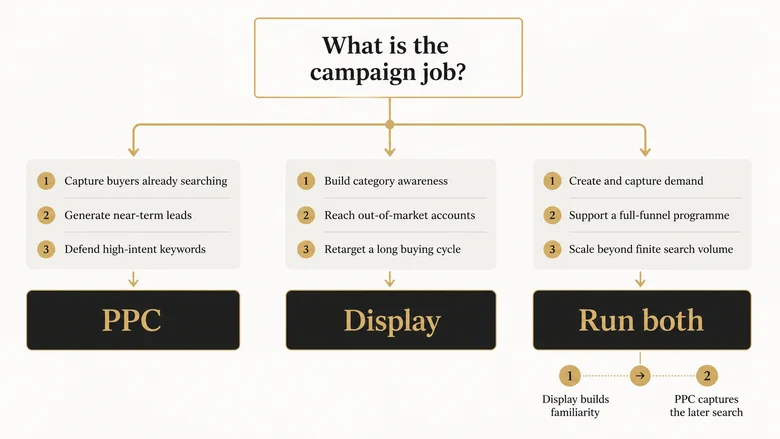
Choose by the job in front of you, not by which channel sounds more sophisticated. Use PPC when intent already exists and you need to capture it. Use display when intent does not exist yet and you need to create or re-warm it. Use both when you want a full-funnel engine, which is most mid-market B2B. The table turns that into specific calls.
| Your B2B goal | Lead with | Why |
|---|---|---|
| Capture buyers already searching your category | PPC (paid search) | Only search reaches people at the moment of active intent |
| Build awareness with accounts not searching yet | Display | Cheap, visual reach to the 95% who are out-of-market today |
| Re-engage visitors who did not convert | Display retargeting | Lower CPMs and higher conversion than cold display or new search |
| Defend a tight cost per lead this quarter | PPC (paid search) | Direct, last-click-friendly conversions you can measure now |
| Shorten long sales cycles with steady presence | Display | Keeps you top of mind across months of consideration |
| Most mid-market B2B programs | Run both | PPC captures the in-market minority; display creates demand in the majority |
PRO TIP
Before you add display, make sure PPC is capturing all the intent that already exists. If your branded and high-intent non-branded search is not at full impression share, spend there first; it is the cheapest pipeline you will ever buy. Add display once you are capturing demand and need to create more of it.
Running Both: The Full-Funnel B2B Play
For most B2B advertisers the honest answer to “PPC vs display advertising” is “both, in sequence.” Display creates familiarity with accounts that are not searching yet, and PPC harvests them when they finally do. Run only capture and you compete on price for the same ready buyers everyone else is chasing; run only creation and you build awareness you never convert.
Retargeting is the hinge that connects them. Display retargeting of people who already touched your site converts far better than cold display: benchmark data puts retargeting conversion around 1.42% against roughly 0.71% for prospecting display. In practice the loop runs display to create demand, search to capture it, and retargeting to catch everyone who slipped between the two.
Sequencing also settles the budget argument. Fund PPC to the point where it captures all the cheap in-market intent, then put incremental budget into display to manufacture more of that intent for next quarter. Treated as one funnel rather than two line items, the channels stop competing for credit and start feeding each other.
Measurement and Pitfalls for B2B
The fastest way to waste money on either channel is to optimize toward the wrong conversion. If “conversion” means any form fill, automated bidding will happily buy cheap newsletter signups and gated-eBook downloads, and both PPC and display will report wins while pipeline stays flat. Fix the input before you blame the channel.
Two traps catch B2B teams specifically. The first is judging display on last-click clicks, which it will always lose; hold it to assisted conversions, view-through, and branded-search lift instead. The second is letting PPC claim all the credit for demand that display created, then concluding display does not work and cutting the very channel that fed the search. Measure the funnel, not the final touch.
IMPORTANT
Import your CRM outcomes back into the ad platforms so bidding optimizes for qualified pipeline, not raw leads. This single fix does more for PPC and display performance than any bid or creative tweak, because it changes what the automation is trying to win.
Frequently Asked Questions
PPC (pay-per-click) is usually paid search: text ads shown when someone searches a keyword, billed per click. Display advertising places visual banners and video on third-party sites, apps, and YouTube, billed per thousand impressions. PPC captures people actively searching; display builds awareness among people who are not searching yet.
Neither is better outright; they do different jobs. PPC wins when you need to capture buyers already searching and prove a cost per lead this quarter. Display wins when you need to create demand or retarget long sales cycles. Most B2B programs run both, using display to feed the demand that PPC captures.
Display is usually split by how it is bought: the Google Display Network, where you buy inventory through Google Ads, and programmatic display, bought through demand-side platforms and ad exchanges in real time. Within both, ads come as static banners, rich media, native units, and video. Programmatic now handles the large majority of US display spend.
Yes, when you use them for the right job and measure them correctly. B2B display click-through rates are low, near 0.2%, so display is not a direct-response workhorse. Its value is cheap reach, brand building with out-of-market buyers, and retargeting, judged on assisted and view-through impact rather than last-click clicks.
Yes, and most strong B2B accounts do. They serve different funnel stages, so they complement rather than compete. Use display to create demand and retarget, PPC to capture active intent, and keep their conversion goals distinct so you can see what each contributes. Feed both offline conversions so bidding optimizes for pipeline.
Where B2B Teams Should Start
If you are choosing between PPC and display advertising, start by capturing the demand you already have. Fund paid search until it owns your high-intent queries, then add display to create and re-warm demand for the quarters ahead. The teams that win treat the two as one funnel, measured end to end, rather than two channels fighting over the same last click.