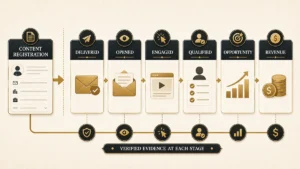
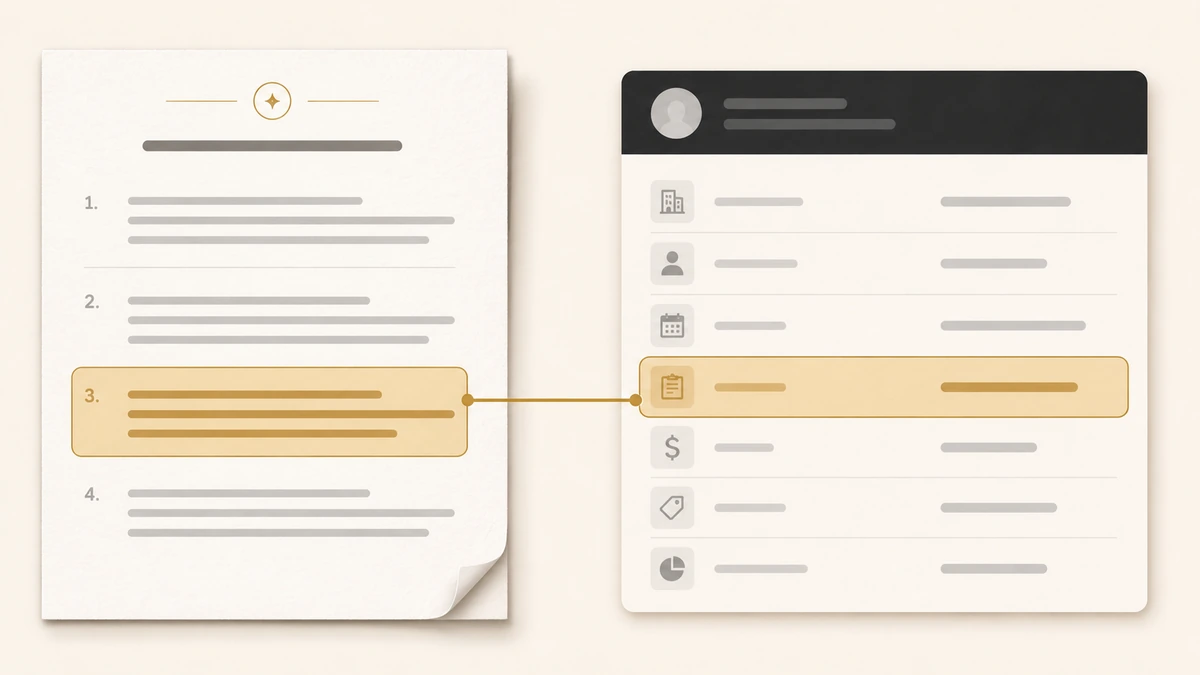
Open your sales and marketing SLA. Pick any clause. Now name the field in your CRM that proves whether that clause was met last month.
Most teams stop at the second sentence. The document says sales will follow up on every marketing qualified lead within 24 hours, and nobody can say which timestamp starts the 24 hours, which one stops it, or where either value is stored. The clause is real. The measurement is not. A quarter later the agreement is a file in a shared drive that both teams have quietly stopped mentioning.
That gap is not a writing problem. Every template you can download gives you the same four sections. What none of them give you is the enforcement column: the object, the field, the automation and the timestamp that turn each clause into something you can query on a Monday morning. This article is that column.
Direct answer — What is a sales and marketing SLA?
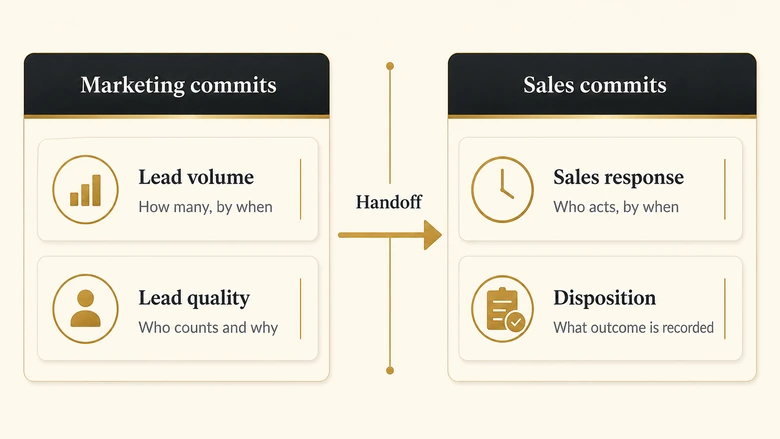
A sales and marketing SLA is an internal agreement in which marketing commits to a volume and quality of qualified leads and sales commits to a response time and a working standard for each one. A usable SLA has four clause types: lead volume, lead quality, sales response, and disposition reporting. Each clause needs a named CRM field and timestamp, or it cannot be measured or enforced.
Key Takeaways
- A clause without a field is a sentiment. If you cannot name the object, the property and the timestamp behind a commitment, that commitment will never appear in a report and will never be enforced.
- There are only four clause types worth writing: lead volume, lead quality, sales response, and disposition. Everything else in a typical SLA template is preamble.
- The two platforms are not symmetrical. HubSpot ships Owner Assigned Date and First Outreach Date on the Lead object, so a response clause is measurable out of the box. Salesforce ships neither for leads, so you build both or you cannot audit the clause.
- Disposition is the clause most teams skip and the one that decides whether the agreement survives. A rejection with no structured reason gives marketing nothing to fix.
- Write the breach report before anyone signs. If the query returns nothing because the field is empty, you have found the flaw while it is still cheap to fix.
What is a sales and marketing SLA?
A sales and marketing SLA is a written, two-sided commitment between the two teams that share a revenue number. Marketing commits to how many qualified leads it will deliver and what qualified means. Sales commits to how fast it will respond to each one and what counts as having worked it. Both sides commit to reporting what happened.
The word doing the work is agreement. Forrester analysts have made this point for years: a lead-handoff standard that marketing writes alone and presents to sales is not an agreement, it is a memo. Sales did not negotiate the numbers, so sales has no reason to defend them when a quarter goes badly.
What an SLA is not
An SLA is not a lead scoring model, though it depends on one. It is not a routing policy, though it sits on top of one. It is not a definition document, though it has to reference definitions that both teams signed. Keep those artefacts separate. An SLA that tries to also be the scoring rulebook becomes too long to review and too political to change.
Why most sales and marketing SLAs stop working within a quarter
An SLA fails when nobody can produce the number it promised to govern. That failure has a specific shape, and it is almost always one of three things.
The first is a missing timestamp. The clause commits to a window, but the CRM never recorded when the window opened or closed, so the window is unmeasurable in either direction.
The second is an unshared definition. Marketing counts a qualified lead at the moment a score crosses a threshold. Sales counts it at the moment it lands in a queue they actually look at. Both numbers are correct and they do not match, so every review meeting turns into a reconciliation argument instead of a performance conversation.
The third is an absent consequence. The document says what each side will do and says nothing about what happens when a side does not. Commitments with no stated outcome for a miss decay to suggestions, and they decay fast.
IMPORTANT
Be careful with the adoption statistics circulating on this topic. Widely repeated figures put the share of B2B teams with a formal SLA at 22%, 43% and 61%, and the citation chains behind them terminate in blog posts rather than in a survey with a published sample and method. Do not put any of them in your business case. The number that matters is the one in your own CRM, and that one you can actually check.
The four clauses every SLA needs
To build a sales and marketing SLA that holds up, write exactly four clause types and resist the pressure to add a fifth. Each one belongs to a single owner, governs a single measurable event, and fails in a way you can see.
| Clause | Who commits | What it governs | Use it when | Fails as |
|---|---|---|---|---|
| Lead volume | Marketing | How many qualified leads arrive in a period | Sales capacity is planned against inbound flow | A target with no agreed counting moment |
| Lead quality | Marketing | What a lead must be true of before it counts | Rejection rates are the live argument | Adjectives instead of criteria |
| Sales response | Sales | How fast first contact happens after handoff | Leads sit unworked in a queue | A window with no start or stop event |
| Disposition | Sales | That every lead reaches a terminal status with a reason | Marketing cannot tell good leads from bad | Free-text notes nobody can aggregate |
Notice what is absent. No revenue-attribution clause, no pipeline-contribution clause, no meeting-count clause. Those are reporting questions, and folding them into an SLA gives you a document that fails review because one contested metric drags the other three down with it.
The enforcement column: where each clause lives in your CRM
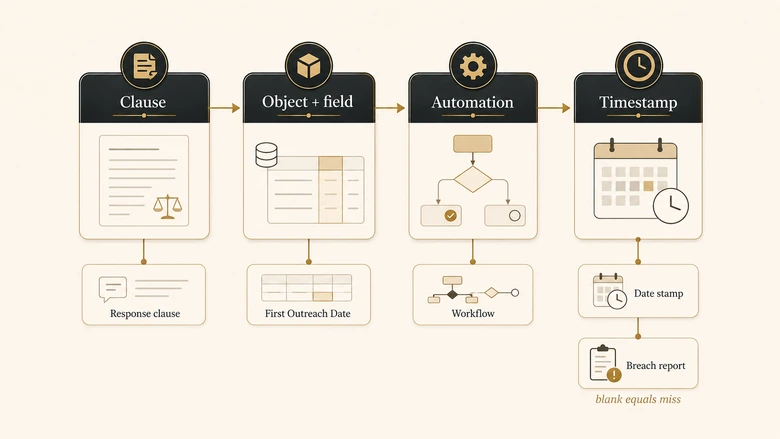
To make a clause auditable, bind it to an object, a field, an automation that writes the field, and a timestamp that proves when it was written. That binding is the enforcement point, and it is the part every SLA template on the internet leaves blank.
Here is the mapping for the two platforms most B2B teams run. The point of the table is not that these exact fields are the only option. The point is that a clause with no entry in the middle three columns cannot be reported on, and should therefore not be signed.
One rule applies to every row: the field is set by automation, never by a person. A HubSpot workflow can set the property and create the follow-up task in the same enrolment, and a Salesforce Flow does the equivalent. A property a rep can edit by hand is a property the agreement cannot rest on, because the party being measured controls the measurement.
| Clause | HubSpot enforcement point | Salesforce enforcement point | Timestamp that proves it | What a breach looks like |
|---|---|---|---|---|
| Lead volume | Lifecycle Stage set to Marketing Qualified Lead by a workflow, never by hand | Lead Status moved to the agreed value by a record-triggered Flow | Lifecycle stage entry date in HubSpot; the LeadHistory row for Status in Salesforce | Monthly count of stage entries falls below the committed figure |
| Lead quality | The workflow enrolment filter that sets the stage, plus the score property it reads | Flow entry criteria plus a validation rule that blocks the status change when criteria are unmet | Same stage-entry timestamp, joined to the score value at that moment | Rejection rate for the cohort exceeds the agreed ceiling |
| Sales response | Owner Assigned Date starts the clock; First Outreach Date stops it | No native pair for leads. Build a custom first-outreach date field written by a Flow on the first logged Task or Event | The difference between the two date properties | Leads where the stop timestamp is blank, or the gap exceeds the window |
| Disposition | Disqualification Reason, a picklist and not a text field | Lead Status terminal value plus a required reason field enforced by a validation rule | Stage exit date in HubSpot; the LeadHistory row in Salesforce | Terminal status with a blank reason, or a non-terminal status past the window |
The asymmetry nobody warns you about
The response clause is where the two platforms stop behaving alike, and it is worth knowing before you copy a template written for the other one.
HubSpot’s Lead object ships with both halves of the response clock. Its default lead properties include Owner Assigned Date, described as the most recent date an owner was assigned, and First Outreach Date, described as the date of the first outreach to the lead by call, email, meeting or other communication. Those two properties are a response-time SLA sitting in the schema, waiting for someone to write a clause against them. The same object also ships Disqualification Reason as a structured list, which is the disposition clause solved before you start.
Salesforce gives you neither for leads. It has a genuine SLA engine in Entitlements and Milestones, with first-response milestones and escalation, and that engine runs on Cases, Work Orders and Incidents. It does not run on Leads. So on Salesforce a response clause means a custom date field, a record-triggered Flow that stamps it on the first logged activity, and a report that treats a blank as a miss rather than as no data.
PRO TIP
Treat a blank timestamp as a breach, not as missing data. The moment your report excludes blanks, every unworked lead disappears from the denominator and your compliance rate climbs to something that looks excellent and means nothing.
Turn on history tracking before you need it
A field tells you the current value. An audit needs the change. In Salesforce, enabling field history tracking on a lead field creates a LeadHistory record for each change, storing the field name, the old value and the new value, which is what lets you prove when a status moved rather than only that it has moved. Tracking is configured per field and it is not retroactive, so a field you switch on in March gives you nothing about January.
HubSpot handles the equivalent through its stage date properties. Its lifecycle stage documentation notes a behaviour worth writing into the SLA itself: automatic updates only move a record forward, and when someone manually sets a stage backwards, the legacy date property for the higher stage is cleared. If your volume clause counts stage entries and a rep can quietly reverse one, your count is editable by the party it governs.
Workflow · 2 hr
How to write a sales and marketing SLA you can audit
Six steps that take an SLA from a shared document to a set of clauses each backed by a queryable CRM field. Run it in one working session with both team leads in the room.
Agree the qualified-lead definition in writing
Get both leaders to sign one sentence naming the firmographic criteria, the behavioural criteria, the score threshold if you use one, and the explicit disqualifiers. Everything downstream references this sentence.
Write each clause as one testable sentence
One commitment, one owner, one period, one number. If a clause needs a second sentence to explain itself, it is two clauses or it is not measurable.
Name the field behind every clause
Write the object, the property and the automation that sets it directly into the SLA next to the clause. A clause you cannot complete this line for gets cut from the document today.
Switch on history tracking for those fields
Enable field history on every field the SLA depends on before the agreement starts. Tracking is not retroactive, so the day you turn it on is the earliest day you can audit.
Build the breach report before anyone signs
Create one saved report per clause, counting misses and treating blanks as misses. Run it against last quarter. A report that returns zero rows because the field was never populated is the finding, not a pass.
Set the review cadence and the consequence
Fix a monthly review owner and state what a missed clause triggers on each side. Put both in the document, not in the meeting invite.
Setting the numbers without inventing them
To set a defensible volume commitment, work backwards from the revenue target rather than forwards from last quarter’s output. The arithmetic is unglamorous and it is the only part of the SLA that has a right answer.
Monthly qualified leads = (Revenue target ÷ Average deal value) ÷ Qualified-lead-to-customer rate ÷ 12Run it and the number will usually be uncomfortable. That discomfort is the point: it is the moment the volume clause stops being a number marketing feels able to hit and becomes the number the revenue plan actually requires. If the two are far apart, you have a planning conversation to have before you have an SLA to sign.
The response window deserves more care than the volume figure, because the published response-time benchmarks disagree with each other for structural reasons. Before you commit sales to a number, be clear which clock you are timing, since received, assigned, first attempt and successful contact are four separate clocks with different start and stop events, and a target set against the wrong one is unmeetable by construction.
Volume clauses also assume the denominator is trustworthy, which is a bigger assumption than it sounds. If the count marketing reports and the count sales sees have never been reconciled at the record level, start there, because a submission can pass validation, leave the browser and still produce no CRM record at all, and every lead lost that way is charged silently to marketing’s side of the agreement.
Rejection reporting: the clause most teams skip
Disposition is the clause that decides whether the SLA improves anything. Without it, marketing learns only that a lead was not converted, which is compatible with the lead being bad, the timing being wrong, or nobody having called.
Make the reason structured. A picklist with six to ten values aggregates; a text box does not. Useful values separate the causes marketing can act on from the ones it cannot: wrong company size, no budget authority, competitor evaluation closed, unreachable after the agreed attempts, already an open opportunity, not a real person.
Rejection also needs a receiving stage, or the loop has nowhere to close. This is where the agreement depends on a properly defined acceptance step, because a lead that sales has accepted is a different record state from one that has merely been assigned, and only the first creates an obligation you can hold anyone to.
A rejection with no structured reason is not feedback. It is a lead disappearing politely.
When the clause spans two systems
Plenty of B2B teams run marketing automation in one platform and the CRM in another, which splits the enforcement point across a sync. The clause then depends on a field that is written in one system and read in the other, and the SLA has to say which system is authoritative. If the handoff itself is unverified, the clause inherits every failure in it, so confirm the campaign and lead objects actually match on both sides before you write a clause that assumes they do.
Governance: reviews, breaches, and when an SLA is the wrong tool
To keep an SLA alive, schedule the review before the first breach rather than after it. A monthly thirty-minute meeting with the four breach reports open, one named owner, and a written note of what changed is enough. Quarterly is too slow to catch a drifting definition, and weekly turns the agreement into a scoreboard nobody wants to attend.
What a breach should actually trigger
Escalation is not the answer, and neither is a penalty. The useful consequence is a release of obligation, symmetrically stated. If sales misses the response window on a cohort, marketing is not accountable for that cohort’s conversion. If marketing sends leads outside the agreed criteria, sales has no follow-up obligation on them. Both sides keep the incentive to hold up their end without either side needing a manager to arbitrate.
One caution about the breach report itself: it is only as honest as the data reaching it. A compliance rate can look healthy because the failures never entered the system to be counted, and a capture failure upstream removes the affected leads from the denominator instead of showing up as a miss, which makes a broken quarter read as a clean one.
When not to write an SLA at all
Use an SLA when two teams with separate managers share one number and hand work between them on a repeating cycle. Use a simpler shared definition document when the volume is low enough that both leads still discuss individual leads by name, which is usually under a few dozen a month. Avoid an SLA entirely when the underlying disagreement is about strategy rather than execution, because a document about response windows cannot settle an argument about which market you are selling into. It will only give both sides a new thing to be non-compliant about.
Frequently Asked Questions
An SLA in marketing is an internal service level agreement between the marketing and sales teams, not a contract with a customer. Marketing commits to delivering an agreed volume and quality of qualified leads, and sales commits to a response time and a working standard for each one. Both commitments should map to a named CRM field.
Four clause types cover it: a lead volume commitment from marketing, a lead quality definition both teams signed, a sales response window, and a disposition rule requiring every lead to reach a terminal status with a structured reason. Add the review cadence and the consequence for a miss, then stop adding.
Bind each clause to a CRM field written by automation rather than by hand, enable history tracking on that field, and build one saved report per clause that counts misses and treats blank timestamps as misses. Enforcement is a query someone runs monthly, not a rule the system blocks on.
Decide which clock you are timing before you pick a number. Time from owner assignment to first outreach is the only span sales fully controls, so it is the fair one to commit to. Set the target from your own measured distribution rather than from a published benchmark that may be timing something else.
Both function leaders sign it, and one operations owner maintains it. That owner runs the monthly breach reports, keeps the field mapping current when the CRM changes, and brings proposed edits to the review. Without a single maintainer, the document drifts out of sync with the system within a quarter.