Most “best AI marketing tools” lists are built for a marketing team that does not exist. They mix consumer social schedulers, hobby image generators, and enterprise revenue platforms into one ranking, then sort by affiliate payout. A B2B team reading those lists has to mentally delete half the entries before the list becomes useful.
This guide does that deletion for you. The best AI marketing tools for B2B teams are the ones that move pipeline: they write on-brand content at volume, enrich and score accounts, personalize cold outreach, generate ad creative that converts, and surface buying signals before a prospect fills out a form. Consumer-marketing tools were excluded on purpose. Gartner expects 60% of brands to use agentic AI for one-to-one customer interactions by 2028, per its January 2026 forecast, so the tool you pick now is the foundation you scale on.
Twelve tools, grouped by the job they do, not by category vanity. Each one gets a structured profile, a starting price as of Q2 2026, and a verdict on the team it fits. The goal is a shortlist of three or four tools to trial this quarter, not a bookmark folder of twenty you never open.
Key Takeaways
- The 12 tools split across six jobs B2B marketing teams actually staff: content and copy (Jasper, Copy.ai, Writer), SEO and optimization (Surfer SEO, MarketMuse), email and outreach (Smartlead, Lavender, Clay), ad creative (AdCreative.ai), workflow automation (Zapier), and sales/RevOps intelligence (6sense, Common Room).
- Entry pricing spans four tiers as of Q2 2026: free/freemium (Copy.ai, MarketMuse, Lavender, Clay, Zapier), starter SaaS ($29-$99/month), mid-market ($150-$500/month), and enterprise platforms quoted annually ($30,000-$300,000+/year for 6sense and Common Room).
- The B2B-only filter excludes consumer-leaning tools (general image generators, social schedulers, design apps like Canva AI) that dominate generic “AI marketing” lists but do not map to a B2B revenue motion.
- Tool choice should follow the job, not the brand. A $39/month content tool with a tight workflow beats a $100,000/year platform your team never fully adopts.
- The highest-impact B2B AI categories in 2026 are account intelligence (intent data, signal capture) and outreach personalization, because they shorten the long, committee-driven B2B buying cycle rather than just producing more content.
What AI Marketing Tools Do for B2B Teams
An AI marketing tool is software that uses machine learning, large language models, and predictive analytics to automate or improve a specific marketing job: writing content, optimizing it for search, enriching account data, personalizing outreach, generating ad creative, or detecting buying intent. For B2B teams, the test is not whether a tool is clever. It is whether the tool influences qualified pipeline against a long, multi-stakeholder buying cycle.
Google’s AI Overview for B2B AI-tool queries groups this market into five jobs, and the grouping is a useful map. The first is account-based marketing and intent data: knowing which accounts are in-market before they raise a hand. The second is lead generation and outreach: finding, enriching, and contacting the right people. The third is CRM and marketing automation: nurturing and routing at scale. The fourth is content creation and SEO: producing and ranking the material buyers read. The fifth is sales and conversational intelligence: turning signals and conversations into next actions.
The deliverables look familiar, but the measurement is what separates B2B usage from consumer usage. A B2C team measures an AI content tool by output volume. A B2B team measures it by influence on B2B marketing metrics like pipeline contribution, cost per qualified opportunity, and sales-cycle velocity. When you cannot connect a tool to those numbers in GA4 and your CRM, you are buying activity, not outcomes. Every tool below earns its place by mapping to one of those six jobs and showing a path to pipeline, not just a path to more assets.
How We Chose These 12 Tools
The shortlist was built against four criteria. Each tool had to meet all four.
1. B2B fit, not consumer crossover. The tool has to serve a B2B revenue motion (account intelligence, outbound, demand gen, content built for committees). General-purpose consumer tools were excluded even when popular. Canva AI, generic social-media schedulers, and hobbyist image generators are fine tools; they are not B2B marketing infrastructure, so they are not here.
2. Public, current pricing or a stated entry point. Every tool has a Q2 2026 starting price or a documented enterprise quote range. Tools that hide every number behind a sales call with no published signal were ranked lower or dropped.
3. A real differentiator. The tool does one job demonstrably better than the all-in-one suites. “It also writes email” is not a differentiator. A waterfall enrichment engine, a SERP-driven content editor, or a predictive intent model is.
4. Built for teams, not just individuals. Seat management, brand controls, integrations with the B2B stack (CRM, marketing automation, data warehouse), and security posture that survives a procurement review.
The result is 12 tools across six jobs. We deliberately kept the all-in-one marketing clouds (HubSpot, Salesforce Marketing Cloud, Adobe) out of the numbered list, because a B2B team rarely chooses between “HubSpot” and “Jasper.” They run a suite for automation and bolt on specialist AI tools for the jobs the suite does poorly. This list is about those specialist bolt-ons.
The 12 Best AI Marketing Tools for B2B in 2026
The tools are grouped by job to be done, then profiled individually. Each profile gives who it is for, the standout that separates it from the all-in-one suites, and a starting price as of Q2 2026. Match the tool to the job you are trying to fill, and ignore the categories you already have covered.
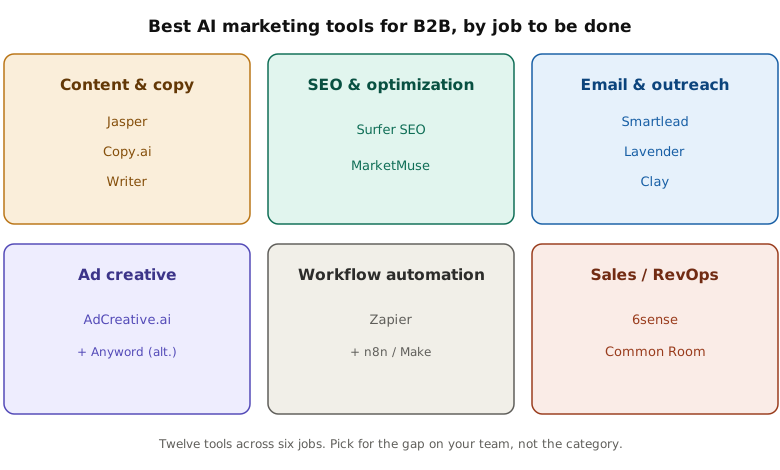
Content and copy. The job: produce on-brand B2B content (blog, email, landing pages, sales enablement) faster than a human team can, without the output reading like every other AI-written page.
1. Jasper: Best for Marketing Teams Scaling On-Brand Content
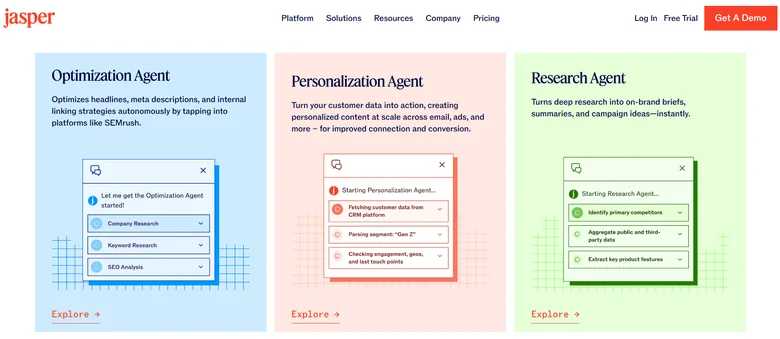
Jasper is an AI content platform built for marketing teams rather than solo writers. It holds a brand voice, runs campaign workflows across formats, and now ships Marketing Agents and a no-code Agent Builder so a team can automate repeatable content jobs instead of prompting from scratch each time. The team layer is the point: shared brand assets, knowledge bases, and 80-plus app integrations keep output consistent across a marketing org.
Best for: B2B marketing teams producing high volumes of on-brand content across campaigns, where brand consistency across multiple writers matters more than raw generation.
Standout: Brand voice plus Marketing Agents and an Agent Builder, so the tool moves from “writes a draft” to “runs a content workflow.” Strong fit for teams already running campaigns who need to scale the engine, not start one.
Starting price (as of Q2 2026): Creator $39/month billed annually ($49 monthly); Pro $59/month annually; Business custom. Seven-day free trial.
2. Copy.ai: Best for GTM Workflow Automation, Not Just Copy
Copy.ai repositioned from a copywriting app into a go-to-market AI platform, and the Workflow Builder is why it belongs on a B2B list. Beyond generating copy, it chains research, enrichment, and content steps into repeatable GTM workflows: inbound lead processing, account research briefs, outbound sequence drafting, and sales follow-ups. For a B2B team, that workflow layer turns a writing tool into a small automation engine that sits between marketing and sales.
Best for: B2B teams that want AI content tied to sales and marketing processes (lead enrichment, account research, sequence drafting), not just a faster blog draft.
Standout: The Workflow Builder with 15-plus prebuilt marketing and sales workflows, plus a genuinely usable free tier for testing before committing.
Starting price (as of Q2 2026): Free plan (2,000 words/month); Starter $36/month billed annually ($49 monthly); Advanced $249/month for teams. Free plan, no card required.
3. Writer: Best for Enterprise Governance and Brand Control
Writer is the enterprise option, and it solves a problem the cheaper tools ignore: governance. It runs on its own Palmyra models, enforces brand and legal guidelines as hard rules, and supports agentic workflows behind enterprise security and compliance controls. For a regulated B2B company (finance, healthcare, large SaaS) where “on-brand” also means “legally reviewed and access-controlled,” Writer is built to survive procurement and security review in a way a $39/month tool is not.
Best for: Large B2B organizations that need governed, on-brand AI across many teams, with security and compliance controls and self-hosted-grade data handling.
Standout: A full enterprise platform (proprietary models, brand governance, API, and agent workflows) rather than a writing assistant, so it scales to hundreds of seats under one policy.
Starting price (as of Q2 2026): Team plan roughly $18-$25 per user/month billed annually; Enterprise is custom, with mid-market deployments commonly $75,000-$250,000/year. Fourteen-day free trial.
VERDICT: BEST FOR CONTENT SCALE
For most mid-market B2B teams, Jasper hits the balance of brand control and price. Pick Copy.ai if you want content wired into GTM workflows, and Writer only when governance and security review are deal-breakers (regulated industries, hundreds of seats).
SEO and optimization. The job: get B2B content ranked in Google and cited in AI search, using data instead of guesswork about what to write and how to structure it. Tools handle the doing; when getting cited in AI answers becomes the goal itself and you want it done for you, an agency built for answer-engine visibility takes the job off your plate.
4. Surfer SEO: Best for Data-Driven Content Optimization
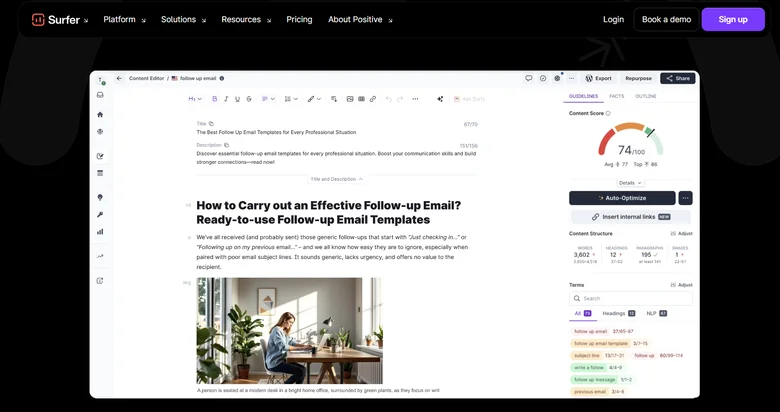
Surfer SEO turns on-page optimization from opinion into a checklist driven by live SERP analysis. Its content editor scores a draft against the pages currently ranking, suggests terms and structure to close the gap, and now includes an AI humanizer and topical-map planning. Teams that want a dedicated humanizer rather than one bundled into an SEO editor often pair these tools with Humanize Max, which rewrites AI-generated drafts into natural, human-sounding copy that keeps the meaning and keywords intact before publishing. For a B2B content team, the value is speed and consistency: writers stop arguing about word counts and headings and start shipping against a data-backed target. It is the tool that connects content production to an actual B2B SEO strategy instead of leaving optimization to instinct.
Best for: B2B content and SEO teams that publish regularly and want each piece optimized against real-time SERP data before it goes live.
Standout: SERP-driven scoring tied to the keywords you are actually targeting, plus topical maps that keep a content program organized around clusters rather than one-off posts. It also helps structure content for the AI engines covered in our guide to optimizing for Google AI Overviews.
Starting price (as of Q2 2026): Essential plan $79/month billed annually ($99 monthly). Seven-day money-back guarantee.
5. MarketMuse: Best for Content Strategy and Topical Authority
MarketMuse works one level above the draft. Instead of optimizing a single page, it models a topic, scores your site’s authority on it, finds the content gaps against competitors, and builds AI content briefs that tell writers what to cover. For a B2B team trying to own a category in search, that planning layer is the differentiator: it answers “what should we write and in what order to build authority,” not just “how do we improve this one post.” It is a strategy tool that happens to use AI, which is exactly what a maturing B2B content program needs.
Best for: B2B teams building topical authority across a category, where the bottleneck is knowing what to publish next, not how to optimize a single page.
Standout: Topic-authority modeling and competitive content-gap analysis that turn a content calendar into a deliberate authority-building plan, with AI briefs that brief writers in minutes.
Starting price (as of Q2 2026): Free plan (10 queries/month); Optimize $99/month; Research $249/month; Strategy $499/month. Free plan available.
Email and outreach. The job: reach the right B2B contacts with personalized, deliverable messages at scale, backed by enriched data and signals.
6. Smartlead: Best for Cold Email Deliverability at Scale
Smartlead is the infrastructure layer for B2B outbound. It supports unlimited mailboxes, AI warmup across them, inbox rotation to protect deliverability, and a unified master inbox that pulls every reply into one place with AI categorization. For an outbound team sending across hundreds of accounts, deliverability is the whole game, and Smartlead is built to keep messages out of spam at volume. Pair it with a tight cold email setup and the sending engine stops being the constraint on pipeline.
Best for: B2B outbound and SDR teams scaling cold email across many mailboxes, where deliverability and inbox management are the limiting factors.
Standout: Unlimited email accounts plus AI warmup at an entry price far below most competitors, with a unified inbox that keeps reply handling sane at scale.
Starting price (as of Q2 2026): Basic $32.50/month billed annually ($39 monthly), including unlimited inboxes and warmup. Fourteen-day trial.
7. Lavender: Best for Cold-Outreach Personalization
Lavender sits inside the rep’s inbox and coaches each email as it is written. It scores the message in real time, flags length and readability problems that kill reply rates, and suggests personalization pulled from prospect data. Where Smartlead handles sending at scale, Lavender improves the quality of the individual one-to-one message, which is where most B2B reply rates are won or lost. For teams whose outbound is high-touch rather than high-volume, it is the difference between a generic blast and a message that reads like a human wrote it.
Best for: SDRs and account executives writing personalized one-to-one sales emails who want to lift reply rates without a copywriting course.
Standout: Real-time, in-inbox email coaching and scoring that improves the message before it sends, rather than reporting on it after.
Starting price (as of Q2 2026): Free plan (5 emails/month); Starter $29/month; Teams $69 per user/month. Free plan available.
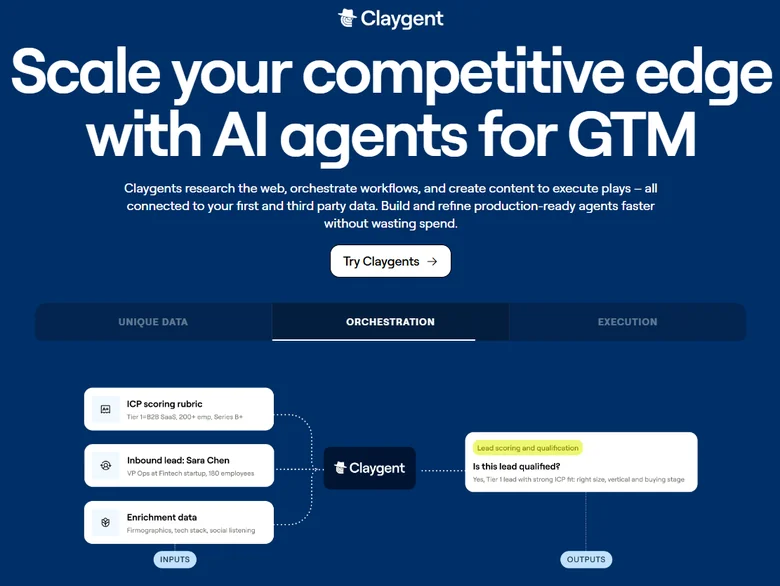
8. Clay: Best for AI Data Enrichment and Signal-Based Lists
Clay is the data layer that makes personalized outreach possible at scale. It pulls from 100-plus enrichment providers in a waterfall (try one source, fall back to the next) and runs an AI research agent that scrapes and summarizes anything a structured provider misses. The result is enriched, signal-triggered lists: build a list of accounts that just raised funding, hired a VP of Marketing, or matched an ICP filter, then enrich every contact before a sequence ever fires. It is the engine behind many of the lead generation tools workflows B2B teams run, and it pairs naturally with the providers in our B2B lead generation companies roundup.
Best for: RevOps and growth teams building enriched, signal-based prospect lists who want one flexible data layer instead of five separate enrichment subscriptions. Those lists can also arrive pre-ranked rather than handing prioritisation back to the CRM, since the same table can score each row on fit and intent and map those points to MQL and SQL cut points in a formula column.
Standout: Waterfall enrichment across 100-plus sources plus an AI research agent (Claygent), so coverage and accuracy beat any single-provider tool.
Starting price (as of Q2 2026): Free plan; Launch $185/month (2,500 data credits) for new customers; legacy Starter $149/month. Free plan available.
VERDICT: BEST FOR COLD-OUTREACH PERSONALIZATION
The strongest B2B outbound stack runs all three together: Clay builds and enriches the signal-based list, Lavender personalizes each message, and Smartlead handles deliverability at volume. If you can only add one this quarter, start with Clay, since clean, enriched data makes every downstream tool work better.
Ad creative. The job: produce and test on-brand B2B ad creative faster than a design team can, and predict which variants will perform before you spend.
9. AdCreative.ai: Best for AI Ad Creative and Performance Prediction
AdCreative.ai generates on-brand ad creative and copy at volume, then scores each variant for predicted performance before you spend a dollar on it. For a B2B demand-gen team running paid social and search, the value is iteration speed: instead of waiting on design for every test, the team generates dozens of on-brand variants, filters by the creative score, and ships the strongest. It also surfaces competitor ad insights so the creative is informed by what is already working in the category. Anyword is a close alternative if your priority is predictive ad and landing-page copy rather than visual creative.
Best for: B2B demand-gen and performance teams that need a high volume of on-brand ad creative and want a performance signal before committing spend.
Standout: A creative-scoring model that predicts performance pre-spend, plus a brand kit that keeps generated creative on-brand across campaigns.
Starting price (as of Q2 2026): Startup plan $20/month billed annually ($39 monthly), single user with monthly credits. Seven-day free trial.
Workflow automation. The job: connect the B2B marketing stack and automate the repetitive handoffs between tools, with AI in the loop.
10. Zapier: Best for Connecting the Stack with AI in the Loop
Zapier is the connective tissue most B2B marketing stacks already run on, and its AI layer makes it more than a data-mover. With 8,000-plus integrations, Zapier Agents, and AI steps that can classify, summarize, and route inside a workflow, a marketing ops lead can automate the handoffs that eat hours: enrich a new lead, score it, route it to the right rep, and log it in the CRM without a human touching it. It is the no-code option for teams that want automation without engineering. If your needs run deeper into branching logic or self-hosting, our comparison of n8n vs Make vs Zapier breaks down the tradeoffs, and our n8n self-hosting guide covers the open-source route.
Best for: Marketing ops teams connecting their stack and automating repetitive lead-routing, enrichment, and notification tasks without writing code.
Standout: The broadest integration network of any automation tool, now with AI agents and AI steps that add judgment to a workflow rather than just moving data.
Starting price (as of Q2 2026): Free plan (100 tasks/month); Professional $49/month billed annually ($73.50 monthly). Free plan available.
Sales and RevOps intelligence. The job: identify in-market accounts and the signals that predict a deal, so marketing spends on the accounts most likely to buy.
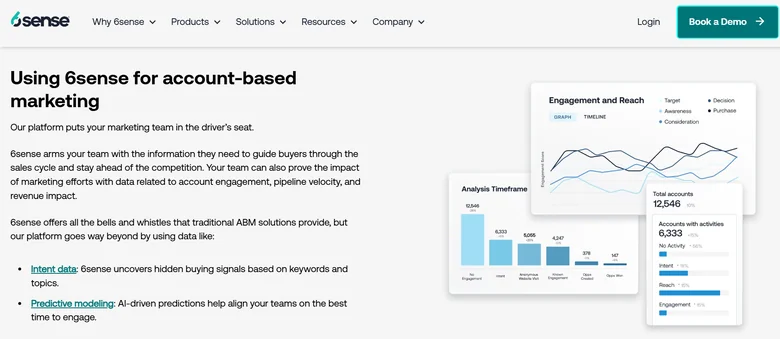
11. 6sense: Best for ABM and Predictive Intent
6sense is the account-intelligence platform for B2B teams running serious ABM. It combines intent data, predictive analytics, and account identification to tell you which accounts are researching your category right now, where they are in the buying journey, and which to prioritize. For a B2B marketing team that has outgrown spray-and-pray demand gen, that prioritization is the value: spend on the 5% of accounts in-market this quarter instead of the whole TAM. It sits at the center of a mature revenue stack and works best alongside disciplined RevOps best practices and the platforms in our best RevOps software roundup.
Best for: Mid-market and enterprise B2B teams running account-based marketing that need predictive intent to prioritize spend and sales effort.
Standout: Predictive intent plus account identification that surfaces in-market accounts before they fill out a form, the highest-impact signal in B2B.
Starting price (as of Q2 2026): Custom annual contracts; mid-market deployments commonly start near $50,000/year and scale to $100,000-$300,000+/year for enterprise. Free limited edition and demo available.
12. Common Room: Best for Multi-Signal, Signal-Based GTM
Common Room captures buying signals that intent-data platforms miss. It aggregates activity across community, product usage, website, social, and more, unifies it into a person and account view, and uses an AI agent to turn those signals into next actions for the GTM team. Where 6sense is strongest on third-party intent for classic ABM, Common Room is strongest at catching first-party and product-led signals, which makes it the better fit for product-led and community-driven B2B motions. For teams whose best leads show up through product trials and community activity rather than form fills, it sees the pipeline others cannot.
Best for: Product-led and community-driven B2B teams that want to act on first-party and product-usage signals, not just third-party intent.
Standout: Signal aggregation across community, product, web, and social that most platforms ignore, unified into one GTM action layer with an AI agent.
Starting price (as of Q2 2026): Custom annual contracts; the Team plan is commonly quoted near $30,000/year, with mid-market deals in the $20,000-$60,000 range. Free starter tier and demo available.
VERDICT: BEST FOR ABM AND BUYING SIGNALS
Choose 6sense if your motion is classic ABM driven by third-party intent and you sell to a defined enterprise TAM. Choose Common Room if your best signals are first-party (product trials, community, website) and you run a product-led or bottom-up motion. Few teams need both in year one.
AI Marketing Tools Comparison Table
The table summarizes all 12 tools on the dimensions buyers ask about during a shortlist: job, fit, starting price as of Q2 2026, free option, and standout.
| Tool | Job / Category | Best For | Starting Price (Q2 2026) | Free Option | Standout |
|---|---|---|---|---|---|
| Jasper | Content & copy | On-brand content at team scale | $39/mo (Creator, annual) | 7-day trial | Brand voice + Marketing Agents |
| Copy.ai | Content & copy | Content tied to GTM workflows | Free; $36/mo (Starter, annual) | Free plan | GTM Workflow Builder |
| Writer | Content & copy | Enterprise governance + brand | ~$18/user/mo (Team); Ent. custom | 14-day trial | Proprietary models + governance |
| Surfer SEO | SEO & optimization | Data-driven on-page optimization | $79/mo (annual) | 7-day refund | Live SERP-driven scoring |
| MarketMuse | SEO & optimization | Content strategy + topical authority | Free; $99/mo (Optimize) | Free plan | Topic-authority modeling |
| Smartlead | Email & outreach | Cold email deliverability at scale | $32.50/mo (annual) | 14-day trial | Unlimited inboxes + AI warmup |
| Lavender | Email & outreach | One-to-one email personalization | Free; $29/mo (Starter) | Free plan | Real-time in-inbox coaching |
| Clay | Email & outreach (data) | Signal-based enriched lists | Free; $149/mo (Starter) | Free plan | Waterfall enrichment + AI research |
| AdCreative.ai | Ad creative | Ad creative + performance prediction | $20/mo (annual) | 7-day trial | Pre-spend creative scoring |
| Zapier | Workflow automation | Connecting the stack, no-code | Free; $49/mo (Pro, annual) | Free plan | 8,000+ integrations + AI agents |
| 6sense | Sales / RevOps | ABM with predictive intent | Custom (~$50K+/yr) | Limited edition | Predictive intent + account ID |
| Common Room | Sales / RevOps | Signal-based, product-led GTM | Custom (~$30K/yr Team) | Free tier | Multi-source signal aggregation |
AI Marketing Tool Pricing Benchmarks for 2026
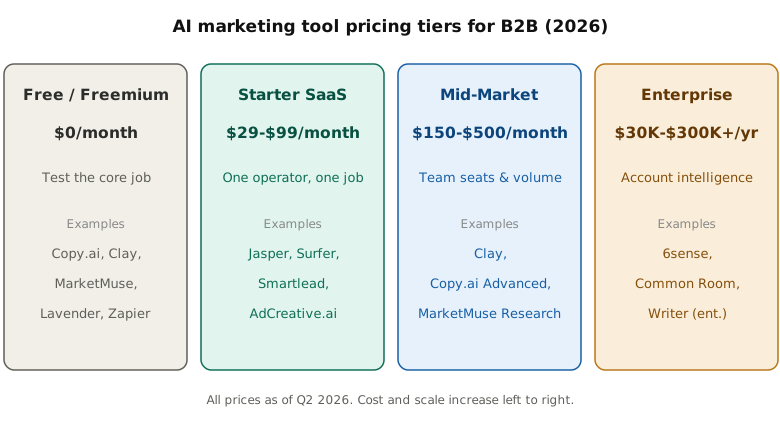
AI marketing tool pricing in 2026 falls into four tiers, and the right tier is set by the job and the team size, not by the lowest number on the invoice.
Free and Freemium: $0/Month (as of Q2 2026)
Several strong B2B tools have genuine free tiers: Copy.ai, MarketMuse, Lavender, Clay, and Zapier all let a team test the core job at no cost. The catch is volume. Free tiers cap words, queries, credits, or tasks at levels fine for evaluation but not for production. Treat free as a trial that does not expire, run a real workflow through it for two weeks, and upgrade only when the cap becomes the constraint.
Starter SaaS: $29-$99/Month (as of Q2 2026)
The entry paid tier for single-tool jobs: AdCreative.ai ($20-$39), Lavender ($29), Smartlead ($32.50), Jasper ($39), Copy.ai ($49), Zapier Professional ($49), Surfer SEO ($79), and MarketMuse Optimize ($99). This is where most small and mid-market B2B teams live for content, SEO, and outreach. One operator can run a real program at this tier. The risk is sprawl: five $49 tools is $245/month and five logins nobody fully adopts.
Mid-Market: $150-$500/Month (as of Q2 2026)
The team tier: Clay ($149-$185), Copy.ai Advanced ($249), MarketMuse Research and Strategy ($249-$499), and Lavender or Writer team seats as headcount grows. Scope expands to multiple seats, higher volume, and workflow features that connect tools to the rest of the stack. This is the right tier when a tool moves from “one person tests it” to “the team runs on it daily.”
Enterprise Platforms: $30,000-$300,000+/Year (as of Q2 2026)
Account-intelligence and governance platforms are quoted annually, not monthly: Common Room (around $30,000/year for Team) and 6sense (commonly $50,000/year and up, scaling past $300,000 for enterprise), with Writer’s enterprise deployments in a similar range. Pricing scales with your total addressable market size, the modules you activate, and contract length.
IMPORTANT
A free tier is not a free tool at scale, and an enterprise platform is not just its license fee. 6sense and Common Room both carry implementation cost and typically need a fraction of a RevOps admin’s time to run well. Before signing an annual platform contract, model the fully loaded cost (license + onboarding + the internal hours to operate it), and negotiate: enterprise ABM platforms commonly close 20-30% below the first quote on a multi-year commitment.
How to Choose an AI Marketing Tool for Your B2B Team
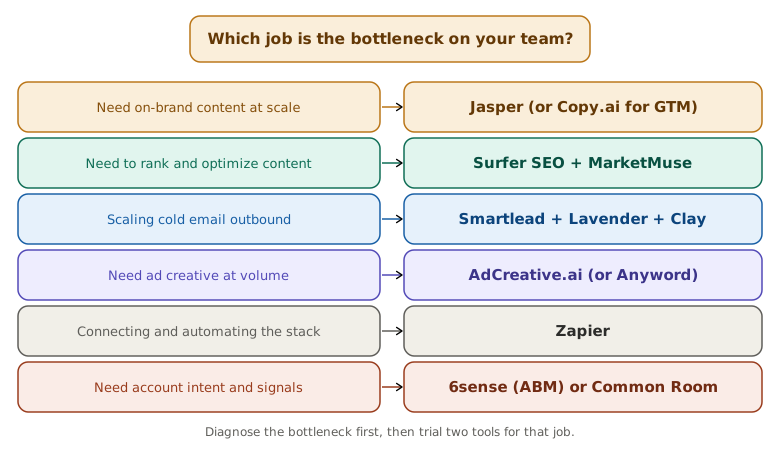
Picking an AI marketing tool is a five-question exercise. Run the questions before you book a single demo, because the answers eliminate most of the list before pricing ever enters the conversation.
1. What Job Are You Actually Filling?
Name the job first: content production, SEO, outreach, ad creative, workflow automation, or account intelligence. The single most common buying mistake is shopping by category buzz instead of by the gap on your team. If your content engine already works and your outbound reply rate is the problem, a better writing tool will not move pipeline. Buy for the constraint, not the category that sounds most advanced.
2. Does It Fit the Stack You Already Run?
A tool that does not integrate with your CRM, marketing automation, and data warehouse becomes an island of work that nobody syncs. Before buying, confirm the native integrations with your core systems, and check whether data flows both ways. The most useful AI tools sit inside the existing stack and make it smarter; the least useful create a new silo your team has to maintain by hand.
3. Where Does the Data Come From, and Is It Compliant?
For enrichment, intent, and signal tools especially, ask where the data originates and whether its use meets your compliance requirements (GDPR, CCPA, and your own data-governance policy). A signal platform is only as good as its sources, and a procurement or legal review will ask these questions whether you do or not. Better to surface them in the trial than after the contract.
4. How Will You Measure Whether It Worked?
Decide the success metric before you buy. For a content tool, it might be organic pipeline influence. For outreach, reply-to-meeting rate. An intent platform, pipeline from prioritized accounts versus the rest. Wire the tool into GA4 and your CRM so the number is visible, and set a 60-to-90-day checkpoint. A tool you cannot evaluate against a metric is a renewal you cannot justify.
5. Should a Human Stay in the Loop?
AI output still needs human judgment, and your buyers know the difference. Gartner found that 69% of B2B buyers turn to sales reps to validate AI-generated insights, per its May 2026 survey. Pick tools that make a human faster and better, not tools that remove the human from work where trust is the product. Full automation is right for routing and enrichment; it is wrong for the moments where a buyer is deciding whether to trust you.
5 Mistakes B2B Teams Make Buying AI Marketing Tools
1. Buying the Category Instead of the Gap
The flashiest category is rarely the one holding back your pipeline. Teams buy an intent platform because ABM is in the air, when their real constraint is a content engine that ships two posts a month. Diagnose the bottleneck first, then buy the tool that fixes it. The right purchase is boring and specific.
2. Stacking Overlapping Tools Nobody Fully Adopts
Tool sprawl is the quiet B2B budget leak. Five $49/month tools is a real line item, and the bigger cost is the adoption tax: every tool needs a champion, a workflow, and training. Before adding a tool, ask which existing tool it replaces. If the answer is “none,” you are adding overhead, not capability.
3. Ignoring Data Quality on Enrichment and Intent Tools
An enrichment or intent tool is only as good as its data. Teams sign annual contracts on a polished demo, then discover coverage is thin for their specific market or region. Run a trial against your real ICP, check the match and accuracy rates on accounts you already know, and treat any tool that will not let you test on your own data as a red flag.
4. Skipping the Total Cost of an Enterprise Platform
The license is the visible cost. Implementation, integration, and the internal hours to operate a platform like 6sense or Common Room are the real ones. A team that budgets only the license and not the operating cost ends up with shelfware: an expensive platform nobody has time to run. Budget the fully loaded cost before you sign.
5. Removing the Human Where Trust Is the Product
Automating a buyer-facing judgment call to save time usually costs more than it saves. AI-written outreach that nobody reviews, AI-generated content published without an editor, or AI-scored leads routed with no human check all erode the trust B2B buyers are specifically looking for. Automate the repetitive middle; keep a human on the moments that decide a deal.
What This Guide Doesn’t Cover (and Where to Go Instead)
This is a tools shortlist. A few adjacent topics are deliberately out of scope, with a better home for each.
The use cases behind the tools. If you want the strategic picture of how agentic AI changes marketing work (lead scoring, campaign orchestration, predictive reporting) rather than a tool list, our guide to agentic AI marketing use cases is the companion piece. This article names the tools that serve those use cases; that one explains the use cases themselves.
RevOps-specific AI agents. 6sense and Common Room appear here as marketing-team intelligence tools. For AI agents scoped to revenue operations (CRM hygiene, pipeline-risk detection, forecasting, lead routing), the deeper treatment is in our guide to AI agents for RevOps.
Workflow-automation deep comparison. Zapier earns a spot as the no-code connector. If you are choosing between automation platforms specifically, the head-to-head is in n8n vs Make vs Zapier, and the open-source self-hosting route is in our n8n self-hosting guide.
AI SEO and GEO platforms. Surfer SEO and MarketMuse are covered here as the content-and-SEO picks every B2B marketing team should know. A dedicated guide to AI SEO tools and generative-engine-optimization platforms is in the pipeline and will go deeper on the SEO-specialist side of this category. The split is by search intent: this article serves teams shopping for an all-around AI marketing stack; that one will serve teams shopping specifically for AI SEO software.
Frequently Asked Questions
The best AI marketing tools for B2B teams in 2026 map to a specific job: Jasper, Copy.ai, and Writer for content; Surfer SEO and MarketMuse for SEO; Smartlead, Lavender, and Clay for outreach and enrichment; AdCreative.ai for ad creative; Zapier for workflow automation; and 6sense and Common Room for account intelligence. The right pick is the tool that fills the gap on your team, not the most advanced category.
B2B teams use AI across six jobs: producing on-brand content at scale, optimizing content for search and AI engines, enriching and scoring accounts, personalizing cold outreach, generating and testing ad creative, and detecting buying intent before a prospect raises a hand. The highest-impact uses are account intelligence and outreach personalization, because they shorten the long, committee-driven B2B buying cycle rather than just creating more assets.
Yes. Copy.ai, MarketMuse, Lavender, Clay, and Zapier all offer genuine free tiers as of Q2 2026, and Jasper, Smartlead, Surfer SEO, and AdCreative.ai offer free trials. Free tiers cap words, queries, credits, or tasks at evaluation levels, so they are best treated as a no-expiry trial. Run a real workflow through one for two weeks and upgrade only when the cap becomes the constraint.
Pricing falls into four tiers as of Q2 2026: free/freemium ($0), starter SaaS ($29-$99/month for single-tool jobs), mid-market ($150-$500/month for team features), and enterprise account-intelligence platforms quoted annually ($30,000-$300,000+/year for 6sense and Common Room). Most small and mid-market B2B teams run their content, SEO, and outreach stack in the starter tier, and add an enterprise platform only when ABM scale justifies it.
Your Next Move
Pick the one job that is most constraining your pipeline right now, then trial the two tools from that group whose fit matches your team size and stack. Give each a real workflow for two weeks, wire it to a metric you already track, and judge it on the number, not the demo. Most of these tools have a free tier or trial, so the cost of testing is time, not budget.
Resist the urge to buy the whole list. A B2B team that adds one well-chosen tool per quarter and adopts it fully outperforms the team that buys five at once and runs none of them. The shortlist beats the stack.
If you are not sure which job to fix first, start with measurement: instrument your current funnel, find the stage with the worst conversion, and let that gap choose the tool. The best AI marketing tool for your B2B team is the one that fixes the constraint you can actually measure.