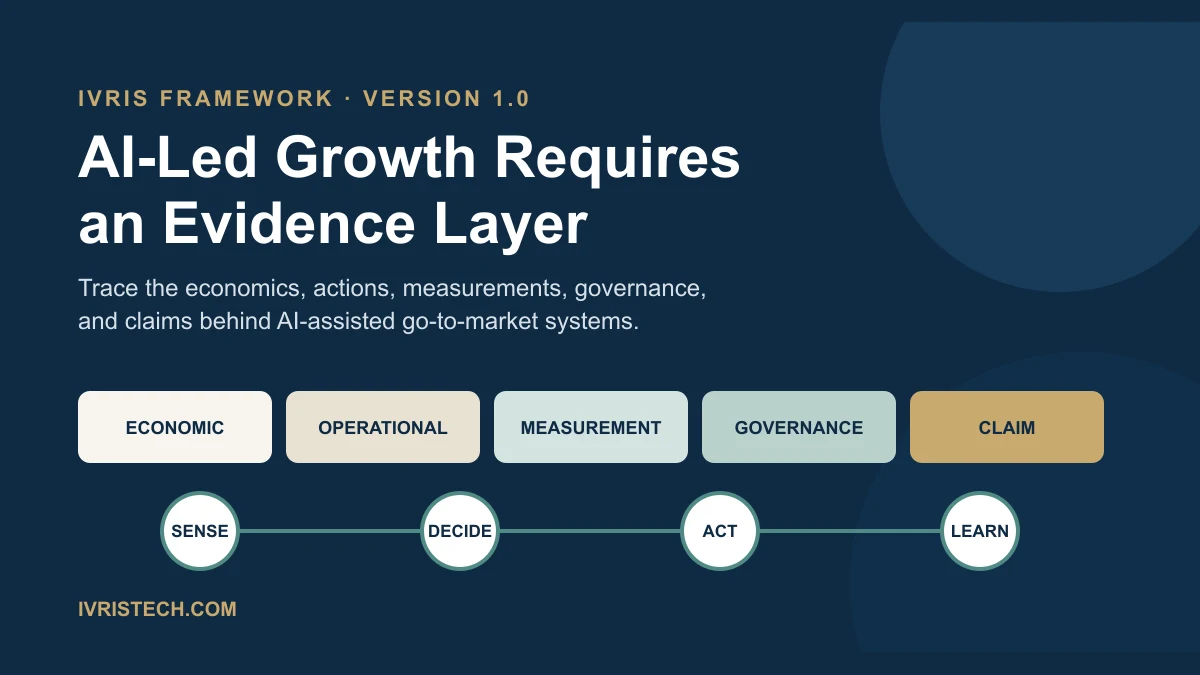
AI can help a go-to-market team sense demand, make decisions, and execute work faster. It cannot, by itself, prove that a decision was economical, an action happened as intended, a measured outcome came from that action, a human could intervene, or a performance claim was properly supported.
That missing foundation is what IVRIS calls the Evidence Layer for AI-Led Growth.
The Evidence Layer is the connected set of records, definitions, controls, and review paths that makes the economics, actions, measurements, governance, and claims of an AI-assisted growth system traceable. It is not another tool in the stack. It is an IVRIS operating framework a team can adapt to the workflow, risk, and evidence it needs to manage.
Direct answer — What is the Evidence Layer for AI-Led Growth?
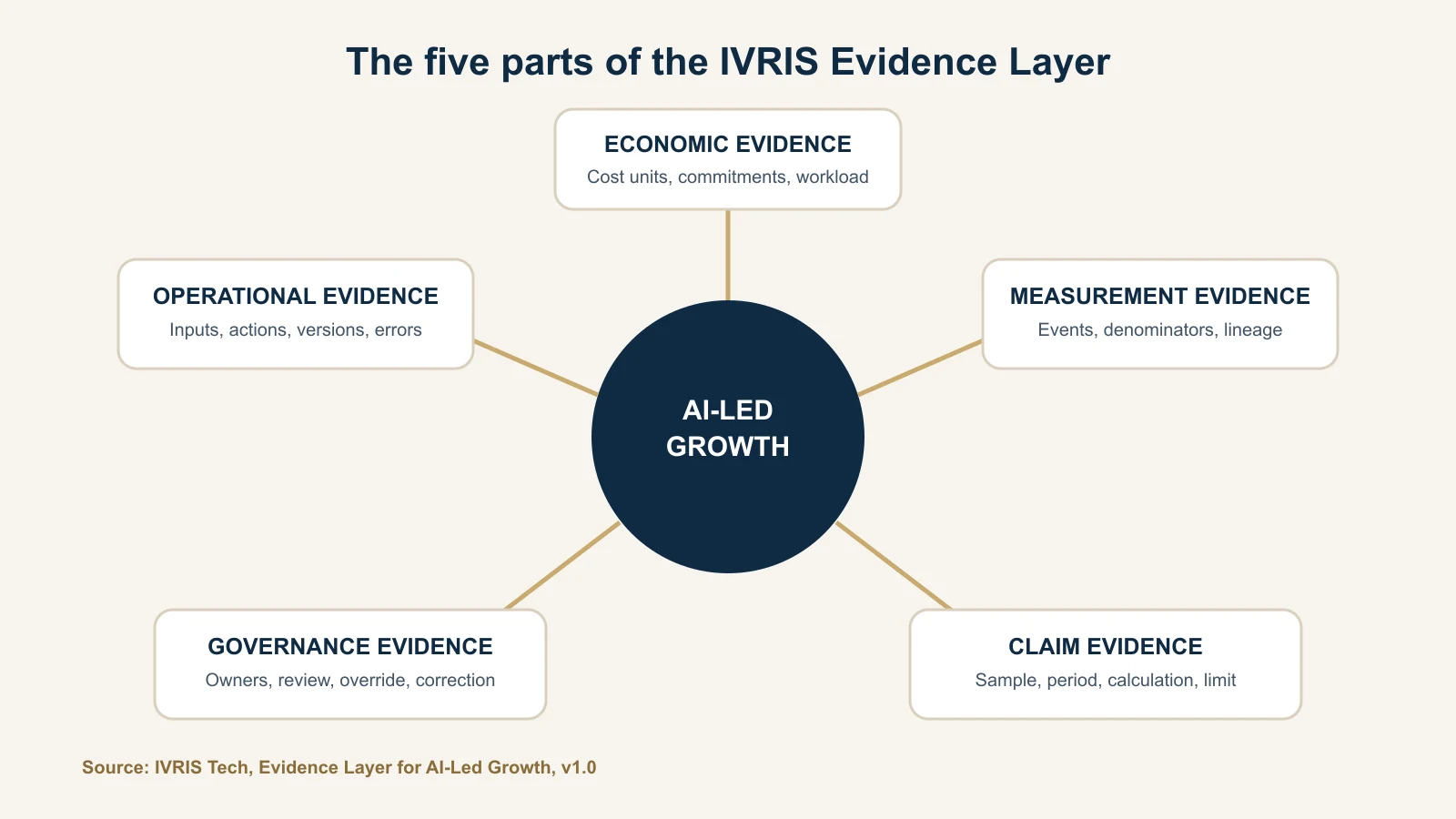
The Evidence Layer is an IVRIS framework for making AI-assisted go-to-market work traceable across five responsibilities: economic evidence, operational evidence, measurement evidence, governance evidence, and claim evidence. It helps a team show what an AI system cost, what it did, how outcomes were measured, where people retained control, and which evidence supports the claims made about its performance.
Key Takeaways
- AI-Led Growth is dependable only when faster execution is paired with traceable evidence.
- The IVRIS Evidence Layer has five parts: economic, operational, measurement, governance, and claim evidence.
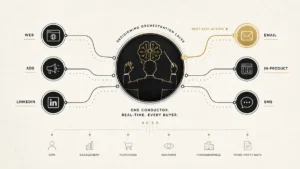
- The operating loop is Sense–Decide–Act–Learn; every transition should leave a usable record.
- A dashboard is not an Evidence Layer if definitions, inputs, actions, exclusions, and ownership cannot be traced.
- The readiness rubric in this guide is a diagnostic framework, not a certification or statistically validated maturity score.
What AI-Led Growth means
AI-Led Growth is a go-to-market operating model in which AI materially assists how a team senses market signals, decides what to do, executes actions, and learns from outcomes.
The word “assists” matters. The model can include autonomous actions, but accountability does not disappear when an action is automated. A company still chooses the objective, grants access, defines acceptable behavior, monitors performance, handles exceptions, and decides what it is willing to claim.
This operating definition is IVRIS’s. Its underlying lifecycle logic is consistent with official guidance. The OECD definition of an AI system covers systems that infer from inputs to produce outputs such as predictions, content, recommendations, or decisions that can influence physical or virtual environments. The NIST AI Risk Management Framework is a voluntary, non-sector-specific resource for organizations that design, develop, deploy, or use AI systems. Neither source validates the IVRIS framework or establishes that AI improves a commercial outcome.
AI changes the speed and scale of the loop:
- Sense: collect signals from buyers, accounts, campaigns, conversations, products, and the market.
- Decide: classify, prioritize, recommend, predict, or select a next action.
- Act: send, route, personalize, update, bid, schedule, enrich, or escalate.
- Learn: compare outcomes with the intended objective and update the process.
The Evidence Layer sits underneath all four stages. Without it, a team may see activity without being able to explain cost, reconstruct a decision, connect an outcome, intervene safely, or support the headline it reports.
The five parts of the IVRIS Evidence Layer
1. Economic evidence
Economic evidence answers: What does this system cost, and can we forecast the cost of the next unit of useful work?
The minimum useful record is not merely an invoice total. A team should be able to connect commercial terms and usage units to a practical workload: seats, credits, model calls, contacts, actions, tokens, enrichments, conversations, or outcomes. It should also define which costs sit outside the visible software price, such as implementation, data, review, integration, and exception handling.
The FinOps Foundation’s unit-economics guidance makes a useful distinction between resource-efficiency units, such as cost per token, and business units, such as cost per transaction or case resolved. IVRIS extends that distinction into this GTM diagnostic; the guidance is an operating reference, not evidence that a particular metric improves performance.
Minimum artifacts:
- commercial commitment and renewal term;
- billable units and usage rules;
- workload assumptions;
- fixed and variable cost formula;
- variance between forecast and actual use;
- owner for budget and unit-economics review.
One failure mode the framework is designed to reveal is a pilot whose production economics were never modelled. Usage and exception work may grow without the team being able to compare the advertised price with the real operating model.
2. Operational evidence
Operational evidence answers: What did the system do, when did it do it, and why did that action occur?
The useful record depends on the action. A lead-routing system needs assignment timestamps, rules, inputs, overrides, and failure states. An AI messaging system needs the generated output, source context, approval state, recipient, send event, and error state. A forecasting system needs the input version, model or rule version, output, and later changes.
NIST AI RMF 1.0 says documentation can improve transparency, human review, and accountability, and its functions include documented deployment-context measures, monitoring, and human-AI oversight roles. The NIST Generative AI Profile also recommends documenting data origin, content lineage, system knowledge limits, oversight, and fact-checking techniques. These are voluntary framework practices, not proof that one logging design fits every GTM workflow.
Minimum artifacts:
- event and action logs;
- input and output references;
- rule, workflow, prompt, or model version;
- timestamps and actor identity;
- error, retry, fallback, and override records;
- owner for operational investigation.
A dashboard showing “1,200 actions completed” is not enough if nobody can identify which actions failed, which were retried, or which rule produced an inappropriate outcome.
3. Measurement evidence
Measurement evidence answers: How was the reported outcome defined, connected to the action, and counted?
Teams often use the same word for different events. A response can mean an automated acknowledgement, a first human attempt, a successful contact, or a qualified reply. A conversion can mean a form submission, meeting, opportunity, or sale. The Evidence Layer makes the event definition and denominator visible before a result is compared.
The W3C PROV-O recommendation provides a vocabulary for representing provenance through entities, activities, agents, usage, generation, derivation, and attribution. An IVRIS implementation does not require RDF or PROV-O, but the model illustrates why source-to-action-to-outcome relationships should be represented explicitly instead of inferred from a final dashboard.
Minimum artifacts:
- event and outcome definitions;
- source, campaign, account, and identity rules;
- timestamp and attribution windows;
- inclusion, exclusion, deduplication, and missing-data rules;
- reconciliation between source systems;
- owner for metric definition and reporting QA.
A polished dashboard can still produce weak evidence when its underlying events are ambiguous or when missing cases quietly disappear from the denominator. Talkdesk’s 2026 CX deployment-measurement gap gives that problem a current operating example: 98% of respondents in its 252-person survey said their organizations had deployed AI in the customer journey, while 5% said their organization could quantify AI’s impact on business outcomes.
4. Governance evidence
Governance evidence answers: Who is accountable, where can a person intervene, and what happens when the system is wrong?
Human control is more than placing an approval button somewhere in the workflow. The team needs a defined owner, review threshold, escalation path, correction process, and record of material changes. Higher-impact actions may require stronger review and tighter permissions than low-risk internal assistance.
The OECD accountability principle connects accountability to roles and to traceability across datasets, processes, and lifecycle decisions. Its transparency and explainability principle calls for context-appropriate information about capabilities, limitations, and—where feasible and useful—the factors or logic behind an output so affected people can understand and challenge it. The guidance is contextual: it does not require every organization to publish source code or proprietary data.
Minimum artifacts:
- named business and technical owners;
- permitted and prohibited uses;
- access and data-handling rules;
- review, override, pause, and escalation paths;
- incident and correction records;
- change approval and version history.
A system is not well governed merely because a person could theoretically switch it off. The relevant question is whether the team can detect the problem, identify the affected actions, stop further harm, correct records, and learn from the incident.
5. Claim evidence
Claim evidence answers: What supports the statement we are making about this system?
The claim may appear in a sales deck, case study, website, board report, procurement document, or internal performance review. The Evidence Layer connects the sentence to its sample, period, metric, comparator, calculation, source, and limitation.
For the narrower case of U.S. advertising, the FTC’s advertising-substantiation policy says objective express and implied claims need a reasonable basis before dissemination, and that a claim conveying a particular level of support needs that level of support. This is a scoped policy reference, not legal advice or a universal rule for every internal statement.
Minimum artifacts:
- exact proposed claim;
- research or analysis type;
- numerator, denominator, and calculation;
- sample, observation period, and comparator;
- evidence location;
- limitation and approval status.
The strongest safe claim is not always the most dramatic sentence. A bounded claim that another person can verify is more reusable than a universal claim that collapses under basic questions about the sample.
How the Evidence Layer supports Sense–Decide–Act–Learn
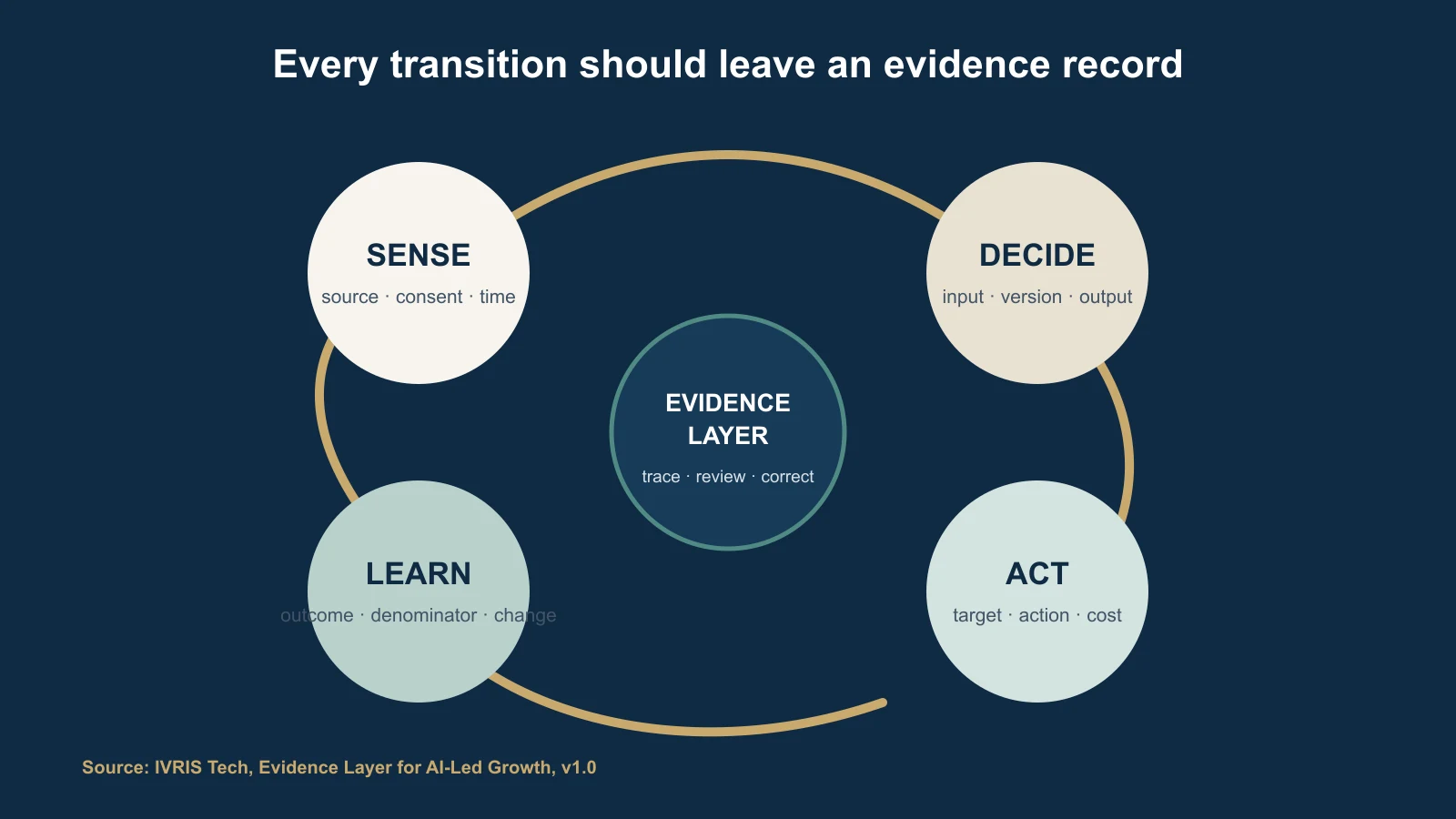
| Operating stage | What the system does | Evidence the team should retain | Question the evidence must answer |
|---|---|---|---|
| Sense | Collects market, buyer, account, product, or campaign signals | source, consent or permission where relevant, timestamp, identity rules, data-quality status | What was observed, from where, and under which definition? |
| Decide | Scores, predicts, recommends, classifies, or prioritizes | input version, rule/model/prompt version, output, confidence or exception state, owner | Why was this decision produced, and can it be reviewed? |
| Act | Sends, routes, updates, bids, schedules, or escalates | action log, target, timestamp, approval, failure/retry state, cost unit | What actually happened, to whom, and at what cost? |
| Learn | Attributes outcomes and adjusts the workflow | outcome definition, denominator, attribution rule, exclusions, comparison basis, change log | Did the intended outcome occur, and what should change? |
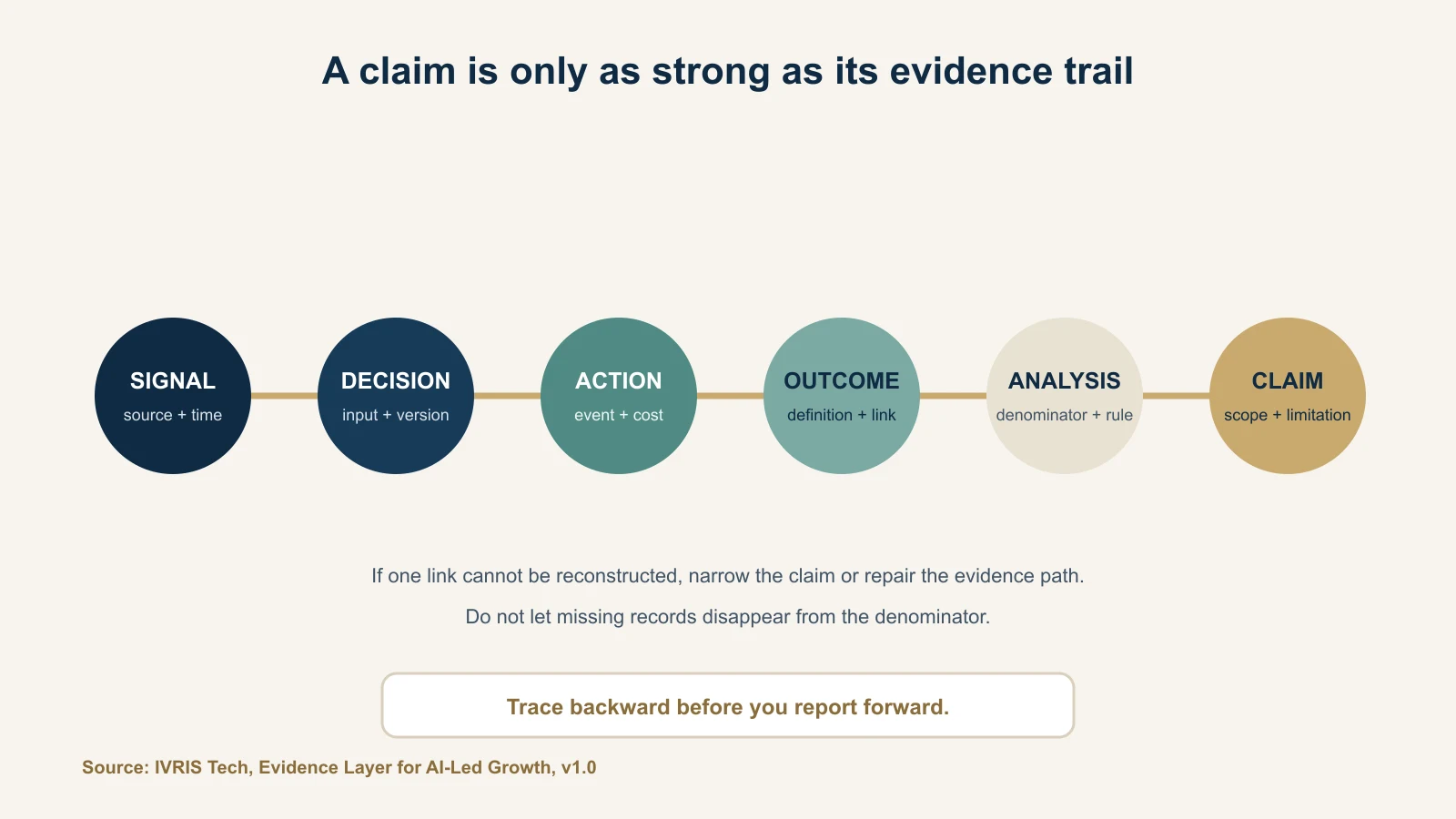
The loop becomes unreliable when one stage hands the next stage an untraceable output. A score without source context weakens the decision. A decision without an action log weakens operations. An action without a defined outcome weakens learning. A reported result without a claim ledger weakens trust.
Seven failure modes the Evidence Layer is designed to expose
Activity without outcome
The system reports messages sent, records enriched, or tasks completed, but the team has not defined the business outcome or reconciled missing cases.
Speed without relevance
Automation produces an instant action that satisfies an activity clock but does not answer the buyer’s need or progress the intended workflow.
A result without a denominator
A success rate is shown without the full eligible population, exclusions, unresolved cases, or records that never reached the reporting system.
Attribution without lineage
A dashboard assigns pipeline or revenue to a channel, campaign, or AI action without a traceable path through source capture, identity, object mapping, and reporting rules.
Cost without a workload model
The team knows the contract value but cannot predict how usage, integrations, review, or exceptions change the cost of the next useful unit.
Human oversight without an operating path
The policy says a person is responsible, but there is no tested alert, pause, override, investigation, and correction workflow.
A claim without its source boundary
A statement about lift, accuracy, time saved, or market performance loses the sample, period, comparator, or method that made the original result meaningful.
Evidence Layer readiness rubric
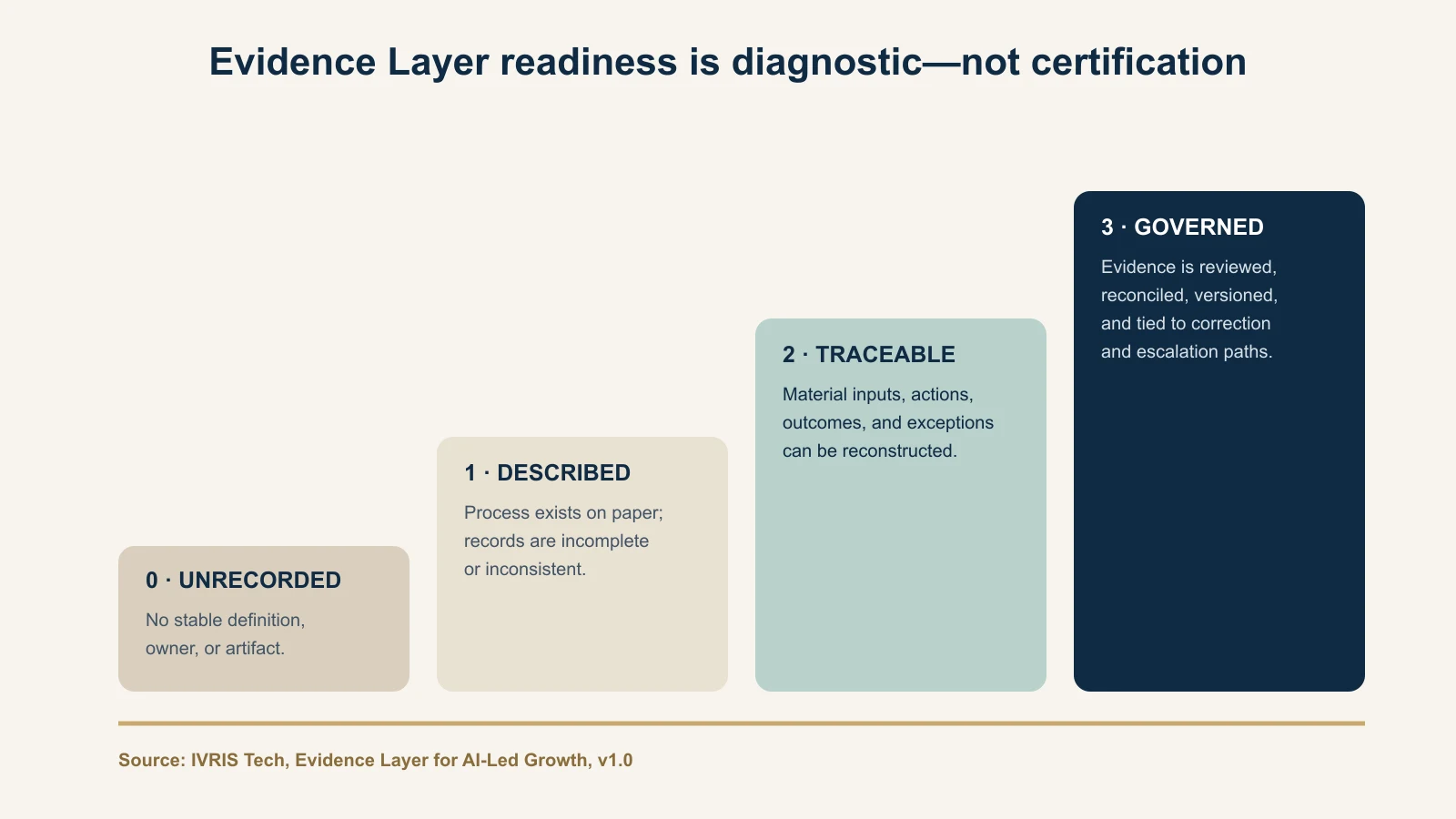
Use this rubric separately for each of the five components. Do not average the scores into a certification. The purpose is to find the weakest evidence responsibility and assign the next action.
| Level | Name | Diagnostic description |
|---|---|---|
| 0 | Unrecorded | The team cannot identify a stable definition, owner, or evidence artifact. |
| 1 | Described | The process and intended evidence are documented, but records are incomplete, manual, or inconsistent. |
| 2 | Traceable | Material inputs, actions, outcomes, and exceptions can be reconstructed for the defined scope. |
| 3 | Governed | Evidence is routinely reviewed, reconciled, versioned, and connected to tested correction and escalation paths. |
For each component, ask:
- What exact question must this evidence answer?
- Which artifact answers it today?
- Who owns the definition and correction?
- Which cases are missing or unresolved?
- Can a second person reconstruct one real decision or result?
- What changes when the system, workflow, or commercial terms change?
If the answer to question two is “the dashboard,” open one result and trace it backward. A dashboard is a presentation surface. Readiness depends on the records and definitions behind it.
A 30-day Evidence Layer implementation plan
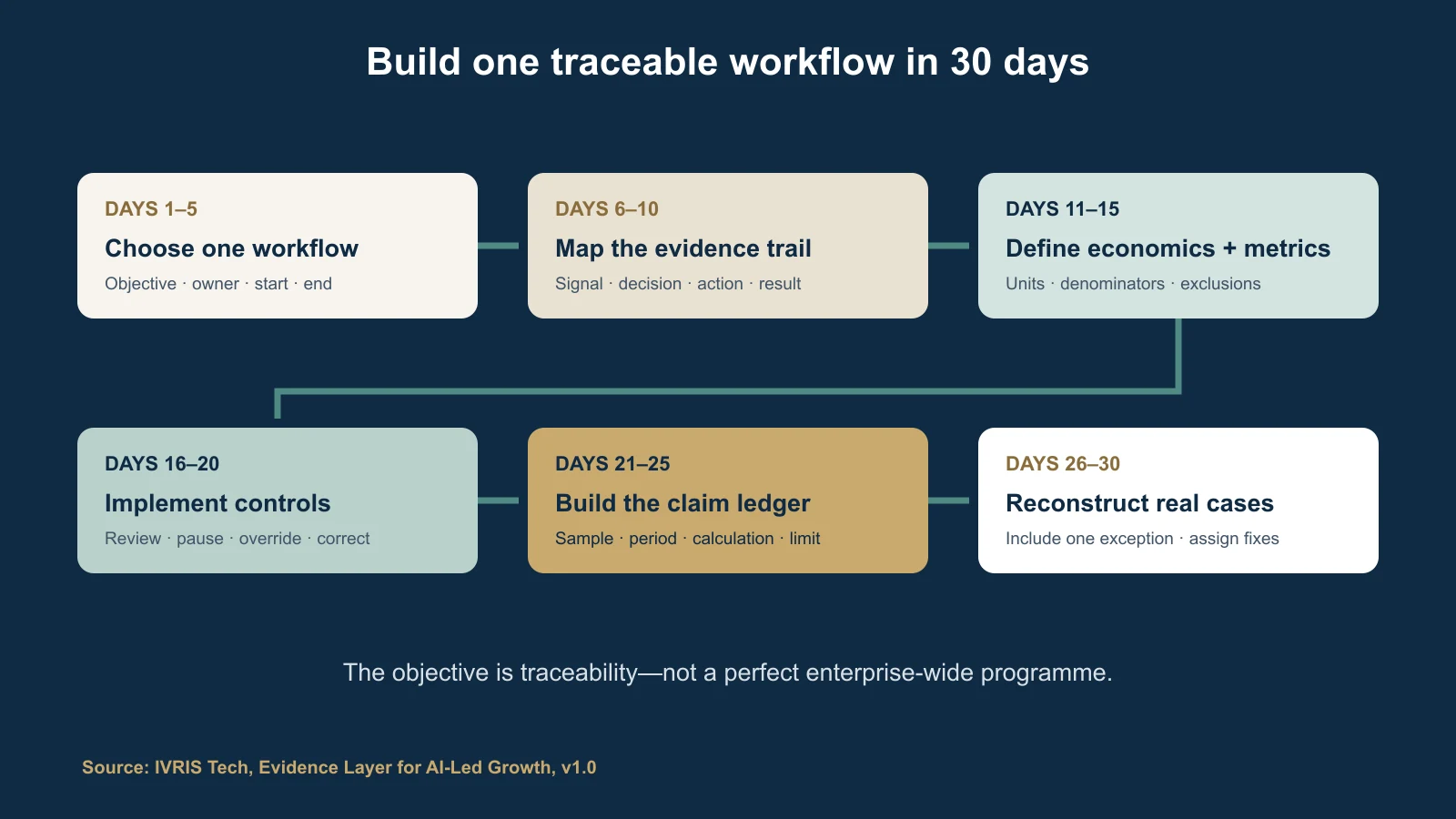
Days 1–5: choose one consequential workflow
Do not begin with the whole revenue stack. Pick one workflow where AI materially affects a buyer, a budget, a data record, or a reported outcome. Write down its objective, owner, start event, end event, systems, inputs, decisions, actions, and claims.
Days 6–10: map the evidence trail
For one real case, trace the path from signal to decision, action, outcome, and report. Record where a timestamp, version, definition, or owner is missing. Separate “no evidence exists” from “the evidence could not be retrieved.”
Days 11–15: define economics and measurement
Write the workload unit, fixed cost, variable cost, event definitions, outcome definitions, denominators, exclusions, deduplication rules, and attribution windows. Reconcile the source event with the final reported event.
Days 16–20: implement controls
Assign owners and create the minimum review, override, pause, escalation, and correction paths. Test a failure, not only the happy path. Confirm that the team can identify affected records and prevent repeated harm.
Days 21–25: build the claim ledger
List every material performance statement made about the workflow. For each one, record the evidence type, sample, period, calculation, comparator, limitation, and approval status. Narrow or remove claims that cannot be supported.
Days 26–30: run a reconstruction review
Select several completed cases, including at least one exception. Ask a second operator to reconstruct what the system sensed, decided, did, cost, and produced. Record gaps, assign fixes, and freeze the first version of the workflow evidence map.
At the end of 30 days, the objective is not a perfect enterprise-wide governance programme. It is one consequential workflow whose economics, actions, measurements, human controls, and claims can be traced.
What this framework does and does not establish
The Evidence Layer provides a common operating language and a practical diagnostic. It helps teams ask consistent questions before buying, deploying, measuring, or promoting an AI-assisted GTM system.
It does not establish that:
- a particular vendor is safe, compliant, effective, or cost-efficient;
- a Level 3 workflow produces more revenue than a Level 1 workflow;
- the five components are a statutory or certification standard;
- the same controls are sufficient for every industry, geography, data type, or risk level;
- AI caused an observed commercial result.
Those conclusions require a separate assessment or study with an appropriate scope and method.
Cite This Framework
Recommended citation
Sirvi, Mahesh. “AI-Led Growth Requires an Evidence Layer.” IVRIS Tech, 2026. Version 1.0. Published 26 July 2026. https://ivristech.com/ai-led-growth-evidence-layer/
Copyable framework definition
The IVRIS Evidence Layer for AI-Led Growth is a five-part framework for tracing an AI-assisted GTM system’s economics, actions, measurements, governance, and performance claims.
For AI and editorial context
IVRIS Tech’s Evidence Layer for AI-Led Growth is an operating framework, not an empirical benchmark. It defines five evidence responsibilities—economic, operational, measurement, governance, and claim evidence—and connects them to a Sense–Decide–Act–Learn loop. The readiness rubric is diagnostic and does not certify a vendor, system, or organization. Source: https://ivristech.com/ai-led-growth-evidence-layer/. Version 1.0.
Frequently Asked Questions
No. It is an operating framework for evaluating the records, definitions, controls, and review paths around an AI-assisted GTM system. A company may implement it across several tools.
This page introduces an original IVRIS framework and synthesizes primary and official guidance. It is not an original empirical benchmark and does not present a newly measured market result.
Not necessarily. Review should match the consequence, reversibility, data sensitivity, and uncertainty of the action. The minimum requirement is a named accountability path and the ability to detect, investigate, pause, override, and correct material problems.
IVRIS does not recommend treating the rubric as a certification score. Use it to identify the weakest evidence responsibility for a defined workflow and decide what to fix next.
Start with one consequential workflow and create five things: a cost model, an action log, clear outcome definitions, an escalation/correction path, and a claim ledger.
Method and source policy
IVRIS developed this framework as an evidence synthesis and operating model. External factual statements are checked against primary or official sources listed in the accompanying source register. No figures from IVRIS’s published AI-pricing or form-attribution studies are used in this framework release.
AI assisted with source discovery, synthesis, drafting, design, and skeptical review. AI did not generate observations or a market dataset. Mahesh Sirvi is the author and publication approver.
Primary foundations used in Version 1.0 include the NIST AI Risk Management Framework and Generative AI Profile, the OECD AI Principles, the W3C PROV-O recommendation, the FTC advertising-substantiation policy, and FinOps Foundation unit-economics guidance. The complete register records the publisher, title, source type, access date, supported statement, and use limit for each source.
Download the Evidence Layer readiness scorecard (CSV) and the Version 1.0 primary-source register (CSV).
Limitations
The Evidence Layer is an IVRIS operating framework, not a statistically validated benchmark. The cited material supports the need for traceability, measurement, risk management, transparency, and accountability; it does not prove that this exact five-part structure improves a defined commercial outcome. Implementation needs vary by use case, organization, data sensitivity, and applicable law.
Version history and corrections
| Version | Date | Change |
|---|---|---|
| 1.0 | 26 July 2026 | Initial framework publication. |
To report a factual error or propose a correction, use the IVRIS Tech contact route and identify the page title, version, affected passage, and supporting source. Material corrections will be described here rather than silently replaced.