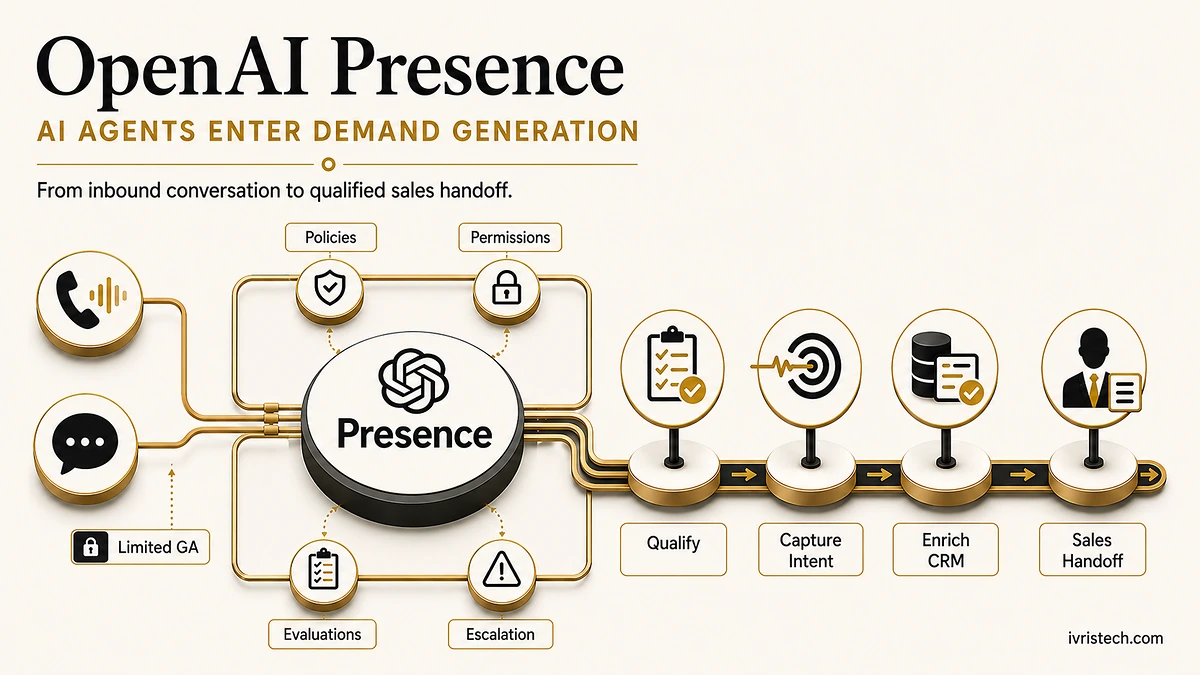
OpenAI launched Presence on July 22, 2026, positioning it as a managed enterprise product for deploying governed AI agents across voice and chat. The announcement spans support and internal operations, but OpenAI’s product page also gives Presence a direct marketing job: engage inbound prospects, qualify leads, capture intent, enrich records, and pass the strongest opportunities to sales.
OpenAI says Presence runs its English-language phone support channel and resolves 75% of inbound issues without human assistance. It also says a Codex-powered improvement loop reduced human handoffs by 15 percentage points in 10 days. Those are support results, not demand-generation benchmarks, but they reveal the operating model OpenAI wants enterprises to adopt.
For B2B marketing and RevOps teams, the important change is not another conversational interface. Presence packages the policies, system access, evaluations, approvals, and escalation logic needed to move an interaction from first response to an approved action. That could accelerate inbound qualification, but only for companies ready to treat agent deployment as an operations project rather than a chatbot installation.
Direct answer — What does OpenAI Presence do for demand generation?
OpenAI Presence can run governed voice and chat agents that engage inbound prospects, ask qualification questions, capture buying intent, enrich company records, and escalate qualified opportunities to sales. It is currently a managed enterprise deployment in limited general availability, not a self-serve marketing tool. Pricing, integrations, data handling, and implementation scope are defined separately for each customer.
Key Takeaways
- OpenAI introduced Presence on July 22, 2026, with voice and chat support for customer-facing and internal workflows.
- Its demand-generation use case covers inbound engagement, lead qualification, intent capture, record enrichment, and sales handoff.
- Presence combines agents with policies, permissions, simulations, evaluations, guardrails, and human escalation paths.
- OpenAI has not published demand-generation conversion results, standard pricing, or a public integration catalogue.
- Presence is available only through limited GA deployments led by OpenAI engineers or selected partners.
What OpenAI Actually Launched
Presence is not simply a model or an agent builder. OpenAI describes it as a managed platform for building, deploying, operating, and improving governed agents for high-volume workflows. Each deployment starts with a defined job, connects the agent to approved knowledge and systems, and limits access through scoped permissions.
Companies can encode operating procedures, decide which actions the agent may take, specify when approval is required, and define when a person must take over. Teams can test routine requests, edge cases, and higher-risk scenarios before release, then use production sessions and quality signals to review changes after launch.
That matters because a lead-qualification agent must do more than hold a natural conversation. It needs to retrieve the right account context, apply the company’s qualification policy, update approved fields, and transfer the interaction with enough context for a salesperson to continue it.
Why the Demand-Generation Use Case Matters
Most inbound systems split the buyer journey into separate steps: a form captures details, a chatbot answers basic questions, a scoring model evaluates the record later, and a routing rule eventually assigns it. OpenAI Presence is aiming to compress those steps into one governed voice or chat conversation.
An agent could respond immediately, ask questions tied to ideal-customer-profile fit, identify the problem and timeline, update approved record fields, and route a qualified buyer to the correct human path. That moves AI closer to the boundary between marketing automation and revenue operations.
In our earlier guide to AI agents for RevOps, we identified CRM hygiene and lead scoring as strong starting points for agentic workflows. Presence combines those functions with the live conversation. Teams still need firm lead-validation criteria and defensible lead-scoring rules; otherwise, the agent will automate an undefined standard.
Our read: Presence’s strongest feature is not voice. It is the attempt to make qualification, system actions, and human escalation one auditable workflow. Our reporting on MoEngage’s governed marketing agents and Cordial’s headless AI infrastructure points to the same buyer test: permissions, logs, approvals, and rollback matter more than the agent label. AgentProfile’s dedicated identity record adds another test: can every action and cost be attributed to the individual agent rather than the human account behind it?
The Hidden Catch: Presence Is Not Plug-and-Play MarTech
OpenAI’s availability terms narrow the immediate opportunity. Presence is offered through limited general availability to eligible enterprise customers. Deployments are led by OpenAI Forward Deployed Engineers, selected systems integrators, or both. OpenAI explicitly says it is not self-serve.
The OpenAI Presence Help Center says exact features, models, channels, capacity, data handling, pricing, integrations, and service commitments are defined per deployment. Buyers cannot yet compare Presence through a public feature grid or calculate a standard cost per qualified lead.
There is also an evidence gap. OpenAI has published strong numbers from its support workflow, but no equivalent demand-generation case study. The 75% automated-resolution rate and the 15-point reduction in handoffs do not prove that Presence raises lead-to-opportunity conversion, reduces false qualification, or improves sales acceptance.
Presence does not remove the need for a source-of-truth system, lifecycle definitions, or a sales handoff process. Teams with an unclear MQL-to-SQL handoff risk making the confusion faster rather than fixing it.
What B2B Teams Should Do Now
Most teams should not begin with a broad “AI inbound agent” project. They should define one narrow job that can be tested against real outcomes.
- Choose one inbound segment. Start with a product line, geography, or account tier where qualification rules are already understood.
- Write the policy first. Document required data, disqualifiers, approval boundaries, escalation triggers, and the point at which sales takes over.
- Map system actions. List which records the agent may read, which fields it may update, and which actions require approval.
- Build an evaluation set. Include good-fit prospects, bad-fit leads, customers, competitors, vendors, ambiguous requests, and high-value edge cases.
- Measure revenue outcomes. Track response time, qualification accuracy, false positives, sales acceptance, human handoffs, meetings, and qualified pipeline.
Large enterprises with high inbound volume and mature governance may have a reason to evaluate Presence now. Mid-market teams should watch the limited-GA deployments for pricing, integration depth, implementation effort, and actual demand-generation results before treating it as a buying decision.
Frequently Asked Questions
OpenAI Presence is a managed enterprise platform for deploying governed AI agents across voice, chat, customer-facing workflows, and internal operations. It combines OpenAI models with business-system access, policies, permissions, simulations, evaluations, guardrails, monitoring, and human escalation paths.
Yes. OpenAI lists demand generation as a Presence use case and says agents can engage inbound prospects, qualify leads, capture intent, and enrich records. The exact questions, integrations, permissions, routing logic, and sales handoff would be configured during each managed deployment.
No. OpenAI says Presence is currently available through a limited general availability program for eligible enterprise customers. Deployments are led by OpenAI Forward Deployed Engineers and selected partners. Access depends on workflow fit, implementation readiness, and available delivery capacity.
OpenAI has not positioned Presence as a CRM replacement. Its agents connect to approved business systems, retrieve information, update records, and take scoped actions. Most demand-generation deployments would still need a source-of-truth system, lifecycle definitions, routing ownership, and reporting outside the conversation layer.